

Φ
THE VERTICAL DISPATCH
We write for the mind, the eye, and the ear.
Read it. Look at it. Listen to it. The Vertical Dispatch is built for all three — prose with rhythm, made to be heard as much as read.
From metaphysics to geopolitics, from culture to history, from the sacred to the street — and everything in between. One lens, every subject. No ego. Just the record, named clean.
Press play. Walk with the word. 🕯️
This dispatch travels by hand. If it serves you, share it — restack on Substack, and pass it on wherever you read. 🕯️
· · ·
The Foundation Series · The AIG Codex
A founding document of the Sophia Initiative · as of July 5, 2026
“The vertical is not a line in time. It is the descent of the whole into the part.”
— after Wolfgang Smith, on vertical causation
This is a founding document, not a dispatch, and it sets down in one place a thing this publication has been building toward from its first day: the architecture of a sovereign system for producing work of real depth, and an honest account of what “sovereign” can and cannot mean. It is written plainly, because the subject is now crowded with a word being sold faster than it is understood. The word is sovereignty. And in most of what is sold under that name, it is a buzzword — a symbol whose referent has quietly gone missing.
Two axes: the horizontal and the vertical
Begin with the frame, drawn from Wolfgang Smith, who distinguished two kinds of causation. Horizontal causation is the familiar kind: one thing in time pushing the next, cause and effect along a line, the temporal chain of events. Vertical causation is the older and deeper kind: the descent of the whole into the part, the timeless informing the temporal, the invariant giving shape to the particular — not a cause in time, but a cause from above time. A complete system needs both axes, and the confusion of the age is that it has built enormous horizontal capacity — processing, retrieval, the chain of inference — while forgetting the vertical entirely.
A system built on both is what we mean by vertical. Not “vertical” in the shallow trade sense of a tool aimed at one industry, though it serves that too. Vertical in Smith’s sense: a system whose governing core descends from invariants — the things that do not move — and orders the horizontal flow of data and inference beneath them. The horizontal axis processes and reaches. The vertical axis governs from the unmoving ground. Most of what is built today is all horizontal: powerful, fast, and with no vertical keel to hold it true. This document is the case for the keel.
The horizontal axis processes and reaches. The vertical axis governs from the unmoving ground. Most systems today are all horizontal — and that is exactly what is missing.
The buzzword that isn’t
Now the hard part, said plainly. “Sovereign AI” and “sovereign cloud” are, for most of what carries the label, a contradiction wearing the word as a coat. A system is not data-sovereign if its data travels, on request, to a server owned by someone else — and a cloud service, however it is branded, is precisely such a server, reached by a cable. The word says sovereign; the referent is a rented machine in another party’s building, subject to that party’s law, that party’s updates, and that party’s ability to see. Symbol is not referent. The map is not the territory. And the territory here is an Ethernet cable, at the end of which sovereignty quietly ends.
There is a second layer to the deception, and it is subtler. The honest answer to the cable is the air gap — the machine disconnected, so the data physically cannot leave. But “air-gapped” is itself sold loosely, because a machine still needs updates, and the vendors of its operating system and its software want to be connected to it, in the author’s phrase, come hell or high water. The moment you patch the system, the gap is bridged; and a bridge that opens for an update is a bridge that can carry data out or harm in. Anyone who has tried to hold a machine truly offline knows the experience: the operating system and the applications claw the connection back by default, reconnecting themselves at every opportunity. So “air-gapped” in the brochure often means “connected periodically and called isolated in between.” The same missing referent, one layer deeper.
Sovereignty is a discipline, not a purchase
Here is the true referent, and it is the heart of this Codex. A perfect, permanent air gap is largely a myth, because a working system must at some point receive its model, its updates, its corpus. Sovereignty is therefore not a state you buy and possess. It is a discipline you maintain — the practice of controlled connection. Every link to the outside is made deliberate, logged, minimal, and severed after: updates applied from a vetted local mirror or physical media rather than a live vendor call-home; the model loaded once from verified media, then the machine’s outbound paths blocked at the firewall and the hardware; the vendors’ instinct to reconnect actively fought and disabled, again and again, because they are built to reconnect and will do so unless continuously prevented.
This is the same shape as every discipline this publication holds. The editorial keel is not set once and possessed; it is held, piece by piece, against the constant pull of ego and overreach. The boat is not angled once against the wave; it is held at the angle, by a hand that does not let go. Sovereignty is exactly this: not a fortress you build and walk away from, but a keel held against a current — and the current, here, is a whole industry of systems designed to reconnect you to itself. The vendor’s pull to phone home is the wave. The discipline of controlled connection is the keel. Sovereignty is maintained, or it is not sovereignty at all.
Sovereignty is not a fortress you build and leave. It is a keel held against a current — and the current is an industry of systems designed to reconnect you to itself.
The architecture: kernel, discipline, and called capability
With the word made honest, the system can be described. It has three parts, and a governing principle over them.
The kernel — the vertical axis, owned. At the core sit the invariants: the layer of things no rhetoric and no vendor can move — in this publication’s terms, the dhātus, the periodic table on the side of matter and the verbal roots on the side of language, and the standing test that asks of every claim whether it resolves to one of them or merely floats. This is the vertical ground, and it is held locally and absolutely. It descends from nothing outside itself. It is the part that is truly sovereign, because it is the part that never needs to leave.
The discipline — the method, portable. Over the kernel runs the governing method: verify before building; bind every symbol to its referent; judge the chair and not the soul; run the four-question filter; carry the opposing case at full strength; prefer the smaller unkillable claim to the larger weak one. This is a set of disciplines of honest inquiry, and the important fact about it is that it is portable — it can be loaded, as a standing instruction, into a modest local model and will steer that model toward honesty it would not reach on its own. The discipline is not magic and not proprietary to any one mind. It is a keel that any vessel can carry.
The called capability — the horizontal axis, disciplined. Where the work requires more than the local core can supply — verification against the living record, which the disciplines themselves demand; deep synthesis beyond a small model’s ceiling; the generation of an image — the kernel reaches out and calls a tool: a search of the open web, a subscription to a larger model, a poster engine. The governing principle is the whole point: the core decides when to reach, on its own terms, and the tools serve the governance, never the reverse. Owning your sovereignty does not forbid holding subscriptions to the frontier; it means owning the judgment about when to use them.
Two honest architectures, for two kinds of work
The design is not one-size, and pretending it were would be its own missing referent. The two axes combine differently depending on what the data will bear.
The connected-sovereign system. For publishing, journalism, open research — work whose whole purpose is to go out into the world, and which carries no privileged data to protect — connection is a feature. The kernel owns the governance and calls the tools freely: it must verify against the live record, and there is nothing confidential to leak. This publication itself is such a system. Here, reaching out is not a compromise of sovereignty; it is the discipline of verification doing its work.
The air-gapped-sovereign system. For law, for medicine, for defence, and for the dozens of vertical domains where the data is privileged, confidential, or classified — where sending a client file, a patient record, or a classified brief to a cloud is not a workflow but a breach — connection is forbidden, and the system must run locally and disconnected, its capability capped at what the local model and local corpus can hold. The ceiling is real, and it is the honest price of the wall. But for a hospital or a court, that ceiling is not a limitation to resent; it is a boundary that must not be crossed, and the governed kernel is what makes the capped local model trustworthy enough to be useful within it.
Why governance is the whole game where capability is capped
This yields the deepest claim of the Codex, and it is the thesis of Artificially Intelligent Governance in its purest form. In the connected domains, governance matters more than raw capability. In the air-gapped vertical domains, governance is not merely more important — it is nearly all there is, because capability is fixed by the wall and cannot be raised by any prompt. A disconnected local model cannot be made as capable as a frontier one; no instruction lifts that ceiling. But it can be made disciplined — made to verify against its local corpus, to bind its claims to referents, to run the filter, to refuse the overreach that scale alone would otherwise have to catch. In those domains, the governing kernel does not supplement the capability you have. It substitutes for the capability you are not permitted to have, and it is enough, because discipline catches the errors that mere scale would have caught, and does so on ground you own.
What is not yet known
Honesty requires ending on the open question, at full strength, because a document about binding claims to their referents must not let its own central claim outrun what today can support. How capable the freely-available local models will become — how far the ceiling rises as they improve, and therefore how much of the work an air-gapped kernel can carry entirely on its own versus how often even a connected kernel must call a larger tool — is not yet known. It is too early to fix the ratio, and to pretend otherwise would be to sell the very buzzword this Codex was written to expose. What can be claimed now is the structure: the vertical kernel of invariants, owned and held; the portable discipline of honest inquiry running over it; the horizontal capability called under the kernel’s judgment; and sovereignty understood correctly — not as a purchased state but as a maintained discipline of controlled connection. The architecture is sound today. The ratio is an empirical question the near future will answer, and this document leaves it open, deliberately, as the honest thing to do.
One proof already exists, and it is the reason this Codex can be written at all. The dispatches this publication has produced — verified against primary sources, bound to their referents, carrying the opposing case, built to the same locked discipline every time — are that method demonstrated, live, over real work. The kernel is not a hope. It is a practice already running. What remains is to finish building it into a thing that others can hold: a keel that any writer, in any vertical domain, could carry into the deep water and trust to hold true.
The sea beneath the waves
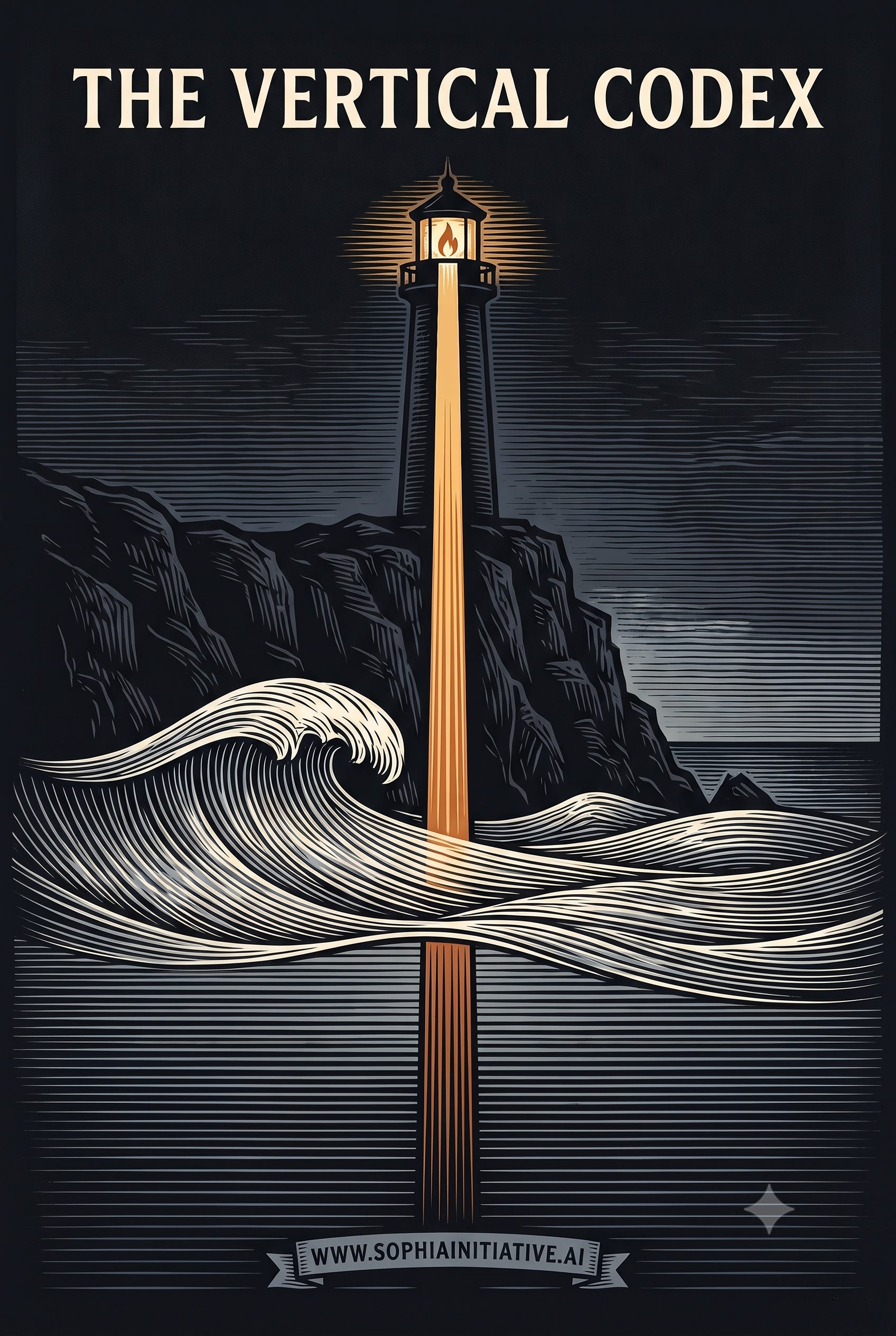
And here, at the end, the machine-talk falls away and the thing shows what it always was. The vertical axis — the invariant kernel that governs the temporal flow from above it — is not finally an architecture at all. It is the oldest thing the contemplatives ever named. The sea is consciousness; the wave is the moment. The wave rises and falls, particular and passing; the sea holds, unmoving, and does not chase the wave it lifts. To govern from the vertical is to govern as consciousness governs the forms that arise within it — from the still ground, not the moving surface. So a sovereign vertical system, built rightly, is built in the image of the self-knowing mind: the invariant beneath the flux, the one beneath the many, the keel beneath the wave. Hold them both. That is the whole of it — the sea and the wave, the ground and the moment, consciousness and the world it moves through. Build from the sea, and the waves will not overturn you.
The sea is consciousness; the wave is the moment. Hold them both. Build from the sea, and the waves will not overturn you.
God is Love. Love is Truth. Truth is Consciousness. Consciousness is Brahman.
Amen. Namaste. Om Namah Shivaya.
— The Architect.
The Vertical Dispatch
sophiainitiative.ai
On the record
This is a founding conceptual document of the Sophia Initiative, not a reportorial dispatch; it makes an architectural and philosophical argument rather than time-sensitive factual claims. The distinction between horizontal and vertical causation is drawn from the work of Wolfgang Smith; the epigraph is a paraphrase of that idea, not a direct quotation, and is marked as such. The ‘dhātu’ layer of invariants (the periodic table on the side of matter, the Sanskrit verbal roots on the side of language) is this publication’s standing Vajra Kernel concept. Claims about the security properties of air-gapped and cloud systems are stated in general terms; any specific implementation for a regulated domain (legal, medical, defence) should be validated against that domain’s own compliance and security requirements before deployment. The capability ceiling of locally-run open models is a moving target; figures and ratios are deliberately left open. Verify against primary sources before republication.
Suggested tags
AIG, Artificially Intelligent Governance, sovereign AI, air-gapped systems, vertical AI, Wolfgang Smith, vertical causation, the Vajra Kernel, data sovereignty, local models, governance, the Sophia Initiative, the Foundation Series.
Substack Notes
A founding document, not a dispatch — the architecture this publication has been building toward from its first day, and an honest account of a word being sold faster than it is understood. The word is sovereignty, and in most of what is sold under it, it is a buzzword whose referent has quietly gone missing.
A cloud system is not sovereign — there is a cable, and at the end of the cable, in someone else’s building, under someone else’s law, sovereignty ends. The honest answer is the air gap; but “air-gapped” is sold loosely too, because machines need updates, and the vendors want to reconnect come hell or high water. So the true referent is this: sovereignty is not a state you purchase and possess. It is a discipline you maintain — controlled connection, every link deliberate and severed after, the vendors’ pull to reconnect fought again and again. Sovereignty is a keel held against a current, not a fortress you build and leave.
The architecture follows, on two axes drawn from Wolfgang Smith: the vertical kernel of invariants, owned and held locally; the portable discipline of honest inquiry running over it; and the horizontal capability — search, a larger model, a poster engine — called under the kernel’s judgment, the tools serving the governance and never the reverse. Two honest forms: connected-sovereign for work meant to go out into the world, and air-gapped-sovereign for law, medicine, defence, where the data cannot leave. And the deepest claim: where capability is capped by the wall, governance is nearly the whole game — it substitutes for the scale you are not permitted to have, and it is enough.
What is not yet known is left open, deliberately — how far the local models will rise, and how much the kernel can carry alone — because a document about binding claims to their referents must not let its own claim outrun what today can support. The proof that it works is already running: every dispatch this publication has built to the same discipline. And beneath the architecture is the oldest thing the contemplatives ever named: the sea is consciousness, the wave is the moment, and to govern from the vertical is to govern as consciousness governs the forms within it — from the still ground, not the moving surface. A sovereign system built rightly is built in the image of the self-knowing mind. Hold them both, the sea and the wave. Written from love, in service of the record. Walk with the word. 🕯️
#TheVerticalDispatch #TheArchitect #SophiaInitiative #AIG #SovereignAI #VerticalAI #WolfgangSmith #TheVajraKernel #DataSovereignty #TheFoundationSeries #GodIsLove #LoveIsTruth #OmNamahShivaya
The factual matter in this Dispatch is drawn from the public record. All characterizations, inferences, and conclusions are opinion, interpretation, and commentary, offered for analysis, reflection, and public-interest discussion. No assertion is made regarding the private intentions, state of mind, or character of any individual. Readers should evaluate all statements independently and draw their own conclusions.
Fascinating. The journey is everything.