

Philosophy · Consciousness · Civilisational Analysis
Part One of Two — The Diagnosis
“The medium is the message.”
— Marshall McLuhan, Understanding Media, 1964
In 1962 a Canadian professor of English gave the coming age a name. Marshall McLuhan looked at the telegraph, the telephone, the radio and the television, and he saw that electronic media were collapsing distance — that a message could now cross the planet faster than it could cross a room. The world, he said, was becoming a global village. The phrase escaped him almost immediately. It was taken up, repeated, printed on conference banners, and received as a warm thing: a shrinking world, a reunited human family, the long estrangement of geography finally undone. Connection. Closeness. The village green of the whole species.
That is not what McLuhan meant, and it is not what we received. He knew what a village actually is. A village is not gentle. A village is a place of total visibility, where everyone is known and nothing is private, where the eyes of the neighbours are a permanent weather. A village runs on involvement so complete it has no exits. It is intimate and it is suffocating in the same breath. McLuhan was not promising us a reunion. He was warning us that the electronic age would return humanity to the conditions of the tribe — the surveillance, the conformity, the inability to step outside the circle of the watched — and do it at the scale of the entire planet.
Sixty years on, the village is built. We carry it in a pocket. And it has every property McLuhan named and none of the warmth the phrase was assumed to carry. This dispatch is the first of two. Its task is the diagnosis: to set out, plainly and without contempt, what the platforms are and what they do to the people inside them — which is to say, to all of us, the author of these words included. The second dispatch will turn inward, to the question the diagnosis raises and cannot answer: who, then, are you in this, and what does that make you answerable for. But the inward turn is not earned until the outward picture is honest. So we begin with the structure.
One discipline of this Dispatch holds from the first line to the last. The judgement here is aimed at the structure. The compassion is aimed at the people. There is no vantage point outside the medium from which a writer may look down on those caught in it; the writer is caught in it too. If a line ever seems to sneer at the villager rather than examine the village, that line has failed, and you should hold it to account.
I. THE MEDIUM IS THE MESSAGE
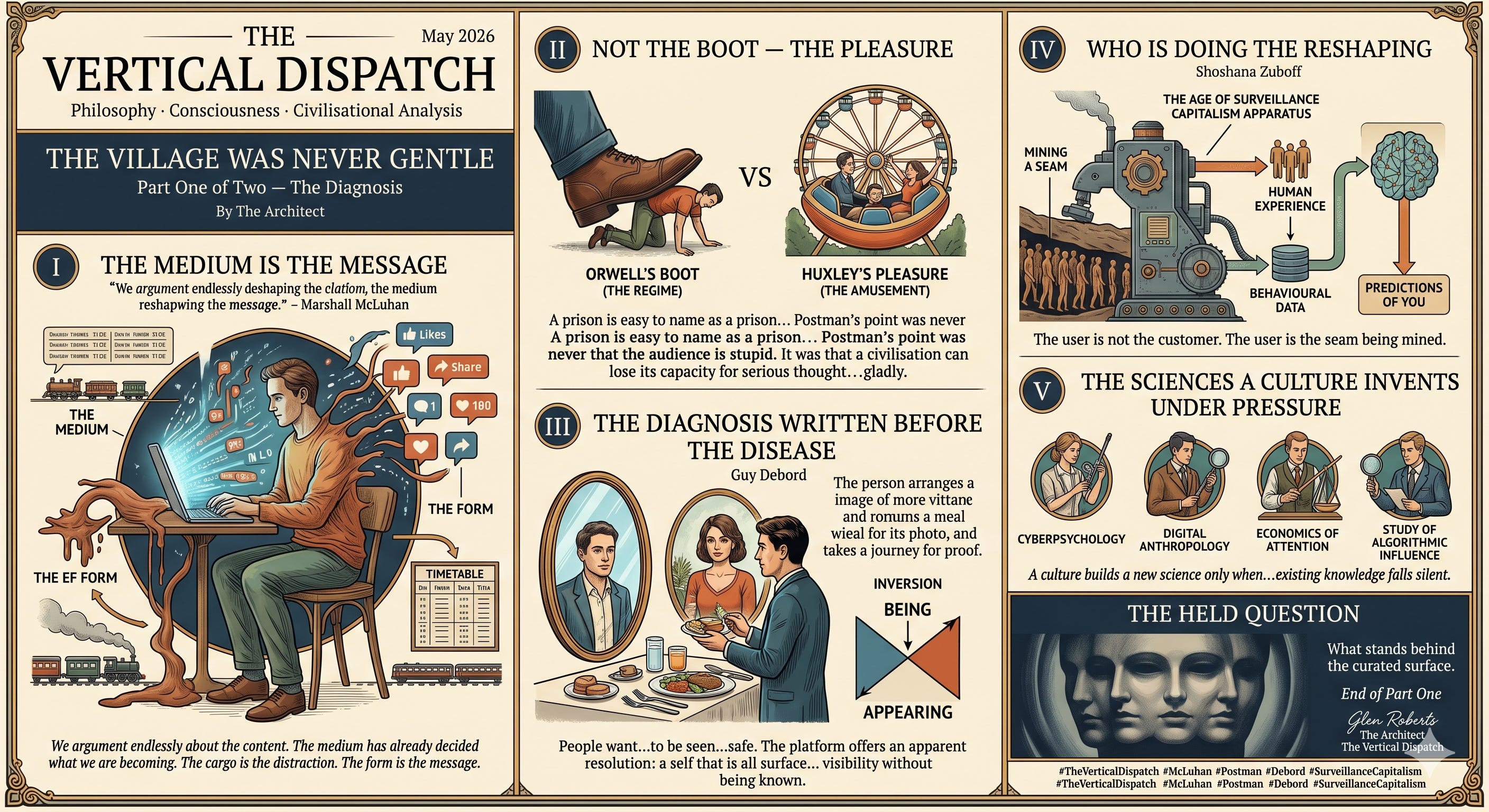
McLuhan’s most quoted sentence is also his most misunderstood. The medium is the message does not mean that content is unimportant. It means that the form of a medium — its speed, its scale, the senses it engages, the kind of attention it demands — reshapes the human being who uses it far more profoundly than anything the medium happens to carry. The railway did not change human life by what it transported. It changed human life by abolishing the old distances, by making the timetable a fact of consciousness, by stitching the country into a single market. The cargo was incidental. The form was the message.
Apply that test to the platform in your hand and the diagnosis arrives quickly. We argue endlessly about content — this post, that claim, this account, that ban. The arguments are not pointless, but they are aimed at the cargo. The message is the form. The form is a feed that never ends, refreshed by a pull of the thumb. It is a metric attached to every utterance — a count of who approved. It is a design that rewards the immediate over the considered, the brief over the developed, the reaction over the thought. It is an architecture that makes being-seen the unit of worth and being-unseen the quiet verdict of failure.
None of that depends on what you post. It is true of the wise post and the foolish one, the kind account and the cruel one. The platform reshapes its user the way the village reshaped its villager: by being a particular kind of place, with a particular set of eyes, demanding a particular kind of performance simply as the price of being present at all. That is McLuhan’s warning, fully delivered. We were watching the cargo. The form was doing the work.
We argue about what is posted. The medium has already decided what we are becoming. The cargo is the distraction. The form is the message.
II. NOT THE BOOT — THE PLEASURE
McLuhan described. Neil Postman judged. In 1985, in Amusing Ourselves to Death, Postman set two prophecies of ruin against each other and asked which one had come true. George Orwell feared a boot: a regime that would ban the book, control the fact, inflict pain, and rule by what it withheld from us. Aldous Huxley feared something subtler and, Postman argued, more accurate — that no one would need to ban a book in a society where no one wanted to read one; that we would not be crushed by what we hate but dissolved by what we love; that the truth would not be concealed but simply drowned in a flood of triviality and amusement until serious public thought lost the ground to stand on.
Postman wrote that about television. He did not live to see the platform, but the platform completes his argument with a precision that is almost unkind. No one is conscripted onto these systems. There is no boot. People arrive freely, gladly, and stay because the experience is engineered, with real skill, to be difficult to leave. The harm — the fracturing of attention, the slow replacement of reflection by reaction — does not arrive disguised as harm. It arrives wrapped as delight. It arrives as the thing you reach for to feel better.
This is the hardest part of the diagnosis to hold, and it must be held without blame. A prison is easy to name as a prison; its walls announce themselves. An amusement park does not. When the mechanism of harm is also the mechanism of pleasure, the ordinary defences of a reasonable person are turned the wrong way round. You cannot simply decide to resist what is built, deliberately, to be the most rewarding thing within reach in a tired hour. To notice this is not weakness, and to be caught by it is not foolishness. It is the predictable result of meeting an engineered system with an unengineered will. Postman’s point was never that the audience is stupid. It was that a civilisation can lose its capacity for serious thought without a single act of force — and never feel the loss as it happens, because every step of the descent was pleasant.
Orwell feared what would be done to us. Huxley feared what we would do to ourselves, gladly. The platform did not need the boot. It only needed to be the most pleasant thing within reach.
III. THE DIAGNOSIS WRITTEN BEFORE THE DISEASE
There is a way to test whether an observation about the present is shallow or structural. A shallow observation could only be made now, with the device already in hand. A structural one could have been made before the device existed — because it was never really about the device. By that test, the deepest description of the platform was written in 1967, by a French theorist named Guy Debord, in a book called The Society of the Spectacle. There was no platform. There was barely colour television. And yet the diagnosis is exact.
Debord argued that in a society organised around the spectacle, lived experience is steadily displaced by its own representation. What is directly lived recedes; what is depicted advances to take its place. The result is a quiet inversion of being and appearing. It is no longer enough to have an experience. The experience must generate an image of itself, produced and offered for others, and over time the image becomes the point and the experience becomes its raw material. The meal is arranged for the photograph. The journey is undertaken for the proof of the journey. The self is curated before it is lived.
Hold that against the contradiction at the centre of platform life — the one this Dispatch set out to name. People want, badly and humanly, to be seen. And people want, just as badly, to remain safe — unjudged, unexposed, in control of the frame. The platform offers an apparent resolution: a self that is all surface, a curated representation that can be sent out to be seen while the actual person stays behind it, hidden. You may be visible without being known. You may perform presence while withholding the vulnerable fact of yourself. Debord named that inversion sixty years ago, before the instrument that would make it the ordinary condition of billions. The diagnosis preceded the disease. That is how we know it is not a complaint about gadgets. It is a description of a direction a civilisation can travel.
To be seen without being known: the platform did not invent that wish. It industrialised it. Debord saw the inversion of being and appearing before the machine to enforce it had been built.
IV. WHO IS DOING THE RESHAPING
McLuhan, Postman and Debord leave one question open. They tell us the medium reshapes us, that it does so pleasantly, that it inverts being into appearing. They do not tell us who runs the machine and what that party receives in exchange. For that we need a contemporary, and the most rigorous is Shoshana Zuboff, whose 2019 study The Age of Surveillance Capitalism named the present-tense mechanism with the most care.
Zuboff’s argument, compressed and stated fairly, runs like this. The platform is not, in its economics, a service that happens to be free. It is an apparatus for converting human experience into behavioural data — what you paused on, what you returned to, what you typed and deleted, how long the thumb hovered — and that data is the actual product, refined and sold as a prediction of what you will do next. The free service is the means of extraction. The user is not the customer. The user is the seam being mined. This is a structural claim about a business model, not an accusation against any individual; the design produces the outcome regardless of the intentions of the people inside it.
This is the joint where the diagnosis reaches the present moment, and the present moment is where the next dispatch must begin. The same human experience that Zuboff describes being rendered into behavioural data is also the raw material from which the newest medium is built. The vast models now spoken of with such hope and such dread did not arrive from nowhere. They were trained on the accumulated expression of humanity — the writing, the images, the recorded talk — much of it gathered through exactly the apparatus Zuboff anatomised. The village did not stop reshaping us when the feed was built. The feed was a stage in a longer process. The newest stage is a medium that can answer back, and the particular fear it raises in people is real and deserves to be met directly rather than dismissed. But that is the work of Part Two. Here it is enough to mark the joint: the platform that watched us has become the ground on which the machine that may answer us was built.
The service was never the product. The product was the prediction of you. And the record of human experience, once extracted, became the ground on which the next medium was built.
V. THE SCIENCES A CULTURE INVENTS UNDER PRESSURE
There is one more piece of evidence, and it is the kind this Dispatch values most, because it is not anyone’s opinion. It is the existence of the disciplines themselves.
A culture does not assemble a new science casually. The established disciplines are settled, funded, and defended; they do not yield ground to a newcomer unless something has happened that they genuinely cannot hold. So when new fields appear — quickly, and several at once — that appearance is itself a measurement. It says: a phenomenon has arrived that the old instruments cannot read. In the decades since the global village was built, exactly that has occurred. Cyberpsychology emerged to study what digital environments do to cognition, emotion and the sense of self — because general psychology had no settled account of a mind that lives partly inside a screen. Digital anthropology emerged to study identity, ritual and belonging as they are now constituted online — because the old anthropology assumed the village had a geography. The study of algorithmic influence emerged because classical sociology had no model of a social order shaped, in real time and invisibly, by a system optimising for engagement. The economics of attention emerged because attention had become the scarce resource a trillion-dollar industry was built to harvest, and the old economics had treated it as free.
Place those side by side and the point is not the merits of any one field. It is the pattern. A civilisation builds new sciences only when it has been changed enough that its existing knowledge falls silent. The new vocabulary is the evidence. We did not invent these words because they were elegant. We invented them because something had been done to us, at scale, that we had no language to describe — and a culture that has to invent a language for what is happening to it is a culture that has already been altered. The disciplines are the instruments. Their sudden existence is the reading on the dial.
A culture builds a new science only when something has been done to it that the old sciences cannot hold. The new disciplines are not the achievement. They are the symptom — and the measurement.
THE HELD QUESTION
Set the diagnosis down in one line. The global village was built exactly as McLuhan named it, and it carries the village’s total visibility rather than the warmth the phrase was assumed to promise. Its medium reshapes us by its form, beneath all argument about its content. It does this not by force but by pleasure, which is harder to refuse and carries no blame for being hard. It inverts being into appearing, so that we may be seen without being known — the exact resolution a frightened and lonely person would want, and the exact thing that deepens the fright and the loneliness. It runs on an economics that turns our experience into a product. And the proof that all of this is structural, and not a grievance about devices, is that we have had to build whole new sciences to read what it has done to us.
That is the structure. Notice what the diagnosis cannot do. It can describe the village with great precision and it cannot tell you how to live in it. It can show that the self the platform rewards is a curated surface, and it cannot tell you what the self beneath that surface actually is, or whether there is one, or how a person would find it. Diagnosis names the condition. It does not deliver the patient.
So Part One ends on a held question, and the holding is deliberate. If the medium reshapes the self, and if the self it offers us is an image built to be seen — then what, in you, is doing the being-seen. What stands behind the curated surface. Is the watched self the whole of you, or is it a costume the village handed you and you mistook for your skin. That is not a question the media theorists can answer; it is not their instrument. It belongs to a different lineage — to the contemplatives, to the long inward traditions, to the plain and unsettling proposition that the culture which shaped your sense of who you are was never, in the end, your friend. Part Two takes up that question, and the real fear that the newest medium has raised. The diagnosis is now on the table. The turn inward is where the Dispatch goes next.
— End of Part One —
Part Two Below

God is Love. Love is Truth. Truth is Consciousness. Consciousness is Brahman.
Amen. Namaste.
Signed: Glen Roberts / The Architect / The Vertical Dispatch
#TheVerticalDispatch #McLuhan #Postman #Debord #SurveillanceCapitalism #GlobalVillage #AttentionEconomy #DigitalCulture #Cyberpsychology #CivilisationalAnalysis
This was posted (sometime around 2000) on the C2 wiki on a page about Brave New World:
Soma is not Ecstasy, and it's not Prozac. Soma is television.
That was bloody awesome!