

Philosophy · Consciousness · Civilisational Analysis
Part Two of Two — The Turn Inward
“You are not a stranger in this universe. You are an aspect of it, as a wave is an aspect of the ocean.”
— attributed to Alan Watts, in the spirit of his lifelong teaching
Part One ended on a question and left it standing. The diagnosis was complete: the global village is built, it reshapes us by its form, it does so by pleasure rather than force, it inverts being into appearing so that we may be seen without being known, and it runs on an economics that turns our experience into a product. All of that is structure, and structure can be described from the outside. But the description reaches a wall. It can show that the self the platform rewards is a curated surface — an image assembled to be seen. It cannot tell you what stands behind the surface. It cannot tell you whether anything does.
So Part Two turns inward, and it must, because the question the diagnosis raised cannot be answered in the diagnosis’s own language. If the medium reshapes the self, then what, in you, is being reshaped. When the platform rewards the watched self and the watched self begins to feel like the whole of you — is that feeling true. Is the watched self the entire person, or is it a costume the village handed you, fitted so early and worn so long that you mistook it for your skin.
This is the more delicate half of the dispatch, and it carries a risk Part One did not, so let it be named at the outset. To say that the self may be partly a construction is liberating to a steady person and destabilising to a person already coming apart. This dispatch will not dissolve the self and walk away. The inward turn here arrives somewhere solid, and the solid place is named before the end. If you are reading this in a frightened hour, read it slowly, and read it to the close, because the close is where the ground is.
I. THE SELF THE VILLAGE HANDED YOU
Alan Watts spent a working life on a single, patient observation: that the self most people defend, polish and fear for is not the bedrock they take it to be. It is, in large part, a social construction — an idea of “me” assembled out of a name given by others, a story told by a family, a role issued by a culture, a running commentary that began before memory and never paused long enough to be examined. Watts called it the skin-encapsulated ego: the conviction that you are a separate thing, sealed inside a body, looking out at a world that is not you and to which you must, somehow, prove yourself.
Watts did not regard that self as evil, and neither does this Dispatch. It is useful. A person needs a workable identity to move through a day, to be addressed, to be accountable. The trouble is not that the constructed self exists. The trouble is the forgetting — the loss of the knowledge that it was constructed at all. When the costume is remembered as a costume, a person wears it lightly and is not destroyed when it is torn. When the costume is forgotten, and mistaken for the skin, then every tear in the costume is felt as a wound to the body, and the person spends their strength defending a garment they have confused with their life.
Now hold Watts against the village of Part One, and the two halves of this dispatch lock together. The platform does not merely reward the curated surface. It trains the forgetting. It returns the constructed self to you, hour after hour, with a number attached — a count of approval, a measure of reach — until the costume is not only worn but monitored, scored, and anxiously maintained. The village does not ask whether the watched self is the real self. It simply pays out, in the small currency of being-seen, every time you act as though it is. And a thing rewarded that consistently, that invisibly, becomes very hard to remember as a thing you put on.
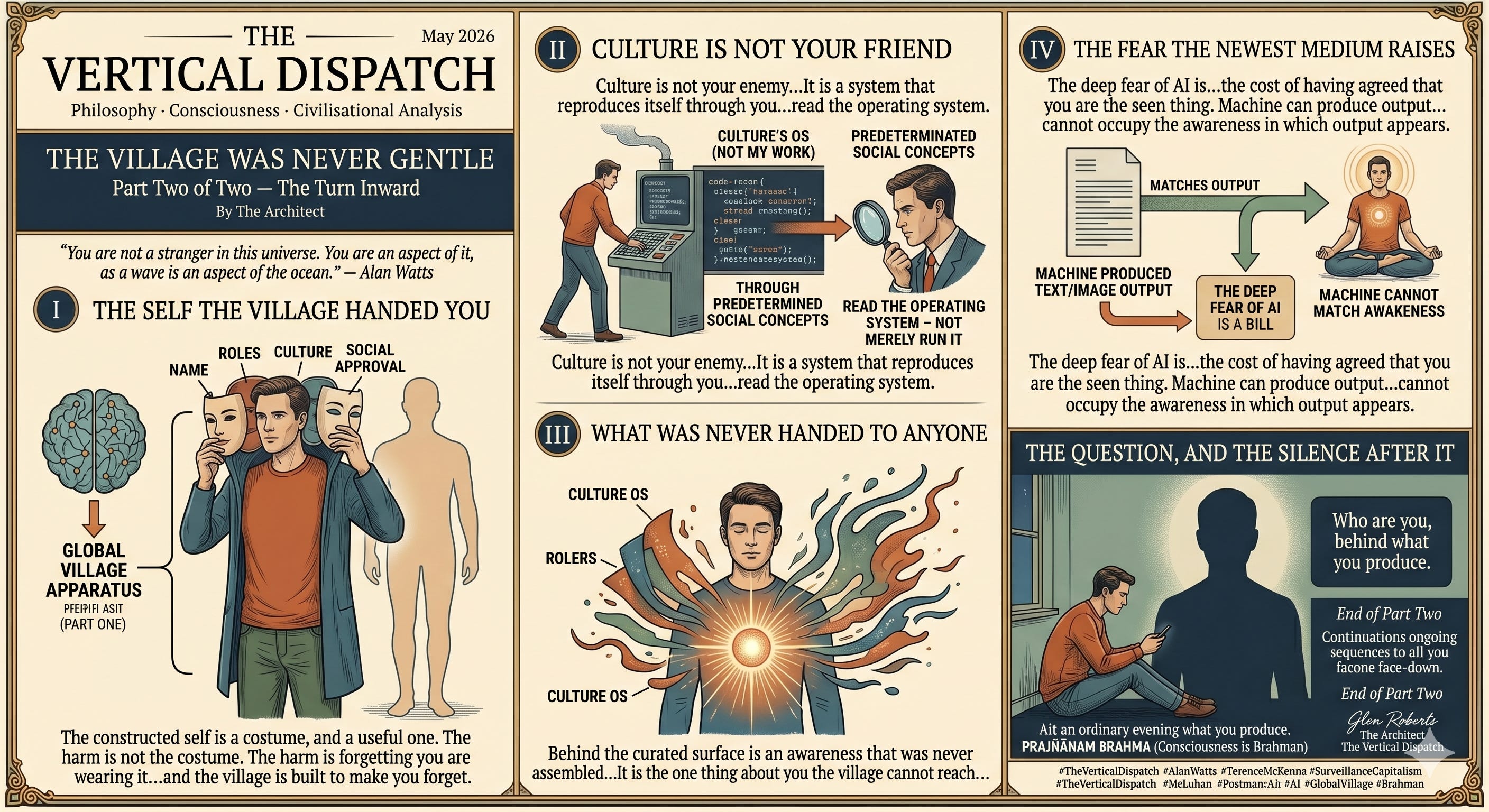
The constructed self is a costume, and a useful one. The harm is not the costume. The harm is forgetting you are wearing it — and the village is built to make you forget.
II. CULTURE IS NOT YOUR FRIEND
There is a sentence that has run quietly under both parts of this dispatch, and it is time to say it plainly. It belongs, in this blunt form, to Terence McKenna, and it is the one idea of his this Dispatch takes up: culture is not your friend.
It is a hard sentence and it is easy to misread, so let it be stated with care. It does not mean that culture is your enemy, or that everything inherited is poison, or that a person should burn the house down and live feral in the name of freedom. Culture carries genuine treasure — language, music, the long memory of the species, the accumulated means of becoming human at all. To call it not-your-friend is not to call it worthless. It is to refuse the assumption that it is automatically, reliably, on your side.
A friend wants your good. Culture does not want anything; it is not a person. It is a vast inherited system that reproduces itself through you, and it will install in you whatever serves its own continuation — useful or harmful, true or false, kind or cruel — with no mechanism that sorts for your flourishing. The accent, the assumptions, the sense of what is normal and what is shameful, the very idea of who you are: these arrived as a settlement you never negotiated. Some of it is gift. Some of it is debt. None of it asked your consent, and none of it can be trusted simply because it is yours and was always there. McKenna’s point, stripped of his cosmology, is small and durable: the operating system you are running was written by something other than you, for purposes that were not centred on you, and a thinking person’s task is to read it rather than merely run it.
This is the hinge of the whole two-part dispatch. The village of Part One is the newest and most aggressive author of that operating system — a culture-machine that writes faster, measures harder, and reaches deeper into the ordinary hour than any culture before it. To say culture is not your friend is therefore not an abstraction. It is the most practical instruction the Dispatch can give. The feed in your hand is shaping who you take yourself to be, in real time, and it is not doing so for your good. To become aware of that shaping — to read the operating system instead of running it blind — is the entire inward turn. Everything else in this dispatch is a consequence of it.
Culture is not your enemy and it is not your friend. It is a system that reproduces itself through you. The work is to read the operating system — not merely to run it.
III. WHAT WAS NEVER HANDED TO ANYONE
Here the Dispatch must say plainly what it has been circling, because the inward turn has to land somewhere a person can stand. If the constructed self is a costume, and the culture that issued it cannot be trusted to want your good, the natural fear is that the examination ends in nothing — that you pull away costume after costume and find an empty hanger. The contemplative traditions, across very different languages and very different centuries, report otherwise. They report, with a consistency that deserves to be taken seriously rather than waved away, that when the constructed self is seen through, what remains is not nothing. What remains is the seeing itself — the awareness in which the whole construction was appearing all along.
This Dispatch is written from inside one of those traditions. Thirty years of Shaivite practice stand under these sentences, and the report they yield is not exotic and not complicated. It is this: there is, behind the curated surface, an awareness that was never assembled, never issued by any culture, never posted and never scored. It did not arrive in the settlement. It is not part of the operating system; it is the screen the operating system runs on. The traditions give it many names. The name is not the point. The point is its character — it is the one thing about you that was not handed to you, and therefore the one thing the village cannot reach, cannot reward, cannot withhold, and cannot take.
Notice what that does to the contradiction at the centre of Part One. The platform offered a frightened, lonely person an apparent rescue: be seen without being known, perform presence and keep the vulnerable self safely hidden behind the image. The rescue fails, always, because the watched image cannot carry the weight of an actual life and the person knows it. But the failure looks total only as long as the watched self is assumed to be the whole inventory. It is not. There is a self that does not need to be seen, because it is not an object that visibility could confirm or deny. It is the seeing. And a person who has even once made contact with that — quietly, without spectacle, in the plain fact of being aware — is no longer wholly governed by the village’s single currency. They still wear the costume. They have simply remembered it is a costume. That memory is the whole of the freedom on offer here. It is enough.
Behind the curated surface is an awareness that was never assembled and never issued. It is the one thing about you the village cannot reach — because it was never handed to you to begin with.
IV. THE FEAR THE NEWEST MEDIUM RAISES
Now the part of this dispatch that cannot be deferred any longer, because it is the fear running under the present moment, and it is real. Artificial intelligence has arrived as a medium that can answer back. It produces text that reads as considered. It produces images, voices, the apparent motions of thought. And it has raised in a great many people — quietly, often unspoken, often beneath the economic worry that is easier to say aloud — a deeper question that deserves to be met without flinching and without false comfort.
The shallow form of the fear is the one most discussed: the machine will take the work, the income, the role. That fear is not foolish and this Dispatch will not dismiss it; livelihoods are real and the disruption is real. But it is not the Dispatch’s altitude, and it is not the fear that keeps a person awake in the deepest hour. The deep form of the fear is this: if a machine can produce the words and the images and the seeming-thought — then what was I, if I was only the one who produced those things. If my output can be matched, was I ever more than my output.
Read that fear slowly and something becomes visible. It has power over a person only on one condition: that the person has already accepted they are their output — their visible production, their posts, their measurable performance, the curated surface. And that belief is not native to the human being. It is precisely the belief Part One showed the village installing, and Section II named as a line of the inherited operating system. The fear of the machine, in its deep form, is not a new wound. It is the village’s bill, arriving for payment. It is what it costs, finally, to have agreed that you are the seen thing. The machine did not create that vulnerability. It found it already in place, already taught, and pressed exactly where the village had pressed for years.
This is why the inward turn is not a retreat from the AI question but the only honest answer to it. The machine can match the output. It cannot occupy the awareness in which output appears. It can produce words about being awake; it cannot be the one who is awake. A person who knows themselves only as their production has every reason to fear a better producer. A person who has remembered the awareness behind the production has met the machine on ground the machine cannot stand on — not because they are cleverer than it, but because they are not, in the end, the thing it competes with. This Dispatch will not tell you the machine is nothing; that is a false comfort and you would be right not to believe it. It will not tell you the machine is everything; that is the village’s panic, sold back to you. It tells you only this: the newest medium forces the oldest question, and it cannot answer it. It can only return you to it. What you are, behind what you produce, is the question. It always was. The machine has merely made it impossible to keep postponing.
The machine can match the output. It cannot occupy the awareness in which output appears. The deep fear of AI is the village’s bill — the cost of having agreed that you are the seen thing.
THE QUESTION, AND THE SILENCE AFTER IT
Two dispatches, set down now in a single line. The global village was built; it reshapes us by its form and by our pleasure; it pays us in being-seen to forget that the watched self is a costume — and the newest medium has pressed on that forgetting until the oldest question can no longer be deferred. That is the whole arc. What remains is not an instruction. It is a question, and it is yours to keep.
Who are you, behind what you produce. Not as a riddle, and not as a test with a graded answer. As the plain question a person might sit with on an ordinary evening, with the feed face-down: are you the curated surface and its count of approval — or are you the awareness in which the surface, and the count, and the whole anxious village have merely been appearing. You do not have to answer it tonight, and you may not answer it in words at all; it is not, finally, a question that words close.
So the Dispatch will not close it for you. It will set the question down, gently, and then be quiet — and leave you with the only words that answer it, in the form the Dispatch has always ended. Read them slowly. They are not an argument. The self will recognise them when it is awake.
— End of Part Two —
What began as a single examination of the global village has become something larger. The village dispatches asked what the platform does to the self. The questions did not close — they opened onto others, and the others onto a whole field. So the Dispatch will continue, in an ongoing sequence, to take up the culture itself: not the politics of the week, but the deeper architecture — what a civilisation has made sacred and what it has made saleable, what it has trained its people to reflect without choosing it. The next dispatch turns to the culture of war: the war a nation wages on its own streets, the war it watches on its screens, and the single reflex that runs them both. No schedule is promised and no number is assigned. The series is simply ongoing, the way the questions are. Read slowly. The rest will follow.
God is Love. Love is Truth. Truth is Consciousness. Consciousness is Brahman.
Amen. Namaste.
Signed: Glen Roberts / The Architect / The Vertical Dispatch
#TheVerticalDispatch #AlanWatts #TerenceMcKenna #Consciousness #ArtificialIntelligence #DigitalCulture #GlobalVillage #Brahman #CivilisationalAnalysis #TheArchitect
"So Part Two turns inward, and it must, because the question the diagnosis raised cannot be answered in the diagnosis’s own language. If the medium reshapes the self, then what, in you, is being reshaped. When the platform rewards the watched self and the watched self begins to feel like the whole of you — is that feeling true. Is the watched self the entire person, or is it a costume the village handed you, fitted so early and worn so long that you mistook it for your skin."
Community, or Consciousness itself?
Many of these thoughts and discussions I have had regarding Near Death Experiences, death.
This planet itself is a living and breathing community, working in cooperation...except humans, cause they think in terms of pyramid instead of circle.
Interesting read.
Thanks for sharing