


THE VERTICAL DISPATCH
We write for the mind, the eye, and the ear.
Read it. Look at it. Listen to it. The Vertical Dispatch is built for all three — prose with rhythm, made to be heard as much as read.
From metaphysics to geopolitics, from culture to history, from the sacred to the street — and everything in between. One lens, every subject. No ego. Just the record, named clean.
Press play. Walk with the words. 🕯️
On Craft · The Age of Consequences
May 2026
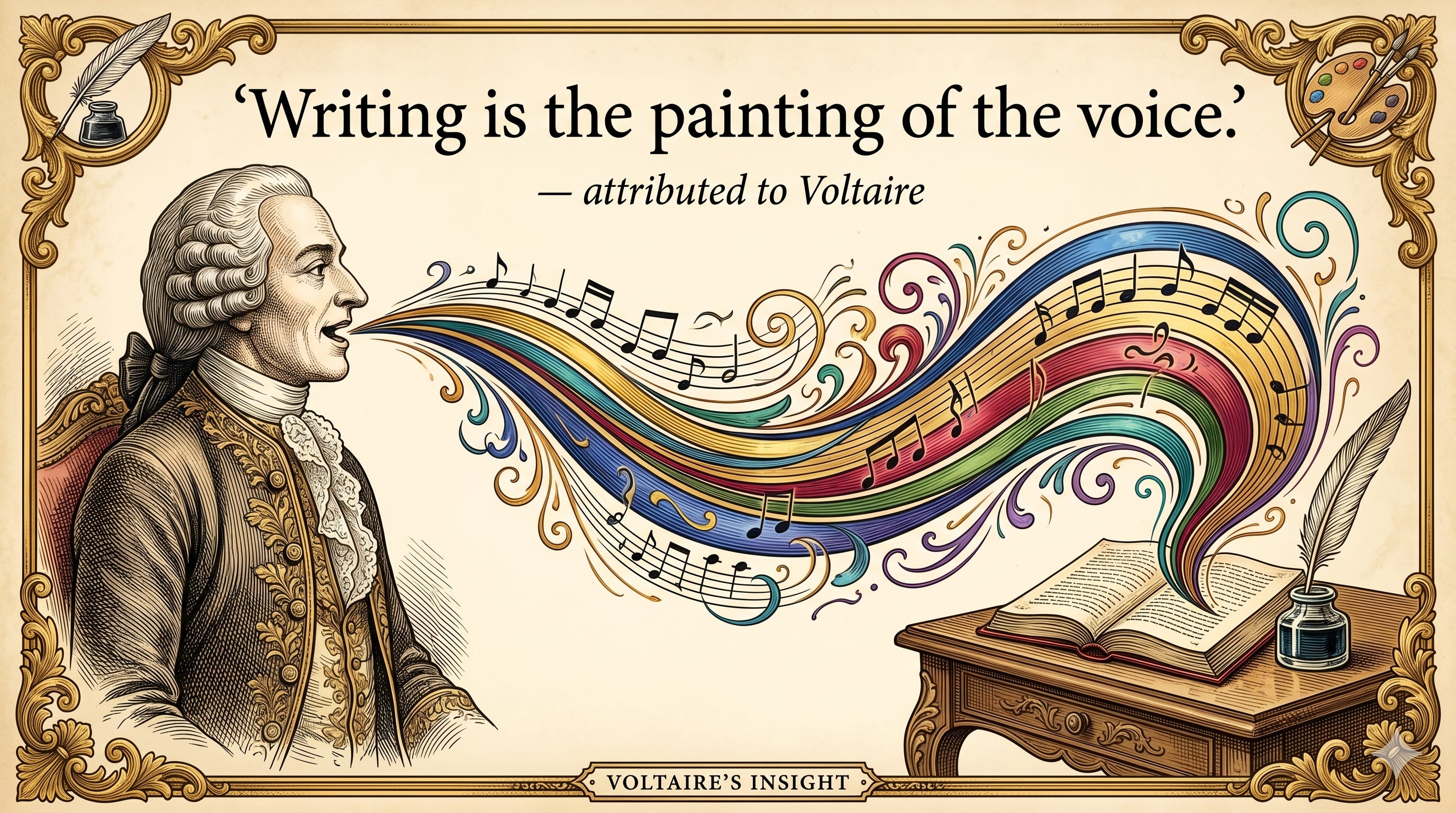
“Writing is the painting of the voice.”
— attributed to Voltaire
Everyone is chasing the camera. The platforms push video. The feeds reward the face, the cut, the performance. The advice given to every writer who wants to be read is, increasingly, to stop writing and start filming. Go live. Show your face. Perform.
And in the rush toward the camera, the industry has walked straight past the format that was sitting in front of it the whole time — the oldest one we have, quietly made new by a single piece of technology almost nobody is thinking about clearly.
The written word, read aloud.
The Oldest Form, Made New
Before the page, there was the voice. Homer was heard, not read. The Psalms were sung. The Gospels were spoken aloud in rooms full of people who could not read a word. For almost the whole of human history, language lived in the ear — and the writers who endured were the ones who wrote for it. Cicero read his sentences aloud before he trusted them. So did Dickens, who performed his own work to thousands. The essay, the sermon, the oration — all of it was built to be spoken and heard, because that is how language entered a human being for ten thousand years before it ever entered through the eye alone.
Silent reading is the strange exception, not the rule. It is recent. It is private. And it asks something of the reader that a great many people — more than will ever say so — find genuinely hard.
Now the technology has quietly closed the circle. Any piece of writing can be heard, in a clean human voice, by anyone, while they walk, while they drive, while they rest their eyes. The word has returned to the ear. And the writers who understand what that means have an advantage the camera-chasers cannot see, because they are looking the wrong way.
Why It Beats the Camera
Consider what each format actually asks of the person on the other end.
Video asks for the eyes and the full attention, in a fixed place, at the screen. Live asks for the eyes, the attention, and the schedule — be here, now, or miss it. Both demand that the audience stop their life and point themselves at a rectangle. Both reward the things that have nothing to do with truth: charisma, production, the confident delivery of a thin idea. A weak point, performed well on camera, beats a strong point delivered plainly. That is the economy of the screen, and it has been hollowing out public thought for a generation.
The voice on the page asks for almost nothing. It rides alongside a life already in motion. It does not need your eyes — you can be walking the dog, washing dishes, driving home. It does not need your schedule — it waits for you. It needs no studio, no lighting, no performance, no face. It needs one thing only, and that is the thing that matters: the writing has to be good.
The Thing That Cannot Be Faked
This is the heart of it. The camera lets a weak writer hide. Behind the edit, the music, the personality, the lighting, a thin idea can be dressed until it looks like a strong one. The performance covers the prose.
The voice on the page strips all of that away. There is nowhere to hide. No jump cut to rescue a dead sentence, no music to carry a flat paragraph, no charisma to paper over a clumsy clause. When writing is read aloud, every weakness is laid bare in the ear — the limp rhythm, the broken joint, the word that does not earn its place. And when the writing is good, the voice does the opposite: it lifts it, it lets the cadence breathe, it makes the strong sentence ring.
So the format filters for the one quality that can be neither bought nor performed: can you actually write? Not can you perform, not can you edit, not can you command a room with your face. Can you build a sentence that holds its shape when a stranger’s voice carries it into someone’s ear. That is the whole test, and it is an honest one. It cannot be gamed by equipment or budget or charm. It can only be met by the work.
The Writer’s Own Instrument
There is a quieter gift in this, for the writer, before any reader ever arrives. To listen to your own work read aloud is to be handed the most honest editor there is. The ear catches what the eye forgives. A sentence you have read silently a hundred times, and approved a hundred times, will stumble the instant a voice carries it — and in that stumble is the flaw you could not see. Read your draft aloud, or let the voice read it to you, and the bad joints announce themselves. The rhythm tells the truth.
This is not a new discovery. It is the oldest discipline in the craft, rediscovered by anyone honest enough to use it. The great writers all did it. They read aloud, because the ear is the better instrument, and the more truthful one. The technology has simply made that discipline available to everyone, on every piece, at the press of a button.
The Format Hiding in Plain Sight
So while the industry films itself, and the feeds fill with faces, and the advice keeps arriving to stop writing and start performing — the oldest format quietly waits, made new, asking only for excellence and rewarding nothing else.
This is not a smaller medium. It is the most intimate one we have. A voice in the ear, carrying a clear idea, into a person whose hands are busy and whose eyes are tired and whose attention the screen has spent all day mining. No face. No performance. No ego. Just the writing, read true.
The camera-chasers will not see it, because they are looking the wrong way. That is fine. The opening is there for whoever can do the one thing the format demands. Write well enough to be heard.
Write for the ear. It is the oldest way, and the only one that cannot be faked.
God is Love. Love is Truth. Truth is Consciousness. Consciousness is Brahman.
Amen. Namaste. Om Namah Shivaya.
— The Architect
The Vertical Dispatch
sophiainitiative.ai
#WritingCraft #WriteForTheEar #TheVoiceOnThePage #TextToSpeech #ListenAndRead #Substack #SubstackWriters #TheCraftOfWriting #ProseRhythm #ReadAloud #AntiVideo #IntimateMedia #NoEgoJustTheWork #OralTradition #Cicero #Dickens #TheWrittenWord #DepthOverPerformance #TheVerticalDispatch #TheArchitect #SophiaInitiative #AgeOfConsequences #GodIsLove #LoveIsTruth #OmNamahShivaya