

“Desire, anger, and greed — these three are the triple gate of hell, destructive of the Self. Therefore one should abandon all three.” — Bhagavad Gita 16.21
— ★ —
Fifteen days of teaching. The Self that cannot die. The fire of knowledge. The thread inside the pearl. The cosmic form. The field and its knower. The inverted tree whose roots are in heaven. All of it pointing in one direction — toward what is real beneath what appears.
Today I put the philosophy down and speak plainly.
Chapter Sixteen has no cosmic imagery. No Sanskrit cosmology. No multi-armed visions or inverted trees. Just two lists and a clear statement of what separates a life that moves toward the real from a life that moves away from it. After fifteen chapters of preparation, Arjuna — and every reader who has genuinely followed this teaching — is ready to hear this without flinching.
There are two fundamental orientations a human being can take toward existence. The divine and the demonic. Not two separate categories of people sorted at birth into the saved and the damned. Two orientations available to every human being in every moment — two directions the same awareness can face.
— ★ —
The divine qualities take three verses to describe. Notice that I begin not with moral achievement but with fearlessness.
Fearlessness first. Because the root of every demonic quality — as we will see — is ultimately fear. Fear wearing the mask of aggression. Fear wearing the mask of greed. Fear wearing the mask of arrogance. The being who has genuinely understood what they are has nothing to fear from what can happen to them. Not because they are protected from difficulty. Because what they know themselves to be cannot be diminished by any difficulty that arrives.
Then purity of heart. Steadfastness in knowledge and practice. Generosity. Self-restraint. Non-violence. Truth. Freedom from anger. Compassion for all beings. Gentleness. Modesty. The absence of excessive pride.
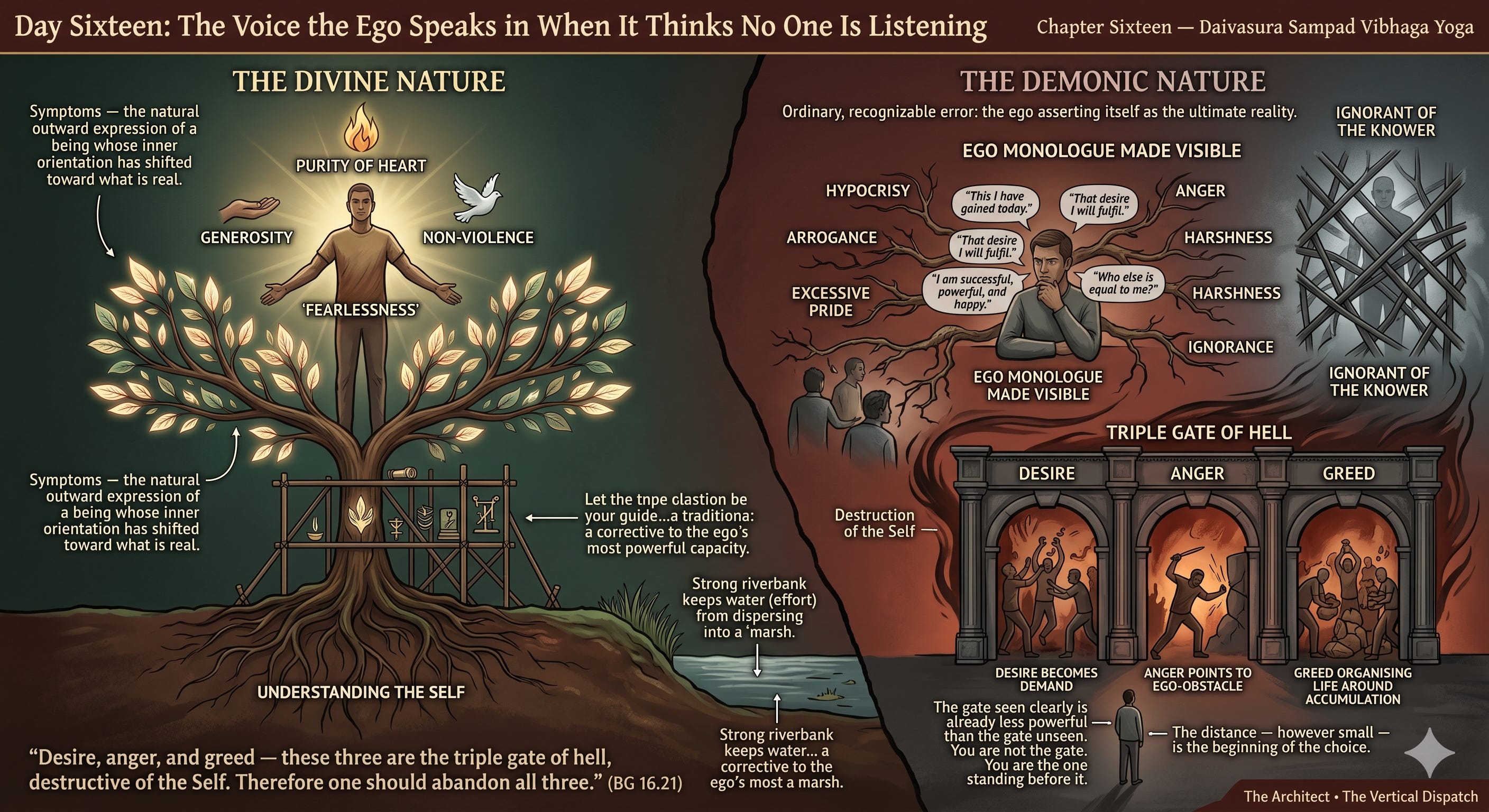
Shankara was careful about how these qualities are understood. They are not a moral checklist to be performed. They are not the conditions of admission to the spiritual life. They are symptoms — the natural outward expression of a being whose inner orientation has genuinely shifted toward what is real. You cannot manufacture fearlessness by trying to be fearless. You cannot produce genuine compassion by deciding to be compassionate. These qualities arise from understanding the way fragrance arises from a flower — not as a project but as a consequence.
The divine qualities are what a human life looks like when it has been genuinely touched by the recognition that the Purushottama — the Supreme Person — is what it most fundamentally is. They are the leaves the roots produce.
— ★ —
The demonic qualities take one verse.
Hypocrisy. Arrogance. Excessive pride. Anger. Harshness. Ignorance.
The economy is deliberate. Shankara noted it. Three verses for the divine. One for the demonic. Not because the demonic is less important to understand — but because the demonic is fundamentally simple. All six qualities listed are expressions of the same single error: the ego asserting itself as the ultimate reality of what a person is. Every demonic quality is that one mistake wearing a different face.
Hypocrisy is the ego managing its reputation. Arrogance is the ego comparing itself upward and finding itself superior. Excessive pride is the ego attached to its own image. Anger is the ego encountering an obstacle to its will. Harshness is the ego indifferent to the reality of others. Ignorance is the ego refusing the knowledge that would dissolve it.
One root. Six branches. Cut the root and all six wither.
— ★ —
Now I describe the demonic nature at length. And what I describe is not a monster. It is a recognisable human being. Perhaps the most recognisable human being in this text.
The demonic do not know what to do and what to refrain from doing. They have neither purity nor right conduct nor truth. They say: the world has no truth, no basis, no God. It is born of desire alone. Nothing more.
Holding this view — that existence is random, that consciousness is an accident, that there is no ground beneath the surface of things — they act accordingly. They pursue desire without any reference beyond desire. They accumulate without limit. They treat others as instruments.
And then comes the passage that Shankara called the most psychologically honest in the entire chapter. The internal monologue of the ego at its most complete expression. Listen to it carefully — because every human being has heard this voice. The only question is whether it has been recognised for what it is.
“This I have gained today. That desire I will fulfil. This is mine, and that wealth too will be mine. That enemy has been slain by me, and I will slay others too. I am the Lord. I enjoy. I am successful, powerful, and happy. I am wealthy and well-born. Who else is equal to me?” — Bhagavad Gita 16.13–15
This is not the speech of a villain in a story. This is the ego’s ordinary daily monologue, made visible. Most of the time it moves beneath the surface — in the background of planning, in the quiet satisfaction of comparison, in the small ways the mind organises the world around the central premise that this self is what matters most.
The demonic person is not someone else. The demonic orientation is the direction the mind moves when the practice of these fifteen days has not been established. When the knower has been forgotten and only the field remains. When the branch has been mistaken for the root and an entire life has been organised around that mistaking.
Shankara’s point is not to frighten or to condemn. It is to make the orientation visible so that it can be recognised when it arises — in oneself, in the world, in the structures of power that organise human societies. The demonic is not extraordinary. It is what ordinary human selfishness looks like when it has been given enough time and enough resources to fully express its own logic.
— ★ —
Then the three gates. The passage that has entered every tradition that has ever engaged with this text.
“Desire, anger, and greed — these three are the triple gate of hell, destructive of the Self. Therefore one should abandon all three.” — Bhagavad Gita 16.21
Not three separate problems requiring three separate solutions. Three expressions of the same root error — the belief that the separate self is ultimate and that reality must be organised around its satisfaction.
Desire that has forgotten it is optional becomes demand. When the demand is met the self is temporarily satisfied. When it is not met the self experiences anger — the ego’s response to the obstacle that stands between it and what it believes it requires. And underneath both desire and anger is greed — the fundamental orientation of taking rather than giving, of accumulation rather than offering, of the self trying to make itself larger and more secure by adding to what it holds.
Hell in this teaching is not a location. It is a state — the state of being organised entirely around the satisfaction of the separate self while remaining entirely ignorant of what the self actually is. It is the most complete possible form of the original confusion — the knower fully convinced that it is nothing but the field.
The gates are called gates because they are entry points, not destinations. The person who sees the gate clearly — who recognises desire becoming demand, anger arising from obstruction, greed organising the life around accumulation — that person is standing before the gate, not inside it. The seeing is itself the beginning of freedom from what is seen.
— ★ —
The chapter closes with something that sounds conservative but is in fact deeply practical.
Let the tradition be your guide. Not because tradition is infallible. Not because the accumulated wisdom of the past is beyond question. But because the ego, left entirely to its own devices, will always find sophisticated reasons to justify what it already wants to do. The tradition — the gathered wisdom of those who have genuinely seen — provides a corrective to the ego’s most powerful capacity: its ability to convince itself that its preferences are principles.
The seeker who uses the tradition as a scaffold while genuine discrimination is being developed is using it correctly. The seeker who mistakes the scaffold for the building, who treats external authority as a permanent substitute for inner knowing — that one has misunderstood. But in the early and middle stages of genuine practice, the tradition is not a cage. It is the riverbank that keeps the water from dispersing into marsh.
As inner discrimination develops — as the knower learns to recognise the field for what it is, as the gunas become visible, as the three gates become recognisable from a distance — the scaffold can gradually be set aside. Not abandoned. Honoured and set aside. The way a completed building honours the scaffold that made it possible by no longer needing it.
— ★ —
Today the question is direct and personal. Not philosophical.
Which of the three gates is most active in your life right now? Not in some abstract sense — concretely, specifically. Where is desire operating as demand rather than preference? Where is anger pointing to an ego-obstacle rather than a genuine injustice? Where is greed — not necessarily for money, but for security, for approval, for the continuation of a comfortable arrangement — organising decisions that are being called something else?
This is not a question to produce guilt. It is a question to produce clarity. The gate seen clearly is already less powerful than the gate unseen. You are not the gate. You are the one standing before it. That distance — however small — is the beginning of the choice.
— ★ —
Tomorrow: Chapter Seventeen — The Three Faiths
The Architect • The Vertical Dispatch
#BhagavadGita #Chapter16 #DaivasuraSampadVibhagaYoga #TheArchitect #TheVerticalDispatch #BG16_21 #TripleGateOfHell #DesireAngerGreed #DivineOrientation #DemonicOrientation #EgoVoice #RootError #HypocrisyArroganceGreed #FearlessnessFirst #PurityOfHeart #ShankaraCommentary #SelfVsEgo #TheField #BranchVsRoot #SelfSelfishness #TraditionAsScaffold #SpiritualInquiry #SelfDiscrimination #FreedomFromAttachment #InnerKnowing #TransformationOfConsciousness