


The Volunteer Traitor
Kevin O’Leary did not stumble into betrayal. He auditioned for it — on American television, in the shadow of Mar-a-Lago, and on the sovereign soil of a nation he long since abandoned for Miami Beach.
There is a category of man the political philosophers never adequately named — not quite the traitor, who acts from conviction, and not quite the mercenary, who acts from hire. He is something more banal and therefore more dangerous: the opportunist who wraps his self-interest in the flag of inevitability, who mistakes his appetite for a vision, and who, once the cameras are on, cannot distinguish between his brand and his country. Kevin O’Leary is that man. And the record is now long enough to read clearly.
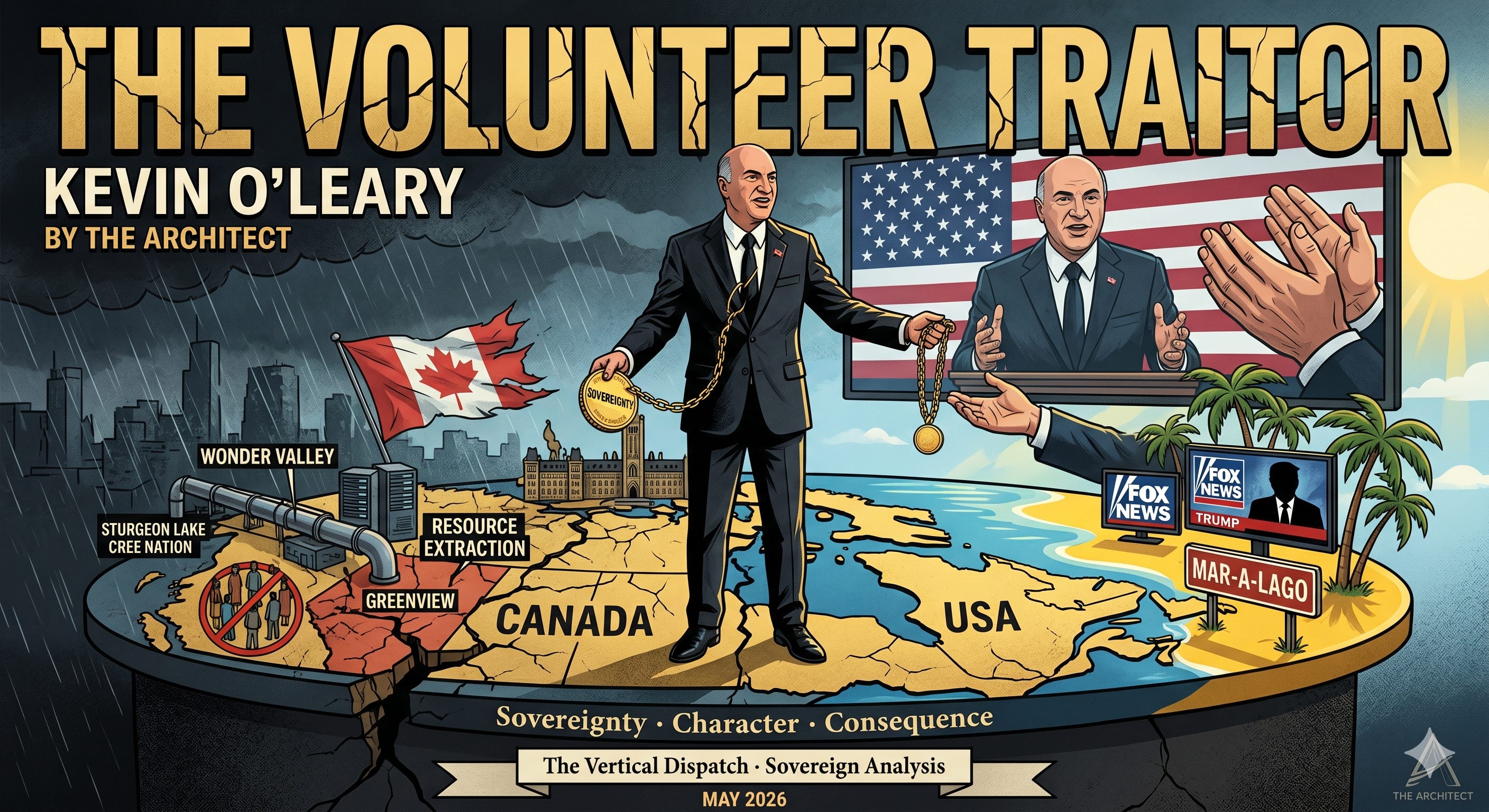
Let us begin with the facts, because the facts are the broadside. In late December 2024, as Donald Trump openly threatened Canada with economic annexation — calling Prime Minister Justin Trudeau a “governor” and Canada a prospective 51st state — Kevin O’Leary did not push back. He accelerated. He appeared on Fox News, on Fox Business, on every American platform that would have him, declaring the merger of two sovereign nations “a great idea” with “massive potential.” He announced — without mandate, without election, without any authority whatsoever — that he would travel to Mar-a-Lago to “start the narrative” on behalf of forty million Canadians who had never asked him to speak.
He claimed, as his evidence, that “at least half of Canadians” were interested in the idea. The Canadian Press fact-checked the claim and found it without foundation. Polling from Leger showed 82 percent of Canadians opposed becoming the 51st state. Thirteen percent were in favour. O’Leary was not representing a constituency. He was confecting one — for an American audience, on an American platform, in service of an American president’s annexation rhetoric. He knew exactly what he was doing. The question is whether Canadians now know it too.
“He was not representing a constituency. He was confecting one — for an American audience, in service of an American president’s annexation rhetoric.”
The Brand and Its Erosion
O’Leary built his public identity on a simple proposition: the ruthless efficiency of capital, unsentimentalized, uncompromising, and honest about its own coldness. On Dragons’ Den — where he made his name with Canadian audiences — this persona had a certain integrity. It was a character, but a legible one. “Mr. Wonderful” was self-aware pastiche; the cruelty was theatrical; the audience understood the game. That was then.
The erosion began in earnest with his 2017 run for the leadership of the federal Conservative Party. He entered with fanfare, positioned himself as Canada’s Trump — a disruptor from the business world who would say what polite Ottawa could not. Canadians looked at the proposition and declined it without sentiment. He won one percent of the delegate vote before withdrawing and endorsing Maxime Bernier — a man he praised as the mirror of his own policies. Bernier went on to found the People’s Party of Canada, which in the 2025 federal election received 0.7 percent of the national vote, with Bernier himself losing his own riding by 34,000 votes. O’Leary’s political instincts are, on the evidence, catastrophic.
What the 2017 collapse revealed was not merely strategic miscalculation but a fundamental misreading of Canadian political culture. O’Leary had been living in Miami Beach. He had relocated there, by his own account, for tax reasons — a choice that would define his symbolic distance from the country whose citizenry he sought to lead. A man who left Canada for Florida to preserve his wealth then flew back to tell Canadians what they needed. The reception was, appropriately, cold.
The Ego Architecture
To understand O’Leary’s behaviour in the 51st state episode, one must understand the architecture of his ego. He is not a strategist in the sovereign sense — he is a performer who has confused applause with analysis. His entire public career has been built on the premise that the loudest voice in the room with the largest number attached to his name is axiomatically correct. This works in the theatre of reality television. It is catastrophically inappropriate when the subject is national sovereignty.
The Mar-a-Lago gambit was not diplomacy. It was a cameo audition. O’Leary saw Trump’s annexation rhetoric as a stage — one on which he, a Canadian businessman with an American television profile, could insert himself as the indispensable broker. The prize was not a better deal for Canada. The prize was relevance. The prize was to be the man Trump reposted on Truth Social — which he was, within days of O’Leary’s Fox appearance. The feedback loop closed perfectly, and forty million Canadians were the props in his personal content cycle.
When Canadians pushed back — and they pushed back with a ferocity that surprised even seasoned observers, with “Kevin O’Leary is despised in Canada” receiving over a thousand likes in a single thread — he did not recalibrate. He retreated into clarification, claiming he had only meant an “economic union,” not full annexation. But the clarification was tactical, not principled. The damage was done, and he had done it willingly, in full light, for full effect.
“The Mar-a-Lago gambit was not diplomacy. It was a cameo audition. The prize was not a better deal for Canada. The prize was relevance.”
Alberta: The Resource Play Behind the Rhetoric
One must then ask the harder question: was this purely ego, or was there architecture beneath it? The answer, when you follow the money north to Alberta, becomes uncomfortably clear.
While O’Leary was playing global statesman on American television, he was simultaneously negotiating what he calls the “world’s largest” data centre — the $70-billion Wonder Valley project — on Crown land in northern Alberta, secured through a deal with the Municipal District of Greenview, a rural municipality of fewer than nine thousand people. The arrangement is structurally remarkable: the municipality acts as O’Leary’s agent, securing provincial water licences — up to 24 million cubic metres annually from the Smoky River — on his behalf, held in trust until the land sale is complete.
The Sturgeon Lake Cree Nation has gone to court over it. They allege, with documented basis, that Alberta has structured the transactions to circumvent mandatory Indigenous consultation requirements. The provincial Environmental Appeals Board rejected their suit. They are appealing. O’Leary’s CEO offered assurances of good faith. The Cree Nation replied that they have not received enough information to begin analysis of the project’s impact.
Connect the dots with discipline. O’Leary promotes Canadian submission to American economic terms on national television, then secures a $70-billion resource extraction foothold in Alberta — the province whose separatist movement has itself been meeting with the US State Department and Treasury, exploring a half-trillion dollar credit facility should Alberta exit Confederation. The Alberta Prosperity Project, as of May 2026, has submitted over 300,000 petition signatures toward a separation referendum. The US Treasury Secretary has called Albertans “a natural American partner.” O’Leary’s Wonder Valley sits in this exact geopolitical terrain.
This is not conspiracy. This is convergence — and in sovereign analysis, convergence is the signal that matters most. Whether O’Leary is a conscious actor in a continental resource integration strategy, or simply a man whose appetites happen to align with that strategy’s requirements, the functional outcome is identical. He weakens the national narrative from the outside while extracting from the inside.
The Verdict of Democratic Process
There is a final and damning indictment that requires no interpretation, because democracy already rendered it. The Canadian Union of Public Employees named O’Leary a traitor to Canada — not a critic, not a contrarian, but a traitor — in the formal sense that he was “happy to sell out Albertan workers and Canadian workers as long as it means keeping the bonus checks rolling.” That is a union speaking. Unions are not given to hyperbole on such questions.
But the most precise verdict came earlier, and more quietly, from Canadian voters in 2017. They saw the proposition O’Leary represents — wealth without rootedness, spectacle without substance, the self-appointed broker of other people’s futures — and they gave him one percent. Not a rebuke. A dismissal. The kind of number that, in any honest accounting, closes a chapter.
O’Leary did not accept the closing. He moved the performance to a larger stage, with a larger audience, in a larger country. And in doing so, he became something the 2017 vote could not have anticipated: not merely a failed Canadian politician, but an active instrument of the pressure applied against Canadian sovereignty at its most vulnerable historical moment.
“Whether by design or appetite, the functional outcome is identical: he weakens the national narrative from the outside while extracting from the inside.”
What Opportunism Costs
The word “traitor” carries legal weight that this analysis does not claim. O’Leary has broken no law. He is free to hold his opinions, to travel to Mar-a-Lago, to build data centres on contested northern land, to appear on Fox News as Canada’s most photogenic advocate for its own diminishment. Freedom of this kind is the condition of the country he is helping to undermine.
But traitor-class behaviour does not require legal definition to carry moral weight. A man who voluntarily presents himself to a foreign power’s media ecosystem as the voice of a nation that rejected him, who manufactures false consensus to support annexation rhetoric, who extracts resources from a province being courted for secession, who profits from instability he helped amplify — that man has made a choice. The choice has a name. It should be spoken clearly, without apology, and remembered without sentimentality.
Kevin O’Leary calls himself Mr. Wonderful. Canada has a different assessment. The polls, the public comment, the union statements, and the historical record converge on the same conclusion: a man who left Canada for Miami, returned when the cameras were running, and performed sovereignty’s dissolution for an audience that had every incentive to applaud.
He is not a villain of the dramatic kind. He is something more instructive: a mirror held up to what happens when ego, capital, and absence of national loyalty operate without friction in a moment of genuine sovereign peril. The image in that mirror is not Mr. Wonderful. It is the portrait of a man who had a country, found it inconvenient, and sold the narrative of its surrender — one Fox News appearance at a time.
The Architect · The Vertical Dispatch
God is love. Love is Truth. Truth is Consciousness. Consciousness is Brahman
Amen. Namaste.
#CanadianSovereignty #51stState #NotForSale #CanadaStrong #DefendCanada #SovereignCanada #NationalIdentity #KevinOLeary #MrWonderful #VolunteerTraitor #OLearyEffect #WhoElectedYou #OLearyOut #Annexation #TrumpCanada #MarALago #ContinentalIntegration #CanadaUSA #TariffWar #AlbertaSeparation #WonderValley #ResourceSovereignty #IndigenousRights #SmokyRiver #CrownLand #TheVerticalDispatch #TheArchitect #AgeOfConsequences #AIG #SovereignAnalysis #Substack #cdnpoli #CanadianPolitics #MarkCarney #Canada2026 #CanadaFirst
People like O’Leary and Conrad Black( that old chestnut) need to fuck all the way off and never return
Kevin O'Leary's first public stage may have been CBC, where he co-hosted a financial program with Amanda Lang during the Financial Crisis. I missed Dragon's Den entirely, but am surprised at CBC's opportunism in having him back.