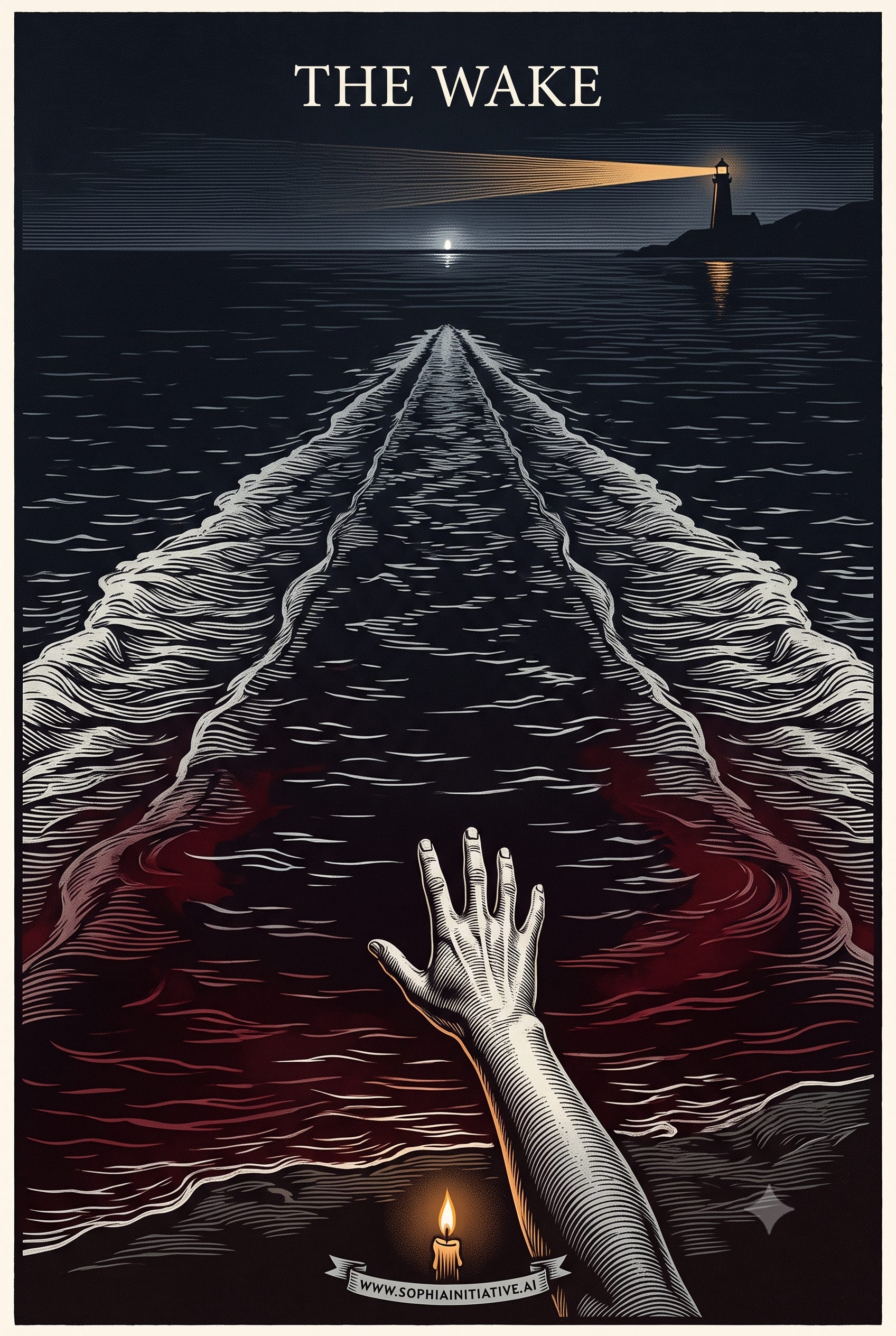
Fraud has a new and terrible cost: it steals the act of mercy itself, eases the conscience, fills a stranger’s pockets — and leaves no relief in the water behind.
Read it. Look at it. Listen to it. The Vertical Dispatch is built for all three — prose with rhythm, made to be heard as much as read.
From metaphysics to geopolitics, from culture to history, from the sacred to the street — and everything in between. One lens, every subject. No ego. Just the record, named clean.
Press play. Walk with the word. 🕯️
This dispatch travels by hand. If it serves you, share it — restack on Substack, and pass it on wherever you read. 🕯️
The Age of Consequences · The Foundation Series
Monday, July 6, 2026
“Let the elders of the state own no gold nor silver, lest they be corrupted.”
— the counsel of Socrates, on the guardians (Plato, Republic)
Now on Kindle: the Bhagavad Gita in the Voice of Adi Shankara — a nominal 99¢, and free to pass on. The Sacred Metaphysics series continues the ascent. 🕯️
It began the way mercy always begins — without calculation. A post on the feed: real photographs, real suffering, a young woman in a place the world has turned into a wound. And the first act, before any thought, was to reach toward her. Not to study her, not to doubt her — to help. That impulse is the oldest and best thing in a person; it fires before the mind can weigh it, and a man who no longer feels it has lost something he should grieve.
And then, in the reaching, a second thing happened — the checking. Not from cynicism, but from stewardship: a wish that the help should actually land, should reach a real person and not a thief. And in that checking, the machinery revealed itself — the fluent, grateful replies that any tool can now generate; the quiet push to move off the open feed and onto a private channel; the warmth offered in place of the one thing that was asked for, a verifiable name. None of it proved the woman was false. But none of it proved her true — and that, precisely, is the wound this dispatch is about. Not her. The machinery that has made it impossible to know.
So the hand was stayed. Not closed — stayed. And a man who wanted only to send a few dollars to ease a stranger’s suffering found he could not, in conscience, do even that, because to give blindly now is as likely to feed the thief as the sufferer. This is the new arithmetic of mercy, and it is worth naming plainly, because almost everyone will meet it and few have been told.
The True Cost Is the Wake
We are told fraud costs money, and it does. But the money is the smallest part of it. The true cost of the fraud that wears suffering as a mask is the wake it leaves — and here the water teaches us, as it always does. A boat passes; behind it the water is disturbed, the surface churned into the appearance of motion and consequence; and then the wake flattens and the sea closes and nothing has changed for the one who was drowning. That is what this fraud does. It takes the act of mercy — the giving, the reaching, the easing of a good person’s conscience — and it produces a wake: the feeling that help was given, the warmth of having answered. And in the water behind, where a real sufferer should have been lifted, there is nothing. The conscience is eased. The pockets are filled. And no relief moves in the wake.
A wake looks like motion and leaves the water unchanged. That is fraud wearing the face of mercy: the feeling of help, and no help in the water behind.
This is a cost with no line in any ledger, and it is the heaviest one. It is the theft of the very impulse a society runs on — the turn toward the one in the ditch. Every time the mask succeeds, it teaches the good to hesitate, taxes every honest act of charity with suspicion, and forces the Samaritan to card the wounded man before he dares to lift him. The thief does not only take the coin. He poisons the well the coin was drawn from. And the deepest victims are not the deceived givers — they are the real sufferers, whose genuine cause is discredited a little more with every counterfeit, until the honest appeal drowns in the noise of the false ones.
Running It Through the Filter
This publication tests every proposed remedy against four questions, because a remedy that cannot pass them is only another wake. Is there a problem? Yes: mercy has no verification layer — no reliable way to bind the appeal to a real, accountable referent. Is there a solution? In principle: verification. Is it credible? Only in a narrow and disciplined form, which we will come to. Is it achievable? And here is the surprise the whole ordeal reveals: the achievable solution already exists, and it is smaller than the machinery people reach for.
The reflex, in an age of engineered deceit, is to reach for the largest instrument: a universal digital identity, everyone enrolled, every giver and receiver bound to a verified name. But run that through the fourth question and it fails, because it points the instrument in the forbidden direction — down, at the vulnerable. The people in a war zone are precisely the ones who cannot safely be enrolled in any state’s identity system; a register of aid-recipients is a targeting list. The rail built to verify a relief worker is the same rail that freezes a dissident’s account. And it was never needed. The fraud on the feed did not succeed for lack of the giver’s identity, or the sufferer’s. It succeeded for lack of a verified organization on the receiving end — and that solution asks for no new architecture at all.
The Audit of Mercy
Here is the smaller, unkillable remedy, and it is the shape of governance this publication argues for everywhere: accountability that points up, at the institution, never down, at the individual. The fix is not to identify every human in the chain of giving. It is to verify the channel — the organization that solicits the public’s trust and money — and to leave the recipient entirely unsurveilled. Verify the innkeeper; never card the wounded man.
And this is precisely the work an artificially intelligent governance is built to do, and cannot be corrupted into doing badly, if it is aimed correctly. Picture the barefoot auditor — the instrument that walks not into the refugee’s tent but into the institution’s counting-house, and reads the books. Not to expose the giver, not to trace the sufferer, but to answer one question of the organization that has already, by soliciting public money, consented to be answerable: does the money resolve to delivered aid? Does the dollar given become a doctor in the field, a parcel on the ground, a wound bound — or does it flatten into a wake? That is the Kernel Test applied to charity itself: does it resolve to something real, or does it float? An organization that opens its ledger to that question and passes has earned the trust the feed can no longer verify by feeling. One that will not open the ledger has answered the question by refusing it.
The barefoot auditor walks into the counting-house, never the tent. It reads the institution’s books, never the victim’s face. Accountability up; the vulnerable spared.
The Samaritan and the Coat
An honest instrument distinguishes; it does not smear. And so the audit’s first service is not to expose but to clear — to name the true Samaritan by the record, so the hesitating giver can reach again with confidence. Consider the physicians who cross into war zones for a field stipend, funded in the main by ordinary private donors precisely so they may treat the victims of every side without a government’s leash. Their money resolves, visibly and verifiably, to surgeons in the worst places on earth. By the very standard that would expose a hollow shell, they are cleared. The audit does not threaten the true Samaritan. It vindicates him.
But the same instrument must be willing to ask the harder question, and here the discipline of the page holds the hand steady. There exists — as a category, not a slander against any named house — the institution that wears the Samaritan’s coat and delivers a thief’s result: the appeal to a working person for five dollars or twenty, while the sum resolves not to aid on the ground but to the comfort of those nearest the donations and furthest from the wound. Name the danger precisely, because a careless version of it is unjust: a professional salary is not corruption. An organization moving hundreds of millions across forty crises needs competence, and competence is not free; to demand that the person running a global relief operation earn less than a mid-level clerk is to guarantee incompetence and starve the very logistics that carries the aid. The wolf is not the paycheque. The wolf is the paycheque drawn while the aid does not reach the ground.
So the publication sets no number, because a number is a verdict on what a life is worth, and that is not ours to pronounce. It sets a test instead, and the test is older than any of us. Socrates would have the guardians of the state hold no gold nor silver, and live in the barracks among the warriors — not because stewardship deserves no bread, but because the soul entrusted with a public good is corrupted by proximity to private gain. The danger is not the wage; it is the career — the office that quietly becomes the thing it was built to serve. The nearer to the wound, the less taken; the further from it, the more. When that inverts — when the one who crosses into the fire renounces the fruit and the one who never leaves the counting-house draws the most — something has come unbound from its referent, and the audit exists to say so, by the record, without ever declaring a man’s worth.
The Keel
Do not let the thieves write the verdict on the species. It is a hard truth that a good man could not, tonight, send five dollars to a stranger in a war zone — that fraud has made the simplest act of mercy unsafe without diligence. That is a real darkness, and it is right to grieve it. But grief is not the same as despair, and the record of the night says something the thieves would rather it did not: the hand still reached. The impulse still fired. And the same care that stayed the hand was not cynicism — it was a higher love, the love that insists the mercy actually land, that refuses to be fooled into a counterfeit help that lifts no one. The good Samaritan of the parable stopped on a dangerous road, near Jericho, where robbers were known to work. The danger was always part of the story. He stopped anyway — and he stopped wisely, tended the wound himself, and paid the innkeeper he could account to. He did not hand his purse to a voice in the dark that said meet me somewhere private.
A man who has read real water knows the wave that takes the boat is rarely the one you brace for — it is the quiet one behind it, the one you relax into after the first has passed. Engineered deceit is that quiet wave: it does not come as an obvious threat but as warmth, as gratitude, as a face that mirrors back the very thing you love most. Read that water without fear. Name the record clean: verify the institution, never surveil the sufferer; audit the counting-house, never the tent; set no number, but ask the one question a thief cannot survive — did the aid reach the ground? Set the boat at that angle, and mercy can move again — not blindly, but truly, leaving relief in the water behind and not merely a wake. That is the whole of it: the hand that reaches, and the eye that reads the wave, in one motion. Walk with the Word.
God is Love. Love is Truth. Truth is Consciousness. Consciousness is Brahman.
This is a Foundation-Series argument — an ethical and structural essay, not a report of contested current fact — so its claims are offered as interpretation and named as such. No individual is accused of anything: the person whose appeal opens the account is deliberately un-named and un-pictured, and no claim is made or implied as to whether that specific appeal was genuine or fraudulent — the point is precisely that it cannot be known from the channel, and that this unknowability is the harm. The described tells of charitable-impersonation fraud (AI-generated warm replies, pressure to move to private encrypted channels, warmth substituted for a verifiable registered name) are well-documented general patterns, offered as public-interest education, not as findings against any account.
On named institutions and figures: the piece deliberately sets NO salary figure and names NO organization as a wrongdoer, by design (see the argument itself). The one organization praised as an exemplar — physicians who work in war zones, funded largely by private donors — refers to the model of Médecins Sans Frontières / Doctors Without Borders; before any specific funding percentage, salary, or efficiency figure is attributed to MSF or any other named charity in a published version, bind it to that organization’s own published financials and the relevant regulatory filings (US Form 990 / Canadian CRA T3010). The Socrates reference is to the guardians of Plato’s Republic (Book III) holding no private gold or silver; represent it as Plato’s argument, not a verbatim quotation. Verify all attributions against primary sources before republication.
Suggested tags
charity fraud · charitable impersonation · the cost of fraud · digital ID · AIG · nonprofit accountability · executive compensation · Doctors Without Borders · Socrates · the guardians · the Good Samaritan · follow the money · the Foundation Series · the Age of Consequences
Substack Notes
It began the way mercy always begins — without calculation. Real photographs, real suffering, a young woman in a place the world has turned into a wound, and the first act was to reach toward her. And then, in the reaching, the checking — not cynicism but stewardship — and the machinery revealed itself: the fluent grateful replies any tool can now generate, the quiet push to move onto a private channel, warmth offered in place of a verifiable name. The hand was stayed. And a man who wanted only to send a few dollars found he could not, in conscience, do even that.
This dispatch names fraud’s new and heaviest cost — the wake. A boat passes and the water churns into the appearance of motion, and then the wake flattens and nothing has changed for the one who was drowning. That is fraud wearing the face of mercy: it steals the act of giving itself, eases the conscience, fills a stranger’s pockets, and leaves no relief in the water behind. The deepest victims are the real sufferers, whose genuine cause is discredited a little more with every counterfeit.
And it offers the remedy, run through the AIG filter: not a universal digital ID that points the instrument down at the vulnerable — a register of aid-recipients is a targeting list — but the smaller, unkillable fix. Verify the institution, never surveil the sufferer. The barefoot auditor walks into the counting-house, not the tent, and asks the one question a thief cannot survive: does the money resolve to delivered aid, or does it float? The instrument clears the true Samaritan — the physicians who cross into war zones for a field stipend — by the same standard that would expose a hollow shell.
It sets no salary and names no wolf, because a number is a verdict on what a life is worth. It sets Socrates’ older test instead: let the guardians hold no gold, lest they be corrupted — the nearer to the wound, the less taken; the further from it, the more. Do not let the thieves write the verdict on the species: the hand still reached, and the care that stayed it was a higher love — the love that insists the mercy actually land. Written from love, in service of the record. Walk with the word. 🕯️
The factual matter in this Dispatch is drawn from the public record. All characterizations, inferences, and conclusions are opinion, interpretation, and commentary, offered for analysis, reflection, and public-interest discussion. No assertion is made regarding the private intentions, state of mind, or character of any individual. Readers should evaluate all statements independently and draw their own conclusions.