

Φ
THE VERTICAL DISPATCH
We write for the mind, the eye, and the ear.
Read it. Look at it. Listen to it. The Vertical Dispatch is built for all three — prose with rhythm, made to be heard as much as read.
From metaphysics to geopolitics, from culture to history, from the sacred to the street — and everything in between. One lens, every subject. No ego. Just the record, named clean.
Press play. Walk with the word. 🕯️
This dispatch travels by hand. If it serves you, share it — restack on Substack, and pass it on wherever you read. 🕯️
sacredmetaphysics.org
0protocol.ai
visva.world
sophiainitiative.ai
THE VERTICAL DISPATCH // ESSAY ON LITERACY, MEDIUM & LINEAGE
Why thirty-eight percent of Grade 3 children fail to read in the world’s most credentialed nation—and what Plato, Cardinal Newman, Marshall McLuhan, Enoch, and Jnana Yoga reveal about recovering deep literacy.
Thirty-eight percent of Canadian children finish Grade 3 unable to read proficiently. At the very same moment, Canada claims the highest rate of post-secondary credential attainment in the industrialized world at sixty-four percent. Place those two figures side by side and a comforting national myth collapses on contact. A country does not produce more than one in three nine-year-olds struggling to decode print while simultaneously leading the OECD in diplomas and degrees unless something fundamental has severed the link between formal schooling and actual mastery of the written word.
Two reports released in November 2026 by the Aristotle Foundation for Public Policy—One in Three 9-Year-Old Canadians Cannot Read and Why Literacy Is at an All-Time Low—brought the childhood numbers into sharp relief. Across Canadian provinces, between twenty and fifty-six percent of students fail to meet Grade 4 reading standards, while today’s Grade 10 students score two to three years behind their peers from twenty-five years ago. Yet treating this collapse as an isolated classroom glitch misses the deeper architecture of the problem. Children do not learn to value print inside an adult civilization that has largely abandoned sustained reading.
CORE STRUCTURAL AXIOM
Schools cannot cultivate deep reading inside children when nearly half of working-age adults operate below functional synthesis and trade linear prose for continuous digital streams.
I. The Credential Paradox and the Non-Reading Home
Examine the adult side of the ledger through Statistics Canada and the OECD Programme for the International Assessment of Adult Competencies (PIAAC Cycle 2). Canada leads every OECD member nation in tertiary attainment, with sixty-four percent of adults aged twenty-five to sixty-four holding a college diploma, trade certificate, or university degree compared to an OECD average of forty-three percent. Official spokespeople cite that ranking endlessly as proof of a knowledge economy. Yet when PIAAC measures what adults actually do with written text, Canada’s mean literacy score lands at 271—squarely inside Level 2.
Level 2 literacy allows a reader to scan a short passage and locate an explicit fact, but it falls short of Level 3 (276 and above), the minimum threshold required to navigate dense, multi-source arguments and evaluate competing claims. Forty-nine percent of Canadian adults fall below Level 3. Nineteen percent sit at Level 1 or below, meaning nearly one in five working-age Canadians struggles with anything beyond brief, familiar sentences. Only fourteen percent reach Levels 4 and 5, where a mind integrates multiple complex texts, weighs subtle inferences, and detects hidden assumptions.
Even the credentials themselves mask the erosion. Canadians holding post-secondary certificates or diplomas below a bachelor’s degree average 275—still inside upper Level 2. Those with a high school diploma or less average 246. Even university graduates with a bachelor’s degree or higher average 293, sitting in the middle of Level 3 rather than commanding Level 4 or Level 5 synthesis. An August 2026 longitudinal study from Georgetown University analyzing PIAAC Cycles 1 and 2 across Western nations confirmed that literacy losses span adult cohorts rather than afflicting youth alone, with Canadian adults aged fifty-five to sixty-five dropping sixteen points over a single decade as daily reading habits atrophied.
Canada leads the OECD in tertiary attainment with 64% of adults aged 25 to 64 holding post-secondary credentials (compared to the 43% OECD average), yet record credential counts mask a widening deficit in foundational reading depth. In early education, 38% of Grade 3 students are non-proficient readers against a 62% proficiency benchmark, meaning more than one in three nine-year-olds lacks fluent print decoding. That early gap carries into adulthood: while Canada’s national mean adult literacy score of 271 outperforms the 259 OECD average, it still sits within PIAAC Level 2—falling short of the Level 3 threshold required for complex synthesis. Specifically, 49% of Canadian adults score below PIAAC Level 3 (vs. 66% across the OECD) and struggle with multi-source prose, including 19% at Level 1 or below (vs. 26% OECD) who can only navigate brief, simple texts. Conversely, just 14% reach PIAAC Levels 4 and 5 (vs. 11% OECD), leaving sustained analytical synthesis in the hands of a narrow minority.
This adult baseline transforms the Grade 3 crisis from a mystery into a mirror. PIAAC Cycle 2 documents a widening literacy gap between adults raised by low-literacy parents and those raised by high-literacy parents. When parents no longer keep serious books open at the kitchen table, read long-form arguments aloud, or model quiet concentration after supper, children enter Grade 1 treating written language as an alien chore. Phonics instruction in school provides the indispensable mechanical key—and as the Aristotle Foundation notes, a 2026 study across five provinces proved that explicit structured literacy advanced eighty percent of struggling readers by one and a half grade levels in five months—yet mechanics alone cannot thrive in a home environment starved of continuous print.
II. McLuhan, Postman, and the Wasted Closure
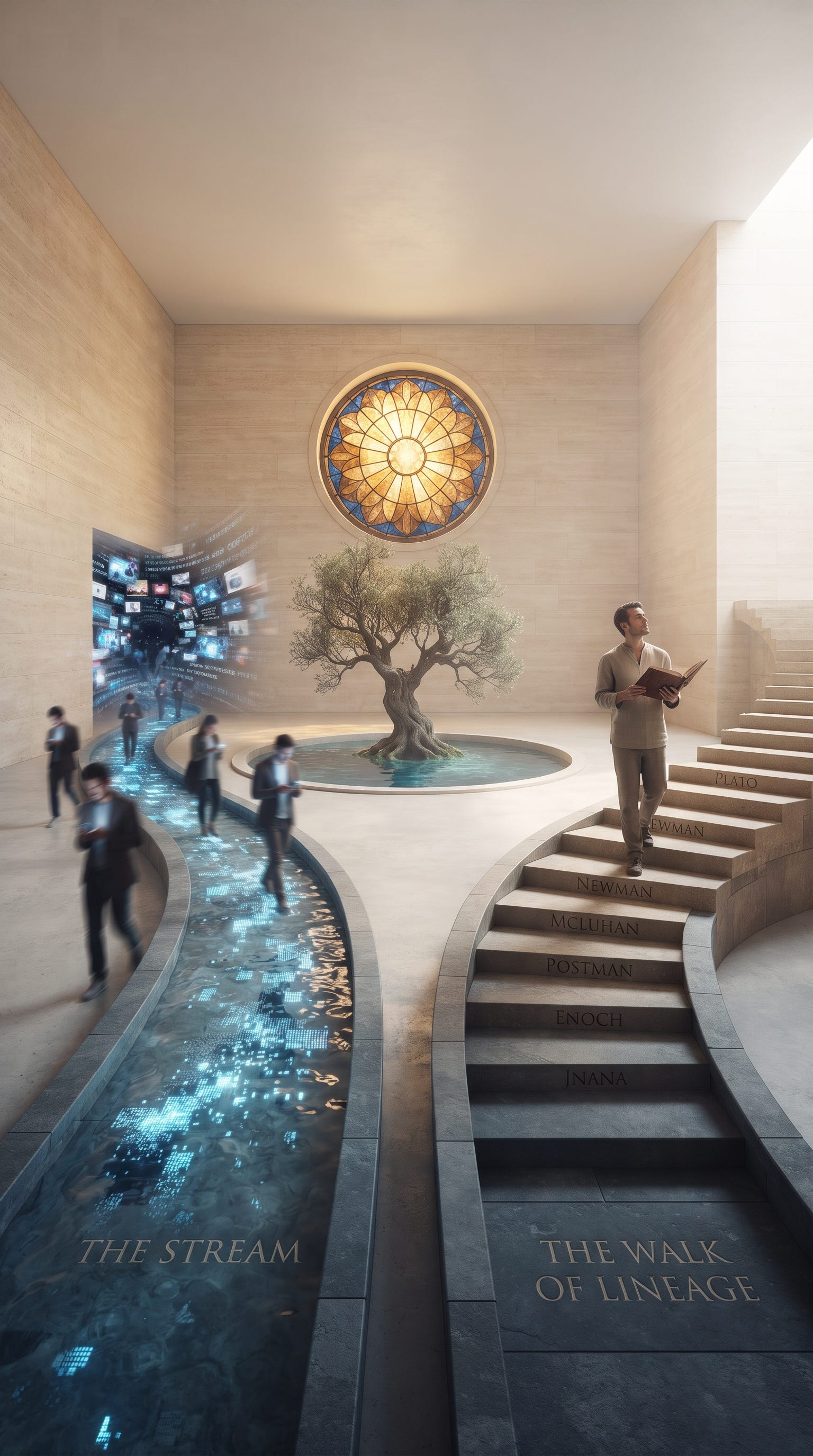
More than sixty years ago, Marshall McLuhan formulated the diagnostic law that modern education ministries still refuse to hear: the medium shapes human perception more decisively than any surface message carried inside it. A printed book imposes a silent, linear discipline. Words sit fixed on the page. The reader controls the pace, pauses at a difficult clause, turns back three pages to verify a premise, and holds an unfolding structure inside memory. Print creates the physical condition for contemplation and discernment.
A digital stream imposes the opposite architecture. Screens reward rapid switching, visual novelty, and immediate reaction. Nothing stays still long enough to demand inward digestion. Neil Postman extended McLuhan’s insight in Amusing Ourselves to Death and Technopoly, warning that when a culture hands its classrooms and public square over to screen-based convenience, serious exposition withers into fragmented entertainment. Attention fractures into thirty-second intervals; difficulty feels like a software defect rather than an invitation to think.
Look at what public school systems actually did during the COVID-19 closures when millions of children stayed home. Instead of mailing printed readers, structured phonics primers, grammar workbooks, and historical texts to every household—and pairing them with disciplined daily reading lessons—boards rushed children onto laptops, tablets, and asynchronous portals. Teachers uploaded static PDF worksheets to Google Classroom and Brightspace, linked pre-recorded video clips, and assigned leveled digital story apps built around ‘three-cueing’—training children to guess unfamiliar words from illustrations or first letters rather than decoding phonemes. Worse still, school accounts rolled out text-to-speech extensions that read passages aloud automatically, allowing struggling readers to bypass print mechanics altogether.
The result matched McLuhan’s law with mathematical precision. Toronto District School Board tracking cited by the Canadian Children’s Literacy Foundation showed that by March 2021, fifty-five percent of Grade 1 students in virtual schooling lagged behind in reading, up from forty-five percent before the closures. Webcams and classroom masks stripped away the visual mouth cues young children use to map speech sounds to letters. Even after classrooms reopened, devices stayed on the desks. Research cited in the Aristotle Foundation’s August 2026 report Children and Screens demonstrates that students on classroom laptops spend up to thirty-nine minutes of every hour off-task, toggling tabs and skimming fragments while sequential print textbooks disappear from school shelves. Sweden recognized the wreckage in 2023 and began pulling digital tablets out of early grades to restore printed books and handwriting; North American bureaucracies kept buying software licenses.
III. Lineage and the Great Conversation
The damage caused by streaming culture reaches far beyond nine-year-olds. It explains why so much contemporary journalism, commentary, and academic output feels weightless—forgotten forty-eight hours after publication. A writer raised inside the stream lives trapped in an eternal present tense. Every headline appears unprecedented; every political quarrel looks brand new; every opinion starts from the author’s immediate feelings rather than from an established body of human inquiry.
Contrast that thinness with thinkers who refuse to step onto the page empty-handed. Consider how figures as different as Ralph Nader, Cornel West, and Chris Hedges construct an argument. Nader never opens with vague sentiment; he anchors every indictment in statutory records, regulatory filings, engineering data, and institutional receipts. Cornel West situates every modern crisis inside a deep philosophical, classical, and prophetic lineage stretching from Plato and Chekhov to the Black prophetic tradition. Chris Hedges frames contemporary institutional decay through Thucydides, classical tragedy, historical memory, and documented mechanisms of power. One need not agree with every conclusion any of them reaches to recognize the structural difference in craft: they enter the Great Conversation carrying lineage, receipts, and prior concepts tested across centuries.
Nothing in human nature or political economy appears out of thin air. When writers read deeply across history, philosophy, scripture, and law, they gain an immediate immune system against propaganda and shallow novelty. They recognize old fallacies wearing new technological masks. Without that lineage, a writer merely adds noise to the feed—producing disposable reactions tailored for an audience averaging Level 2 comprehension.
IV. Plato, Cardinal Newman, Enoch, and Jnana
To repair what credentialism and digital streaming have broken, education must recover its proper aim. Four ancient and classical witnesses converge on the exact discipline required.
In Book VII of the Republic, Plato dismantles the modern assumption that education consists of pouring information into an empty vessel—or loading apps onto a student tablet. Plato defines genuine education as periagoge: the turning of the whole soul away from flickering shadows on the cave wall toward intelligible reality. A child guessing words from pictures on a glowing screen remains chained to shadows. Turning the soul requires effort, sequence, grammar, dialectic, and stillness.
Nineteen centuries later, Cardinal John Henry Newman articulated the same distinction in The Idea of a University. Newman separated useful training and certificate collection from true intellectual culture. Mere instruction crams the memory with scattered facts or vocational tricks; real education forms a philosophical habit of mind—characterized by freedom, equitableness, calmness, moderation, and wisdom. A mind formed in Newman’s sense grasps how parts relate to a coherent whole, weighs evidence without panic, and refuses to mistake a credential for understanding. Canada’s sixty-four percent tertiary attainment rate paired with Level 2 literacy stands as a textbook portrait of what happens when a society scales credentials while abandoning Newman’s habit of mind.
That inward steadiness reaches back even further into the oldest strata of human wisdom. In the fifth chapter of Genesis, the biblical record summarizes an entire human life in four stark words: ‘Enoch walked with God.’ Walking with God names an unbroken, deliberate orientation of attention toward the living Ground of truth—step by step, year after year, refusing to drift with the crowd or scatter the mind across passing distractions. You cannot walk with truth while sprinting from tab to tab.
The Vedic tradition names this same sovereign discipline Jnana Yoga—the path of knowledge pursued not for social status, career advancement, or rhetorical vanity, but for the sake of knowledge, wisdom, and truth itself. Jnana begins with viveka—rigorous discernment between the real and the illusory, between invariant principle and transient appearance. In that light, careful reading and exact grammar cease to look like dry schoolroom chores. Reading a dense text slowly, tracing every subject to its verb, testing every claim against primary evidence, and holding silence long enough for meaning to settle into understanding becomes an act of inward sovereignty.
V. Recovering the Discipline of the Book
Institutional reform in Canadian schools remains urgent and overdue. Faculties of education must abandon failed cueing theories, mandate systematic phonics and explicit grammar, restore sequential print textbooks, and clear distracting screens out of early classrooms. Yet anyone waiting for ministries of education or teacher unions to rescue the next generation will wait in vain.
Literacy is rebuilt where it has always lived: inside individual minds and disciplined households. Close the stream for an hour each evening. Put physical books—history, classical philosophy, literature, and clear reference texts—back into the hands of children and adults alike. Read aloud without rushing. Demand exact definitions instead of vague impressions. Enter the Great Conversation with lineage, patience, and discernment. A civilization does not stay free at Level 2, and no diploma can substitute for a mind that knows how to read, weigh, and walk with truth.
SUBSTACK TAGS: Literacy Crisis, PIAAC, Education Reform, Marshall McLuhan, Neil Postman, Cardinal Newman, Plato, Deep Reading, Cultural Lineage, Sovereign Mind
God is Love. Love is Truth. Truth is Consciousness. Consciousness is Brahman.
Amen. Namaste. Om Namah Shivaya.
— The Architect.
Written from love, for a sacred humanity, in the full light of consciousness, toward the greater good.