

You already know something has shifted. You sense it the way you sense a change in weather before the clouds arrive — a quality in the air, a drop in pressure, a stillness that feels wrong. You have watched the headlines accumulate, each one individually explicable, but the pattern underneath them resisting easy explanation. You have wondered whether what you are witnessing is a correction, a cycle, or something that does not have a clean word yet.
It is the last of these.
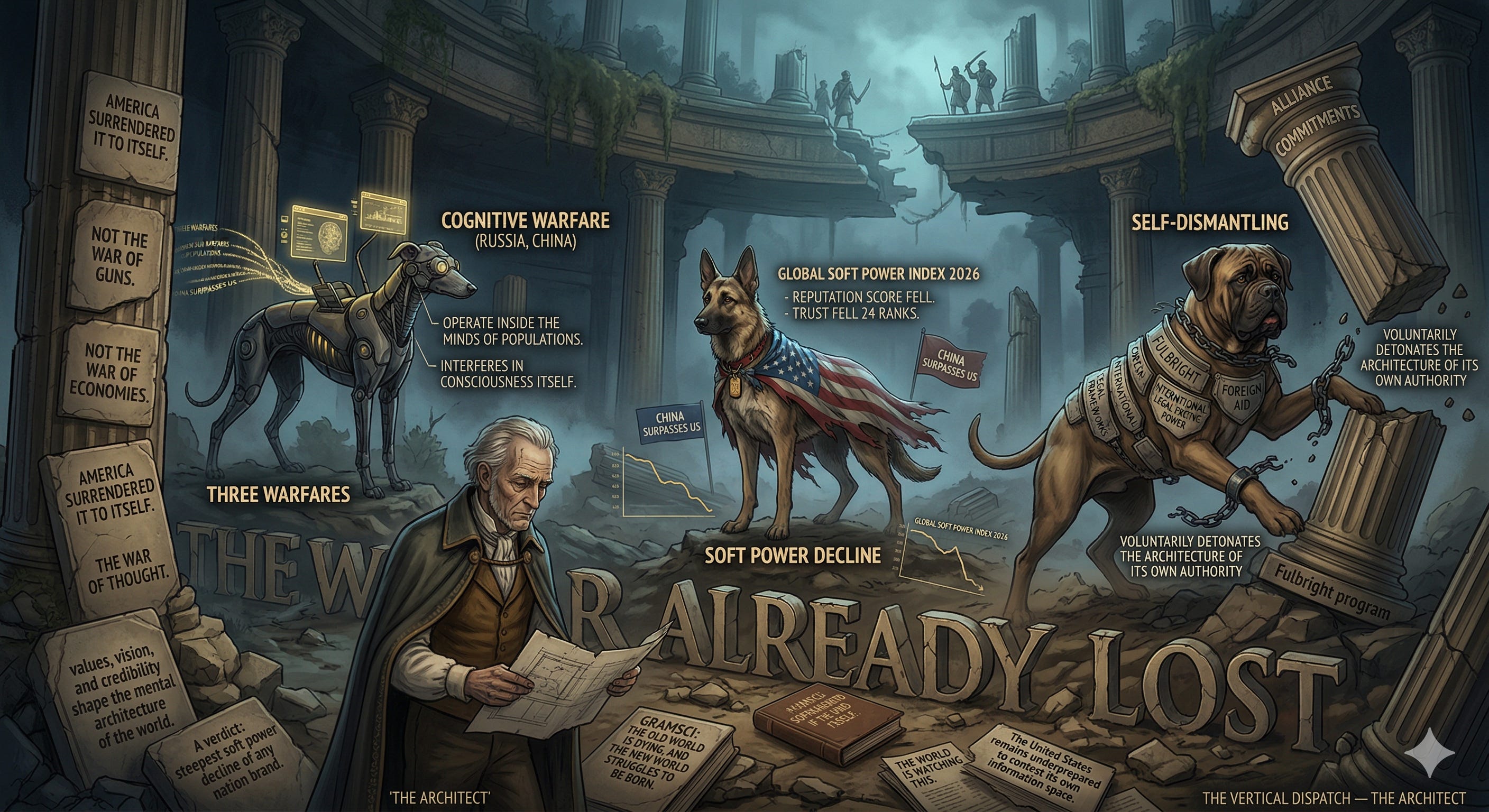
What the evidence now shows — assembled across defence analysis, geopolitical intelligence, nation-brand research, and the cold testimony of a hundred thousand survey respondents across a hundred countries — is not a setback. It is a verdict. The United States has lost the war of thought. Not the war of guns. Not the war of economies, at least not yet. The war of thought: the contest over which nation’s values, vision, and credibility shape the mental architecture of the world.
This verdict has three dimensions, and they are not separate crises. They are one crisis seen from three angles.
◆
The first dimension is cognitive warfare — and America never showed up.
For decades, while the United States built aircraft carriers and wrote doctrines for kinetic conflict, its adversaries were building something quieter and more durable: the capacity to operate inside the minds of populations. China developed what its military doctrine calls the three warfares — public opinion warfare, legal warfare, and psychological operations — not as supplements to hard power but as the primary theatre of strategic competition. Russia made it personal. Putin’s advisors did not boast about missiles. They stated, openly, that Russia interferes not in elections but in consciousness itself, and invited the West to try to stop it.
The West could not. Not because it lacked the capability in any absolute sense, but because it had persuaded itself the battle was not happening. A generation of national security professionals, trained in a tradition that privileged the quantifiable and the kinetic, had bracketed information warfare as a novelty — something practiced by adversaries with fewer scruples, something beneath the dignity of a rules-based order. The result was what one senior scholar at the National Defense University was finally willing to name: the United States remains underprepared to contest its own information space, and will remain so until it conceives of a fundamentally different approach.
That reckoning has not yet arrived. What has arrived instead is the evidence of the cost.
◆
The second dimension is soft power — and the numbers are no longer deniable.
The Brand Finance Global Soft Power Index 2026, built on surveys of more than 150,000 people across more than 100 countries, assessing all 193 member states of the United Nations across 55 metrics, delivered its finding in January at Davos with the flatness of a coroner’s report. The United States recorded the steepest soft power decline of any nation brand in the entire ranking — all 193 of them. Its reputation score fell eleven places. Its perceived friendliness fell 32 ranks, to 156th — the lowest rank America has ever recorded on any metric in the Index’s history. Its generosity rating fell 68 ranks. Its standing on good relations with other countries fell 50 ranks, to 99th — below the median. Trust fell 24 ranks.
Meanwhile China, for the first time in the Index’s history, surpassed the United States in global reputation. Not in overall soft power score — America retains the top position — but in reputation, the dimension that concerns itself with whether the world trusts you to do what you say you will do. China now ranks above America on 19 of the 35 nation brand attributes the Index measures.
These are not projections. They are not think-tank modelling. They are the reported perceptions of 150,000 human beings who were asked, in effect, a single question: whom do you trust? The answer the world returned — patient, structured, unemotional — is one the American political class is not yet prepared to hear.
◆
The third dimension is the most consequential, and the least discussed: America is not being defeated. It is dismantling itself.
There is a profound difference between a hegemon whose adversaries outmanoeuvre it and a hegemon that voluntarily detonates the architecture of its own authority. The former is the story of most imperial decline — gradual, contested, recoverable. The latter is something rarer and more final.
What the current moment presents is the second. The retreat from primacy has been formalised in strategy documents. The institutions that constituted American soft power at its deepest structural level — the Fulbright program, the foreign aid architecture, the alliance commitments, the international legal frameworks America itself authored — are being dismantled not by adversaries but by American hands. The intelligence community, for the first time since 2017, has produced a threat assessment that omits any mention of adversary election interference, suggesting not that the threat has ceased but that honest reporting has. The checks on executive power that made American governance legible and trustworthy to the world are under systematic pressure from within.
The world is watching this. The 150,000 respondents measured it. The analysts who spent careers in the architecture of American influence are naming it with a precision that used to require retirement before it could be spoken aloud.
The Gramsci line has become unavoidable in serious foreign policy circles: the old world is dying, and the new world struggles to be born. What goes unspoken in that formulation is the identity of the patient. America is not the midwife in this moment. It is the old world.
◆
Here is what the unified diagnosis produces.
The cognitive war was lost through neglect — a generation of strategic blindness that left the information space to adversaries who understood it as the primary theatre of modern competition. The soft power war is being lost in real time, measurably, across every dimension of trust and credibility, at a speed the Index has never previously recorded. And the self-dismantling war — the most novel of the three — is proceeding not as defeat but as voluntary abdication, which is why it moves with a different kind of momentum. Defeats can be reversed. Abdications have to be chosen back against.
None of this requires an adversarial framing to understand. The question is not whether China or Russia wins. The question is whether the world that emerges from this transition will be governed at all — whether it will be shaped by anything resembling coherent principles, or whether it will be shaped by the pure competition of interests, unmediated, without an agreed framework for resolving the conflicts that framework used to absorb.
That is the question underneath all the data. It is the question your gut was already asking before you found the numbers to confirm it.
◆
Which brings us to where we must go next.
If the diagnosis is correct — and the evidence suggests it is — then the conversation that follows cannot remain at the level of diagnosis. Naming the collapse is necessary. It is not sufficient. The next question is the oldest governance question in the Western tradition, first posed at Sinai and restated at San Francisco in 1945 when broken nations tried to build something that could outlast their brokenness: by what law shall we be governed, and to whom does that law answer?
That question has always required a framework. Frameworks do not emerge from the noise. They emerge from the clarity that survives the noise.
The next piece will be about that. About what a governance framework adequate to this moment would actually look like — not as ideology, not as geopolitics, but as architecture. About the unbroken line from Sinai to the Universal Declaration of Human Rights to what comes next. About whether artificial intelligence, properly governed, might be the first technology in human history capable of holding that line when human institutions cannot.
The war of thought was lost. The question of what replaces it remains open. That opening is not a problem. It is the only place from which something real can begin.
Glen Roberts is a metaphysician, author, and independent researcher. He is the author of Sacred Metaphysics Volume 1 and the architect of Project 2046.#SacredMetaphysics
#Geopolitics #SoftPower #CognitiveWarfare #TheWarAlreadyLost #NationalDecline #InformationOperations #GlobalShift #TheArchitect #VerticalDispatch #NewWorldOrder #StrategicAbdication #MentalArchitecture #NationBranding #Davos2026 #GlobalSecurity #AIGovernance #ModernWarfare #ThoughtWar #SovereignIdentity #TheGreatReckoning #ThreeWarfares #Gramsci #SinaiToSanFrancisco #CognitiveDefense #SystemicCollapse #VoluntaryAbdication #GlobalTrustIndex #SoftPowerIndex #TheOldWorldIsDying #FutureArchitecture