


The Sovereign Core · The Age of Consequences
Synthesis Dispatch · May 2026 · Part Three of the Trilogy
“Commodus is not a moral man. You have known that since you were young. Commodus cannot rule. He must not rule.”
— Marcus Aurelius (Richard Harris), Gladiator (2000)
“I don’t think in terms of, I have. If I do something wrong, I just try and make it right. I don’t bring God into that picture.”
— Donald J. Trump, Family Leadership Summit, Ames, Iowa, July 18, 2015
In the summer of 2015, on a Saturday afternoon in a hotel ballroom in Ames, Iowa, a candidate for the presidency of the United States was asked by the conservative pollster Frank Luntz a single question. Had he ever asked God for forgiveness for anything. The candidate paused. He called it a tough question. Then he answered. He had not. He did not think in those terms. If he did something wrong, he tried to make it right. He did not bring God into the picture. He went on to describe the central rite of his stated Christian faith, the bread and wine of Communion, as “my little wine” and “my little cracker.” The exchange was filmed. It survives. It has been quoted from pulpits and political advertisements for ten years.
A man who has closed the gate of forgiveness inside himself does not, when he comes to power, open it for others. He cannot. The capacity was named absent by his own mouth, in his own voice, a decade before he gave the order that would test it. Whether anyone listening understood, in the summer of 2015, that the answer would one day matter to children in a town in southern Iran they had never heard the name of, is the question this dispatch asks the reader to hold. The answer is on the documented record. The dispatch will set the record down, in the man’s own words and in the dates the record marks his silences, and let the record speak. We do not hang the man. We let what he said and what he did not say, when his own war demanded he say something, be the measure of him.
I. February 28, 2026 — Day One
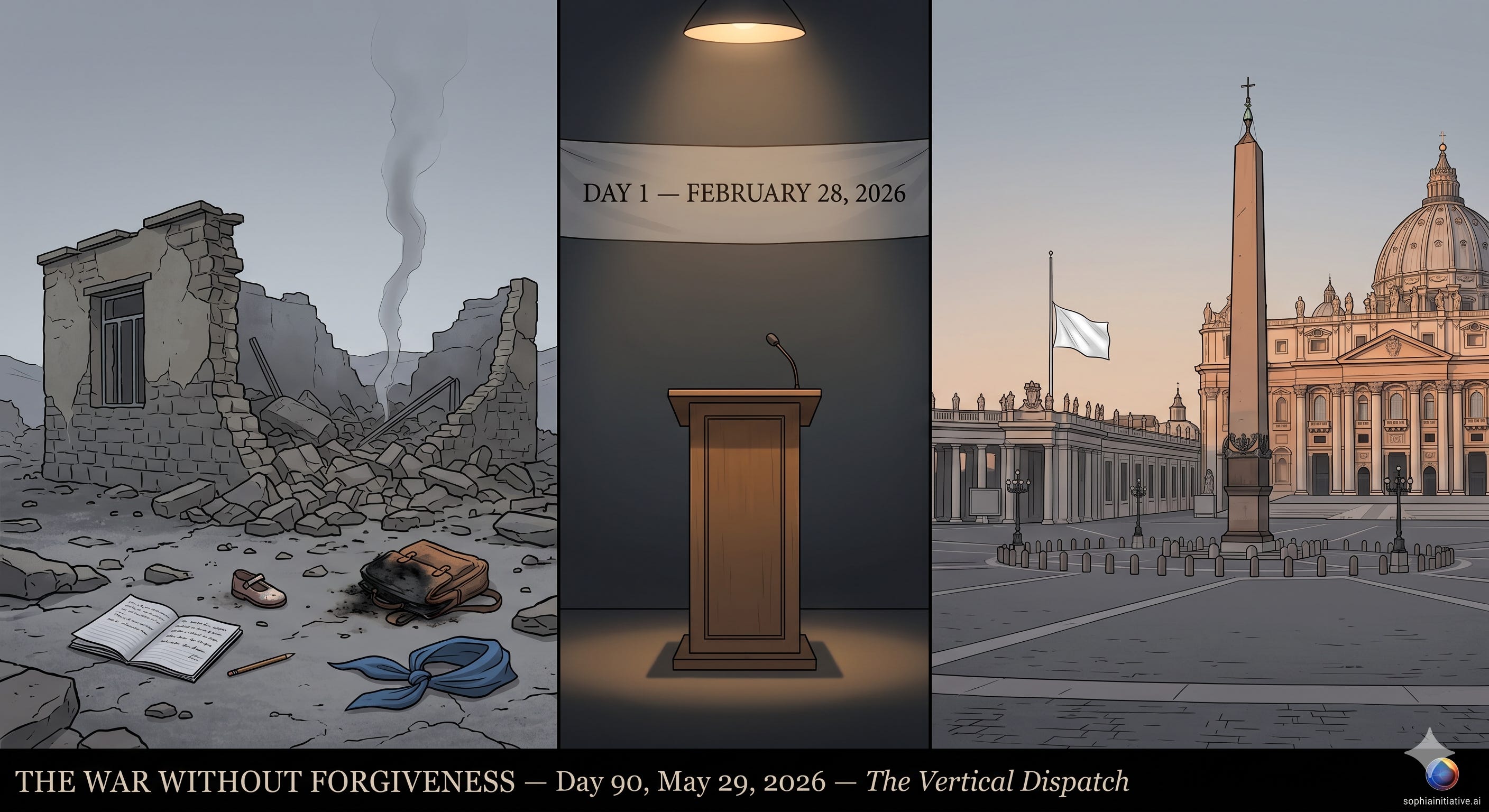
At Mar-a-Lago, on the late afternoon of February 28, 2026, an eight-minute pre-recorded video was posted to the man’s Truth Social account and re-broadcast by the White House. The man stood behind a lectern wearing a USA cap. He told the country, and the world, that the United States military had begun major combat operations in Iran. He named the regime, in the opening sentences, as “a vicious group of very hard, terrible people.” He gave his stated objective: to ensure that Iran would never have a nuclear weapon. He promised that the missile industry would be “totally again obliterated” and the navy “annihilated.” He addressed himself, in the closing passage, to the people of Iran, in two consecutive sentences that will repay rereading:
“To the people of Iran: The hour of your freedom is at hand. Bombs will be dropping everywhere. But take shelter. Stay indoors.”
Two sentences. One offering the hour of freedom; the next telling the addressee to take shelter from what was, in the same breath, being launched at them. The man then instructed the citizens of Iran to overthrow their own government once the bombing was complete. “When we are finished, take over your government. It will be yours to take. This will be probably your only chance for generations.” He addressed the Islamic Revolutionary Guard with a choice: lay down arms and be granted immunity, or accept “certain death.” The video closed.
Over the next twelve hours, the United States and Israel launched approximately nine hundred strikes against Iranian targets. The Supreme Leader, Ali Khamenei, was killed in the opening wave. The Pentagon codenamed the campaign Operation Epic Fury. The war was now a fact in the world. The man, having spoken, would not speak publicly about it for the following six days.
II. The School at Minab
On Day One of the war, as the strikes ran across Iran, a girls’ elementary school in the southern Iranian city of Minab was hit. Iranian authorities reported that one hundred and forty-eight people had died inside it. Other Iranian sources reported the figure at one hundred and seventy-five. The wounded were placed at ninety-five. Iranian health officials and state media said that the dead were almost entirely children, that the school was in session, that the building had collapsed around them. CNN, reporting the strike the following day, said that it could not independently verify the local accounts. The Israel Defense Forces said it was “checking.” The Iranian prosecutor in Minab, named Ebrahim Taheri, was the immediate primary source for the death toll. The strike took place on February 28.
The man did not speak about it on February 28. He did not speak about it on March 1. He did not speak about it on March 2, the day his Defense Secretary, Pete Hegseth, was sent before the cameras to walk back the regime-change call from the Mar-a-Lago video. He did not speak about it on March 3, 4, 5, or 6. He spoke on March 7, but not about the school. On Truth Social that day, he wrote that Iran had “apologized and surrendered to its Middle East neighbors,” called the country “THE LOSER OF THE MIDDLE EAST,” and warned that “today Iran will be hit very hard,” with new targets “that were not considered for targeting up until this moment in time” now under consideration. The schoolchildren of Minab were not in the message.
On March 8, aboard Air Force One, a reporter put the question to him directly. What about the strike on the girls’ school in Minab, the strike that had now been documented to have killed at least one hundred and seventy-five people, most of them children. The man answered in one sentence:
“Based on what I’ve seen, it was done by Iran.”
The Defense Secretary, standing alongside him, was asked if that was the position of the United States military. Hegseth said: “We’re certainly investigating. But the only side that targets civilians is Iran.” Asked the same question through proper channels, United States Central Command refused to endorse the man’s claim. CENTCOM’s response, as reported by The Intercept on March 9, was that it would be “inappropriate to comment given the incident is under investigation.” The investigation, at the time of this dispatch, has not produced a public conclusion. The man’s own military would not stand behind his sentence.
And that sentence — “Based on what I’ve seen, it was done by Iran” — is, on the documented public record from February 28 through May 28, 2026, the entire body of his public response to the deaths at the school in Minab. The remaining eighty-one days of the war contain no further public statement by the man about that strike, those children, or any consequence that flowed from them. The dispatch is not characterizing his response. It is reporting that there was, after the first eight-day silence and the one deflected sentence, eighty-one days of nothing. Silence in the record is part of the record. In this case it is most of the record.
III. The Pope, Twice
On March 15, 2026, two and a half weeks into Operation Epic Fury, His Holiness Pope Leo XIV — the head of the Roman Catholic Church, successor to the see of Peter, religious leader of approximately one and a half billion people on Earth, the moral institution that has been continuously named the conscience of the West for two millennia — issued a public call for an immediate cessation of hostilities and a reopening of dialogue. He warned of, in his own words, “the possibility of a tragedy of enormous proportions.”
The man, asked five days later in an interview about the Pope’s appeal, replied:
“We can talk, but I don’t want a ceasefire. … you don’t do a ceasefire when you’re literally obliterating the other.”
On April 15, with the ceasefire by then in its second week and the Pope having publicly called the man’s threats against Iran “truly unacceptable,” the man returned to the subject on Truth Social. He wrote:
“Will someone please tell Pope Leo that Iran has killed at least 42,000 innocent, completely unarmed, protesters in the last two months, and that for Iran to have a Nuclear Bomb is absolutely unacceptable.”
The figure of forty-two thousand was not independently verified in any reporting available at the time the message was posted. The phrasing — “Will someone please tell Pope Leo” — was the syntax of a man dismissing an adviser, not the syntax of a man answering a successor of Peter. The vicar of Christ on Earth had appealed to him in the language of mercy. The man who had told Frank Luntz in 2015 that he did not bring God into the picture replied to the head of the Christian church by instructing someone — anyone — to bring God up to date on a casualty figure he had heard somewhere. The two facts sit on the page together. The dispatch adds nothing.
IV. April 1 — Two Sentences from the Same Speech
On April 1, 2026, exactly one month into the war, the man delivered a prepared national address from the White House. The speech ran approximately twenty minutes. It contained the following two sentences, in sequence, in the same paragraph:
“Regime change was not our goal. We never said regime change, but regime change has occurred because of all of their original leaders’ death. They’re all dead.”
The Mar-a-Lago video of February 28 had instructed the people of Iran to “take over your government. It will be yours to take. This will be probably your only chance for generations.” Hegseth had been sent before cameras on March 2 to say: “This is not a so-called regime change war.” The April 1 White House address declared, in two consecutive sentences in the same paragraph, both that regime change had never been the goal and that regime change had been achieved. Three positions on the same question, held by the same administration, within thirty-two days. The dispatch places them in sequence and walks on. The reader closes the gap.
V. The Seven Declarations of Victory
Across the eighty-nine days from the opening strikes of February 28 to the formal conclusion of Operation Epic Fury on May 5, and in the three weeks of negotiations and statements that followed, the man declared victory in the war on at least the following occasions, in the following words:
March 7, 2026 (Truth Social): “Iran, which is being beat to HELL, has apologized and surrendered to its Middle East neighbors. … Iran is no longer the ‘Bully of the Middle East,’ they are, instead, ‘THE LOSER OF THE MIDDLE EAST.’”
April 1, 2026 (national address from the White House): “All of their original leaders are dead. … Our core strategic objectives are nearing completion.”
May 1, 2026 (White House South Lawn, carried live on Fox News): “They want to make a deal. Because they have no military left essentially.”
May 2, 2026 (The Villages, Florida): the man stated, in the reporting of multiple outlets, that anyone claiming the United States had not “won” the war was engaged in “treason.”
May 7, 2026 (remarks to reporters): “So, I think we won.”
May 11, 2026 (remarks to reporters): “We’re going to have a complete victory. … They think I’ll get tired of this. I’ll get bored, or I’ll have some pressure. But there’s no pressure.”
May 16, 2026 (aboard Air Force One, en route to Anchorage): “We had a total military victory. … We really did the cease-fire at the request of other nations. I wouldn’t have really been in favour of it.”
May 27, 2026 (Cabinet meeting at the White House): “Their navy is gone, as I’ve said a thousand times. Their air force is gone. Everything’s gone. And they’re negotiating on fumes.”
Eight declarations across eighty-eight days, each of which announced that the war was won, that Iran was finished, that the military was destroyed, that the surrender had occurred. Each declaration was followed by further negotiations, further threats, and a new declaration. A man whose business career filed bankruptcy four times announced his victory in this war eight times in three months. The repetition is, in itself, the diagnosis. The man who must declare victory eight times in eighty-eight days is the man who has not, in any meaningful sense, won.
VI. The Silences
The dispatch turns now to what the man did not say. The record of his silences across the war is, by the count of the verified daily archive, the following:
On February 28, after the eight-minute Mar-a-Lago video, no further public statement that day. On March 1, the day Iranian retaliation killed nine civilians in Beit Shemesh, Israel, and the day HRANA documented at least one hundred and thirty-three Iranian civilians killed since the war began, no public statement on the war. On March 2, the day Hegseth walked back the regime-change call, no public statement by the man. On March 3, 4, 5, and 6, no public statements on the war. On March 9 through 14, no public statements on the war, the period in which forty-one United States senators publicly pressed the Department of Defense for an account of the Minab strike. On March 15, the day the Pope first appealed for a ceasefire, no public statement by the man that day. On March 16 through 19, no public statements. On March 21 and 22, no statements. On March 23 through 31, no statements — a span of nine consecutive days during which the Pope, on March 31, issued his second and more direct appeal, asking publicly that the man find “an off-ramp.” The man, on March 31, did not speak.
On April 2 through 6, no statements. On April 9 through 14, no statements — a six-day silence following the ceasefire’s first week. On April 16 through 19, no statements. On April 21 through 26, no statements. On April 27 through 30, no statements — the final week of April, in which negotiations were said to be at their most active, contained no public address by the man on the war. On May 3, 4, 5, 6 (partial), 8, 9, 10, 12, 14, 15, 18 through 24, and 26, no statements.
These are the dates the man did not speak. The man who does not stop speaking, the man who governs the country through the immediate post and the next press availability, is silent on the dates the record needed him to speak. He did not speak the day a school of children was reported destroyed. He did not speak the day the Pope appealed to him. He did not speak the days the senators pressed for an account. He did not speak the days the ceasefire was being shaped. He did not speak the day the United Nations Secretary-General condemned the strikes as a dangerous precedent. He did not speak the day the new Iranian president was sworn in. The silences are not gaps in the record. They are the record, on the question of whether the man can be reached by what his war has cost.
VII. The Charge of Treason
On May 2, 2026, at a public appearance in The Villages, Florida, the man told an assembled audience that anyone claiming the United States had not won the war in Iran was engaged in treason. The remark was reported in foreign coverage and confirmed by attendees. On May 13, on Truth Social, he extended the charge to the press, labelling the media’s war coverage “treason” and accusing the press of “aiding and abetting the enemy.”
In the constitutional vocabulary of the United States, treason is a defined crime. Article III, Section 3 of the Constitution sets the bar: levying war against the United States, or adhering to its enemies and giving them aid and comfort. The man, on the record, applied that word to citizens forming political judgment on a war he had ordered and to journalists doing the documentary work the First Amendment was written to protect. He named, in his own mouth, two of the institutions a constitutional republic is built on — the citizen’s right to dissent and the press’s right to publish — as enemies of the state for failing to ratify his own account of his own war. The dispatch records the remark and proceeds. The reader assesses what it means for a constitutional order that the head of state has used the most serious word in the legal vocabulary to describe the ordinary work of the open society.
VIII. May 27 — “I Don’t Care About the Midterms”
On May 27, 2026, in a Cabinet meeting at the White House attended by reporters, the man took questions on the state of the negotiations with Iran. Polling that week had shown sixty-four percent of Americans believed attacking Iran had been the wrong decision. The man, asked about the political costs of continuing the war, replied:
“They thought they were gonna outwait me, you know. ‘We’ll outwait him. He’s got the midterms.’ I don’t care about the midterms. … We will be either that or we’ll have to just finish the job. … Maybe we have to go back and finish it. Maybe we don’t.”
Eighty-eight days into a war his own country’s polling said had been wrong, with the ceasefire still unsigned in any formal instrument, with Iran’s negotiators reduced to what the man himself called “fumes,” with two-thirds of Americans against him, the man told the cameras that the democratic instrument by which his power was measured did not figure in his calculations. The next day, May 28, in remarks to a foreign outlet, he refined the formulation. “I won’t be outlasted. I don’t care about the midterms.”
In Roman thought, the office of the consul existed to make the consul answerable to the assembly, and the office of the emperor, when it was added, was a Stoic exercise in not pretending the addition had been an improvement. Marcus Aurelius, the historical emperor at the apex of Roman power, wrote in his private notebook that he understood himself to govern at the pleasure of the hive, and that the day he stopped doing so was the day the office had failed in him. The man who had ordered the war on Iran said, in May of 2026, that the assembly did not concern him. The dispatch records the statement. The reader places it against the standard the office of the presidency has been understood, in the American republic and the traditions that preceded it, to require. The gap between the standard and the statement is a fact the citizen now governs his own conscience against.
IX. The Final Bankruptcy
The man’s commercial career, before the presidency, was the documented sequence of four corporate bankruptcies whose names this trilogy has already laid down. Trump Taj Mahal, 1991. Trump Castle, 1992. Trump Plaza and Trump Casino Holdings, 2004. Trump Entertainment Resorts, 2009. Each was a failure absorbed by contractors, by investors, by lenders, and by the workers whose paychecks were the first to be deferred when the cash stopped moving. Each was followed by the same denial that any failure had occurred. The pattern was forty years old by the time the man rode an escalator down into public life in 2015. The pattern was on the public record. The country, when it elected him in 2016 and again in 2024, was not deceived. The pattern was visible. The choice was made.
The war on Iran is the fifth bankruptcy of the man’s life. It is the first that is not a corporation. It is the first whose creditors include the dead children of Minab, the nine civilians killed in Beit Shemesh on the first night of Iranian retaliation, the three foreign workers killed in the United Arab Emirates by the missiles that followed, the at least one hundred and thirty-three Iranian civilians documented by HRANA across the opening week, the unknown number of Iranian dead the full count of which the Iranian government has not yet released, the United States service members whose families do not yet know the costs were worth them, the credibility of every American security guarantee that will now be weighed against the question of whether Washington can be trusted to keep the next one, and the reserve standing of the dollar, which every chancellery in the world is now recalculating against the question of whether a power that can do this can also be relied upon to honour the system the dollar floats on.
The bankruptcy is now official. The trustee has not yet been appointed. The creditors have not yet been paid. The question this dispatch leaves with the reader, as the trilogy closes, is the question of the scale on which the bill comes due, and against which estates it is collected. The first dispatch in this series, The Closing of the Sky, named the empire as the unit that is now in receivership. The second, The Man Who Had No Virtue, named the man at its centre. The third names the war, the eighty-nine days, the children of Minab, the head of the Roman church appealing into a silence the man would not break, and the seven declarations of victory that did not constitute one. What the trilogy has not named, because honest study does not name what it cannot yet know, is the scale on which the bankruptcy is to be paid.
X. The Open Question
Three scales are now possible. Reading the documented record laid down across these three dispatches, with the additional verified material the next eighteen months will bring, every chancellery in the world is now calculating which of the three has begun.
The first is that the war on Iran bankrupts the United States in the way the second Boer War, the Suez crisis, and the loss of India bankrupted Britain across the twentieth century — slowly, undignified but contained, with the empire’s withdrawal from the world’s central role completed inside a generation while the institutions of the home country continued, diminished but intact, to function. In this scenario the American republic survives the closing of the American century, and the long work of remaking the relationship between American power and the international order is carried out by other hands in other capitals while Washington adjusts to its new altitude. This is the contained scenario. It is also, on the historical record, the rare one.
The second is that the war bankrupts parts of the global order — the system of alliances that depended on the credibility of the American security guarantee, the reserve standing of the dollar that depended on the trust the system itself depended on, the rules-based architecture put in place after 1945 to prevent the kind of unilateral war the world has just witnessed. In this scenario the United States survives but its relationships do not, and the world reorganises around new centres — the democratic middle powers naming what comes next, the BRICS and their successors accelerating the multipolar shift, the dollar’s reserve role distributed across a basket the way it has been quietly distributed already in the central banks of Asia and the Gulf for a decade. This is the partial-global scenario. The Saab GlobalEye agreement signed in Ottawa on May 27, 2026 — Canada’s first major defence procurement chosen against two American manufacturers, with the partnership designed to make Canada a manufacturing hub of the alternative defence industrial base — is the first crisp signal that this scenario has already begun.
The third is the scenario this trilogy has refused to name in advance, and refuses now to name with any confidence, because honest study does not predict what it cannot evidence. A nuclear-armed power whose head of state has now demonstrated that the sacred restraints on the use of force can be set aside on the basis of a single eight-minute video, and whose conduct of the war that followed showed no operative concept of proportion, restraint, or remorse, is a power that has crossed a threshold the international order spent eighty years building the threshold against. Whether that threshold once crossed can be uncrossed, whether other powers will hold to the restraints the United States has demonstrated it will not, whether the post-1945 prohibition on the use of nuclear weapons survives the first decade after the man who ordered Operation Epic Fury — these are questions the trilogy raises and does not answer. They are questions the world will now answer, by what it does next, in chancelleries the Architect does not sit in and conversations the Architect is not party to.
The first dispatch said the wall has been read. The second said the man at the centre has named, in his own voice, the closed gate inside himself. The third says the war he made of those facts is now eighty-nine days behind us, the children of Minab are still dead, the man has still not asked, and the world is now calculating against the question of how much of itself it can afford to leave inside the consequences of a single uninigrated shadow at the centre of the descending empire.
Close — The Return
Carl Jung wrote that whoever is not aware of his shadow is at the mercy of his shadow. Marcus Aurelius, who governed the empire from which our word for governance descends, wrote that what is not good for the hive is not good for the bee. The fictional Marcus Aurelius of the year 2000, played by Richard Harris, told his son Commodus, in the screenplay’s most quoted line, that Commodus was not a moral man, that he could not rule, that he must not rule. The historical Commodus took the throne anyway. Rome did not survive his reign in its republican spirit. The empire continued, in its outer form, for another three centuries. The proper study, in every generation that followed, named what had been lost when the wrong man had taken the office of the moral standard and held it against its grain.
The trilogy closes here. The diagnosis is now in the reader’s hands. The standard has been set, in the language of Marcus and Jung and the documented record. The man has been measured against the standard, in his own words and the courts’ verdicts and the silences the public record has preserved. The war has been laid down, in his statements and his contradictions and his absences. The open question of the scale on which the bankruptcy is to be paid is now the reader’s question, to carry into whatever work the reader does next, in his own life, in his own household, in his own nation, in his own institutions. The dispatch has done its work. The proper study now resumes, with the reader, in the silence the reader will choose to fill, or not fill, with what he has read.
The wall was read. The reading is complete. What the reader does with the reading is the next part of the work, and it does not belong in any dispatch. It belongs in the life that reads it.
God is Love. Love is Truth. Truth is Consciousness. Consciousness is Brahman.
Amen. Namaste. Om Namah Shivaya.
— The Architect
Read the work. Walk with us.
sophiainitiative.ai
#TheWarWithoutForgiveness #IranWar #OperationEpicFury #Minab #PopeLeoXIV #Vatican #Ceasefire #Trump #TrumpPresidency #USPolitics #ForeignPolicy #Geopolitics #MiddleEast #Iran #Carney #Canada #CdnPoli #DemocraticAlliance #MiddlePowers #AfterAmerica #WorldOrder #Empire #EmpireCollapse #DescentArc #Belshazzar #MeneMeneTekelUpharsin #TheClosingOfTheSky #TheManWhoHadNoVirtue #TrilogyPartThree #Jung #Shadow #DepthPsychology #MarcusAurelius #Gladiator #Forgiveness #Accountability #CivilianCasualties #ProperStudy #SacredMetaphysics #TheVertical #TheVerticalDispatch #TheArchitect #SophiaInitiative #Project2046 #ValuesBasedGeopolitics #GlennfordEllisonRoberts