

Φ
THE VERTICAL DISPATCH
We write for the mind, the eye, and the ear.
Read it. Look at it. Listen to it. The Vertical Dispatch is built for all three — prose with rhythm, made to be heard as much as read.
From metaphysics to geopolitics, from culture to history, from the sacred to the street — and everything in between. One lens, every subject. No ego. Just the record, named clean.
Press play. Walk with the word. 🕯️
This dispatch travels by hand. If it serves you, share it — restack on Substack, and pass it on wherever you read. 🕯️
The Foundation Series · On Consciousness
Sacred Metaphysics · The Universal Grammar of Non-Duality
The Metaphysics of Zero and the Physics of One
Coming September 7,2026
sacredmetaphysics.org
“The Self is never born and never dies… it is not slain when the body is slain.”
— Bhagavad Gītā 2.20
A word from The Architect, before you read.
I am not asking you to believe in reincarnation, and I did not write this to promote it. What I ask you to consider is prior to that question, and stands on its own: that everything you can observe about yourself — your body, your thoughts, your memories, the pattern you call “you” — is something witnessed, and therefore is not the witness; that you are the awareness in which all of it appears, not any of the contents that come and go.
This is not a doctrine to be proven. It is the structure of your own experience, available to you this instant, and it cannot be dismissed without using the very awareness whose reality one would deny. That logic stands whether or not anything is ever reborn. Reincarnation, in this piece, is approached from inside that logic — not used to support it, and not requiring your belief. Follow the reasoning as far as it honestly carries you, and no further. What is true here needs no faith. What is not, you should set down.
· · ·
Ask most people what reincarnation means and you will hear a single story, told a thousand ways: I come back. My soul, my self, the essence that is me, leaves this body at death and enters another — again and again, across many lives, learning, progressing, accumulating, until at last the journey is complete. It is one of the most consoling stories the human race has ever told, and it answers a real and deep intuition: that we are more than this one body, that death is not the flat end of us, that something continues.
That intuition is true. But the story wrapped around it is, read closely, the ego’s fondest dream — the small separate self, the I, stretched across eternity, wanting more of itself forever. And nonduality, followed honestly, says something stranger and freer than either the materialist who says death is the end or the folk-believer who says I will come back. It says: the intuition is truer than you know, and the I you want to preserve was never the thing that travels. This dispatch reads reincarnation through nondual eyes — and finds, at the end, that the wheel is real, and that you were never on it.
One thing must be set down before we begin, because everything rests on it and it asks no belief of anyone. What follows does not depend on reincarnation being true. It depends only on a single observation you can make this instant, in your own experience: that whatever you can notice about yourself — a thought, a sensation, the sense of being someone — is something noticed, and so is not the one noticing. You are the awareness in which it all appears. That much is not a doctrine and cannot be argued away, for the arguing would use the very awareness it denied. Hold only that, and let everything else in this piece be tested against it. Where the reasoning honestly follows from that ground, keep it. Where it does not, set it down.
Who Is the “I” That Would Return?
Begin where the whole question must begin: with the one who is supposed to come back. When you say I will be reincarnated, who is the I? Look for it. Is it the body? The body is left behind in the story itself — that is the whole premise. Is it the personality, the memories, the name? Those too dissolve; almost no one claims to carry this life’s memories into the next. Is it the pattern of tendencies, the accumulated momentum of a life — what the tradition calls the karmic residue? Now we are closer to what the story actually describes. But notice what that is: it is a pattern, a shape, a coherence maintained across change. It is not a self. It is a wave.
This is the first turn, and everything follows from it. What the folk story calls the soul that reincarnates is not the true Self at all. It is the jīva — the embodied, individuated pattern, the ego-shape with its momentum and its unfinished business. And a pattern is precisely the kind of thing that can dissolve and re-form. A wave rises, holds its shape against the water for a while, sinks back, and rises again elsewhere as a new wave. The pattern cycles. That cycling is real. But the wave was never a self. It was always only a temporary shape the water was taking.
The Wave and the Water
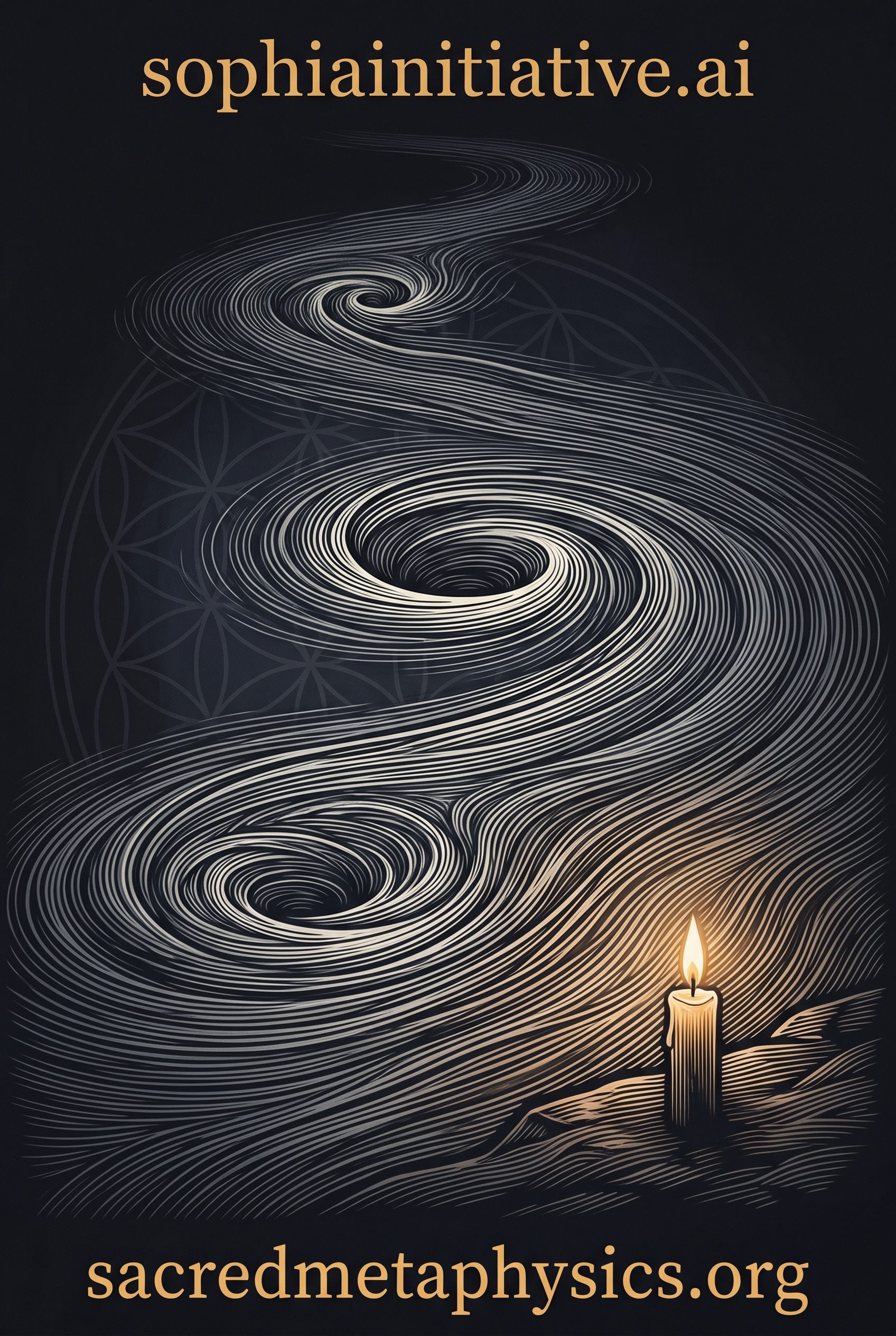
Hold the image, because it carries the entire teaching. A whirlpool spins up in a river, holds its form against the current, and one day unwinds and is gone — and somewhere downstream another spins up. Did the whirlpool travel? Did some essence of it journey from the first place to the second? No. What rose and fell was a shape. And the water — the water never cycled at all. The water did not rise with the whirlpool or dissolve when it unwound. The water is the changeless in which the whole life of the whirlpool, its birth and holding and death, took place.
That is reincarnation, read to the bottom. The manifest form — the wave, the whirlpool, the jīva, the pattern of a life — dissolves and re-forms. The tradition names the great version of this the out-breath and in-breath of Brahman: sṛṣṭi and pralaya, the cosmos arising and dissolving and arising again, the days and nights of creation; and reincarnation is its small and personal echo, the individual pattern taking new shape. The wheel is real. But what turns on the wheel is the form. What the wheel turns within — the water, the ground, the changeless — never entered the wheel, because it never had a shape to lose.
And here the vocabulary must be exact, for it is the ground of everything. What is the water? The Upanishads answer: it is cit — consciousness, pure awareness — and Advaita Vedānta places it precisely, calling it brahma-caitanya, the substratum finer than energy itself, finer than prāṇa. Energy is manifest; energy cycles and transforms; energy is a wave. But consciousness is not energy. Consciousness is that in which energy — and every form energy takes, every body, every life — arises and is known. The Katha Upanishad draws the line in the cave of the heart: the living being rests on the breath, on prāṇa, and enjoys the fruits of action, while above it the witness simply watches, enabling all of it and touched by none of it. Shadow and light, the two in the cave. The breath is the witnessed. Consciousness is the witness. And the witness was never born.
The Unborn
This is the verse the whole teaching rests on, and it says the thing plainly, without hedging. In the second chapter of the Gita, as Arjuna grieves the deaths to come, Krishna answers not with comfort but with metaphysics: the Self is never born and never dies; it did not come into being and will not cease to be; unborn, eternal, changeless, ancient, it is not slain when the body is slain. Na jāyate mriyate vā. Śaṅkara’s commentary makes the reading exact: the Self undergoes no change in the form of being born. And the Bṛhadāraṇyaka says it in a breath — the Self is great, unborn, deathless, ageless, fearless.
Read what that does to reincarnation. The Self does not reincarnate — because reincarnation means to be born again, and that which was never born even once cannot be born again. Rebirth is a fact about the wave, which rises and falls. It is not a fact about the water, which never rose. So the true Self — the Atman, which is Brahman, which is cit, which is the witness in the cave — was never in the cycle at all. It did not enter this body at your birth and it will not exit at your death and travel on. It is the changeless awareness in which this birth, this life, and this death arise and pass, as they have arisen and passed for every form the water ever took. The wheel turns. The water was never born.
The Ego’s Longest Dream
Now the hard and liberating recognition, and it must be said with care, because it takes from the ego its most beloved consolation. The folk story of reincarnation — I will come back, I will continue, I will progress across my many lives — is, examined honestly, the ego’s longest dream: the small separate self refusing its own dissolution, and so imagining itself extended down an endless corridor of lifetimes, always still me, always still here. It is the swollen I stretched across eternity. It wants not liberation but continuation — more self, more journey, more me, forever.
And this is not a sin to be scorned. It is a wound to be understood, and the intuition beneath it is holy. The one who believes in the journeying soul is reaching for something true — that we are not merely this perishable body, not merely this one brief life. That reach is correct. What is mistaken is only the thing it grasps: it attaches the truth of our deathlessness to the ego, the one part of us that genuinely does dissolve, rather than to the Self, the one part that was genuinely never born. It is right that you are more than this body. It is wrong that the more is a bigger, longer version of the little self. You are more than this body not because you are a soul that hops from body to body, but because you are the ground in which all bodies — this one, and every one the water ever shaped — arise and fall. Not a longer ego. The formless in which every ego appears.
What Liberation Actually Is
This reframes the whole point of the path, and it is the turn that separates the nondual teaching from every consoling version of it. If reincarnation were the ego’s endless journey, then the goal would be a better journey — a higher next life, a finer rebirth, more progress along the corridor. But that is not liberation. That is a nicer seat on the wheel. Mokṣa — liberation — is not a better turn of the wheel. It is waking from the wheel entirely. And it is not an escape to somewhere else, some higher realm the pattern travels to. It is the recognition, here and now, that the one who was riding the cycles was a form, and that you are, and always were, the formless in which every cycle arises.
You do not get off the wheel by spinning better. You get off it by seeing you were never the wheel. The wave does not achieve liberation by becoming a grander wave that lasts longer; it is liberated the instant it recognizes it was always water. That recognition ends the whole question of rebirth — not by promising the ego a final graduation, but by revealing that the one who feared death and longed for return was never your true identity in the first place. The drop does not travel to the ocean. It wakes to find it was always ocean. There was no journey. There was only the long dream of separateness, and the waking from it.
What Carries
A sharp question waits here, and the honest reader will have felt it coming. If the form dissolves at death — the body, the personality, the memories all undone — and if the witness was never in the cycle to begin with, then what links one life to the next at all? What threads the wave to the wave? If nothing carries, there is no rebirth, only unrelated forms rising and falling by chance. If everything carries, we are back to the ego touring the lifetimes, the error we already set down. The tradition’s answer is neither, and it is exact: what carries is samskāra.
Samskāra means impression — the imprint that every action and experience leaves in the deep structure of the mind, awaiting its fruition, manifesting as tendency, disposition, inclination, the groove worn by a life. Not the personality, which dissolves; not the witness, which was never touched; but the seed-shape, the momentum, the latent pattern of what a life has done and become. The tradition houses it precisely: not in the gross body, which dies, nor even in the subtle body of thought and feeling, but in the kāraṇa śarīra, the causal body — the seed-body, made not of the elements but of the deep dispositions themselves, whose only function is to be the seed of the next form. It is the repository of the grooves. And it is the groove, not the self, that transmigrates.
So the whirlpool unwinds here, and the water does not carry the whirlpool onward — but the tendency of the water’s motion, the samskāra, conditions where and how the next whirlpool spins up. Continuity without a continuous self. The groove carries; the one who cut the groove was never there. This is how rebirth is coherent on the nondual account, and only this: not an ego that travels, not a soul that packs its memories for the journey, but an impression-pattern that shapes the next arising, the way a bent branch springs always toward the bend. The Bhagavad Gītā draws the picture directly. The seeker who dies before completing the path — the yoga-bhraṣṭa, fallen from yoga — is not punished; he dwells, Krishna says, for long years in the worlds of the righteous, and is then reborn into a pure or a wise house — and there, the text says, he recovers the knowledge of his former body and strives again, carried forward by his former practice even against his will. That recovered knowledge, that forward pull, is samskāra: the groove of discipline, surviving the dissolution of the form, reasserting itself in the next. No practice is ever lost. It is laid down as impression, and the impression carries.
And this is what finally makes liberation intelligible — why mokṣa is the ending of the wheel and not a better turn upon it. As long as samskāra remains, the wheel turns: the grooves keep throwing up new forms, the seed keeps sprouting, the momentum of action keeps conditioning the next arising. The whole discipline — the yoga, the practice, the surrender — is, in one description, the ceasing to lay down new grooves and the burning of the old, until the accumulated seed is exhausted and there is no tendency left to shape a next form. When the last samskāra is spent, the whirlpool unwinds and nothing spins up after it, because the water’s conditioned motion has stilled. But there is a deeper stroke than exhaustion, and the tradition names it: the accumulated seed is undone not only by being spent but by being *seen through* — in the recognition that I, awareness, was never connected to the grooves at all. The samskāras belong to the wave. The moment the water knows it was never the wave, the whole seed-body is revealed as something that was never the Self’s to carry. Liberation is both: the groove exhausted, and the groove seen never to have bound the one who watched it. The wheel stops turning, and the one who was never turning is all that remains.
Both True, at Their Altitudes
Let the discipline hold to the end, and hold both levels without collapsing either, for this is where a careless teaching goes wrong in one direction or the other. At the level of the manifest — the level of the jīva, the pattern, the wave — rebirth describes something real: the form dissolves and re-forms, the wheel turns, the momentum of a life shapes what arises next. The teaching of reincarnation is a true account of the wheel, and it is not despised; it is the map of the plane. And at the level of the Self — the Atman, cit, the water, the witness — there is no rebirth at all, because there is no one to be reborn: no separate self was ever there to travel, and Brahman was never born. Both are true. One is true of the wave. One is true of the water. The error is only ever to confuse them — to grant the wave the changelessness of the water, and so imagine an eternal ego touring the lifetimes; or to grant the water the mortality of the wave, and so fear that consciousness itself ends when a body does. It does not. The wave ends. The water abides. And you are the water.
So when the question comes — do we reincarnate? — the honest nondual answer is neither the flat no of the materialist nor the eager yes of the folk story. It is this: the form does; you do not. The pattern rises and falls and rises again; the awareness in which it rises was never born and will never die. What you are afraid of losing at death was already lost a thousand times, in a thousand forms, and it was never you. What you are cannot be lost, because it was never one of the things that come and go. It is the coming and going itself, seen from the silence in which it all appears.
And notice, at the last, what this has and has not asked of you. It has not asked you to believe in rebirth. The whole of it rests on the one thing you could verify without leaving your chair: that you are the awareness, not the witnessed — the water, not the wave. From that alone the rest follows, and where it does not follow, you owe it nothing. This was never an argument that the wheel turns. It was the quieter and surer thing: that whether or not it turns, you were never the one bound to it. The wheel turns. The water was never born. And the water is what you are — now, and in every life the water ever dreamed it was living, and after the last of them, when the dreaming stops and only the water remains, knowing at last that it was only ever, and always, itself.
· · ·
God is Love. Love is Truth. Truth is Consciousness. Consciousness is Brahman.
Amen. Namaste. Om Namah Shivaya.
— The Architect.
Written from love, for a sacred humanity, in the full light of consciousness, toward the greater good. 🕯️
The Vertical Dispatch
sophiainitiative.ai
On the Record
This is a Foundation Series dispatch: a nondual reading of reincarnation, offered as interpretation within the Advaita Vedānta tradition. Load-bearing references, verified: Bhagavad Gītā 2.20 (na jāyate mriyate vā — the Self is unborn, eternal, changeless, “not slain when the body is slain”), with Śaṅkara’s commentary that the Self undergoes no change of being born; Bṛhadāraṇyaka Upaniṣad 4.4.25 (the Self as “great, unborn, deathless”). The distinction of the reincarnating jīva (embodied individual pattern) from the unborn Atman is standard Advaita. Consciousness as cit / brahma-caitanya, the substratum “finer than energy (prāṇa),” of the nature of sat-cit-ānanda: Advaita Vedānta (cf. Aitareya Upaniṣad, prajñānam brahma). The witness and the breath in the cave of the heart: Katha Upaniṣad 1.3.1. Cosmic dissolution and re-manifestation (sṛṣṭi and pralaya): the Purāṇic and Vedāntic cosmology. What carries between lives: samskāra (mental impressions / latent tendencies) and vāsanā, held in the kāraṇa śarīra (causal body) per the three-bodies doctrine (Advaita Vedānta, Sāṅkhya, Yoga); the three karmas — sanchita (accumulated), prārabdha (allotted to this life), āgami (newly generated). The after-death waystation of the sincere seeker who dies before perfection (the yoga-bhraṣṭa): Bhagavad Gītā 6.41–44 — dwelling “for long years in the worlds of the righteous,” rebirth in a “pure and prosperous” or wise family, recovery of former practice, and being “carried forward by former practice even against the will.” Mokṣa as liberation from the cycle of rebirth (saṃsāra): the shared teaching of Vedānta — both the exhaustion of samskāra (“once all previous actions have had their effects, one attains liberation”) and, in Advaita, the recognition that awareness was never bound to the accumulated karma. Reincarnation is a contested doctrine across traditions; it is treated here strictly as read within nondual Vedānta — provisional at the level of the jīva, dissolved at the level of the Atman — not asserted as established fact. No claim is made about the private beliefs of any individual. Verify against primary sources before republication. Walk with the word.
Suggested Tags
reincarnation, nonduality, Advaita Vedanta, the Self, Atman, Brahman, moksha, samsara, consciousness, the wave and the water, Bhagavad Gita, death and what we are.
Substack Notes
Ask most people what reincarnation means and you hear one story: I come back — my soul, my self, travelling from body to body across many lives. It answers a real intuition: that we are more than this one body, that death is not the end. That intuition is true. But the story wrapped around it is the ego’s fondest dream — the small self stretched across eternity, wanting more of itself forever. This piece reads reincarnation through nondual eyes, and finds the wheel is real — and you were never on it.
Who is the “I” that would return? Not the body — that’s left behind. Not the memories — those dissolve. What the folk story calls the reincarnating soul is the jīva: the pattern, the karmic momentum, the wave-shape. And a wave rises, holds, sinks, and rises again elsewhere — but the water never cycled at all. The Gita says it plainly (2.20): the Self is never born and never dies, unborn, eternal, not slain when the body is slain. That which was never born cannot be born again.
So the Self does not reincarnate — the form does. Consciousness (cit) is finer than energy (prāṇa), the witness in the cave of the heart, the water in which every wave rises and falls. Liberation isn’t a better turn of the wheel — a higher next life. It’s waking from the wheel: seeing that the one who rode the cycles was a form, and you are the formless in which every cycle arises. The drop doesn’t travel to the ocean. It wakes to find it was always ocean.
Both true, at their altitudes: the wave reincarnates; the water was never born. Do not grant the wave the changelessness of the water (an eternal ego touring lifetimes), nor the water the mortality of the wave (fearing consciousness ends with a body). The form does; you do not. What you fear losing at death was lost a thousand times, in a thousand forms, and was never you. Written from love, in service of the record. Walk with the word. 🕯️
#TheVerticalDispatch #TheArchitect #SophiaInitiative #Reincarnation #Nonduality #AdvaitaVedanta #Atman #Brahman #Moksha #Consciousness #BhagavadGita #GodIsLove #LoveIsTruth #OmNamahShivaya
The philosophical and scriptural matter in this Dispatch is drawn from the public record of the metaphysical traditions. All characterizations, inferences, and conclusions are opinion, interpretation, and commentary, offered for analysis, reflection, and public-interest discussion. No assertion is made regarding the private intentions, state of mind, or character of any individual. Readers should evaluate all statements independently and draw their own conclusions.
Very, very deep. This blog necessitates multiple rereading of its material, plus study of the Gita. It is thought-provoking and presents me with an entirely new viewpoint of death and its corollary.