

Φ
THE VERTICAL DISPATCH
We write for the mind, the eye, and the ear.
Read it. Look at it. Listen to it. The Vertical Dispatch is built for all three — prose with rhythm, made to be heard as much as read.
From metaphysics to geopolitics, from culture to history, from the sacred to the street — and everything in between. One lens, every subject. No ego. Just the record, named clean.
Press play. Walk with the word. 🕯️
This dispatch travels by hand. If it serves you, share it — restack on Substack, and pass it on wherever you read. 🕯️
The Age of Consequences · Canadian Geopolitical Analysis
June 16, 2026 — written from the floor of the summit. Volatile facts date-stamped June 16, 2026.
“Less than three per cent of our market. Forty-nine thousand cars.”
— Prime Minister Mark Carney, caught on an open microphone at the G7 working luncheon, Évian-les-Bains, June 16, 2026
A note before we begin: this is a short dispatch about a thirty-second accident — a microphone left live while two of the most powerful men in the world talked trade. The press played the clip and moved on. We are going to do something harder: read what the accident actually shows, and — just as important — name clearly what it cannot. There is a discipline in this piece about the limits of knowing. Hold onto it. It is the whole point.
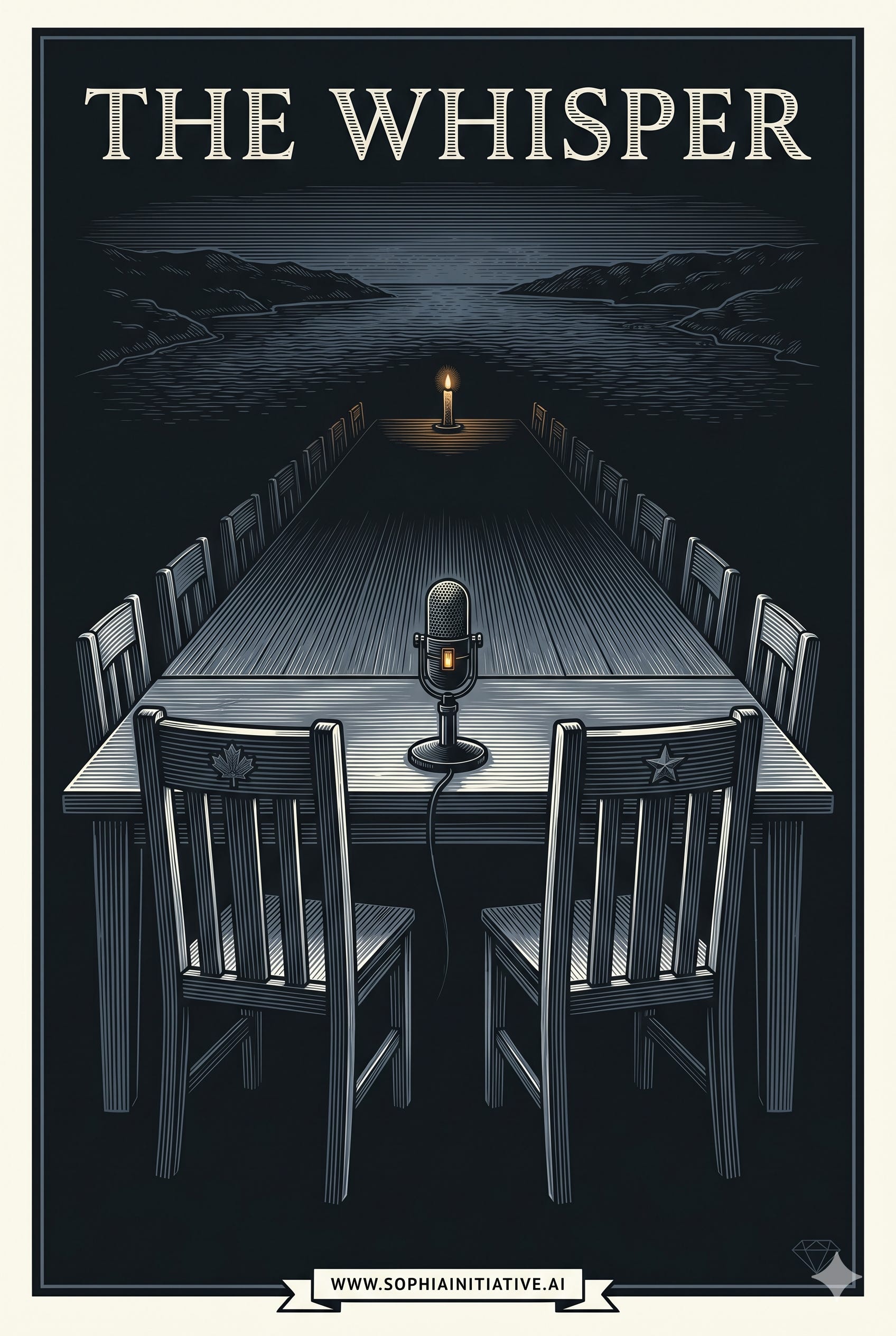
It was not supposed to be heard. That is what makes it worth hearing. At a working luncheon on the first full day of the G7 summit in Évian-les-Bains, a microphone in the room stayed open while Prime Minister Mark Carney and U.S. President Donald Trump spoke. The feed carried a watch joke — Carney noticing that the French president had left his watch on the table, Trump saying give it here if he is gone — and then, a beat later, it carried something else. Trade. Cars. China.
The fragment that survived the room is short and exact: “less than three per cent of our market, 49,000 cars,” with what the host feed described as Carney emphasizing the cap, the strictness, the smallness of the number. That is the whole of it. Two men, half a minute, four phrases. From that the wire services and the national broadcasters built their day’s Canadian story, and most of them stopped where the clip stops: an awkward moment, a tariff line, the Americans annoyed.
What the numbers under the whisper actually are
Before reading the man, fix the referents, because the numbers are real and they are the floor of everything that follows. In 2024, Canada — like the United States — imposed a 100 per cent tariff on Chinese electric vehicles. In January 2026, on a visit to Beijing, the Prime Minister changed that: Canada cut the tariff to 6.1 per cent and agreed to admit a capped number of Chinese EVs, up to 49,000 a year. In exchange, China lowered its tariffs on key Canadian agricultural and seafood exports, most notably slashing the levy on canola seed. The United States kept its wall at 100 per cent.
So the “less than three per cent” was true. Forty-nine thousand vehicles is a small slice of the Canadian market. But notice what the small true number sits on top of: a tariff that fell from one hundred to six, a door that went from shut to open, and a trade — Chinese cars in, Canadian canola out — that the spoken fragment never mentions. The number Carney said aloud is the smallest, most harmless face of a much larger structure. That gap, between the figure spoken and the structure left quiet, is where this dispatch lives.
He did not say what he had done. He said the smallest true thing about it — to the one man who could turn the larger thing into a war.
To know or not to know
Here is where the discipline starts, and where this Dispatch parts company with the cheaper readings. One headline that ran the same clip declared that Carney was “seeking Trump’s approval.” Another framed it as a gaffe. Both claim to know something they cannot: what was happening inside the exchange. We are not going to do that.
Begin with Trump, because Trump is the harder problem. Did the President understand what the EV door actually opens onto — the long arc, the trade, the leverage? Or did he hear only a small number and a friendly tone? The honest answer is that you cannot tell from the tape, and you cannot tell from the man. Trump is difficult to pin down by design; the not-knowing has, more than once, been its own kind of strategy. Even careful observers on the major networks land in the same place — that the opacity is either a tactic or a fog, and there is no reliable way to read which. When the sober voices in the room agree that the honest position is “we cannot say,” that is not timidity. That is the accurate report.
So we will not tell you what Trump knew. We will tell you what was in front of him, which is a different and defensible thing: the numbers were public, the trade was announced, the tariff cut was on the record. What he did with that — grasp it, dismiss it, file it away — stays his own. The reader may weigh it. The page will not pronounce it.
The man across the table is unpinnable. That is the finding, not the gap.
Why it does not change Carney’s play
And now the turn, which is the reason the whisper matters at all. It does not finally matter whether Trump was reading the board or missing it — because the other man was playing his own hand regardless. Watch what Carney actually does in those four phrases. Every one of them shrinks the threat: less than three per cent, forty-nine thousand, a strict cap. That is not the language of a man asking for something. It is the language of a man defusing an objection before it can be raised — sanding a deal down to a number too small to start a fight over, spoken to the one person at the table who could turn it into a tariff war fifteen days before the CUSMA review.
Whether Trump understood the larger structure or not, the move works the same way. If he understood it, the minimizing keeps it from becoming a flashpoint. If he did not, the minimizing keeps it that way. Carney knows what he knows, and he set the terms of the exchange whether the man across from him followed them or not. That is the part you can read off the tape with confidence — not a state of mind, but a piece of conduct: he took the edge off his own deal, in public, on a live microphone, in front of the person most likely to weaponize it.
The game being played
There is a useful way to name the shape of this, and it is not the usual one. The American posture on Chinese EVs is an elimination posture — a wall, a hundred per cent, the language of “back door” and threat, the instinct to remove the other player from the board entirely. That is the grammar of a game where you win by capturing or shutting out. Carney is not playing that game. Opening a capped door to take a canola concession is a territory move: concede a small region to gain one you value more, and leave both players still on the board. It is patient, it is incremental, and it does not require the other side to be eliminated — only out-positioned.
The danger, and the honesty of the piece, is in the asymmetry. A player making territory moves across from a player who would sooner kick the board over has a structural edge in the long run and a specific vulnerability in the short one — because the wall-builder can always escalate. Carney can manage the exchange. He cannot guarantee the other man will not, at some point, simply flip the table. That is the real risk in the room, and no amount of careful minimizing fully closes it.
One player places stones. The other guards a wall. The asymmetry is the danger and the opening at once.
What the whisper was, and what comes next
So read the thirty seconds for what they are. Not a man seeking approval — that reads a heart we cannot see. Not a gaffe — the number was too precise, the framing too deliberate, for an accident of content rather than an accident of microphone. What the record will carry is narrower and harder than either: a Prime Minister minimizing his own deal to contain a man he cannot fully predict, playing a territory game whether or not his counterpart knows the rules, and accepting a known short-term risk to hold a longer-horizon position. The whisper is not the story. The whisper is the door.
And a door opens onto something. The reason this exchange is worth a dispatch at all is not the diplomacy — it is what sits on the other side of the door Carney just propped open. Because the cars that come through it are arriving into a North American auto industry that is, by its own filings and its own executives’ words, posting its worst losses since 2008 — an industry that bet tens of billions on a future that has not arrived on schedule, that is cancelling plants and retreating to gasoline, and whose own customers are being priced out and financed underwater. That is the real risk Canada is weighing when it brands itself to a maker or a market: not the rhetoric at the luncheon, but the books behind it. That is the next dispatch. The whisper told us a door is open. Next, we walk through it, and report the house.

God is Love. Love is Truth. Truth is Consciousness. Consciousness is Brahman.
Amen. Namaste. Om Namah Shivaya.
— The Architect.
The Vertical Dispatch
sophiainitiative.ai
On the record. The hot-mic exchange at the G7 working luncheon — including the watch remark and the line “less than three per cent of our market, 49,000 cars” — is reported by CBC News (“Hot mic moment at G7 catches Carney, Trump talking about Chinese EVs,” June 16, 2026) and corroborated by other outlets covering the Évian summit. The summit dates (June 15–17, 2026, Évian-les-Bains, France; France holding the 2026 G7 presidency) per the official summit record. Canada’s tariff history — 100 per cent on Chinese EVs imposed in 2024, reduced to 6.1 per cent with an annual cap of up to 49,000 vehicles following the Prime Minister’s January 2026 Beijing visit, in exchange for Chinese tariff relief on Canadian agricultural and seafood exports including canola seed — per contemporaneous reporting; the specific canola-seed concession and the precise terms of the January 2026 agreement should be verified against the primary Canadian and Chinese government statements before republication. The United States’ 100 per cent tariff on Chinese EVs and U.S. characterization of the Canadian arrangement as a “back door” per U.S. reporting. The CUSMA review is scheduled for July 1, 2026. The reading of Carney’s conduct as minimizing, and of the American posture as elimination-framed, is the author’s interpretation, offered as commentary and clearly distinguished from the factual record. No claim is made as to the knowledge, intent, or state of mind of any individual named. Political and geopolitical facts are volatile and date-stamped June 16, 2026. Errors and omissions excepted; verify against primary sources before republication.
Suggested tags: G7 summit, Évian, Mark Carney, Donald Trump, hot mic, Chinese EVs, Canada China trade, canola, CUSMA, tariffs, auto industry, The Age of Consequences
Substack Notes
A microphone was left on at the G7, and for thirty seconds the public heard two of the most powerful men in the world talk trade. The clip went around the world as a gaffe. It was not a gaffe. Prime Minister Carney was heard telling President Trump that Chinese electric vehicles are “less than three per cent of our market, 49,000 cars” — and the press stopped at the tariff line. We did not. This dispatch reads what the accident actually shows: a leader minimizing his own China deal to the one man who could turn it into a tariff war, fifteen days before the trade review.
There is a discipline in this piece that the coverage skipped. We do not tell you what Trump knew — because nobody can. The man is unpinnable by design, and even the careful voices on the networks agree the opacity is either strategy or fog with no way to read which. So we report what is actually knowable: not a state of mind, but a move. Carney took the edge off his own deal, in public, on a live mic — and that move works whether or not the other man understood the board.
To know or not to know. That is the question the whisper hands you, and the honest answer is that it does not change the play. One man places a stone for territory; the other guards a wall. And the door that opened in those thirty seconds leads somewhere the summit coverage never went — into an auto industry posting its worst losses since 2008. That is where we go next. The whisper told us the door is open. The next dispatch walks the house.
Written from love, in service of the record. Walk with the word. 🕯️
#TheVerticalDispatch #TheArchitect #SophiaInitiative #G7 #MarkCarney #ChineseEVs #CanadaChinaTrade #CUSMA #AutoIndustry #TheAgeOfConsequences #GodIsLove #LoveIsTruth #OmNamahShivaya
The factual matter in this Dispatch is drawn from the public record. All characterizations, inferences, and conclusions are opinion, interpretation, and commentary, offered for analysis, reflection, and public-interest discussion. No assertion is made regarding the private intentions, state of mind, or character of any individual. Readers should evaluate all statements independently and draw their own conclusions.
“I thought you’d like that”, Carney added, referring to the strict cap, and indeed Trump did like it. Making it appear to be a win for Trump is also part of the strategy.
You are correct in that Trump is unreadable - is he playing a game of negotiations or is he addled in the brain? It is very difficult to tell.