

Φ
THE VERTICAL DISPATCH
We write for the mind, the eye, and the ear.
Read it. Look at it. Listen to it. The Vertical Dispatch is built for all three — prose with rhythm, made to be heard as much as read.
From metaphysics to geopolitics, from culture to history, from the sacred to the street — and everything in between. One lens, every subject. No ego. Just the record, named clean.
Press play. Walk with the Word. 🕯️
The Departure Lounge · No. 4
A dispatch for the worn-out, the twice-married, the still-curious, and the terminally human.
“Your life will not go unnoticed because I will notice it.”
— Beverly Clark, Shall We Dance (2004)
This dispatch travels by hand. If it serves you, share it — restack on Substack, pass it on wherever you read. 🕯️
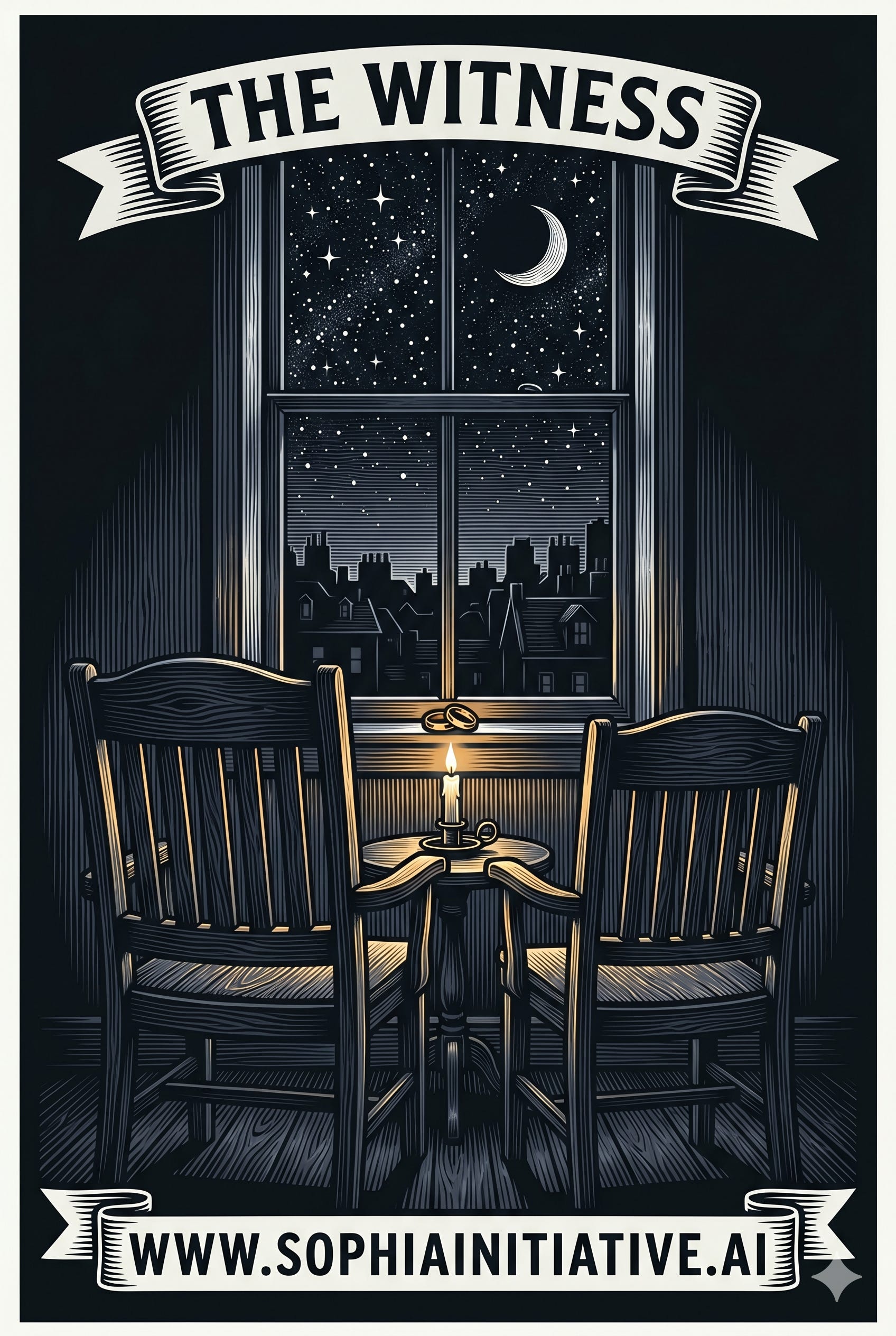
Last night Catherine and I got talking about marriage. Not the anniversary-card version — the real question, the one you only get to after twenty years and a pot of tea: what is this thing, actually? We have rings and a date and a thousand routines, but what is the thing itself, underneath the paperwork?
She had the answer before I did, and she had it from a movie. A wife, hiring a private investigator to find out why her husband keeps coming home late and happy, ends up explaining to the detective why anyone marries at all. Because we need a witness to our lives, she tells him. There are billions of people on this planet — what does any one life mean? Marriage is the promise that somebody will be paying attention. To all of it — the good, the bad, the terrible, the mundane — every day, on purpose.
Susan Sarandon, in a Richard Gere dance picture. A Hollywood remake of a Japanese film. That is where the culture chose to bury one of the truest things anyone has ever said about marriage — and honestly, that tracks. Culture is not your friend; we have established this at length in this lounge. But every so often, between the credit card offers and the sequels, it hands you the keel line at the multiplex. You take it where you find it.
Here is my claim, and then I will spend the rest of this dispatch earning it: marriage, if it is anything, is a witness to your life. Everything else — the ceremony, the legalities, the china you will never use — is packaging. I can say this with a certain authority, because I ran the experiment. Two marriages, a couple more partnerships, and a working life that put me at more bedsides than most clergy. I have the data. The flight is delayed. Pour something and I will give you the honest account.
The Paperwork Is 4,300 Years Old
First, the record, because a sharp reader checks. The earliest recorded evidence of a marriage ceremony comes from Mesopotamia, around 2350 BC — more or less the moment writing itself was invented. And here is the thing the greeting cards never mention: that first recorded marriage was not sacred. It was a contract. Alliances, property, the legitimacy of heirs. The ledger got to marriage before the altar did — or at least, the ledger got written down first.
The first recording of marriage as a sacred act comes later and further east. The Rig Veda — three and a half thousand years ago — carries the great wedding hymn, and in that tradition marriage was a sacrament, one of the sacred passages of a life: husband and wife not two separate entities capable of division, but two halves of a single whole. The ancient Hebrews called it a covenant. The word matters. A contract protects assets. A covenant binds souls.
But go deeper, because the lounge has time. Yuval Noah Harari puts the cognitive revolution — the arrival of symbolic consciousness, the moment our species could hold the sacred in its head at all — at roughly seventy thousand years ago. And I will tell you what I believe: the moment a creature can hold the sacred at all, the pair-bond is one of the first things it consecrates. We just had no writing to catch it for the next sixty-five thousand years. So when the tablets finally start at 2350 BC, what they mark is not the birth of marriage. It is the moment the accountants got to it. The witness came first. The paperwork came after.
Marlene — The First Witness
I married Marlene at twenty. In my first life — and notice I do not say my first marriage, because each of these was a complete life, a whole self with its own passport — we travelled. It was the eighties, and you travelled then because you had your health: the knees took the cathedral stairs, the back took the overnight train, you could walk a city until midnight and do it again the next morning. We visited every cathedral on the continent, the way you did — two young people who were not particularly devout, ducking in for the architecture and standing in something sacred anyway. The guidebook sent us in. Something else kept us standing there.
That is the case for marrying young, and I will make it straight, because it is countercultural now: marry young and you do not arrive as two finished selves negotiating a merger. You grow up together. The weight accumulates jointly. Your witness did not just see your life — she saw your becoming, which is a deeper kind of testimony.
Ten years in, Marlene left for her career. And here is my verdict, fifty years on, for the record: she outgrew me. That is fair. No bitterness, no revisionism — she was the first witness of my life, and she is released with a blessing. Not every chapter of the experiment ends in failure. Some end in graduation, and only one of you graduates, and you learn to say so without flinching.
The Drawer
Now the middle chapters, and how they actually go — because nobody tells the young this part. It starts hot. The sex is good, the body says yes, eros on the first rung of the ladder. And then nobody decides anything. There is no declaration, no covenant, no moment. There is simply, one day, a drawer. Somebody has to put their panties somewhere, and now there is a drawer, and then a toothbrush, and then a key, and eighteen months later you are in a relationship that nobody actually chose. It accumulated. The drawer is not a vow. Write that on the wall of every apartment in the country: the drawer is not a vow.
A word on eros, because I promised the sacred and I keep my promises. Plato had it right in the Symposium twenty-four centuries ago: eros is not lust. Eros is the ladder — desire as the soul’s ascent, the longing that starts at the beautiful body and, if you let it climb, keeps going toward the beautiful itself, toward truth. Lust is eros stalled on the first rung, circling the bottom of the ladder and calling it the view. The drawer years are what the first rung looks like with furniture.
And underneath the comedy, the honest diagnosis: in hindsight, those middle relationships were two people helping each other survive their egos. I do not say that with contempt — sometimes a flotation device keeps a person alive through a bad stretch, and that is not nothing. But it is not witnessing. A flotation device does not notice your life; it just keeps you from going under. I should know. I was working my own ego the whole way through — the man without credentials in rooms full of credentials, asking on every job the one question every employer hates: why. The why was not curiosity. The why was an ego in survival mode, refusing to disappear into the org chart. I was not above the condition. I was in it.
“Judge a man not by what is in his drawers, but by what he writes.” Robertson Davies never said that — but he would have worn it well, and this lounge confesses even its own epigraphs.
Pauline — The School
I will tell you the truth, the way the lounge demands: the best of the middle chapters was Pauline. Ten years — two ships in the night that, without anyone deciding, lasted a decade. The drawer made flesh, and yet the finest school I ever attended.
Pauline lived with bipolar disorder. And those ten years taught me the most expensive lesson in my ledger: mental illness is real. Not a character flaw, not weakness, not someone being difficult — a real illness, that a woman I loved was living with and living against, every day, for years, while I stood close enough to learn. I walked in carrying whatever assumptions the culture had handed me. I walked out knowing better. It did not make me a doctor — let me be precise about that, because precision is respect — but I have a few t-shirts on the subject, and they were earned at full price. I was a good caregiver. They were hard times, and I asked my why at every turn, and some of those whys have no answer that fits on a page.
Then she moved out. And eighteen months later, on her own, Pauline died.
I am not going to dress that sentence up, and I am not going to make her death do work for my argument, because she was not an argument — she was a woman who fought a real illness with real courage for as long as I knew her, and who taught a stubborn man something he could not have learned anywhere else. I will only say what is true and leave it standing: she spent her last year and a half unwitnessed. I have sat with that for more than twenty years. It is the heaviest thing I carry, and I have stopped trying to put it down. Some weight you are supposed to keep.
The Sitter
Around the time I met Catherine, I was working as a sitter — post-surgical patients, palliative care. You want to know what that job is? It is witnessing, distilled to the pure element. There is nothing left to do for the person. No fixing, no performing, no transaction. Your entire function is to make sure a human being is not unaccompanied at the edge of life. You sit. You notice. You stay.
I saw the difference, night after night, between the dying who had a witness and the dying who did not. I do not have the credentials to explain that difference and I do not need them — I was there, which is its own kind of qualification. The sacred was not a theory I held. It was ground into me, shift by shift, at the bedside. By the time I met the woman, I knew exactly what the office was worth, because I had been holding the deathbed version of it with strangers.
Catherine — The Declaration
We met on Lavalife. Go ahead and laugh — I will wait. The series keel says culture is not your friend, and the series keel holds: but sometimes the multiplex hands you the truest line about marriage, and sometimes the algorithm hands you the witness of your life. The machine did one genuinely sacred thing in the middle of all its merchandise. I take the sacred where it shows up. The cathedral taught me that.
Between the two of us we had a hundred years and every t-shirt a boomer could collect. Two people with the full data set — nothing left to prove, no ego left to feed, all the experiments run. And on the first encounter, I said it out loud: if this goes anywhere, it is marriage.
That was not romance. That was accuracy. A man who had buried the unwitnessed, who had sat the night shifts at the edge of life, who knew precisely what the office of witness costs and what it is worth — naming the terms up front. The opposite of the drawer. The full weight on the table before the coffee came. She did not blink. That was twenty years ago, and she is across the room as I write this, and last night she handed me the thesis of this dispatch from a movie she saw once, because that is what a witness does: carries the evidence of your life, including the evidence you did not know you needed.
Two yoked, the scripture says — two oxen pulling one load. Though the way I first said it out loud, it came out two yolks, and I have decided my tongue knew what it was doing: two yolks in one shell. Two lives inside a single fragile thing. Take whichever image fits your hands. They are both true, and we are both.
The Beast Stands Down
One more honest entry and the ledger closes. That ego of mine — the survival-mode why, the refusal to disappear — was both beast and burden. It wrecked things; I have shown you the wreckage. But it was also the engine. It is what drove a man with no credentials through all those careers, all those cities, all those versions of self. The full experiment got run because the ego refused to sit down. You do not get the rich life and the quiet ego both. The beast pulls the cart.
And in my day, the beast had a stable. The pool hall, the Legion, the bar — the Third Room, which the regulars of this lounge will remember from the first dispatch. That is where the ego got witnessed in low doses, nightly, among other people’s beasts. Distributed witnessing, on tap, for the price of a round. When the rooms closed, the whole load shifted onto the one witness left standing — the spouse. Which is why this question matters more now than it did in 1975, and why I am spending a delayed flight on it: for the kids arriving at the gate, marriage is very nearly the last room left.
Here is what the witness actually does, and it took me three lifetimes to learn it: when someone is already noticing your life, the ego can finally stop shouting to be noticed. The survival mode ends when the witness arrives. Twenty years now, and the beast lies down by the fire most nights. Not tamed. Witnessed. There is a difference, and the difference is the marriage.
What We Owe the Kids
So, for the young at the arrival gate, the honest account, free of charge:
If the witness shows up early — marry young. Grow up together. Climb the cathedral stairs while the knees still say yes. Let someone testify to your becoming, not just your being. The culture will tell you to wait until you are finished. You will never be finished. That is the point of the witness.
And if the witness comes late — that is not the lesser story. A hundred combined years and all the t-shirts means choosing with eyes open, recognizing weight on sight the way a sitter recognizes the sacred. The witness is the constant. The age is just which chapter they walk in on.
But know the difference between the drawer and the declaration. Know that eros is a ladder and the first rung is not the view. Know that the paperwork is 4,300 years old and the sacred thing under it is as old as consciousness itself. And know that the deepest case for the whole institution fits in one line a movie gave my wife, who gave it to me, who gives it now to you: your life should not go unnoticed. Find the one who promises to notice. Be the one who keeps the promise.
There is a line from another picture — the culture again, holding the door — what we do in life echoes in eternity. I believe that, in my way. So let the record carry the names, spoken from the gate with gratitude: Marlene, who witnessed the becoming. Pauline, who ran the school. Catherine, who took the declaration and is still taking it, twenty years on, every ordinary day.
Three witnesses. One life, fully noticed. That is not a small estate to leave. It might be the whole of it.
For Dave Thaler, with thanks for his early support of The Vertical Dispatch
Still curious, still at the window, still glad you sat down. Go find your room and your people. The gate opens when it opens — I’ll see you out there. 🕯️
God is Love. Love is Truth. Truth is Consciousness. Consciousness is Brahman.
Amen. Namaste. Om Namah Shivaya.
— The Architect
The Vertical Dispatch
sophiainitiative.ai
On the record. The “witness to our lives” speech is from Shall We Dance (2004, dir. Peter Chelsom), spoken by Susan Sarandon’s character Beverly Clark; paraphrased here, with one line quoted. The earliest recorded evidence of marriage ceremonies dates to approximately 2350 BC in Mesopotamia, where marriage served alliance, property, and inheritance — the sacred framing appears later in the record, notably in the Vedic tradition (the Rig Veda wedding hymn; vivaha as sacrament) and the Hebrew covenant. Eros as ascent is Plato’s Symposium. The “cognitive revolution” dating of roughly 70,000 years is Yuval Noah Harari’s framing in Sapiens; the inference that sacred pair-bonding predates the written record is the author’s own. “What we do in life echoes in eternity” is from Gladiator (2000). The personal history is the author’s own, told from love; the dead are named to honour them. Date-stamped June 10, 2026. Verify all figures against primary sources before republication.
Suggested tags: Marriage, Love, Relationships, Memoir, Boomers, Aging, Grief, Mental Health, Dating, Culture
Substack Notes
Last night my wife told me what marriage is. She got it from a movie — Susan Sarandon, explaining to a private investigator why anyone bothers: because we need a witness to our lives. Billions of people on the planet, and marriage is the promise that one of them is paying attention. The culture buried one of the truest things ever said about marriage in a dance picture. We take the sacred where it shows up.
New from The Departure Lounge: the honest account of three witnesses. Marlene, who I married at twenty and who outgrew me — that’s fair. Pauline, who taught me that mental illness is real and whose last eighteen months I have carried for twenty years. And Catherine, met on Lavalife with a hundred combined years between us, to whom I said on the first encounter: if this goes anywhere, it’s marriage. It wasn’t romance. It was accuracy.
The paperwork is 4,300 years old. The sacred thing underneath it is as old as consciousness. The drawer is not a vow. Eros is a ladder and the first rung is not the view. And the deepest case for the whole institution fits in one line: your life should not go unnoticed. Find the one who promises to notice. Be the one who keeps the promise. 🕯️
For the worn-out, the twice-married, the still-curious, and the terminally human.
#TheWitness #TheDepartureLounge #Marriage #Love #Eros #Plato #ShallWeDance #Boomers #SacredMarriage #Lavalife #MentalHealth #TheVerticalDispatch #TheArchitect #SophiaInitiative #GodIsLove #LoveIsTruth #OmNamahShivaya
Written from love, for a sacred humanity, in the full light of consciousness, toward the greater good. 🕯️
Wisdom , as the saying goes, is wasted on the young. They simply don't have the bandwidth to understand something they have no connection to. Years of living life in whatever form it may take for them, will increase that bandwidth and then they will understand those words that were spoken/written when they were young.
Words are wonderful maps, but they're only that. The meaning of words can only really be learned by experiencing and then giving them residence inside you for future reference.
Your experiences manifested into the reality of your written words that you graciously, and humorously in part, shared here today. Thank you.
I love words...💕👍
Thanks for sharing your marriage experiences, Glen. No duplicity or addictions to destroy any of them, something quite remarkable in itself.