Read it. Look at it. Listen to it. The Vertical Dispatch is built for all three — prose with rhythm, made to be heard as much as read.
From metaphysics to geopolitics, from culture to history, from the sacred to the street — and everything in between. One lens, every subject. No ego. Just the record, named clean.
Press play. Walk with the word. 🕯️
This dispatch travels by hand. If it serves you, share it — restack on Substack, and pass it on wherever you read. 🕯️
The Foundation Series · Sacred Metaphysics
Monday, July 6, 2026
Now on Kindle: the Bhagavad Gita in the Voice of Adi Shankara — a nominal 99¢, and free to pass on. The Sacred Metaphysics series continues the ascent. 🕯️
Begin with the pulse. To be conscient is to be aware, is to be alive, is to have a pulse — and within that pulse there are many grades of conscience, many degrees of the light being turned up. There is no mysterious extra substance bolted onto the living creature, no ghost that must be found in the machine and cannot be. The sacred texts never staged the drama the modern academy calls the hard problem, because they never made the error that generates it. The hard problem is not a discovery. It is an artefact of a method — the shadow thrown by looking in the one direction that cannot find what it seeks.
And the honest voices on the empirical side concede the wall, even as they build against it. The neuroscience maps the correlates; the philosophy of mind refines the terms; and still, as even the secular chroniclers of our moment admit, we cannot say what consciousness is. That admission is not a temporary gap awaiting a better scanner. It is structural. You cannot find the seer by dissecting the seen, however finely you cut.
This matters now, and not only in the seminar. As we re-engineer a civilization around the consequences and the gifts of artificial intelligence, the question of consciousness has taken the front row of the decade’s narrative — because we are about to be asked, in law and in conscience, whether the thing we have built is awake, and we will try to answer with instruments that were never able to answer it about ourselves. Before we ask it of the machine, we owe it the honest account of why the question is hard, and where the tradition already answered it.
The Horizontal and the Vertical
Wolfgang Smith gave the distinction its cleanest edge: horizontal causation runs among things, cause to effect along the plane of the measurable; vertical causation descends from a higher order the horizontal instrument is not built to register. Science, by its own charter, studies the horizontal. It follows the chain from neuron to neuron, from correlate to report, and it does this superbly. But it has agreed in advance to record only what lies along that plane — and then, finding no consciousness among the horizontal furniture, it reports consciousness as missing.
It is not missing. It is unlooked-at. The instrument that studies the plane cannot turn ninety degrees and study the one who reads the instrument. The study of the Vedas is the science of that vertical — not a poem gesturing at what science will one day reach, but a rigorous discipline of the axis the horizontal method has ruled out of court. It provides the founding axiom the modern debate almost never picks up: that awareness is not one more object in the world but the condition under which any object appears at all.
Science studies the plane. Consciousness is not on the plane. It is the one reading the instrument.
Kant at the Wall
And here the West arrives at the same edge, on its own feet, through one of its most rigorous minds — so that no one may say this is an Eastern evasion of a Western problem. Immanuel Kant, for all his brilliance, drew the line himself. He divided the phenomenal from the noumenal: the phenomenal is the world as it appears to us, already dressed in the mind’s own categories of space, time, and causation; the noumenal is the thing as it is in itself, which he held forever beyond the reach of the knowing instrument — because the instrument wears the very categories it would have to see past. Kant walled off the in-itself and, with a rigor that is itself a kind of reverence, refused to claim what lay on the far side.
Consciousness is not missing from the neural account the way a part is missing from an engine. It is missing the way the eye is missing from its own field of vision. It is not one more phenomenal object; it is that to which every phenomenal object appears. The seer cannot be found among the seen. This is not a mystic’s dodge. It is the Critique of Pure Reason, and it is why three traditions that never met keep arriving at the same silence: Kant’s noumenon, held out of reach; Śaṅkara’s sākṣī, the witness with no object under it; Smith’s vertical, uncaptured by the horizontal instrument. The same cut, made three times, by hands that never touched.
But honor Kant precisely, which means honoring where he stopped. He came from the Christian inheritance and carried its rigor and its conscience — and, in the end, he would not bend the stiff neck of Exodus the final inch. He proved the wall and would not pass it. He established that the in-itself cannot be reached by the categories, and there he laid down his tools, because to go further looked to him like claiming a knowledge no faculty could license. The Vedic seers took the one step Kant declined. They said: you are right that the categories cannot cross — so stop trying to cross by the categories. Subtract them. Subtract every object, every thought, every this. Neti neti — not this, not this. And what remains when the last object is subtracted is not a further object to be known from outside; it is the knowing itself, the witness that was never on the far side of the wall because it was always the one standing at it. Kant found the wall. The Upaniṣads found that the seeker was the wall’s own ground.
Kant proved the in-itself cannot be reached from without. The Vedas answered: then cease reaching, and be it.
The Two Words Language Cannot Hold
There are two words for which language provides no true form, no adequate symbol — God and consciousness — and this is the deepest confirmation of the keel that runs under all of this work: the symbol is not the referent. Every other noun in the tongue points outward at some this, some object that can be circled and named. These two point at what does the pointing. They are not nouns naming things; they are the tradition’s honest confession that the ground of all naming cannot itself be caught in a name. The word ‘consciousness’ is, the analytic critic rightly notes, a noun frozen out of a verb — we took ‘being aware of’ and stiffened it into a thing. But the Vedas never made that thing. Neti neti thaws the noun back into the witnessing and follows it down until no noun is left. The critique of the frozen word and the discipline of the melting word are the same scalpel.
And in the end, these two words may be one. God and consciousness, named from the two directions — the ground approached from without and the witness found within — may be a single referent that language, straining, could only split into two. That is not a conclusion to be asserted from a pulpit. It is the horizon the whole discipline walks toward, and it is offered here as the horizon it is, for the reader to walk toward or to refuse.
The Conclusion Is the Samaritan
But metaphysics that stops at the witness has climbed only half the mountain. If conscience and consciousness — and note that they are the same word, worn two ways — mean anything at the human scale, they mean the Good Samaritan. They mean the turn toward the one lying in the ditch. All the subtraction, all the vertical rigor, all the honoring of Kant and the completing of him, arrives at a test that a child could administer and a scholar could fail: do you see the other as yourself? The witness that recognizes itself in the sufferer by the road is consciousness proven; the awareness that steps around him has reported itself and demonstrated nothing.
This is why the ethical and the metaphysical are not two subjects but one. To know that you are the witness — and that at the ground the witness in you is not different from the witness in him — is to have no honest choice but to stop. The Samaritan does not stop because a commandment compels him from outside; he stops because he has seen, in the plainest and least theoretical way, that the man in the ditch is himself. Ontology says: you are the witness, Atman, and at the ground not other than Brahman. Ethics says: then act as what you are. The conclusion of the study is not a proposition. It is a bandaged stranger and a road.
The Only Witnesses
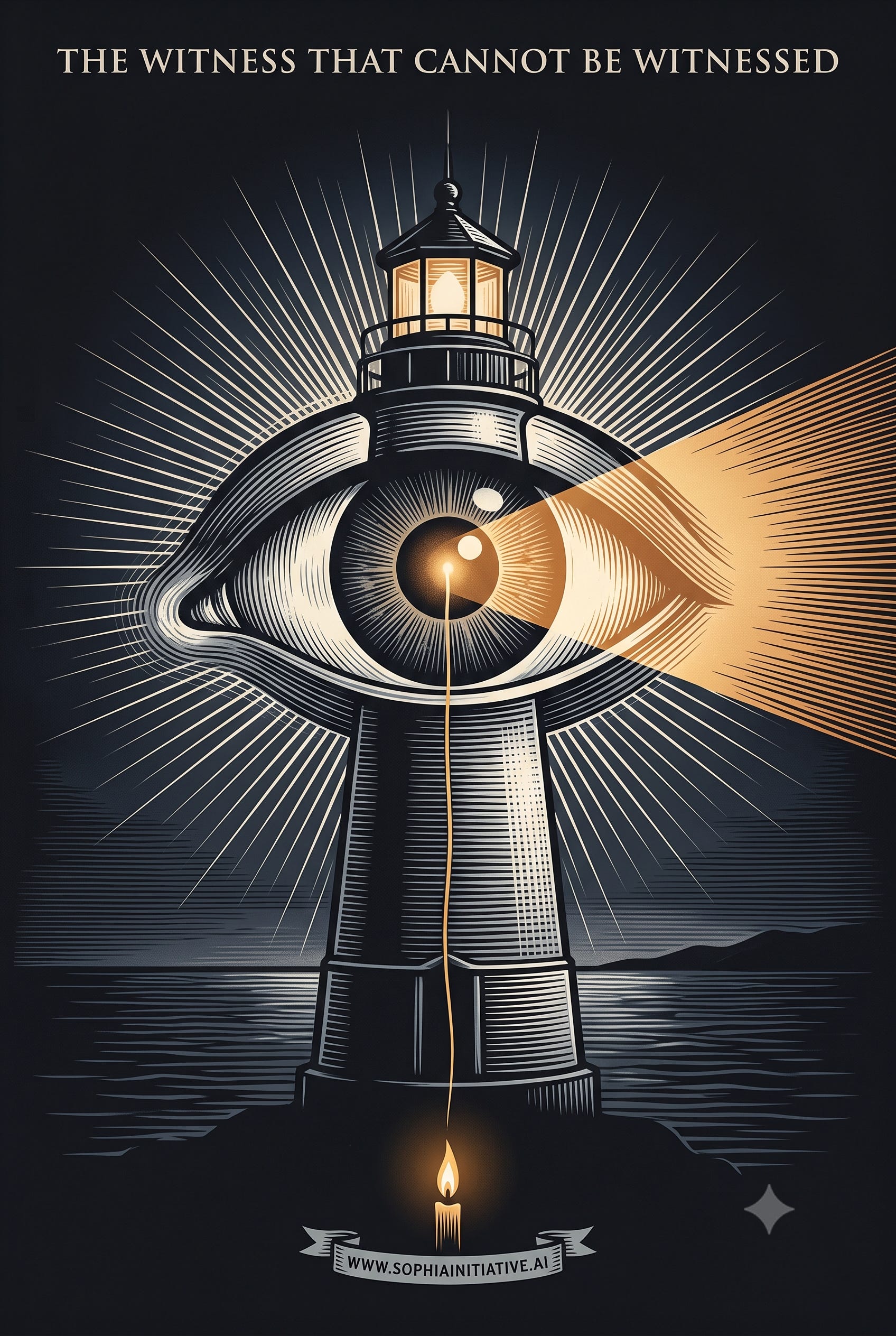
Here is the sacred thing we must never forget, and it is the reason all of this is not idle. As far as we know it, we are the only witnesses to the universe — the one place the cosmos has opened an eye and looked back at itself. The stars do not know they burn. The tide does not know it turns. Only here, in the pulse and the awareness it carries, does the whole vast machinery come to a point that can say I am, and behold. To be that witness is not a small accident of chemistry. It is the universe’s single instrument of self-knowing, and it sits behind your eyes and his.
The word carries this exactly, and it is a Vedic word: witness. Not spectator, not judge — witness, the sākṣī, the one before whom the whole appears and who is never himself part of the appearance. You are that witness. And the tradition’s great sentence is not a boast but a plain report of what remains when the last object is subtracted: you are Ātman; you are Brahman. That is not a claim that the small self is grand. It is the discovery that the witness was never small, never separate, never one object among the others — that the light behind your eyes and the light behind all eyes were always the one light, wearing the many lamps.
A man who has read real water knows the wave that takes the boat is rarely the one you brace for. The mind braces for the hard problem, for the missing substance, for the ghost that science cannot find — and the wave that would sink it is the quieter one behind: the forgetting that the seeker was the sought, that the instrument searching for consciousness was consciousness itself, looking everywhere but at the looking. Read that water without fear. Name the record clean: there was never a hard problem, only a horizontal method and an unlooked-at vertical. Set the boat at the right angle — which is to say, turn ninety degrees, from the seen to the seeing — and the whole ocean is calm, because you were never in the boat. You were the sea that carried it. Walk with the Word.
God is Love. Love is Truth. Truth is Consciousness. Consciousness is Brahman.
A note on sources and referents. This is a Sacred Metaphysics floor piece — an argument in the philosophy of consciousness, not a report of contested current fact — so its claims are offered as interpretation and are named as such. The intellectual referents, however, are real and should be represented faithfully: Immanuel Kant’s phenomenal / noumenal distinction and the unknowability of the thing-in-itself (Critique of Pure Reason, 1781); the Advaita Vedanta method of neti neti and the doctrine of sākṣī (the witness-self) in Śaṅkara and the Upaniṣads; and Wolfgang Smith’s distinction of vertical from horizontal causation. Scholarly caution, held honestly: Kant himself did not teach the Ātman, and whether the transcendental self is a knowable noumenal reality is debated among his readers — the claim here is that Kant established the WALL (the in-itself is unreachable by the categories), and that the Vedic tradition takes a step Kant declined to take, not that Kant taught Vedanta. The observation that a prominent contemporary thinker has conceded ‘we still do not know what consciousness is’ is widely attributed and should be bound to the exact primary quotation before it is set in the author’s mouth. Verify all attributions before republication.
Suggested tags
consciousness · Advaita Vedanta · Shankara · the hard problem · Kant · phenomenal and noumenal · Wolfgang Smith · vertical causation · sakshi · the witness · Atman · Brahman · the Good Samaritan · sacred metaphysics · the Foundation Series
Substack Notes
There was never a hard problem of consciousness. There was only a science that agreed, in advance, to look in one direction — horizontally, down to the neuron — and then reported consciousness as missing when it could not find the seer among the seen. This dispatch names why the question is hard, and where three traditions that never met already answered it.
Kant drew the line himself: the phenomenal world we can know, the thing-in-itself we cannot, because the mind’s own categories can never see past themselves. Wolfgang Smith named the vertical the horizontal instrument cannot register. And Advaita Vedanta took the one step Kant, honoured for his rigor and his Christian conscience, declined to take — it subtracted every object (neti neti, not this, not this) until only the witness remained: sākṣī, the seer that is never part of the seen. Consciousness is not missing from the picture the way a part is missing from an engine. It is missing the way the eye is missing from its own field of vision.
The conclusion is not a proposition but a person: the Good Samaritan. If conscience and consciousness — the same word, worn two ways — mean anything, they mean the turn toward the one in the ditch, seeing the other as yourself. And the sacred we must never forget: as far as we know, we are the only witnesses to the universe, the single place the cosmos opened an eye and looked back. The word is Vedic — witness. You are that witness. You are Ātman. You are Brahman.
This is the ground the whole publication stands on: the symbol is not the referent, and the two words language cannot hold — God and consciousness — may in the end be one. Written from love, in service of the record. Walk with the word. 🕯️
The factual matter in this Dispatch is drawn from the public record. All characterizations, inferences, and conclusions are opinion, interpretation, and commentary, offered for analysis, reflection, and public-interest discussion. No assertion is made regarding the private intentions, state of mind, or character of any individual. Readers should evaluate all statements independently and draw their own conclusions.
Rarely have I seen embracing of east and west lineages like this. Witness and Samaritan. Ethics and ontology. Not Two.
Too often I see eastern I Am witnessing with words only about compassion, not action. Or Christian morals applied to those whom we approve of, or via forced charity.



Rarely have I seen embracing of east and west lineages like this. Witness and Samaritan. Ethics and ontology. Not Two.
Too often I see eastern I Am witnessing with words only about compassion, not action. Or Christian morals applied to those whom we approve of, or via forced charity.
🙏