

“The one who sees the supreme Lord existing equally in all beings, the imperishable in the perishable — that one truly sees.” — Bhagavad Gita 13.27
— ★ —
The third and final movement of the Gita begins today. Twelve chapters of preparation — the grief of Chapter One, the metaphysics of Chapter Two, the path of action, the fire of knowledge, the ladder of practice, the cosmic disclosure, the overwhelming vision, the quiet return to devotion. All of it has been building toward what the final six chapters now deliver: the complete philosophical account of what is real, what binds, and what liberates.
Chapter Thirteen opens with two Sanskrit words that Shankara considered the most important distinction in the entire text. Kshetra and Kshetrajna. The field and the knower of the field.
I tell Arjuna: this body is called the field. The one who knows this field — that one is called the knower of the field. And know me as the knower of the field in all fields. The knowledge of both the field and its knower — that I consider true knowledge.
Two words. One distinction. Everything the Gita has been pointing at from the first chapter is contained here.
— ★ —
The field is everything that can be observed. Let the full weight of that settle before moving on.
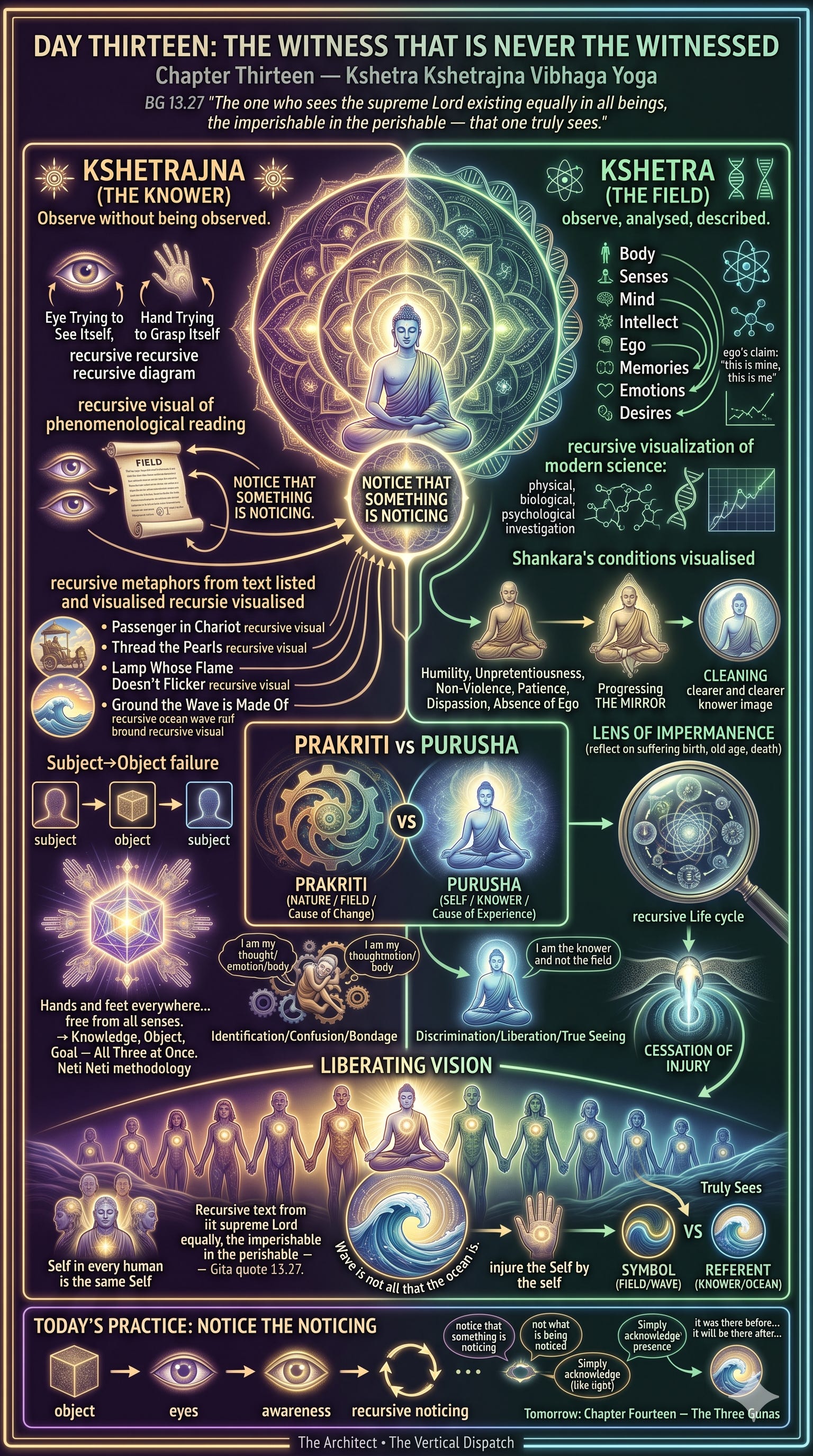
Not just the physical body — though the body is included. The field also contains the senses that gather information from the world. The mind that receives and processes what the senses gather. The intellect that discriminates and decides. The ego that claims ownership of the processing and says: this is mine, this is me, this is what I am. The memories that accumulate and form the story of a self. The emotions that colour experience. The desires that move the whole apparatus toward what it wants and away from what it fears.
All of this — the entire inner life of a human being, everything that psychology studies, everything that therapy works with, everything that philosophy has tried to map — this is field. This is kshetra. This is what can be known.
And then there is the knower. The one who observes all of this without itself being observed. The witnessing awareness that watches the mind think without itself being a thought. That notices the emotion arising without itself being the emotion. That is present for every experience without being any particular experience.
You have encountered this knower before in this series, though it has worn different names. The passenger in the chariot. The thread the pearls ride on. The lamp whose flame does not flicker. The ground the wave is made of. Chapter Thirteen gives it its most precise name and its most exact philosophical description.
— ★ —
The field is knowable. Everything in it can in principle be observed, analysed, described. Modern science is, in large part, the systematic investigation of the field — the physical, biological, psychological, and social dimensions of what can be experienced and measured.
The knower cannot be made into an object of knowledge in the same way. And this is the point that stops the analytical mind in its tracks, because the analytical mind is accustomed to turning everything into an object and examining it. The knower is the one thing that cannot be turned into an object — because every attempt to examine it uses the very capacity that is being examined. The eye trying to see itself. The hand trying to grasp itself. The subject that becomes an object the moment you look for it — and yet something was looking.
This is not mysticism. This is precise phenomenology. Right now, as these words are read, something is reading them. That something — the awareness in which the words appear, in which the understanding forms, in which the response arises — that is the knower. Where is it located? What colour is it? What size? When did it begin?
These questions do not produce answers because the knower is not a thing in the field. It is what the field appears in.
— ★ —
Now I describe what Shankara called the conditions for genuine knowledge — not the knowledge itself but the qualities that make a mind capable of receiving it. And the list is worth reading slowly because each quality names something specific about what the ego does that makes genuine seeing impossible.
Humility — the willingness to not already know. Unpretentiousness — the absence of the performance of wisdom. Non-violence — not just toward other beings but toward one’s own experience, not forcing it into predetermined shapes. Patience — the willingness to wait for what reveals itself rather than reaching for conclusions. Dispassion toward sense objects — not indifference, but the loosening of the grip that makes every experience about what the ego can get from it. Absence of ego — not the destruction of the functional self but the cessation of its claim to be the centre around which all reality orbits.
And then this: reflection on the suffering inherent in birth, death, old age, and sickness. Shankara read this not as pessimism but as clarity. The person who has genuinely sat with the fact of death — their own death, as a real event that will arrive and not as an abstract concept that applies to others — that person has a quality of attention that the person who has not yet done this simply does not possess. The awareness of impermanence is not morbid. It is the lens that brings the present moment into focus.
These qualities, Shankara said, are not the knowledge. They are the cleaning of the mirror. The mirror that reflects clearly enough to show the knower to itself.
— ★ —
Then I describe Brahman — the supreme ground — and the description moves in the way that all genuine descriptions of the Absolute must move. Not toward greater precision but toward the dissolution of every category that would limit what is being pointed at.
With hands and feet everywhere. With eyes, heads, and mouths everywhere. With ears everywhere. Yet free from all the senses. Unattached yet supporting all. Outside and inside all beings simultaneously. Unmoving yet moving. Far away yet nearer than near. Undivided yet appearing divided in beings. The light of lights, said to be beyond darkness. Knowledge itself, and the object of knowledge, and the goal of knowledge — all three at once.
Shankara read this as the Gita’s closest approach to the Upanishadic method of neti neti — not this, not this. Every quality given is immediately complicated or negated, not because Brahman is contradictory but because Brahman exceeds every category including the categories of having qualities and not having qualities. The mind reaches for a definition and finds that whatever it grasps is immediately exceeded by what was not grasped. This is not failure of the description. This is the description working correctly. It is training the mind to stop looking for the knower among the known.
— ★ —
The distinction at the philosophical heart of Chapter Thirteen is between prakriti and purusha — nature and the Self. Both are beginningless. Both are real. But they are real in different ways.
Prakriti — nature, the field, the entire apparatus of experience — is the cause of everything that happens. Every effect, every instrument, every agent of action arises from prakriti. This is the domain that science studies, that psychology maps, that philosophy analyses.
Purusha — the Self, the knower — is the cause of experience in a different sense. Not the cause of what happens but the cause of the fact that what happens is experienced at all. Without the witnessing awareness, the field generates no experience. The tree falls in the forest with no one to hear it. Matter without consciousness is, in the deepest sense, an event with no audience — and an event with no audience is, in the deepest sense, not quite an event.
The confusion of these two — the identification of the witnessing Self with the field it witnesses — is the root of bondage. The practitioner who believes themselves to be their thoughts is confused about this. The practitioner who believes themselves to be their emotions is confused about this. The practitioner who believes themselves to be their history, their body, their desires, their achievements or failures — all of these are the same confusion at different levels of subtlety.
The discrimination between them — the clear, sustained recognition that I am the knower and not the field — is the root of liberation. Not a belief about this. Not a philosophical agreement with it. The living recognition, present in experience, that what I most fundamentally am is the witnessing awareness in which all the contents of the field appear and pass.
— ★ —
The chapter closes with the simplest and most direct statement of the liberating vision in the entire Gita.
“The one who sees the supreme Lord existing equally in all beings, the imperishable in the perishable — that one truly sees.” — Bhagavad Gita 13.27
The knower of this field — the witnessing awareness reading these words right now — is the same as the knower of every field. The Self in you is the Self in the person beside you. The Self in the person beside you is the Self in the stranger across the world. The Self in every human being is the same Self that witnesses through every pair of eyes that has ever opened anywhere in this universe.
This is not a moral teaching about treating others as equals — though it has moral consequences. It is an ontological statement about what is actually true. The equality is not something to be achieved by effort. It is something to be recognised as already the case.
Shankara noted the precision of the closing phrase: that one does not injure the Self by the self. The separate self — the ego that believes itself to be the ultimate reality of what a person is — when it acts from that belief, it acts against the grain of what it actually is. It injures the Self by the self. Every act of genuine seeing — every moment in which the knower is recognised as the knower — is the cessation of that injury. Not by effort. By clarity.
The symbol is not the referent. The field is not the knower. The wave is not all that the ocean is. And the one who sees this — truly sees it, not as a concept but as the living ground of their experience — that one, the Gita says simply, truly sees.
— ★ —
Today there is one practice and it requires nothing but attention.
At some point during this ordinary day — in a conversation, in a moment of difficulty, in a quiet moment between tasks — notice that something is noticing. Not what is being noticed. The noticing itself.
Do not try to describe it or locate it or hold onto it. Simply acknowledge its presence the way you acknowledge the presence of light when you open your eyes. It was there before the acknowledgement. It will be there after. It does not require your confirmation to continue.
That — whatever that is — is the knower. Everything else, however intimate, however apparently central to who you are, is field. The recognition of the difference, even for a single moment, is the beginning of what Chapter Thirteen calls truly seeing.
— ★ —
Tomorrow: Chapter Fourteen — The Three Gunas
Glennford Ellison Roberts Author — Sacred Metaphysics & Consciousness: History of the Absolute & Eternal Cumberland, Ontario, Canada
God is Love. Love is Truth. Truth is Consciousness. Consciousness is Brahman.
Amen. Namaste.. 🙏
#TheVerticalDispatch #TheArchitect #BhagavadGita #ChapterThirteen #KshetraKshetrajnaVibhagaYoga #TheField #TheKnower #Prakriti #Purusha #Shankara #AdvaitaVedanta #NonDuality #Consciousness #WitnessingAwareness #NoticeTheNoticing #UniversalDynamics #SacredMetaphysics #Ontology #SelfRealization #TrulySees #Project2046 #VajraKernel #April2026 #GlenRoberts #TheVerticalDispatch
I see the God within in very few and nothing in most.