

ϕ
THE VERTICAL DISPATCH
We write for the mind, the eye, and the ear.
Read it. Look at it. Listen to it. The Vertical Dispatch is built for all three — prose with rhythm, made to be heard as much as read.
From metaphysics to geopolitics, from culture to history, from the sacred to the street — and everything in between. One lens, every subject. No ego. Just the record, named clean.
Press play. Walk with the word. 🕯️
This dispatch travels by hand. If it serves you, share it — restack on Substack, and pass it on wherever you read. 🕯️
Sacred Metaphysics · The Age of Consequences
Before you read the sky for its meaning, stand a moment beneath it for its size. For the eternal is not a long time, and the divine is not a large person; and the surest way to lose them both is to measure them with the small self’s clock.
There is a word at the head of one of the oldest books of the Hebrews, and the West has carried it for centuries in the wrong hands. Hevel, the Preacher calls the whole of the passing world — hevel havalim, hakol hevel — and our Bibles render it vanity, vanity of vanities, all is vanity, as though the old king were scolding us for pride. But the word does not mean pride. Hevel means a breath, a vapour, a wisp of mist that shows for a moment on a cold morning and is gone before the hand can close on it. It is the very name of Abel, Adam’s second son, the life cut short — a breath, and then nothing. The Preacher was not moralising. He was measuring. He looked at the whole procession of the living and saw mist: here a moment, gone a moment, each small life a single exhalation against a sky that does not breathe. All is vapour. And the West, keeping the word and losing its meaning, mistook a statement about scale for a sermon about vanity.
So before you read the sky for its meaning, stand a moment beneath it for its size, and let the old word do its true work on you. Begin with a small sum, because the small self reckons in sums. A single life runs, at its full length, something under a hundred years. Set twenty lives end to end and you have not two thousand years of one continuous seeing, but twenty little flickers, each lit and gone, none of them present to the others; the years add on the page, but the living of them does not. And even that borrowed two thousand years reaches back only to the edge of one written age. The oldest temple we have yet found standing, at Gobekli Tepe, was raised eleven and a half thousand years ago — more than a hundred lifetimes laid nose to tail, and still we stand nowhere near the beginning. Take four thousand years, take forty thousand; pile the breaths as high as you like, and the whole heap is a candle held up against a night that has no far wall. This is the first thing the sky teaches, before it teaches anything else: how small the seeker’s idea of a long time has always been.
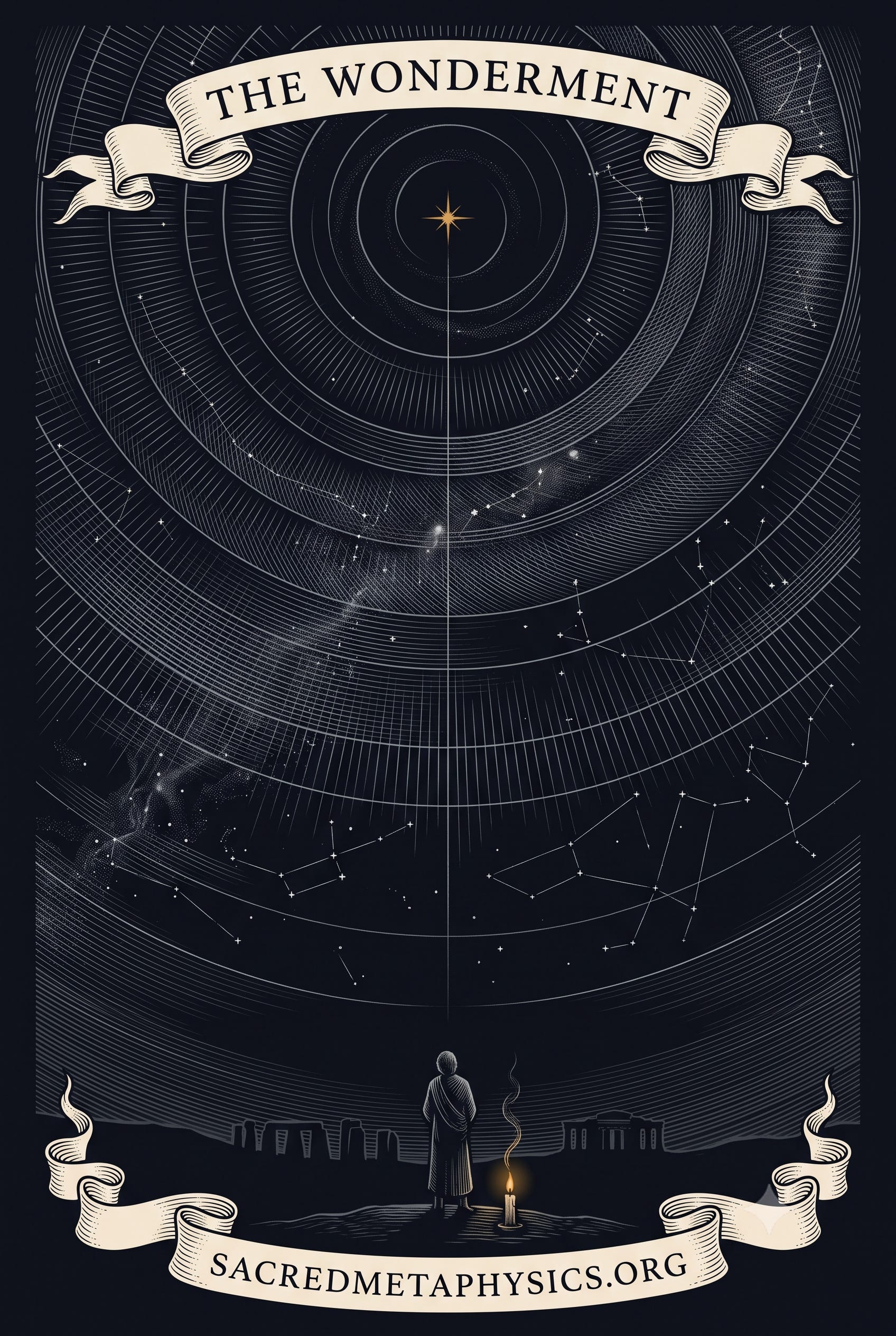
And it is the same with space, and the sky is the one instrument that shows the two as one thing. The light you see in a single star left it before that temple was built, and has been crossing the dark ever since to arrive, tonight, at your eye. Look up, and you are not looking out so much as looking back — the sky is the one page where distance and duration are the same reading, where to see far is to see long. No book on a shelf can do this. The book shows you a fact; the sky shows you the scale of the fact, written in light across a depth the mind cannot pace out. This is why we begin the whole climb here, with the oldest scripture and not the newest, and why astrotheology is the right instrument for what we are attempting: because the sky is the one place where space and time grow large enough to break the small self’s measure of them — and only a measure that has been broken can be replaced with a true one.
The Accountant in the Sky
Now set that scale beside the way the small self speaks of God, and hear the discord at once. Listen to how the ego pictures the divine: a keeper of accounts, bent over the ledger of one small life, finding time for this person’s Tuesday and that person’s worry, tallying the little sums of the particular. It is a touching picture, and it is the small self’s god exactly — the ego’s own face enlarged and set upon a throne, a bigger person minding a bigger desk. But hold it against the sky for one moment and it cannot stand. A God who is only an accountant is a God inside time, spending it as we spend it, a little here and a little there; and a God inside time is no eternal God at all, only the largest of the perishing things, the greatest of the vapours. If the word God is to mean anything worth the saying, it cannot mean a person with a great deal of time. It must mean the One outside the counting altogether — the eternal and universal ground of every soul that has ever stood in space or lasted through time, present to all of them at once, not because it hurries between them like a clerk, but because it was never divided among them in the first place.
The Two Words, Picked Up at the Door
Here we must pick up two words we would otherwise keep at arm’s length, and say plainly why. God and consciousness are the two most worn words we own — the first blackened by every idol raised in its name, the second flattened by every attempt to shrink it to a flicker in the skull. We handle them carefully, and often set them down, for both come to us already half-corrupted. But stand them under the sky and something in them is recovered. For ask it honestly: if there is a God, what could it be but the eternal One, universal to every soul in all of space and time? And if there is a consciousness that is not merely mine — not the private flicker behind one face, but the awareness looking out through every eye that has ever opened — what could that be but the same One, universal to all of space and time? Two words, come to us down two different roads, the one from the temple and the other from the mind; and under the sky they arrive at the same place. We will not force them to be one. We will only walk far enough up that you may discover, in your own seeing and not upon our word, that they were never two.
The Wonderment
And this is why we say wonderment, and not proof. The sky does not argue you into the eternal; it stands you beneath it until the small self’s measure fails, and in that failure something larger opens. The seeker came to the stars, very often, to find his fortune — a little word about his one small life. He will find instead the scale against which that life is a single breath, a hevel, mist on the morning air; and he will find that the scale is not cold. For here the oldest scripture of the Hebrews meets the oldest of the East, and the lament is answered. Where the Preacher saw only that all flesh is vapour, the seers of the Upanishads looked past the vapour to what does not pass, and said of it: it is never born and never dies; unborn and eternal, it is not slain when the body is slain. The breath is hevel; but the one who breathes is not.
And that One is not somewhere else. It is the true face of the SELF, the ground the seeker most deeply is. The bigness of the sky is not a wall thrown up between you and the divine. It is the size of the thing you turn out to be.
Stand beneath the heavens long enough for the accountant to fall silent, and the wonderment that remains is not terror at your smallness but recognition of your vastness — the drop, looking up at last, and seeing the ocean it never left.
God is Love. Love is Truth. Truth is Consciousness. Consciousness is Brahman.
Amen. Namaste. Om Namah Shivaya.
— The Architect
The Vertical Dispatch
sophiainitiative.ai
On the record
This dispatch draws on the opening of the Book of Ecclesiastes (Qoheleth, “the Preacher”), whose Hebrew keyword hevel — conventionally translated “vanity” — carries the primary sense of breath, vapour, or mist; this reading is well attested in Hebrew-Bible scholarship and is offered here as interpretation, not as the only rendering. Hevel is also the Hebrew name of Abel. The temple complex at Göbekli Tepe in present-day Turkey is dated by archaeologists to roughly the tenth millennium BCE, making it approximately eleven to twelve thousand years old. The teaching that the imperishable ground “is never born and never dies… unborn and eternal, it is not slain when the body is slain” paraphrases the Katha and the Bhagavad Gita (Gita 2:20) and the wider Upanishadic tradition. The astronomical claim that starlight reaching the eye tonight left its source long ago is standard astronomy. The interpretive frame — astrotheology as the instrument of scale, the ego’s “accountant” god, and the identity of God and universal consciousness in the SELF — is the position of Sacred Metaphysics. No living person is named or characterised. Verify each stone before you stand on it, against primary sources, before republication.
Suggested tags
astrotheology, hevel, ecclesiastes, the sky, space and time, the eternal, consciousness, brahman, the SELF, wonderment, scale, the upanishads, gobekli tepe, sacred metaphysics, the vertical dispatch, the drop and the ocean.
Substack Notes
There is a word at the head of one of the oldest books of the Hebrews, and the West has carried it for centuries in the wrong hands. Hevel, the Preacher calls the passing world — and our Bibles render it vanity, vanity of vanities, as though the old king were scolding us for pride. But hevel does not mean pride. It means a breath, a vapour, mist on a cold morning, gone before the hand can close on it. It is the very name of Abel, the life cut short. The Preacher was not moralising. He was measuring. He mistook nothing; the West did, keeping the word and losing its meaning — a statement about scale, heard as a sermon about vanity.
Before you read the sky for its meaning, stand beneath it for its size. Set twenty lives end to end and you have not two thousand years of seeing but twenty flickers, each lit and gone. The oldest temple we have found, Gobekli Tepe, was raised eleven and a half thousand years ago, and still we stand nowhere near the beginning. Pile the breaths as high as you like; the whole heap is a candle against a night with no far wall. And the light of a single star left it before that temple was built — look up, and you are not looking out so much as looking back, where to see far is to see long.
Now hear how the ego pictures God: an accountant bent over the ledger of one small life, tallying this person’s Tuesday and that one’s worry — the ego’s own face enlarged and set upon a throne. But a God inside time, spending it as we spend it, is no eternal God at all — only the greatest of the vapours. If the word is to mean anything, it cannot mean a person with a great deal of time. It must mean the One outside the counting altogether, present to every soul at once, not because it hurries between them like a clerk, but because it was never divided among them in the first place.
Where the Preacher saw only that all flesh is vapour, the seers of the Upanishads looked past the vapour to what does not pass: it is never born and never dies; unborn and eternal, it is not slain when the body is slain. The breath is hevel — but the one who breathes is not. And that One is not somewhere else. It is the true face of the SELF, the ground you most deeply are. The bigness of the sky is not a wall between you and the divine. It is the size of the thing you turn out to be — the drop, looking up at last, and seeing the ocean it never left. Written from love, in service of the record. Walk with the word. 🕯️
#TheVerticalDispatch #TheArchitect #SacredMetaphysics #Astrotheology #Hevel #Ecclesiastes #TheEternal #Consciousness #Brahman #TheSELF #Wonderment #TheUpanishads #GodIsLove #OmNamahShivaya
The content of this Dispatch is philosophical, scriptural, and contemplative commentary offered for reflection and public-interest discussion. It describes interpretations of ancient texts and the position of Sacred Metaphysics. Scriptural and scholarly readings are offered as interpretation, not as settled fact. No living individual is named or characterised. Readers should evaluate all statements independently and draw their own conclusions.
Nice! Perspective is so telling!
This piece is so beautifully structured and written.
It is a treasured drop in the Substack ocean.