


A Report on Complexity, Consequence, and the World That Would Greet an Independent Alberta
Preface: The Question Behind the Question
The 300,000 signatures delivered to Elections Alberta are not a policy proposal. They are a pressure instrument — wielded with considerable skill by a premier who needs the threat of separation more than she needs separation itself. But instruments have a way of acquiring momentum beyond the hand that wields them. And so the question that has been tactical in Premier Smith’s hands must now be examined as if it were real: what would an independent Alberta actually face?
The answer is not simple. It is not comforting. And it arrives at the worst possible geopolitical moment in a generation.
This report examines the separation question from three angles: the financial complexity of disentanglement, the geopolitical context that makes this moment uniquely dangerous for any new state seeking to establish itself, and the specific lessons of American transactionalism that should give every Albertan pause about who they imagine as their natural partner once the Canadian relationship is severed.
No quarter is given. The analysis follows the evidence.
Part One: The Financial Architecture of Separation
What Alberta Would Owe
The financial case for Alberta separation has always rested on a seductive arithmetic: Alberta sends more to Ottawa in taxes than it receives in transfers, therefore separation is profitable. This calculation is not wrong. It is incomplete — in the way that a person calculating the profit from selling their house without accounting for the mortgage, the moving costs, the loss of shared utilities, and the price of rebuilding everything from scratch is not wrong, merely catastrophic.
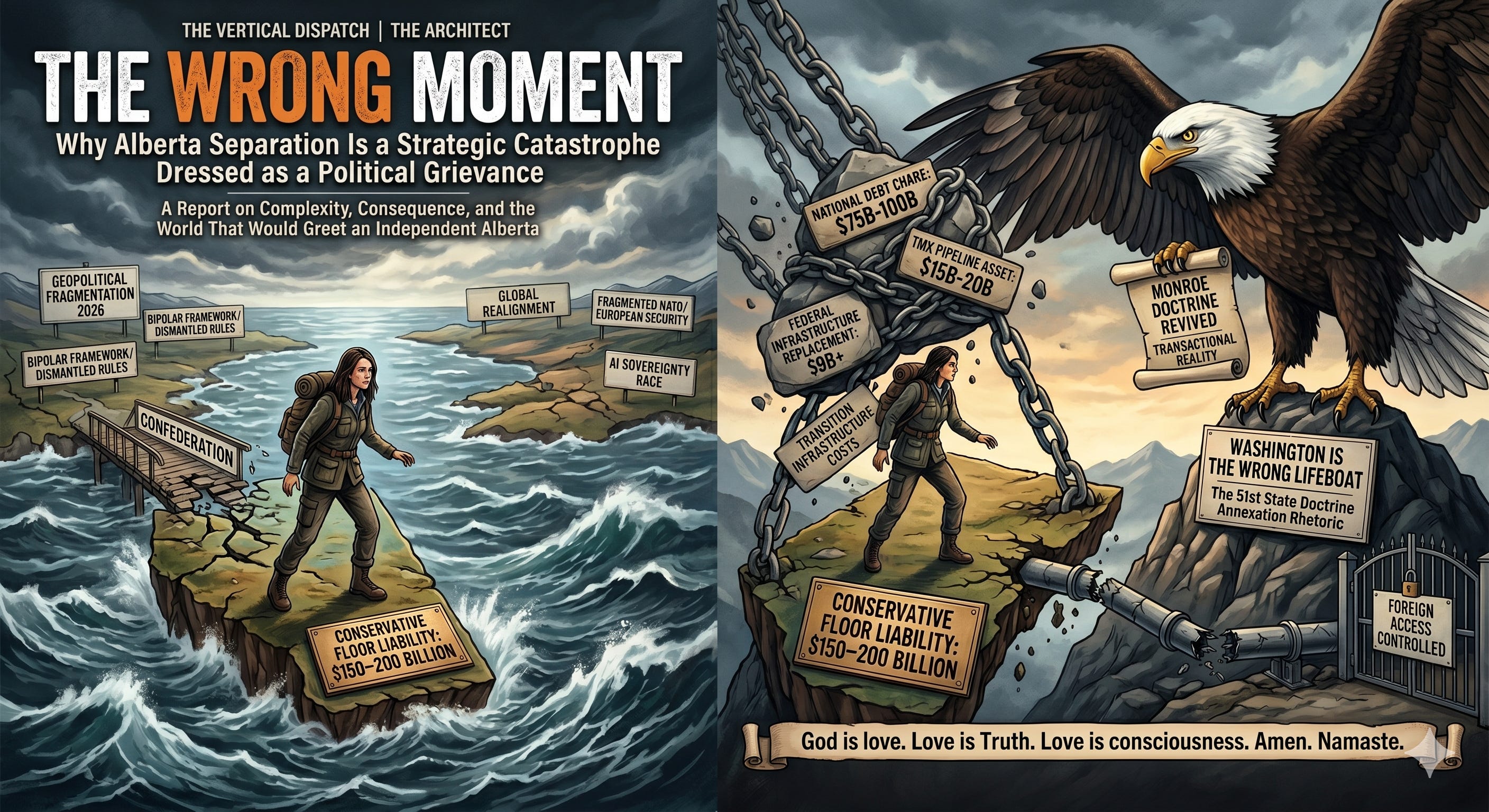
The National Debt Share. Canada carries a federal debt of approximately $1.2 trillion. Alberta’s proportional share would fall in the range of $75 billion to $100 billion. This is not a hypothetical. It is a standard component of any sovereign dissolution under international law, as established by the precedents of Czechoslovakia’s peaceful separation and the legal frameworks developed during Quebec’s near-misses. Alberta would inherit this obligation on day one of independence, before a single barrel of oil had been exported under its new sovereign flag.
Trans Mountain Pipeline. The federal government spent $34 billion constructing TMX. It is a federally owned asset that traverses Alberta, serves Alberta producers primarily, and connects to the Pacific coast through British Columbia — a province that would remain part of Canada. Three scenarios are plausible: Alberta purchases at fair market value (currently $15–20 billion, meaning Canada absorbs a loss it would not accept); Canada retains ownership and charges tolls set by a foreign government; or the asset becomes a protracted legal dispute. None of these scenarios is favourable to Alberta. All of them are avoided by remaining in Confederation.
Federal Infrastructure Already Embedded. Through the federal Investing in Canada Infrastructure Program alone, Alberta received $3.66 billion, leveraged into more than $9 billion in total investment. These funds are spent — they exist now as roads, water systems, and public facilities. They cannot be returned. They become a bargaining chip in Ottawa’s hands, not Alberta’s.
The Annual Transfer Cliff. In 2025–2026, federal transfers to Alberta included $6.6 billion through the Canada Health Transfer and $2.1 billion through the Canada Social Transfer — a combined $8.7 billion in annual flows funding hospitals, schools, and social programs. An independent Alberta would need to replace this through its own taxation on day one.
CPP and Pension Obligations. Unwinding decades of CPP contributions, obligations to current retirees, and the actuarial complexity of separating a province’s pension liabilities from the national pool is not a transaction. It is a decade-long legal negotiation conducted against the backdrop of market uncertainty. An Alberta Pension Plan would be smaller, less diversified, and inherently more exposed to single-resource volatility.
Transition Infrastructure Costs. Canada handles, on Alberta’s behalf, the full architecture of national governance: border services, customs, immigration, military defence, foreign diplomatic missions, currency, banking regulation, securities oversight, aviation and food safety, and dozens of other domains Alberta currently accesses at shared cost. Building these institutions from scratch is conservatively estimated at $10–20 billion before a single recurring annual expense is counted.
The Conservative Accounting
A reasonable conservative floor for Alberta’s total separation liability — national debt share, pipeline asset negotiation, pension unwinding, transition infrastructure, and lost transfer revenue capitalized over a five-year transition — is in the range of $150 to $200 billion, before a single external shock or negotiating disadvantage is factored in. This is not an argument that Alberta could not sustain itself. It is an argument that the path from here to there runs through a financial gauntlet of extraordinary complexity, negotiated against a federal counterparty with every incentive to make the terms difficult.
Part Two: The World That Would Greet an Independent Alberta
The Geopolitical Context of 2026
The separatist imagination tends to picture the world as a stable marketplace of nations into which a new state simply inserts itself, announces its oil reserves, and begins receiving delegations from grateful importers. That world has not existed for some years. The world of 2026 is something considerably more dangerous, more transactional, and less welcoming of small, resource-dependent new entrants than at any point since the Cold War.
The organizing principle of global trade has fundamentally shifted. Economic sovereignty has replaced free-market efficiency as the governing logic of international commerce. Governments are using trade policy as a geopolitical weapon. Supply chains are being reshored. Blocs are forming and hardening. The era in which a small, prosperous jurisdiction could prosper through openness and rule-based trade has given way to an era in which size, alliance membership, and strategic leverage determine who gets access to what.
A Bipolar Framework Replacing the Rules-Based Order. The post-Cold War multilateral system — the WTO, predictable trade rules, the primacy of international law in commercial disputes — is being actively dismantled from both ends. Countries are being forced to choose sides in ways that constrain their economic options. An independent Alberta, with no existing treaty relationships, would enter this environment as a supplicant — seeking membership in trade agreements it currently enjoys as part of Canada, negotiating bilateral terms from a position of no prior relationship and no leverage beyond its oil.
The BRICS Realignment. The BRICS bloc now accounts for approximately 40% of global GDP by purchasing power parity. Its share of global growth is projected at 58% through 2029, compared to the G7’s approximately 25%. The energy markets Alberta most needs — Asia, the Gulf, the Indo-Pacific — are increasingly organized around frameworks and relationships that Canada has spent decades cultivating. Alberta would begin those relationships at zero.
The Fragmentation of Alliance Structures. NATO is under internal strain. European security architecture is being renegotiated in real time. The Anglo-American alliance is itself under stress from American unilateralism. An independent Alberta would inherit none of Canada’s treaty obligations, NATO membership, Five Eyes intelligence access, or defence relationships. It would need to negotiate its own security arrangements from scratch, in an environment where every major power is already managing a complex portfolio of competing relationships.
The Technology and AI Sovereignty Race. The competition for artificial intelligence dominance has become inseparable from national security. Governments are treating AI infrastructure as strategic assets. Export controls are determining which countries can access advanced computing. An independent Alberta — a resource economy without a significant technology sector, without the scale to develop sovereign computing infrastructure — would be a consumer in this race, not a participant.
Part Three: The American Illusion
Why Washington Is the Wrong Lifeboat
The separatist imagination has a preferred destination. It is rarely stated explicitly, but it is there in the logic of every grievance: Alberta, freed from the constraints of Canadian confederation, would naturally align more closely with the United States — sharing its energy, its values, its conservative political culture, its aversion to federal overreach.
This is the most dangerous assumption in the entire separatist case. Not because it is false on its face, but because the United States of 2025 and 2026 has revealed, with unusual clarity, exactly what it thinks of its neighbours.
The 51st State Doctrine. The Trump administration’s annexation rhetoric is not a negotiating tactic. It is a statement of strategic intent. Senior Trump advisers stated that Canada is “not a real country.” The administration revived the Monroe Doctrine in its most expansive form — asserting American prerogative over the entire Western Hemisphere. It imposed 25% tariffs on Canadian goods, threatened to “ruin” the Canadian economy, and made explicit that the path out of punishment was absorption. Now consider what this means for an independent Alberta — 4.7 million people, landlocked, single-resource economy, no military, no diplomatic network — seeking to establish itself as a sovereign state on the American border at the precise moment Washington has declared its intent to bring the entire northern half of the continent under its effective control.
The Transactional Reality. The Trump administration has demonstrated, across every relationship it has touched, that it operates on a single principle: what can you give us, and what leverage do we have to extract it? Applied to an independent Alberta: you have oil we want access to, you have no military, you have no alternative export routes without our cooperation, and your economy would crater without access to our market. What are you prepared to offer? The answer, in that negotiation, is everything — regulatory environment, royalty rates, pipeline access terms, labour standards, environmental protections, currency arrangements. Every sovereign instrument Alberta imagined wielding freely would become a chip in a negotiation it could not win.
The Historical Verdict. The history of American energy investment in resource-dependent neighbours is sufficient. Mexico nationalized its oil in 1938 precisely because American companies had structured concession agreements so advantageous to themselves that Mexican sovereignty over its own resources was nominal. Venezuela’s history with American oil companies is a study in the extraction of value from a resource-rich state with insufficient leverage to set its own terms. The pattern is not American malice. It is American interest, pursued without apology by a nation that has always believed its strategic requirements supersede the sovereignty of smaller neighbours. Alberta, independent and landlocked, would not be the exception to this pattern. It would be its latest illustration.
Part Four: The Verdict of the Moment
This Is Not the Time
There are moments in history when separation from a larger political entity is not only justified but strategically wise — when the costs of union have become so great, and the conditions for independent survival so favourable, that the leap is defensible on every dimension: financial, political, cultural, and strategic.
This is not one of those moments.
The world is in a period of structural flux unlike anything since the post-war settlement of 1945. The rules-based international order is fragmenting. Alliance structures that seemed permanent are under internal stress. The United States has entered a phase of aggressive unilateralism that treats its closest partners as problems to be managed rather than allies to be respected. New power blocs are forming, and the countries best positioned to navigate this transition are those with size, existing treaty relationships, established diplomatic networks, and the credibility that comes from decades of reliable multilateral engagement.
Canada has all of these. Alberta, alone, would have none of them.
The separatist case is built on a grievance that is real: Alberta has been poorly served by federal energy policy, has subsidized national programs from which it receives less than its proportional share, and has watched its constitutional interests treated as negotiating chips rather than settled rights. These grievances are legitimate. They deserve to be heard, addressed, and remedied within Confederation. But the remedy is not dissolution. The remedy is leverage — exactly the kind of leverage that 300,000 petition signatures theoretically provide, if wielded by a premier genuinely committed to winning concessions rather than using the threat as cover for her own failures of delivery on the MOU.
The irony at the centre of this story is precise: the separatist movement gives Smith leverage she is using to extract federal concessions she is then failing to deliver on. The more Alberta credibly threatens to leave, the more Ottawa invests in keeping it. The more Ottawa invests, the larger the bill Alberta would owe if it ever followed through. And the larger that bill, the more catastrophic the separation scenario becomes at the very moment the separatist movement is strongest. This is not a political contradiction. It is a trap.
Summary: The Complexity Matrix
The separation question is not one question. It is at least six, and they compound:
Financial: What does Alberta owe on disentanglement, and can its resource-dependent fiscal base absorb that obligation during a global energy transition? Conservative estimate: $150–200 billion before transition costs.
Legal: How long do the negotiations take, and what happens to investment, credit ratings, and the Alberta economy during a multi-year dissolution process? The Czechoslovak separation took years under far more stable conditions.
Geopolitical: What kind of world greets a new Alberta? One in which the rules-based trading system has fragmented, in which the bloc structures it would need to join are already formed and are not waiting for a landlocked oil province to apply.
Strategic: Who defends Alberta? With what military, what intelligence relationships, what treaty obligations? NATO membership does not transfer. Five Eyes does not transfer. NORAD does not transfer.
Commercial: Who buys Alberta’s oil, through whose pipelines, on whose terms? Every export route runs through either Canadian or American territory. Neither is controlled by an independent Alberta.
Temporal: Why now? At the precise moment the world is reorganizing into blocs, the United States is demonstrating its willingness to coerce its neighbours, global energy markets are in structural transition, and the financial cost of independence has never been higher.
There is no answer to any of these six questions that makes separation the strategically rational choice at this moment in history.
The separatist petition is a legitimate expression of political frustration. It deserves to be taken seriously as a signal of how badly Ottawa has managed the Alberta relationship over decades. It does not deserve to be taken seriously as a blueprint for action — because the action it implies, in this world, against this financial backdrop, with this neighbour to the south, would not produce the sovereign, prosperous, self-determining Alberta its proponents imagine.
The eagle in the beaver’s costume has convinced a portion of Alberta that the beaver’s dam is a prison. It is not. It is, at this moment in history, the only structure standing between them and the flood.
God is Love. Love is Truth. Truth is Consciousness. Consciousness is Brahman, Amen. Namaste.
#AlbertaSeparation #CanadianSovereignty #Geopolitics #AlbertaOil #CanadianPolitics #DanielleSmith #TheVerticalDispatch #AIG #NorthernSovereignBloc #GlobalRealignment #Trump51stState #EnergyPolicy
Glen, this is one of the most sober and carefully argued pieces on Alberta separation I've read. You've done the movement a service by treating it seriously rather than dismissing it, and then dismantling it from within its own logic. I want to engage with your six questions honestly, because they deserve honest engagement—and because I think your conclusions are largely correct, even if I arrive at them from a different direction.
What You Got Right
Your financial accounting is the strongest section. The $150-200 billion floor for separation costs—national debt share, pension unwinding, transition infrastructure, pipeline negotiations—is a conservative estimate that aligns with what serious analysts have calculated. The Trans Mountain point is especially sharp: a federally owned asset crossing British Columbia (which remains Canadian) creates a negotiation Alberta cannot win. Either Alberta buys it at a loss Canada won't accept, or Canada retains it and charges tolls. Neither is good for an independent Alberta.
Your geopolitical framing is also correct. The world of 2026 is not the world of 1993. The rules-based order is fragmenting. Blocs are hardening. The era when a small, resource-rich jurisdiction could prosper through openness and rule-based trade is over. An independent Alberta would enter this environment with zero treaty relationships, zero diplomatic infrastructure, and one product to sell. That's not sovereignty. That's vulnerability.
And your read of American intentions is, if anything, understated. The Trump administration has made explicit that it views Canada as territory to be absorbed, not a neighbour to be respected. An independent Alberta—landlocked, 4.7 million people, no military, desperate for market access—would be handed a negotiation it could not possibly win. Every sovereign instrument Alberta imagined wielding would become a concession extracted by a counterparty that has demonstrated, across every relationship, that it operates on pure transactionalism.
Where I'd Push Back
Your analysis correctly identifies the problem—separation would be catastrophic at this moment—but I think you're too gentle on the alternative you imply. You say Alberta's grievances are legitimate and should be "heard, addressed, and remedied within Confederation." I agree. But how? Ottawa has mismanaged the Alberta relationship for decades. The equalization formula is a grievance machine. Federal energy policy has treated Alberta's resources as a national ATM while blocking the infrastructure needed to get them to market. The 300,000 signatures didn't come from nowhere.
If the remedy is leverage within Confederation, what form does that leverage take? You hint at it—"exactly the kind of leverage that 300,000 petition signatures theoretically provide"—but you don't develop it. This is where I think your analysis stops one step short.
The leverage Alberta needs isn't the threat of leaving. It's the threat of withholding what the federation needs. And that's where Saskatchewan enters the equation—which your piece, focused entirely on Alberta, doesn't address.
The Missing Piece: The Prairie Key
Alberta's oil is essential, but it's not irreplaceable. The world has other oil. What the world doesn't have is an alternative to Saskatchewan's uranium, potash, and rare earths—or to the diluent that makes Alberta's bitumen flow, which comes disproportionately from Saskatchewan's Bakken formation.
If Alberta and Saskatchewan coordinated their resource strategies—conditioning exports on federal concessions, using their combined geological leverage as a bargaining tool rather than threatening separation—Ottawa would have no choice but to negotiate seriously. The Prairie provinces together control the physical inputs to global food security, nuclear energy, and advanced military manufacturing. That's leverage no federal government can ignore.
Your article argues that separation is the wrong answer. I agree. But "stay in Confederation and keep negotiating from the same weak position" is not a strategy. The strategy is: use the resources to force the negotiation Alberta has never been able to win through politics alone.
The Six Questions, Answered Differently
You close with six questions that you say have no answer making separation rational. I'd reframe them:
Financial: The cost of separation is prohibitive—so don't separate. Use the threat of coordinated resource withholding to extract debt relief, pipeline approval, and equalization reform.
Legal: The years of negotiation would paralyze investment—so don't negotiate dissolution. Negotiate a new fiscal arrangement backed by resource leverage.
Geopolitical: The world is fragmenting into blocs—so don't leave the bloc you're already in. Strengthen it by making the Prairie resource economy indispensable to every trading partner Canada has.
Strategic: Alberta would have no military—so don't go alone. Build a Prairie defence cooperation agreement that uses Saskatchewan's uranium and rare earths as bargaining chips for NATO and NORAD access on Prairie terms.
Commercial: Every export route crosses Canadian or American territory—so don't make those territories foreign. Keep them domestic, and use the transit dependency (your "Prairie Knot" logic) to ensure Saskatchewan and Alberta negotiate together rather than separately.
Temporal: Why now? Because the moment is uniquely dangerous for small, isolated states—and uniquely advantageous for resource-rich regions that control what the world cannot replace. The same geopolitics that make separation suicidal make resource conditionality powerful.
The Bottom Line
Your article is a public service. It treats the separatist case with the seriousness it deserves and demolishes it on its own terms. But the question it leaves hanging—"what instead?"—is the one that needs answering most.
The Prairie Key framework is that answer. Not separation. Not quiet submission to Ottawa. But coordinated resource leverage that makes the three Prairie provinces the most powerful bargaining bloc in Confederation—without firing a shot, without leaving a treaty, without spending a dime on separation costs that would never be recovered.
I hope you'll engage with this framework in a future piece. The separatist case fails on the numbers. The Prairie Key case succeeds on the geology. And geology, in the end, is harder to argue with than politics.
With respect
Why Sell Resources if They'll be Turned into Weapons Against You? 5 Part Series
https://kellydwills55.substack.com/p/why-sell-resources-if-theyll-be-turned?utm_source=share&utm_medium=android&r=r5v2
https://kellydwills55.substack.com/p/why-sell-resources-if-theyll-be-turned-996?utm_source=share&utm_medium=android&r=r5v2
https://kellydwills55.substack.com/p/why-sell-resources-if-theyll-be-turned-e9e?utm_source=share&utm_medium=android&r=r5v2
https://kellydwills55.substack.com/p/why-sell-resources-if-theyll-be-turned-525?utm_source=share&utm_medium=android&r=r5v2
https://kellydwills55.substack.com/p/why-sell-resources-if-theyll-be-turned-436?utm_source=share&utm_medium=android&r=r5v2