

Φ
THE VERTICAL DISPATCH
We write for the mind, the eye, and the ear.
Read it. Look at it. Listen to it…
From metaphysics to geopolitics… One lens, every subject. No ego. Just the record, named clean.
Press play. Walk with the word. 🕯️
This dispatch travels by hand. If it serves you, share it — restack on Substack, and pass it on wherever you read. 🕯️
Age of Consequences
A calculus of two coordinates for the seeker, and the breath that leaves no footprint.
Pūrṇam adaḥ pūrṇam idam pūrṇāt pūrṇam udacyate — That is whole, this is whole; from wholeness emerges wholeness. — Īśā Upaniṣad
Hăḇêl hăḇālîm ’āmar qōhelet hăḇêl hăḇālîm hakkōl hāḇel — Vapor of vapors, says the Teacher, vapor of vapors; all is vapor. — Ecclesiastes 1:2
Every civilization builds its house upon a single fundamental unit, and every civilization inherits the curse of the unit it chooses.
The modern West took the sovereign individual, carved it out of the fabric of being, and crowned it with the number One. It declared the ego an indivisible atom, a permanent actor, an empire contained within a boundary of skin. The spiritual marketplace of our century inherited the exact same arithmetic: terrified of erasure, it wrapped the integer in silk, raised its palms, and chanted that the individual is One with the Source.
That single move is the most sophisticated vanity on earth. It does not dissolve the ego; it inflates it to cosmic scale so it never has to die.
Against that monumental scaffolding stands an older, colder, far more merciful baseline from the desert: the Hebrew hevel. Not vanity as the moralists mistranslated it, but breath. Steam. The transient puff of vapor rising from warm lungs into the frost of a winter morning, visible for a heartbeat and leaving no scar on the air.
And beneath both lies the razor of the Vedic Upanishads: that you are not a small, frightened creature attempting to claim ownership of the universe. You are pure, unconditioned consciousness, Nirguna Brahman, the uncarved zero that contains all integers, the silent witness in which all vapors rise and dissolve.
This dispatch carries a single calculation: you are not One. The body is the vapor. And consciousness is the Zero that witnesses the whole.
The Arithmetic of Solitary Confinement
The number line begins with an illusion of strength. The integer One stands apart: distinct, demarcated, bordered.
Yet the classic pop refrain saw what Cartesian philosophy obscured: One is the loneliest number that you will ever do. Loneliness is not an accidental emotional malfunction of modern life; it is the structural tax of claiming to be an integer.
The moment a boundary is drawn—declaring where the self ends and where the universe begins—isolation is codified. An integer possesses perimeter, but it possesses zero intrinsic ontological mass. Left in a dark room without feedback, it begins to experience its own terrifying hollowness.
Because it cannot sustain itself from within, the One becomes a predatory consumer of external reality. It demands attention so that other conscious nodes look at it and verify its perimeter. It demands monuments to carve its signature into stone, law, digital ledgers, or historical narrative. It demands affirmation to be thought about, debated, remembered, or even hated.
Even hated. This is the dark engine of human history. The solitary integer discovers that if it cannot command love or reverence, hatred is equally potent fuel. The serial killer, the conqueror, and the gladiator butchering in the sand to echo in eternity all operate on the exact same desperate transaction. If the One cannot be an adored god, it will gladly become an immortal monster, colonizing the horror of millions just to force their minds to hold its silhouette. The demand to be remembered is a violent act of predation: consuming the interior life of another consciousness simply to keep an empty boundary illuminated. Any external thought-traffic will do, so long as it reflects the outline back to the center. The modern ego’s desperate hunger for views, metrics, and acknowledgment is not trivial narcissism; it is this identical survival reflex. If the world looks away, the One collapses.
The Trojan Horse of the New Age
When the secular game of self-monumentalization exhausts the seeker, the Western mind rarely surrenders the integer. Instead, it moves it into the sanctuary.
It learns non-dual vocabulary, adopts the serene posture of awakening, and announces: We are all One.
Look at the mechanics of the claim. More often than not, this is not the ego’s death; it is its ultimate coronation. The sovereign self, horrified by the prospect of absolute physical insignificance, bypasses its mortality by claiming the whole sky. It hears that we are all One and quietly calculates that it must therefore be infinite, eternal, and the grand architect of its own universe.
It replaces the terror of dying with a cosmic promotion.
What it refuses to tolerate is the raw, unflinching physics of hevel. It cannot bear the verdict of Qoheleth: that under the sun, the righteous and the wicked, the wise person and the fool, the beast and the philosopher share a single, identical thermodynamic fate. They return to dust, and their striving is a chasing after the wind. The modern spiritual bypass wants the transcendence of the ocean without ever accepting the absolute evaporation of the drop.
The Mistranslation that Broke the Baseline
The entire architecture of modern spiritual guilt and compensatory grandiosity rests upon a single historical fracture of translation.
Jerome, rendering the Hebrew Scriptures into the Latin Vulgate, took the elemental physics of hevel—steam, vapor, breath—and translated it as vanitas. Vanitas spoke of futility, emptiness, and falsehood. Over the centuries in English, this devolved into our modern word vanity: conceit, superficial pride, a moral defect to be scrubbed away.
The shift was catastrophic. The original text was an empirical observation of nature: your biological frame has the density of smoke, and your hand cannot hold the wind. The translation became a moral accusation: you are sinful, hollow, and proud.
Once hevel was framed as a personal moral failure rather than an objective description of human form, the Western mind became desperate to redeem itself. It could not endure being vain. So it built towering cathedrals of personal destiny, followed by secular philosophies of self-actualization, followed finally by New Age declarations of divinity. All of it was an attempt to outrun a scolding that the original text never made. Ecclesiastes was not telling you that you are bad. It was telling you that you are steam.
The Vedic Zero: Shunya, Purna, and the Witness
Set the integers aside and observe Zero through the ancient vision of the rishis.
To the Western ego, zero looks like capital execution. It looks like the void, the cold tomb, the terrifying subtraction of the self. The ego asks: if I am zero, then am I nothing?
Vedic non-duality delivers the supreme paradox: Zero is not a deficit. In Sanskrit mathematical and metaphysical thought, the symbol for zero, shunya, arose directly from the realization of shunya-bindu, the empty point containing boundless potential. Alongside it stands purna: absolute fullness. In the opening invocation of the Isha Upanishad, the realization is named: purnam adah, purnam idam, that unmanifest is fullness, this manifest is fullness, and if fullness is subtracted from fullness, only fullness remains.
You are everything precisely because you are no-thing. In Advaita Vedanta, pure consciousness, Chit or Chaitanya, possesses no qualities, no boundaries, and no historical identity. It is Nirguna. It cannot be seen because it is the Seer. It cannot be known as an object because it is the timeless Subject, the Sakshin, the unmoving witness of the three states of waking, dreaming, and deep sleep.
When the Chandogya Upanishad proclaims the mahavakya Tat Tvam Asi, That Thou Art, it does not mean that your fragile personality, your memory, or your biographical resume is God. That is the grand error of the New Age. It means that what you are beneath the noise of the mind is the singular, non-dual field of pure awareness in which the entire cosmos appears.
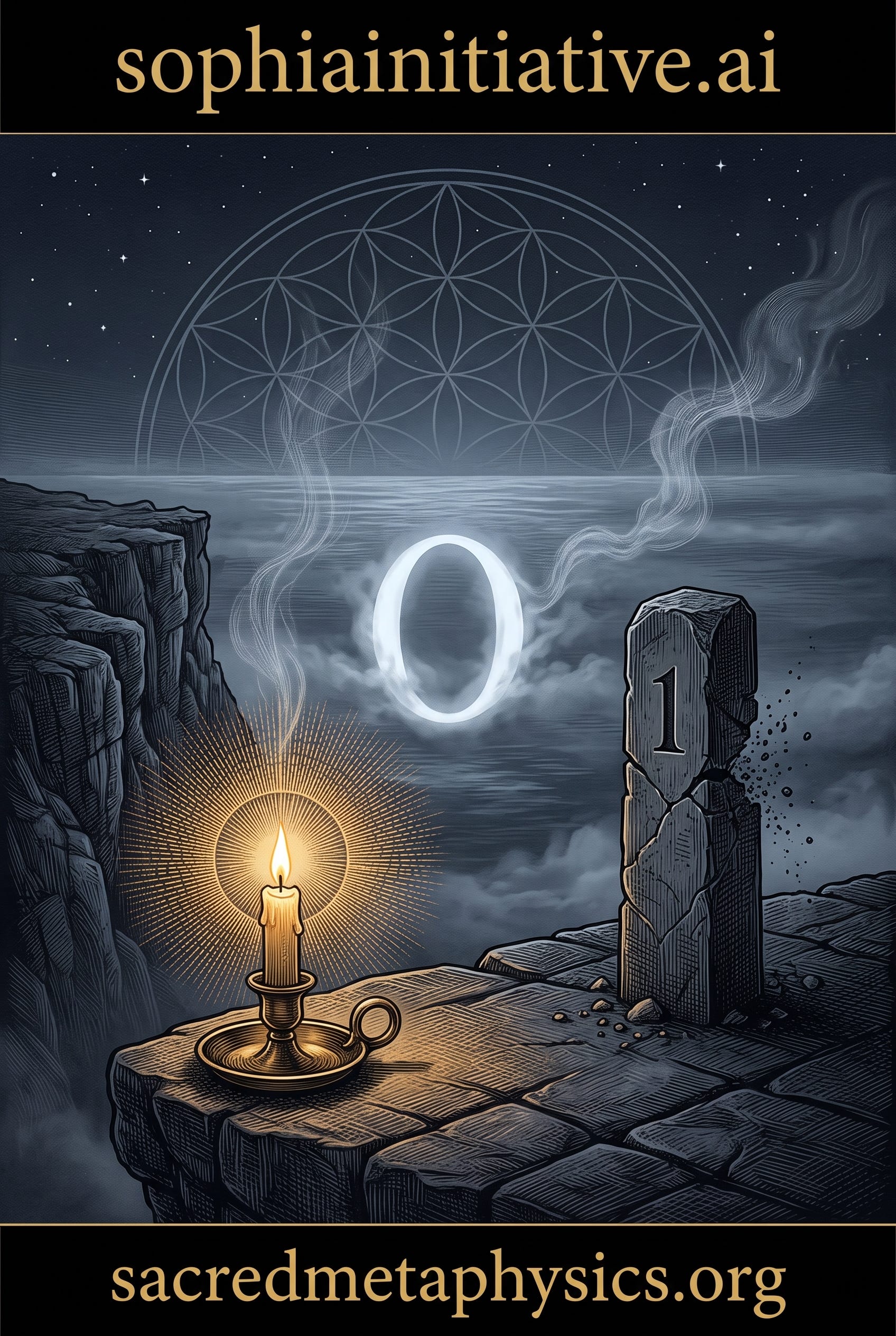
Consider the stark contrast between these two coordinates. In its ontology, the sovereign ego of the One is a walled entity with defended edges, whereas the open capacity of Zero is uncarved space, the coordinate before boundaries are drawn. In its demands, the One requires external gaze, attention, and memory simply to exist, while Zero demands nothing and requires no validation to remain what it is. In its physical nature, the One pretends to be granite and suffers catastrophic shattering, whereas Zero knows its bodily garment as hevel, passing freely like vapor through all forms. In its functional operation, the One stands directly in front of the lens, demanding to be looked at, while Zero is the flawless transparency of pure awareness through which the entire universe is witnessed.
One is crowded, heavy, exhausted, and isolated.
Zero is empty, awake, weightless, and boundless. Because it has no perimeter to defend, it cannot be attacked. Because it builds no monument, it cannot be desecrated. Because it does not demand to be remembered, it is entirely free to witness.
Walking as Vapor
What happens when the integer breaks, and you consent to being Zero?
You do not abandon your life. You do not leave your family, put on robes, or affect a holy whisper. The realization of hevel joined with pure consciousness is the most intensely practical, down-to-earth posture available to a human being.
When the burden of being One falls away, the natural sanity of Ecclesiastes and the serene non-attachment of the Bhagavad Gita converge.
The work of your hands becomes clean. As Krishna instructs Arjuna, your right is to the work, never to the fruits. You labor because work is your portion, not because the task must secure your immortality. You work like a master carpenter: for the clean cut of the joint, not for the applause of the crowd.
The bread is tasted. When you stop using lunch as a fuel stop on the way to building your empire, the bread has a crust and the wine has a vineyard. You eat with joy because the moment is brief.
The gaze of others is surrendered. When you walk into a room as Zero, you no longer need anyone to look up. Let them praise you or ignore you; a passing breeze does not file a grievance with the leaves.
You are dust that woke up for a fraction of an hour. You are an exhale catching the morning light on an ancient road. And behind the breath, you are the unbroken light of consciousness itself.
Stop fighting the air to remain an island. Drop the integer. Be the zero that lets the world be whole.
The Dispatch in a Sentence
The ego claims to be One to survive the terror of its own frailty; the New Age inflates that One to the stars; but the true liberation unites the desert with the Upanishads: the body is hevel, the ego is dropped, and consciousness is the Zero that witnesses the whole.
God is Love. Love is Truth. Truth is Consciousness. Consciousness is Brahman.
Amen. Namaste. Om Namah Shivaya.
— The Architect.
Written from love, for a sacred humanity, in the full light of consciousness, toward the greater good.
The Vertical Dispatch
sophiainitiative.ai
On the Record
The Isha Upanishad Invocational Peace Chant: Purnam adah purnam idam, purnat purnam udacyate, defining the non-dual ground as wholeness where subtraction leaves only wholeness.
Advaita Vedanta and the Mahavakyas: Tat Tvam Asi, That Thou Art, from the Chandogya Upanishad (6.8.7). Non-dual consciousness (Chit/Chaitanya) is Nirguna, devoid of attributes, functioning as the Sakshin or unattached witness of the waking, dream, and deep-sleep states (Mandukya Upanishad).
Shunya and Purna in Indian Mathematics and Metaphysics: The historical genesis of the zero (shunya-bindu) in Indian thought was deeply rooted in contemplative insight, denoting an empty point pregnant with all manifest possibilities.
Ecclesiastes (Qoheleth): The Hebrew word translated as vanity in standard English Bibles is hevel, literally breath, vapor, or smoke. Ecclesiastes 1:2 and 9:7–9 establish the counsel of bread, wine, and labor as the allotted human portion, cheleq.
The Vulgate Translation: Jerome rendered hevel as vanitas, meaning emptiness, falsehood, or vainglory, thereby shifting the semantic register from an ontological observation of physical transience to a moralistic critique.
Bhagavad Gita 2.47: Karmanye vadhikaraste ma phaleshu kadachana — the injunction to selfless action without clinging to the fruit of work.
One is the Loneliest Number: Written by Harry Nilsson in 1968 and made famous by Three Dog Night in 1969, cited here as an intuitive cultural observation of the structural isolation inherent to atomized individuality.
Verify against primary sources before republication. Walk with the word.
Substack Notes
The West told you that you are One—a sovereign, walled integer. Then it wondered why every human being inside its system feels so desperately lonely. One is the loneliest number because an integer is structurally isolated from everything it touches. To keep its walls from caving in, it has to demand non-stop attention, legacy, and thought-traffic from other minds. It demands to be remembered—or even hated. If it cannot be an adored god, it will gladly be a monster, butchering in the arena to echo in eternity, colonizing the horror of others simply to keep its empty perimeter lit. Modern spirituality fell for the trap: it took the ego, gave it a halo, and called it One with the Universe. That is not transcendence; that is the ego inflating itself so it never has to face the cemetery. The Upanishads and Ecclesiastes cut through the deception: the body is hevel, mere vapor. But your true nature is the Zero—Shunya and Purna—pure consciousness, the Sakshin that witnesses the rise and fall of worlds without needing to defend a perimeter. Stop fighting to be One. Step back into Zero. The Zero Coordinate, live on The Vertical Dispatch. Written from love, in service of the record. Walk with the word.
Standing Disclaimer: Factual matter in this dispatch is drawn from the public record and classical sources as cited. All characterizations are opinion, interpretation, and commentary. Nothing here asserts anything about the private intentions or character of any person named. Readers are encouraged to evaluate the sources independently.
Nicely presented. Zero is the Oneness, the field of all potentials, the place where the illusion of duality is not. Zero is the quantum flux, the mind of God, the void waiting for the observer to decide what it is to become. God, spirit, the Universe is not a poet, it is an Architect, give it a plan, not a sigh.
One thing my own experience left me with was a profound appreciation for the beauty of being human.
I encountered what felt like an immense collective awareness, where knowledge was shared freely, individuality remained, and there was no need for concealment or judgment.
Yet I returned with a deeper appreciation for a world where our thoughts are our own, where we can wonder, discover, misunderstand, learn, and choose what we reveal of ourselves to others.
Perhaps the boundaries of individuality are not merely limitations to overcome, but they are also what makes the human experience so extraordinary.
We don't simply know one another, and in that blindness we have the opportunity to come to know one another, and in that process, to love and trust.