

THE VERTICAL DISPATCH
We write for the mind, the eye, and the ear.
Read it. Look at it. Listen to it. The Vertical Dispatch is built for all three — prose with rhythm, made to be heard as much as read.
From metaphysics to geopolitics, from culture to history, from the sacred to the street — and everything in between. One lens, every subject. No ego. Just the record, named clean.
Press play. Walk with the words. 🕯️
Building Canada Strong · The Age of Consequences
As of June 3, 2026
— without malice and without flattery
“The storm is no one’s fault. The angle of the boat is everyone’s.”
On the night of June 2, 2026, somewhere in a long run of social-media posts, the President of the United States shared a Bloomberg article reporting that Canada had slipped into a technical recession, and stamped it with two words: “51st State!” The next day the United States Ambassador to Canada, Pete Hoekstra, amplified it, posting a screenshot of the President’s message; the embassy explained that this was “amplification of the President’s Truth Social post, which is our usual practice.” A two-word taunt, a recession headline, and an ambassador’s repost. By the standards of the present age, barely a ripple. And yet it is worth stopping over, because the small wave reveals the shape of a larger water — and because of where, on the map, the amplification came from.
The United States Embassy stands at 490 Sussex Drive, on what its own architects describe as “the last site in the Parliament Hill zone” — a building deliberately oriented, in their words, toward “the Parliament buildings… to the west.” It is roughly six hundred metres from the House of Commons, an eight-minute walk down Sussex. The message picturing Canada as a failing country fit to be absorbed was amplified, in other words, from three doors down the Hill it was describing as broken. The storm that began as weather in Washington arrived as a repost in Ottawa, from a building close enough to see the Parliament it was trolling.
This dispatch is not about the taunt. Taunts pass. It is about the six chairs the taunt lit up, and what each one did when the wave came through — because a provocation from outside is a test, and a country is read by how its chairs answer it. Two of those chairs sit outside the house, and we judge them by the documented conduct of powerful office. Four sit inside it, and we judge them by the responsibility each office carries. No chair here gets a halo, and none gets a verdict on its soul. Each is weighed by one question only: when the water rose, did you set the boat at the right angle for the people aboard — or did you use the wave for your own shore?
The Two Chairs Outside the House
Begin outside, because accountability points up, at power, and the most powerful chair in this story is not Canadian. The President’s post was not, on any serious reading, a constitutional proposal. There is no movement in Canada for union with the United States; every federal leader and every premier has rejected the idea. The post was something cruder and more familiar: the use of a neighbour’s difficult economic morning as a brochure. The pitch beneath “51st state” is always the same — your economy is weak, you cannot stand on your own, so hand the country over. It is annexation by attrition: tariff a trading partner into a ditch, then point at the ditch as proof they belong to you. We name that for what it is, not because the word wounds, but because the most powerful office on earth aiming it at a friend across the longest undefended border in the world is a matter of public record and public consequence.
The second outside chair is the ambassador’s, and it is a different kind of chair with a different kind of duty. A diplomat is a guest in the country to which he is posted. His office exists to manage the relationship, not to inflame the host’s internal divisions. Amplifying the President’s taunt is, by the embassy’s own account, “usual practice” — but it is worth recalling that this is the same ambassador who, in October 2025, was reported to have delivered an expletive-laced tirade at Ontario’s trade representative over a provincial anti-tariff advertisement, and the same ambassador who had said, only months before, that the President’s “51st state” talk was “done… behind us.” The pattern is not a single repost. It is a diplomat repeatedly placing himself inside Canadian friction rather than above it. Judge the chair by what an ambassador owes the country that hosts him, and the repost from three doors down the Hill is a small breach of a large trust.
The Four Chairs Inside the House
Now come indoors, where the test is different. The outside chairs we weigh by conduct; the inside chairs we weigh by responsibility — by what a Prime Minister, a premier, and an opposition leader owe their own country when a foreign power weaponizes its weakness. Here there are no villains and no saints. There are four leaders, all of whom answered the same wave, and the honest work is to see clearly how each one set the boat.
The Prime Minister’s chair. Mark Carney answered outward and cool. He called the President “an exceptionally active user of social media,” said Canada would not “respond or react” to every post, and declined to expel the ambassador, on the ground that Canada must work with its largest trading and security partner. There is a real case that this is the keel response — that refusing to be baited denies the troller his catch, and that a serious country does not expel an ambassador over a repost. There is also a fair question on the other side: whether a shrug is steadiness or avoidance, and whether “we will not react” can shade into not answering at all. We do not settle it here. We note that, on this provocation, the PM’s chair faced the storm outward and refused to amplify it — which is, at minimum, the opposite of using the wave for his own shore.
The Ontario premier’s chair. Doug Ford held the line on the surface, and sharply: “Canada will never be the 51st state. Canada is not for sale.” That is the right answer to the taunt, said plainly, and it deserves to be named as such. But honesty about a chair does not stop at the line that flatters it. Ford answered the troll and, in the same breath, reached for his own base — claiming Ontario had created “680 per cent more jobs than the U.S.” in April, a figure that depends on a population-adjusted calculation and reads more as a political flourish than a clean comparison. Holding the line and working the room are not the same act, and Ford did both at once. The line was sound. The flourish was for the shore he stands on. A chair can do the country’s work and its own at the same time, and the reader is owed both halves.
The opposition leader’s chair. Pierre Poilievre did something genuinely two-handed. With one hand he pushed back on the “51st state” comment — to his credit, and we name it. With the other, in the same season, he has insisted the recession is “nothing technical,” that the Prime Minister “caused a recession,” and that the documented role of the tariff war is an “excuse” that “does not work.” Set those two hands beside the President’s post and the difficulty is plain: the brochure’s entire pitch is that Canada’s economy is failing and its government cannot manage it — and that is, almost word for word, the message the opposition leader is broadcasting at home. Batting the taunt away with one hand while handing the troller his thesis with the other is not the conduct of a man who wants union; it is the conduct of a man who wants the chair. But the effect, whatever the intent, is to feed the very narrative the bait depends on. We judge the chair, not the heart — and the chair, on this, is working two sides of one wave.
The Alberta premier’s chair. Danielle Smith carries the deepest friction of the four, because hers is structural rather than rhetorical. Alberta is holding its first-ever referendum on independence in 2026, with separation sentiment running near a third of the province. Whatever the premier’s own stated position on staying in Canada, a sovereignty referendum is precisely the internal fracture an external annexation pitch is built to widen — the seam the troller probes for. A taunt is a day’s weather. A referendum is a fault line. And a leader who keeps a fault line open during a season when a foreign power is actively pointing at Canada’s cracks is, by the responsibility of the chair, doing something graver than answering a post badly. She is leaving the door three provinces wide open while the boat trailing bait goes by.
The Boat Trailing Bait
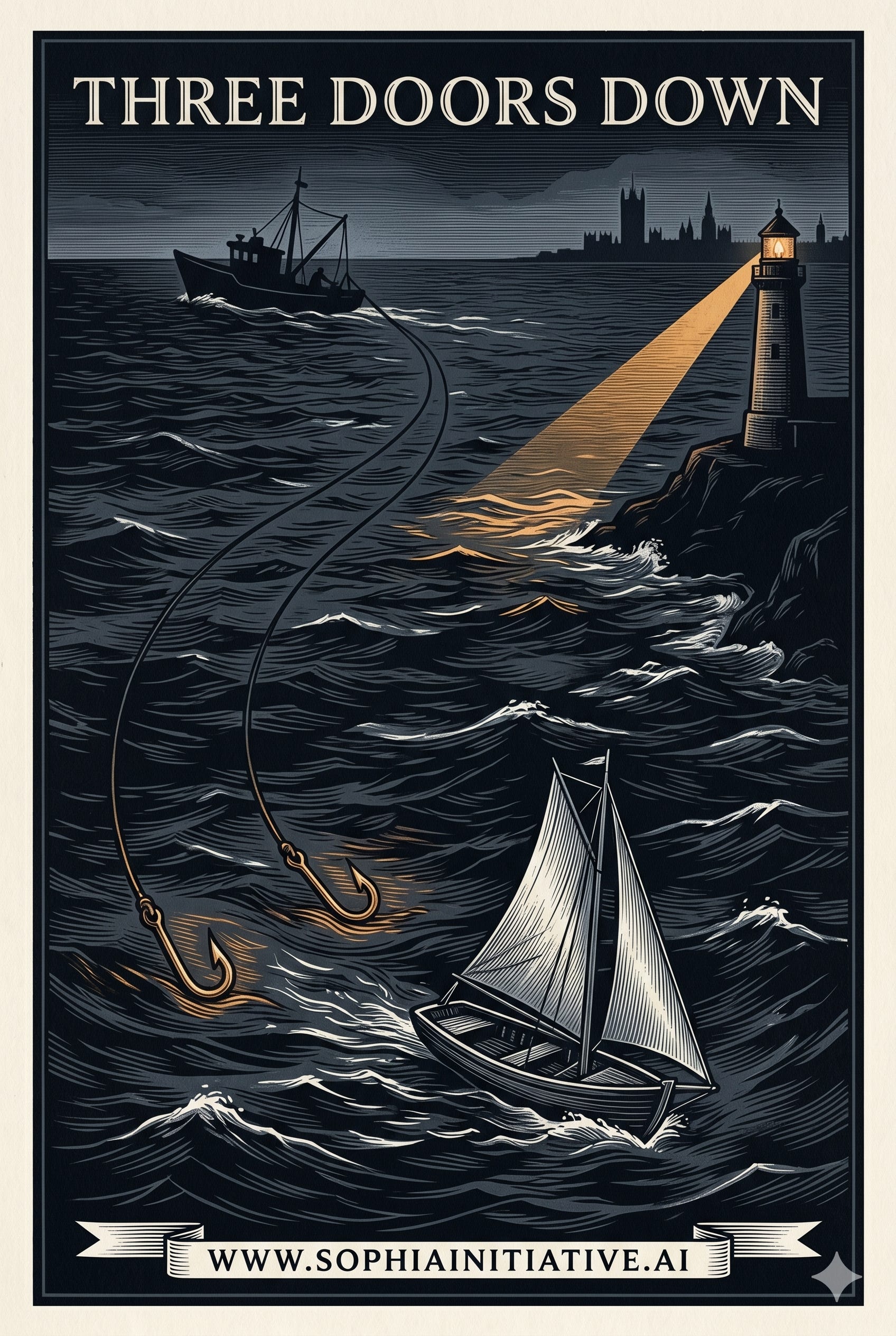
Put the six chairs together and the shape resolves. Picture a boat moving slowly through Canadian water, trailing lines. The President holds the rod; the ambassador, three doors down the Hill, lets out the line. The bait is a real number — a shallow, contested, trade-induced technical recession — dressed up as a verdict: failed country, hand it over. The boat is not fishing for Canada’s consent; no serious person thinks the post wins a province. It is fishing for the strike — for the Canadian voice that will take the weakness-narrative and run with it, because every such voice is a catch that makes the brochure look true.
Seen that way, the four inside chairs sort themselves not by party — all of the provincial and opposition figures here are conservatives, and the federal chair is not — but by whether they struck at the bait or refused it. Carney refused to react. Ford slapped the line away, then flexed for his base. Poilievre slapped it away with one hand and tugged it with the other. Smith keeps a referendum running that is, for the troller, the richest bait of all — not a strike at the line, but an open seam he did not even have to bait. The boat does not need most of them to bite. It needs the friction to stay in the water. And friction, unlike a taunt, does not pass when the news cycle turns.
Final Thoughts: The Friction That Outlasts the Moment
This is the part that calls for thought, and it is why a two-word post is worth a dispatch. The taunt is nothing; it will be gone by the weekend. What is not nothing is the friction the taunt feeds on — the recession narrated as national failure, the unity strained by referendum, the country told daily by some of its own leaders that it is broken. The water that became a wave began in Washington. But the tsunami, if it comes, will not be a foreign army; it will be a country that taught itself, with help from a boat three doors down, to believe it could not stand. That is the friction that goes beyond the moment, and a serious people has to look at it with open eyes.
The keel of this publication is an old one, learned from a man who read a wave at land’s end and set his small boat at the angle that carried the people in it safe over the water, without fear and without spin. That is the whole of what a chair is for, in rough water: not to use the wave for your own shore, but to set the boat so that everyone aboard glides over it together. Six chairs were tested by one small wave this week. The honest reader can now weigh each one — the two outside that trailed the bait, and the four inside that struck at it, refused it, or left a seam open in the hull. The storm is no one’s fault. The angle of the boat is everyone’s. The waters are rough. The keel holds. Walk with the words.

God is Love. Love is Truth. Truth is Consciousness. Consciousness is Brahman.
Amen. Namaste. Om Namah Shivaya.
— The Architect
The Vertical Dispatch
sophiainitiative.ai
On the record — sources (as of June 3, 2026). Trump “51st State!” post: shared June 2, 2026 on Truth Social with a Bloomberg article on Canada’s technical recession (CBC, Global News, CTV, The Maple, June 2–3, 2026). Hoekstra amplification: screenshot reposted on X, June 2–3, 2026; U.S. Embassy statement that this is “amplification of the President’s Truth Social post… our usual practice” (The Maple). Hoekstra’s May 2025 “it’s done” / “behind us” remark and October 2025 expletive-laced exchange with Ontario’s trade representative David Paterson over an anti-tariff ad (CBC, Oct 29, 2025; Toronto Sun; Globe and Mail). Embassy location: 490 Sussex Drive, described by its architects (Skidmore, Owings & Merrill / U.S. State Dept) as on “the last site in the Parliament Hill zone”; ~600 m from Parliament. Carney response: “exceptionally active user of social media,” “not going to respond or react,” declined to expel the ambassador (CBC, June 2, 2026). Ford: “Canada will never be the 51st state. Canada is not for sale,” and the population-adjusted “680% more jobs” claim; StatCan reported Ontario employment up ~42,000 in April while national employment fell ~18,000 (June 2, 2026). Poilievre: pushed back on the 51st-state comment while attributing the recession to government policy and calling the tariff/Iran-war factors “excuses” (CTV; June 1–2, 2026). Alberta independence referendum planned for 2026; separation support reported near one-third. Recession figures per the May 29, 2026 StatCan release (Q4 2025 -1.0% annualized; Q1 2026 -0.1%). All characterizations of motive, framing, and the “bait” metaphor are interpretation and commentary. Errors and omissions excepted; corrections will be made on notice. Verify against primary sources before republication.
#ThreeDoorsDown #51stState #Canada #Trump #Hoekstra #USEmbassyOttawa #MarkCarney #DougFord #PierrePoilievre #DanielleSmith #Alberta #ElbowsUp #CanadaIsNotForSale #TradeWar #Tariffs #BuildingCanadaStrong #NationalUnity #TheAgeOfConsequences #TheVerticalDispatch #TheArchitect #SophiaInitiative #GodIsLove #LoveIsTruth #OmNamahShivaya
Substack Notes
On June 2, the President of the United States stamped two words — “51st State!” — on a Bloomberg article about Canada’s technical recession, and his ambassador amplified it from an embassy six hundred metres down the Hill from the Parliament it pictured as broken. Three doors down. This dispatch isn’t about the taunt — taunts pass. It’s about the six chairs the taunt lit up, and what each one did when the wave came through.
Two chairs sit outside the house, judged by the conduct of powerful office: the President trailing the annexation brochure, and the ambassador who let out the line — the same envoy who once said the 51st-state talk was “done,” and who in October went on an expletive-laced tirade at Ontario’s trade rep. Four chairs sit inside it, judged by responsibility: Carney refused to react; Ford slapped the line away and flexed for his base; Poilievre batted the taunt with one hand and fed the weakness-narrative with the other; Smith keeps a referendum running that is, for the troller, the richest bait of all. No party line and no halos — all the provincial and opposition figures are conservative, the federal chair is not, and each is weighed by what its office owes.
The boat trailing bait doesn’t need a province to bite. It needs the friction to stay in the water. And friction, unlike a taunt, doesn’t pass when the news cycle turns — the recession narrated as failure, the unity strained by referendum, a country told daily by some of its own leaders that it cannot stand. That is the part that calls for thought.
The storm is no one’s fault. The angle of the boat is everyone’s. The waters are rough. The keel holds. Walk with the words. 🕯️
The factual matter in this Dispatch is drawn from the public record. All characterizations, inferences, and conclusions are opinion, interpretation, and commentary, offered for analysis, reflection, and public-interest discussion. No assertion is made regarding the private intentions, state of mind, or character of any individual. Readers should evaluate all statements independently and draw their own conclusions.
What the Conservatives should remember from their former leader, Stephen Harper:
“I think Canadians understand that if the president is willing to use force that could do great damage to our economy, then we have to be prepared to accept any level of damage to preserve the independence of the country.”
He also said that Canada should make:
“any sacrifice necessary” to preserve its independence.
These are beyond the ken of unconscionables like PP or Smith.
Thanks for the article.
Well the danger on the rocks is surely passed,
Still I remain tied to the mast.
Could it be that I have found my home at last?
Home at last.