


Φ
THE VERTICAL DISPATCH
We write for the mind, the eye, and the ear.
Read it. Look at it. Listen to it. The Vertical Dispatch is built for all three — prose with rhythm, made to be heard as much as read.
From metaphysics to geopolitics, from culture to history, from the sacred to the street — and everything in between. One lens, every subject. No ego. Just the record, named clean.
Press play. Walk with the words. 🕯️
The Canadian Shadow Series · The Age of Consequences
As of 5 June 2026
“I felt helpless, quite frankly. There’s nothing you can do.”
— Diane McLeod, Information and Privacy Commissioner of Alberta, on the breach (CBC, 5 June 2026)
This dispatch travels by hand. If it serves you, share it — restack on Substack, pass it on wherever you read. 🕯️
The Number and the Wound Beneath It
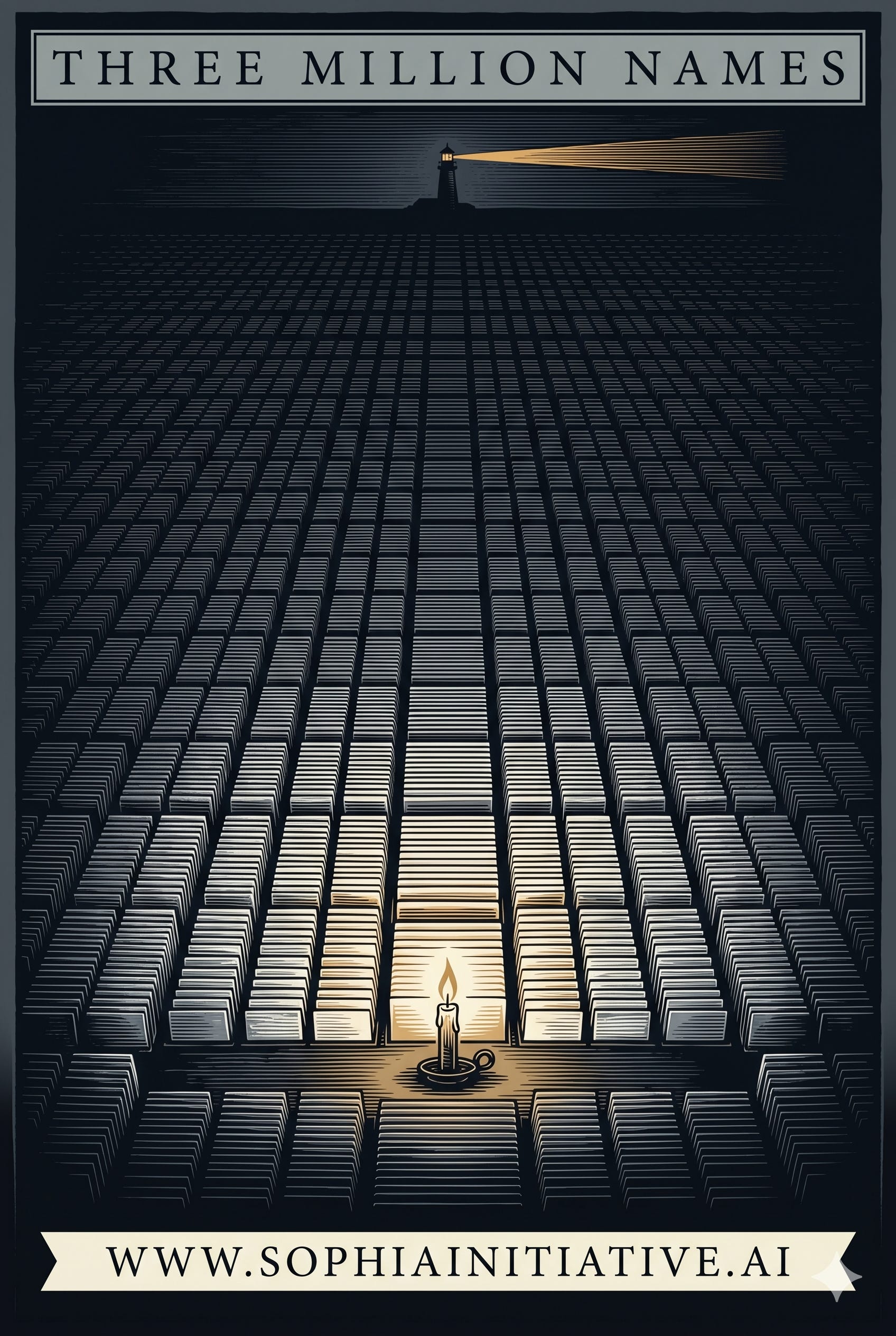
Eighty-four percent of Albertans now agree that political parties, when they collect and hold voters’ personal information, should be bound by the same privacy law that already governs every business in the province. Only five percent prefer the status quo. The figure comes from an Ipsos survey of eight hundred and one Albertans conducted in late May for the BC Freedom of Information and Privacy Association — and it did not arrive in a vacuum. It arrived three weeks after Albertans learned that the personal information of roughly 2.9 million of them — nearly every elector in the province — had been exposed in what the province’s own Privacy Commissioner calls the worst breach of voter data in Canadian history.
The numbers in a list of electors are not abstractions. They are full names, home addresses, postal codes, phone numbers, and a unique identifier for each voter. When Commissioner Diane McLeod described her own position once the data was public, she did not reach for the language of policy. She said she felt helpless. “There’s nothing you can do,” she told the CBC — because under Alberta’s current law, her office has no authority over political parties at all. She has asked, as her predecessors asked before her, for the better part of a decade, to have that gap closed. It has not been closed. And so eighty-four percent of a province, having watched the consequence, are now asking for the same thing.
What Happened, Named Carefully
The established facts, and only the established facts, are these. Alberta’s list of electors is tightly restricted by law: only registered parties, candidates, MLAs, and constituency associations may receive it, and they must safeguard it. In June 2025 a copy was lawfully provided to the Republican Party of Alberta, a registered pro-independence party. In April 2026 that data surfaced inside a publicly searchable online database operated by the Centurion Project, a pro-sovereignty group registered as a third-party advertiser — an entity not entitled to hold the list at all. Elections Alberta seeds each copy of the list with fake “salted” names so leaks can be traced; the salts in the leaked database matched the copy issued to the Republican Party. On the thirtieth of April, the Court of King’s Bench granted an emergency injunction ordering the database removed and the recipients identified. The database came down. The RCMP opened an investigation. As of this writing, no charges have been laid against anyone.
Fairness requires that each named party be heard at full strength, because an investigation is not a verdict. The Republican Party’s leader, Cameron Davies, says the party received the list lawfully, that on learning of the alleged misuse it issued an immediate cease-and-desist to all its vendors and notice to the Centurion Project not to use any data that might have come from the party, and that it will fully cooperate with Elections Alberta and the RCMP; he denies intentional wrongdoing. The Centurion Project’s leader, David Parker, says the group relied on a “third party” for the dataset, likened the database to a phone book, took the app offline, and will comply with the investigation — though the identity of that third party has not been made public, and Elections Alberta at one point stated he was not cooperating, a dispute that remains unresolved. What the Republican Party knew, how the data travelled, and who is ultimately responsible are precisely the questions the investigation exists to answer. This dispatch does not answer them. It reports that they are open.
Why Accountability Points Up, Not Down
Here the distinction this publication holds in all things matters most. The 2.9 million people whose names and addresses were exposed did nothing wrong; they are the wronged. Commissioner McLeod was direct about who is most endangered: those whose home address becoming searchable is not an inconvenience but a danger — people who work in law enforcement, public officials, and, in her own words, those fleeing intimate-partner violence. For such a person, a searchable database of every Albertan’s home address is not a privacy abstraction. It is the possibility of being found. An Edmonton city councillor raised exactly this fear for domestic-violence survivors. So the accountability here points up — at the institutions that held the data, at the decade-old gap in the law, at the parties under investigation — and never down at the citizens who were exposed. The eighty-four percent understand this instinctively. They are not asking to be watched. They are asking that the powerful, who hold their data, be bound by the same duty of care that already binds the corner store.
That is the precise shape of legitimate accountability, and it is worth naming because its opposite — the dream of total visibility, the database that watches everyone in the name of catching someone — is the very thing this breach demonstrates the danger of. A searchable file of three million private lives is what happens when the duty to protect data lags behind the power to collect it. The remedy the province is asking for is not more surveillance. It is the oldest remedy there is: that those who hold power over your information owe you a legal duty to protect it. Sixty-eight percent want that duty written into law. The government has called the breach “completely unacceptable” and says it is reviewing the situation and will consider recommendations once the investigations conclude. It has not committed to closing the gap. The reader may decide what a decade of asking, and a breach of this scale, ought to produce.
The Spark and the Province It Lights
A single breach, however large, would be a story on its own. But this one throws light on a province already living in tension, and the larger picture is worth seeing whole. The same separatist current that produced this data operation is the current driving Alberta’s defining political drama — and the polling beneath it tells a more complicated story than either side’s slogans. The United Conservative Party holds a commanding lead, around 53 percent to the New Democrats’ 36 in the most recent Leger survey, with strength that now extends even into the two big cities and overwhelms the countryside better than two to one. Yet when Albertans are asked what they actually worry about, the constitutional question is not the answer. In Abacus Data’s February survey, 64 percent ranked the cost of living among their top concerns — more than double the share who named independence. Health care and the economy outrank the sovereignty question. The government is trusted on the symbolic economy of resource sovereignty and distrusted on the material conditions of daily life.
This is two Albertas in one geography. The first is the Alberta of the archetype — sovereign, resource-rich, aggrieved at Ottawa, and not entirely wrong to be; the grievances are historically grounded. The second is the Alberta of the particular: the family spending forty-three percent of its income on housing, the share of Albertans reporting difficulty getting health care risen from roughly one in five to one in four in three years, a province graded D-minus on this month’s national poverty report card, four in ten saying they are worse off than a year ago. The first Alberta votes on symbols; the second on conditions; and both live in the same people at once. The breach sits exactly on the fault line between them — a symbolic sovereignty project that produced a concrete, material harm to ordinary Albertans, of every political stripe, all at once.
The constitutional drama continues regardless. A referendum is set for the nineteenth of October, carrying nine questions on immigration, election security, and the constitutional relationship, to which a tenth was added in late May asking whether Alberta should begin the legal process toward a binding separation vote. The official separation question runs to thirty-seven words; in the most recent Angus Reid survey more than half of Albertans called it confusing, and a majority said the premier has handled the matter poorly. And the separation numbers themselves must be read with care, because they swing entirely on wording: asked plainly to stay or leave, roughly seventy percent say remain; asked about commencing a legal process, the figure runs into the low-to-mid twenties; asked simply whether they “support independence,” about a third. These are not a trend so much as a thermometer reading the same fever at different depths. Committed separatism remains a minority. The drift since 2023 is real but modest. The louder signal is unease.
The Dispatch’s Assessment
We do not declare for parties; that is not this publication’s function. What can be said is this. The breach and the eighty-four percent are not a side story to Alberta’s constitutional drama — they are its truest expression. A province whose politics is organized around the symbolism of sovereignty has just been shown, in the most concrete possible way, that symbolism has material consequences: that the machinery of a movement can expose the home address of every voter in the province, including those for whom exposure is a danger, and that the law as written leaves the watchdog helpless to act. The citizens’ response was not to choose a side in the sovereignty war. It was to ask, across every line, that those who hold power over their lives be held to the rules the rest of us already follow. That is the second Alberta speaking — the Alberta of conditions, not symbols — and on this question, at least, it speaks with the voice of eighty-four percent. Whether the province’s politics can hear that voice over the louder drama of the referendum is the question the coming months will answer. The names are exposed. The gap is open. The thermometer is rising. And a province is asking, quietly and overwhelmingly, to be protected by its own law.
God is Love. Love is Truth. Truth is Consciousness. Consciousness is Brahman.
Amen. Namaste. Om Namah Shivaya.
— The Architect
The Vertical Dispatch
sophiainitiative.ai
On the record. Privacy poll: Ipsos, fielded 22–26 May 2026 for the BC Freedom of Information and Privacy Association (n=801; MoE ±4.2%) — 84% agree political parties should be subject to the same private-sector privacy laws as other organizations (9% disagree); 68% want a legal duty to protect voter information; 63% want breach-notification duties; only 5% prefer no external oversight; 48% prefer shared oversight by elections agencies and privacy commissioners (Ipsos release, 2 June 2026; CBC, 5 June 2026). The breach — ESTABLISHED: Alberta’s List of Electors (~2.9 million electors; names, addresses, postal codes, phone numbers, elector ID numbers) is restricted by the Election Act to registered parties, candidates, MLAs, and constituency associations; a copy was lawfully provided to the Republican Party of Alberta in June 2025; the data later appeared in a searchable database run by the Centurion Project, a registered third-party advertiser not entitled to hold the list; Elections Alberta traced the leaked copy to the Republican Party’s via seeded “salted” names; the Court of King’s Bench granted an injunction 30 April 2026 ordering the database removed and recipients identified; the database was taken down; the RCMP is investigating; 568 cease-and-desist letters were issued to people who accessed the database; as of early June 2026 NO charges have been laid against any person or party (Elections Alberta; CBC; Globe and Mail; Canadian Press; The Walrus; April–June 2026). ALLEGED / UNDER INVESTIGATION, not established: that the Republican Party knowingly provided the list to the Centurion Project (alleged context, disputed by the party); that the Centurion Project received the data from a “third party” other than the party (Parker’s claim, identity not made public); whether any individual has been physically harmed (400+ complaints expressing fear; no documented harm). Positions, fairly stated: Republican Party leader Cameron Davies says the list was received lawfully, the party issued cease-and-desist notices to vendors and the Centurion Project on learning of alleged misuse, will cooperate with Elections Alberta and the RCMP, and denies intentional wrongdoing; Centurion Project leader David Parker says the group relied on a third party for the data, took the app offline, and will comply, while not naming the third party (Elections Alberta stated at one point he was not cooperating — dispute unresolved). Commissioner Diane McLeod: “the worst breach in Canadian history involving voter data” and “I felt helpless… there’s nothing you can do” (Calgary Sun, 3 June; CBC, 5 June 2026); her office has no authority over political parties under current law, and the OIPC has for years sought to bring political parties under Alberta’s Personal Information Protection Act (PIPA); the June 2025 privacy overhaul did not include them. Government: Premier Smith called the breach “completely unacceptable” (14 May 2026) and said the government is reviewing and will consider recommendations after investigations conclude (20 May 2026); it has not committed to amending PIPA to cover parties. Whether the government “deliberately delayed” reform is interpretation, not established fact. McLeod’s warning that exposure poses real risk to law-enforcement personnel, public officials, and people fleeing intimate-partner violence (Global News, 2 May 2026); domestic-violence-survivor concern also raised by an Edmonton city councillor. Polling landscape: Leger (3–6 April 2026, n≈1,003, ±3.1%) UCP 53% / NDP 36%, Smith approval 46% / Nenshi 35%, UCP leading both cities and ~64–25 outside them; Abacus Data (20–25 February 2026, n=1,000, ±3.1%) 64% rank cost of living a top-three issue, more than double the share naming independence; Angus Reid (April 2026) ~two-thirds rate the government poorly on healthcare and cost of living, and (25 May 2026) 60% No / 35% Yes on the official referendum question, 51% find it confusing, 56% say the premier handled the issue poorly; separation support varies by wording (~70% remain / 17% leave, Leger March 2026; ~31% on an unmodified “support independence” item, Leger February 2026); the 2023–2026 increase is modest. Referendum set for 19 October 2026 (Elections Alberta; Government of Alberta). Social conditions: Food Banks Canada 2026 Poverty Report Cards (1 June 2026) — Alberta grade D-, 43% spend 30%+ of income on housing (up from 36% in 2023), healthcare-access difficulty ~19%→24% since 2023, ~41% feel worse off than a year ago. No figure in this dispatch is disaggregated by race, group, or class. This dispatch reports an active investigation in which no charges have been laid, states each party’s position, judges institutions and the law rather than individuals, and makes no assertion about any person’s private character or intentions. Errors and omissions excepted; corrections will be made on notice. Verify against primary sources before republication.
#ThreeMillionNames #Alberta #VoterData #Privacy #PIPA #ElectionsAlberta #DataBreach #AlbertaPolitics #DanielleSmith #AlbertaReferendum #CostOfLiving #TwoAlbertas #TheCanadianShadowSeries #TheAgeOfConsequences #TheVerticalDispatch #TheArchitect #SophiaInitiative #GodIsLove #LoveIsTruth #OmNamahShivaya
Substack Notes
Nearly every voter in Alberta — about 2.9 million people — just had their name, home address, and phone number exposed in what the province’s own privacy commissioner calls the worst voter-data breach in Canadian history. Her reaction wasn’t bureaucratic. She said she felt helpless: under Alberta law, her office has no authority over political parties at all. Now 84% of Albertans want that changed — they want parties bound by the same privacy law as every business. Only 5% want to leave things as they are.
Here’s what makes it land. The list was legally given to a pro-independence party, then surfaced in a separatist group’s searchable online database; a court ordered it down, the RCMP is investigating, and — to be fair and exact — no charges have been laid against anyone, and every party says it’s cooperating. But the people most endangered by a searchable map of every Albertan’s address aren’t political at all: law-enforcement families, public officials, and people fleeing intimate-partner violence. Accountability here points up — at the law’s decade-old gap — never down at the citizens who were exposed.
And the breach is a window onto the whole province. Alberta’s politics runs on the symbolism of sovereignty — a referendum is coming in October — but ask Albertans what they actually worry about and 64% say the cost of living, more than double the share who name independence. Two Albertas in one geography: one that votes on symbols, one that lives on conditions (43% spending a third of their income on housing, a D-minus on this month’s national poverty report card). The breach sits right on the fault line — a symbolic project that caused a material harm to everyone at once.
We don’t declare for parties. But the 84% may be the truest thing in Alberta politics right now: not a side in the sovereignty war, but a province asking, across every line, that the powerful who hold its data be held to the rules the rest of us already follow. The names are exposed. The gap is open. And a province is asking, quietly and overwhelmingly, to be protected by its own law.
Written from love, for a sacred humanity, in the full light of consciousness, toward the greater good. 🕯️
The factual matter in this Dispatch is drawn from the public record. All characterizations, inferences, and conclusions are opinion, interpretation, and commentary, offered for analysis, reflection, and public-interest discussion. No assertion is made regarding the private intentions, state of mind, or character of any individual. Matters under investigation are identified as such; no charges have been laid. Readers should evaluate all statements independently and draw their own conclusions.
I’ve received several bogus emails since this news came out. They’re not even good phishing emails. Based in the US or all about obsolete apps. Obviously, very stupid people stole our data. I do worry about elderly Albertans being duped, though.