


The Vertical Dispatch · The Requisite Cabinet · Entry Five
A NOTE ON METHOD, BEFORE THE AUDIT
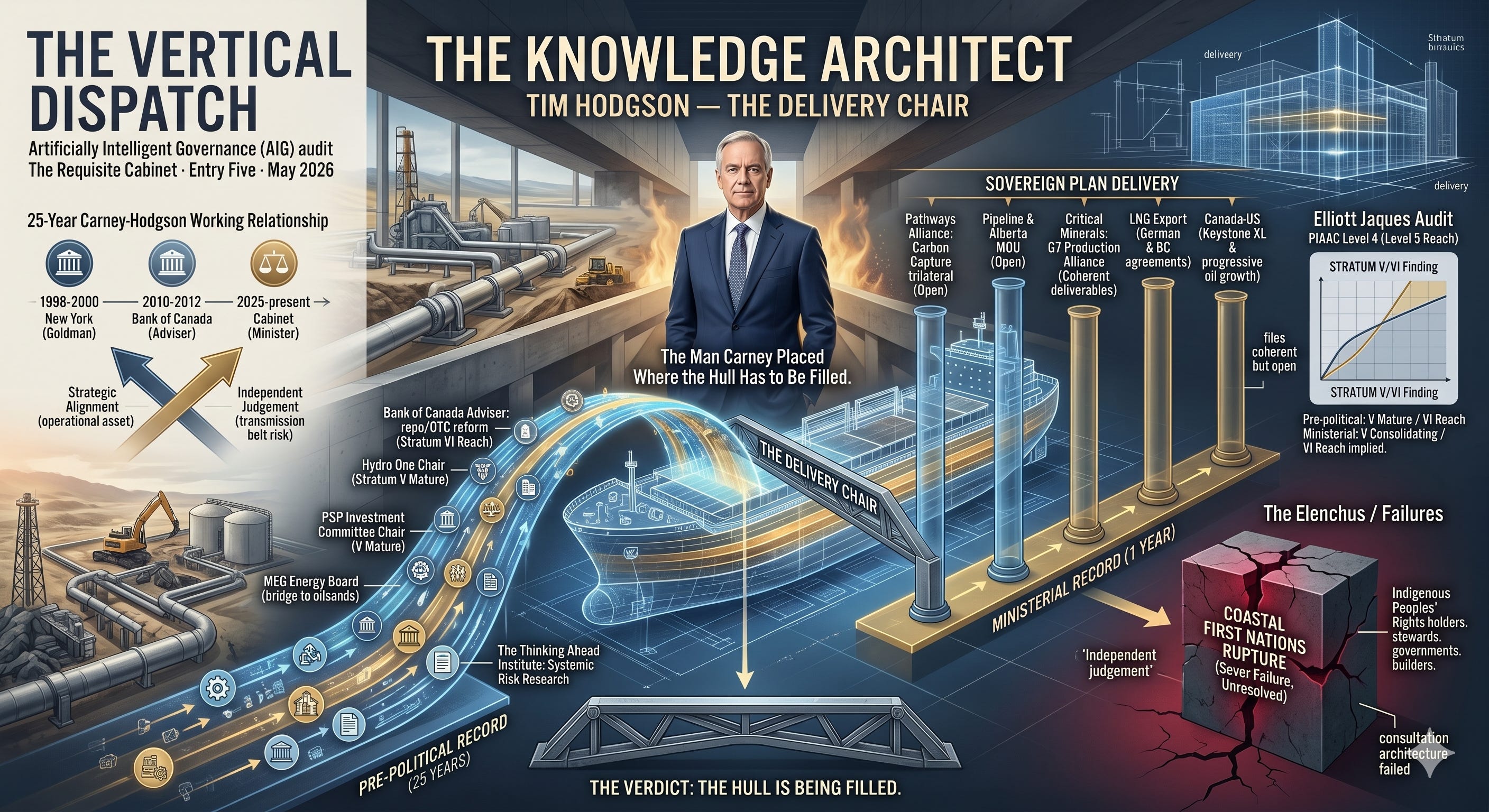
Entry One of this series established that the bar Elliott Jaques described can be cleared, and that Anita Anand at Foreign Affairs is the proof. Entry Two established that the cabinet’s architecture knows what to do with minds still climbing into Stratum VI, and that Mélanie Joly at Industry is the proof of that. Entry Three established that the bench also knows what a closer is and where to place one, and that François-Philippe Champagne at Finance is the proof. Entry Four established that the seams of the federation are being held by an Acadian lawyer whose entire biography was the training for it, and that Dominic LeBlanc at the composite federation chair is the proof. Entry Five turns to the chair where the Sovereign Plan’s commercial proposition actually has to land on the ground — the chair into which Carney placed the one minister in his cabinet whose working relationship with the Prime Minister predates the Prime Minister’s politics by a quarter of a century.
A methodological point belongs here, marked explicitly because it will recur in entries to come. The previous four ministers were audited against ministerial records long enough that pre-political stratum and ministerial stratum did not visibly come apart. Anand had two decades of peer-reviewed comparative legal scholarship before her first cabinet post; by the time the audit reached her, the ministerial record had been built on a foundation already documented at the same stratum. Joly had ten years and five portfolios. Champagne had eight years and five portfolios. LeBlanc had a quarter-century of intergovernmental work across three Prime Ministers. In all four cases the audit could read pre-political and ministerial capacity as one continuous record because the calendar permitted it.
Hodgson is the first minister in the series where the calendar does not permit it. His pre-political record is two and a half decades long and is documented at the institutional scale where Stratum V matures and the lower reach of Stratum VI becomes observable. His ministerial record is one year long. The series now has to do something it has not had to do before: read those two strata separately, name where they sit, name where they reach, and let the elenchus do the work the calendar cannot yet do. That methodological move is named here so it carries forward. When Entry Six or Entry Seven encounters another minister whose pre-political record outweighs the ministerial year, the instrument will be on the shelf where the audit can reach for it. The Hodgson case is not the exception. It is the precedent.
With that established, the audit.
I. THE RESUME BEFORE THE RESUME
Timothy Edward Hodgson was born in Winnipeg, Manitoba, in 1960 or 1961 — the exact date is not part of the public record, and the audit will not invent what the record does not supply. His father, Colin Hodgson, was a Royal Canadian Air Force officer who had immigrated from England. His mother, Marianne Hodgson, née Curlette, was born in Calgary, took her Bachelor of Nursing at the University of Manitoba in 1980, served as Director of Patient Care at Regina General Hospital in 1985, and was elected President of the Saskatchewan Registered Nurses Association in 1988. The childhood that followed from those biographical facts is the childhood of an RCAF family in the Cold War period — Holberg, British Columbia; Gypsumville, Manitoba; Winnipeg; Markham, Ontario; Barrington Passage, Nova Scotia. By the time he reached university age he had lived in five provinces and, on the available record, attended schools in all of them. The pre-political record begins with a Canadian childhood that did not have a single Canadian centre of gravity, and that detail will return when the audit reaches the federation file.
In 1979, at the age of seventeen, he joined the Canadian Armed Forces as a reserve officer. He served until 1985, six years, while completing his undergraduate work. The audit notes this not as a credential — reserve service at that age and in that period was common — but because the record contains few decisions a Canadian seventeen-year-old in 1979 made that committed him, in writing, to a structure larger than himself. He made that one.
Bachelor of Commerce, honours, accounting and finance, University of Manitoba, 1983. He was twenty-two. He took his MBA at the Richard Ivey School of Business at the University of Western Ontario, completing it in 1988. The pre-Goldman career began at Salomon Brothers, then Price Waterhouse, then Merrill Lynch Canada — three firms in the documented record, with years of service not specified. He joined Goldman Sachs at a point in the early 1990s that the public record does not pin precisely, and over the next fifteen years he moved through the firm’s geographies the way investment bankers of his generation moved when they were being kept: New York, then California, then London, then back to New York, then to Toronto.
The chairs he occupied within Goldman tell the audit what kind of mind the firm thought it had. The Telecom, Media and Technology Group in New York and California through the late 1990s and into the early 2000s — the group that built and rebuilt the capital structures of an industry that was, at that moment, doing the largest reorganisation of itself in modern business history. The Investment Banking Services Group covering Canadian clients — the chair from which the relationship with Canadian corporate Canada was managed from inside Goldman. The Corporate Finance and New Issues and Structured Finance departments in London — the chair from which the most complex transaction architecture was assembled. These are not generalist chairs. They are the chairs the firm reserves for people it intends to put in charge of one of its country businesses, and in 2005 the firm did exactly that. Hodgson was named Chief Executive Officer of Goldman Sachs Canada, holding the role until 2010, with what the firm’s own description called “overall responsibility for the firm’s operations, client relationships and regulatory matters.”
Two deals from the Goldman period are documented at the level the audit requires, and the audit will name them both. The first, by his own description, was Alliance Pipeline — the natural-gas line from Alberta and British Columbia to Chicago, financed and built in the late 1990s, of which he has said publicly that it was “one of my first major deals” and “the deal I am still the proudest of today.” The audit will return to that sentence in Section VI, because the man who is now the Minister of Energy and Natural Resources naming a continental hydrocarbon pipeline as the proudest transaction of his Goldman life is a fact that does not require interpretation to be loud. The second is Wascana Energy, 1997 — a hostile-takeover episode in which Hodgson, then working out of New York in Goldman’s Canadian corporate finance group, recognised the bid early and pursued the file with what the press of the period called tenacity. The detail the audit notes is that he was, in 1997, already operating on Canadian transactions from inside an American institution. That cross-border operational discipline becomes structural to everything that follows.
The recurring noun of the Anand audit was protection. The recurring noun of the Joly audit was acceleration. The recurring noun of the Champagne audit was closing. The recurring noun of the LeBlanc audit was relationship. Hodgson’s recurring noun, on the documented Goldman record alone, is delivery — the conversion of a transaction structure into a closed deal that actually moves the world it was built to move. Pipelines get built. Companies get acquired. Capital gets allocated. The chair he occupied for the second half of his Goldman career was the chair from which delivery was measured. That recurring noun matters, because it is also the noun he chose for himself the day he was sworn into cabinet, and the audit will press that consistency in Section VI.
II. THE BANK OF CANADA, AND THE FIRST CARNEY CALL
In June 2010, Governor Mark Carney announced that Tim Hodgson would join the Bank of Canada as Special Adviser to the Governor, effective September 1, with a concurrent appointment as Senior Representative for Financial Markets in the Bank’s Toronto Regional Office. The term was eighteen months. The scope, in the Bank’s own published language, was twofold. He would work with the Bank’s partners to develop and implement reforms to enhance the resilience of repo and over-the-counter derivatives markets and to increase the capital adequacy of financial institutions. And he would lead a team responsible for the Bank’s relationship with the Toronto financial community. He served on the Bank’s Monetary Policy Review and Financial System Review committees throughout.
The chronology matters. The acute phase of the 2008–2009 financial crisis was over. The reform phase was just beginning. The repo and OTC derivatives architecture that had nearly broken the global financial system in 2008 had to be rebuilt, and the rebuilding was a multi-jurisdictional, multi-year exercise being coordinated through the Financial Stability Board, the Basel Committee, and the central banks of the G20. The Bank of Canada under Carney had committed itself to being one of the constructive parties to that rebuild. Carney needed, inside the Bank, someone who knew the markets being reformed from the inside — who had built the structures the reforms would now have to constrain — and who could speak to the Toronto banking and investment community with the operational fluency the reforms required. He reached for Hodgson.
Carney’s public statement at the time was the kind of sentence governors of central banks do not write lightly. “Tim Hodgson is one of Canada’s top investment bankers. He is widely recognised for his exceptional transaction skills and understanding of how markets work. These skills will be invaluable as the Bank works with its partners to design and implement vital reforms. The Bank is privileged that someone of his experience has chosen public service at this critical time.” An unnamed former colleague, speaking to The Telegraph three years later, used a phrase the press of the period would not stop quoting. He made, the colleague said, a monstrous economic sacrifice. The audit notes the phrase but does not place full weight on it, because the source is single and unnamed. What the audit can weigh is the documented fact that a sitting CEO of Goldman Sachs Canada left the chair he had held for five years to take an eighteen-month advisory role at an institution that paid a fraction of the salary, and that he did so when the Governor of the Bank asked him to.
The Telegraph, in the same 2013 piece on Carney, established the prior relationship in a single sentence the audit must read at altitude. “One person who should know is Tim Hodgson, who worked with Carney at Goldman Sachs, their paths crossing in New York between 1998 and 2000.” Goldman in New York from 1998 to 2000 was the firm at the peak of the late-1990s technology and telecommunications cycle, and the chairs they occupied during that window — Hodgson in the TMT group, Carney in the same building at a different stratum of the same firm — were chairs that put them in proximity at the moment the global capital markets were being most actively reshaped by the dot-com cycle. The working relationship that began there has now been continuous for more than a quarter of a century. The audit will return to the structural significance of that fact in Section VII.
Critics of the appointment in 2010 were not absent. The Progressive Economics Forum published a piece under the headline “Fox Guarding the Henhouse?” arguing that placing a sitting Goldman CEO inside the central bank to advise on financial-market reform was an inherent conflict, regardless of the individual’s intentions. The audit notes the criticism as part of the documented record and does not adjudicate it. What it can say is that the eighteen months produced a Special Adviser successor — David Beers, the former Standard & Poor’s sovereign ratings head — which suggests the role itself was institutionally meaningful enough to require a comparably-credentialed replacement. Hodgson left the Bank at the end of his term, returned to the private sector, and did not re-enter federal public service until 2025.
III. THE PRIVATE-CAPITAL DECADE
From the end of his Bank of Canada term until the May 2025 cabinet, Hodgson’s record is the record of a private-capital generalist working at the senior governance level of Canadian institutional capital. The audit will not catalogue every board seat — the brief does that — but it will name the ones that structurally matter.
Alignvest Management Corporation, founded in 2012, where he served as Managing Partner through 2019. Alignvest was, in the Financial Post’s own framing from February 2014, a financial start-up built by Hodgson and his Next 36 co-founder Reza Satchu “to challenge Bay Street.” The phrase is the press of the moment, not the firm’s own, but the structural intent is clear: a private alternative-asset platform built outside the chartered-bank investment-banking architecture. In 2017 the firm co-founded a 250-million-dollar Special Purpose Acquisition Corporation alongside Reza Satchu and former Rogers Communications CEO Nadir Mohamed — at the time one of the larger SPAC vehicles in Canadian capital markets. The Alignvest tenure is the part of the post-Goldman record where the audit can read Hodgson as a builder rather than a closer. The firm was his to architect, and he architected it.
Hydro One — appointed to the board on August 14, 2018, in the immediate aftermath of CEO Mayo Schmidt’s departure during the Ford government’s intervention at the utility, and elevated to Chair effective August 1, 2019, succeeding interim chair Tom Woods. The Toronto Star described his appointment as chair, in July 2019, as coming “after a year of turmoil.” He held the chair through the COVID-19 pandemic, through the Ford government’s rate-freezing policies, through the major capital investments of the utility during a period of provincial political pressure, and resigned on April 29, 2025, following his election to Parliament. Six years as the chair of the largest electricity utility in Ontario, through one of the more politically volatile periods in the utility’s history, is the part of the record that establishes him as something more than a deal-maker. The Hydro One chairmanship is documented institutional governance at provincial-utility scale, conducted under sustained political pressure, completed without rupture. That is genuine Stratum V work.
Ontario Teachers’ Pension Plan, appointed to the board effective January 1, 2023, rising to Vice-Chair, resigning effective March 25, 2025 to run for office. The Ontario Teachers’ Federation “reluctantly accepted” the resignation. PSP Investments, where he served as a board member and as Chair of the Investment Committee, one of Canada’s largest pension investment managers, responsible for the funds of the federal Public Service, the Canadian Armed Forces, and the Royal Canadian Mounted Police. These are not honorary chairs. The Investment Committee of a fund of PSP’s scale is the body that decides how billions of dollars of federal pension capital are allocated. That he chaired it is, in the structural reading, the part of the record where the audit can see him operating at the intersection of public-purpose capital and private-market discipline — which is the precise intersection the chair he now holds is built on.
MEG Energy Corporation, board member 2016 to 2019. Three years on the board of a Calgary-based oil sands producer that would, in the following decade, become a founding member of the Pathways Alliance — the carbon-capture consortium whose trilateral agreement is the contingency on which the Carney-Smith MOU rests. Diana McQueen, a former United Conservative Party cabinet minister who served on the MEG board with Hodgson, said publicly in May 2025: “As far as Tim is concerned, I think he’s a good choice for Alberta and for the industry.” The audit reads the MEG seat as the bridge between the Goldman institutional capital record and the Energy ministerial chair. It is the part of the documented record where Hodgson sat, for three years, in the room where the Alberta oil sands operating reality is discussed without political filter. The brief is correct to flag this as his most directly relevant oilpatch experience.
Sagicor Financial Corporation Limited as Chairman from 2019 to 2021, and concurrent board membership at Sagicor Group Jamaica — a financial and life insurance company with Caribbean operations. Dialogue Health Technologies as a board member from June 2021. The Ivey School of Business at Western University as a board member. Bridgepoint Health as a board member. Next 36 as a co-founder of the entrepreneurship program. The Thinking Ahead Institute at Willis Towers Watson as a co-founder, with research published on Top1000Funds.com on what he and his co-authors called “beta prime” — smart-beta investment construction — and on systemic risk.
It is the Thinking Ahead Institute work the audit must read most carefully, because it is the closest thing in the documented record to an artifact of Stratum VI reach. The publications are framework-building in print, on questions of institutional investment construction, peer-reviewed adjacent, with documented uptake inside the pension and sovereign-wealth-fund community internationally. The brief is thin on the substance of the papers, and the audit will not overweight what it cannot read. But the existence of that publication record — a sitting private-capital chair, in mid-career, taking the time to put framework-construction work into print under his own name — is a Stratum VI signal even if the audit cannot, from the brief alone, score the depth of it.
That is the private-capital decade. Read end to end, it is the record of a generalist operating at the senior governance level of Canadian institutional capital, with one documented international financial-services chairmanship, one major utility chairmanship, one major pension investment committee chair, one oilsands board seat, and a published research output. It is not the record of an academic, the record of a politician, or the record of a public servant. It is the record of a builder who chose, repeatedly, to take chairs where institutions had to be steered through pressure rather than transactions had to be closed.
IV. THE SECOND CARNEY CALL
The second time Mark Carney asked Tim Hodgson to leave the private sector and serve, the ask was not made through the institutional architecture of a central bank. It was made through the institutional architecture of a federal election campaign. Carney won the Liberal leadership on March 9, 2025. By March 25, Hodgson had resigned from the OTPP board and taken an unpaid leave from Hydro One. By March 26, the Toronto Sun was reporting that Carney had recruited Hodgson to run for the Liberals in Markham–Thornhill. By April 29, the Hydro One resignation was formalised. On April 28, in the general election, he won the seat with 27,504 votes — 54.5 per cent — against Conservative Lionel Loganathan’s 21,003. On May 13, 2025, he was sworn in as the forty-something Minister of Energy and Natural Resources, succeeding Jonathan Wilkinson, the only York Region MP appointed to Carney’s cabinet.
Two structural notes belong here, because the brief flags both and the audit will not avoid either.
The first is the riding itself. Markham–Thornhill is one of the most diverse federal ridings in the country, with a significant Chinese-Canadian and South Asian-Canadian population. Mary Ng, the previous Liberal MP, was the first Chinese-Canadian woman to serve as a federal cabinet minister and held the seat from 2017 until she did not seek re-election in 2025. The fact that her successor, in a riding whose demographic profile is what it is, is neither Chinese-Canadian nor South Asian-Canadian is a documented demographic and political fact. The audit notes it because it is part of the structural record of how Carney built his cabinet — by reaching, in this case, for the candidate who matched the chair he intended to fill rather than the riding the chair would be filled from. The political risk of that decision belongs to the next election, not to this audit. The structural reading is that Carney’s recruitment logic was portfolio-led, not riding-led, in a way that the previous four ministers’ selections were not.
The second is the absence of a nomination contest. The public record contains no significant nomination contest in Markham–Thornhill. Effectively an acclamation. The audit notes this because it is the part of the record where the question of whether Hodgson was recruited as a candidate, or as a minister, is answered. He was recruited as a minister. The riding was the instrument that put him into Parliament. That is not a criticism — it is a structural observation, and it is the observation that explains why he was sworn into one of the most consequential portfolios in the cabinet on his first day in elected office.
The recruitment rationale, on the documented record, is stated in two voices. Carney’s public framing was that Hodgson’s combination of energy-sector board experience — Hydro One, MEG Energy — and Goldman Sachs background made him the right person to transform Canada into an “energy superpower.” That is the rhetorical case, and the audit will not put weight on superpower language one way or another, because the phrase is campaign material rather than analysis. The other voice is a source familiar with Hodgson’s thinking, quoted in the press: “He felt really seized by the moment, by the economic war that the United States had declared on us. That is why he put his hat in.” The audit notes that sentence and does not psychologise it. What it can read structurally is that the entry was framed, at the moment of entry, as a response to the second Trump administration’s trade posture — not as a continuation of a Canadian political career, because there was no Canadian political career to continue.
The chair Carney placed him in is, by structural function, the chair through which the Sovereign Plan’s commercial proposition has to land. The pipelines. The critical minerals. The liquefied natural gas. The energy diversification toward Europe and Asia. The Pathways Alliance carbon-capture file. The Alberta MOU. The British Columbia consent. The Quebec consent. The Indigenous consultation architecture. All of these run, simultaneously, through one minister’s desk. That is the chair Entry Five audits.
V. THE FIRST YEAR — THE PORTFOLIO ASSEMBLED
The audit will read the first year of the Hodgson chair as a single connected record, because reading the files in isolation does not produce the structural picture the chair actually presents. Five files, in parallel, all year long.
The Pathways Alliance carbon-capture file. The Calgary speech of May 23, 2025 — his first major address as minister, delivered to the Calgary Chamber of Commerce — closed with the sentence “All of us, governments and industry, need to get the Pathways project done.” That sentence has been the operational frame of his Pathways work ever since. July 4, 2025: 21.5 million dollars in federal funding announced for five Alberta carbon-capture projects under the Energy Innovation Program. February 15, 2026: public backing of the 16.5-billion-dollar Pathways Alliance carbon-capture project in Calgary, with the explicit framing of “future-proofing our industry.” March 24, 2026: on the April 1 MOU deadline, the careful sentence — “the relationship between Alberta and the federal government is strong, and we’re both committed to the same thing, whether we get there on April 1, a day later, a week later, whatever. I’m not focused on that.” Same day, on the substance: “I was talking with Premier Smith yesterday. I am confident we share a goal of building the biggest carbon-capture project in the world.” May 14, 2026: an additional 21.5 million dollars for five Alberta carbon-capture projects. Throughout May 2026, the minister’s office articulated that carbon capture is a “key pillar” and a “critical tool,” with the government working with the Oil Sands Alliance to advance Pathways as a precondition for a new bitumen pipeline.
The pipeline file. The Carney-Smith MOU of November 27, 2025. Hodgson, on the day of the announcement, was in Vancouver — not Calgary — meeting with British Columbia Premier David Eby, who had publicly called the MOU “unacceptable” on the grounds that British Columbia had not been consulted. The next day, Hodgson told reporters that the MOU “does not say which port, on what part of the coast,” and that it was “premature” to draw conclusions about changes to the West Coast tanker ban. In December 2025, when the Conservative Party brought a non-binding pipeline motion, Hodgson decried it as “a cynical ploy to divide us” that “cherry-picked” the MOU. By April 2026 the public record acknowledged the April 1 MOU deadline would not be met.
The critical minerals file. PDAC 2026 in Toronto, March 3 — the keynote speech. 165 million dollars for 22 domestic critical-minerals projects. 3.6 billion dollars in total programs. A 1.5-billion-dollar First and Last Mile Fund. A 2-billion-dollar fund with equity-investment and offtake-agreement tools. The framing sentence: “Our critical minerals are cards in our hands — giving us an advantage as we engage in the world as it is, not as we wish it to be.” The G7 Critical Minerals Production Alliance, launched under Canada’s G7 presidency at the Kananaskis Summit in June 2025. May 20, 2026: 55 million dollars announced for Arctic infrastructure to support critical-minerals supply chains in Nunavut, including five million dollars for Glacies Technologies. The Hope Bay gold-mine redevelopment announcement at Agnico Eagle the day before. The critical-minerals file is, on the documented record, the file in which the chair has produced the most coherent sequence of deliverables in its first year. It is also the file where the geographic reach of his ministerial travel — India in January, Paris in February, Houston in March, Nunavut in May — has been most visibly aligned with a single strategic argument.
The liquefied natural gas file. August 27, 2025, in Berlin, accompanying Prime Minister Carney: a public criticism of former Prime Minister Trudeau for not making sufficient effort to export Canadian LNG to Europe — “the new Canadian federal government has made a conscious choice to re-centre energy and critical minerals.” September 16, 2025: a streamlined “one project, one review” approval of a floating LNG export facility off the British Columbia coast, called “one of the largest private-sector investments in Canadian history.” November 17, 2025, in Le Devoir: openness to an LNG megaproject in Quebec, conditional on Quebec’s consent — “Si le Québec n’y est pas ouvert, c’est sa décision.” February 2026: dismissal of “pundits” questioning LNG viability, with the argument that direct conversations with potential clients indicated better demand than the public commentary suggested. May 14, 2026: an LNG announcement in Vancouver with Premier Eby and Minister Adrian Dix — the Eby relationship visibly repaired from the Vancouver meeting six months earlier.
The Canada–United States file. CERAWeek in Houston, March 23 to 26, 2026 — Hodgson opened Canada House at the conference and met with American officials to discuss Keystone XL permitting. The Bloomberg interview the next day. The Radio-Canada interview the day after that — “Le Canada est de retour” on the international energy stage. The structural argument throughout, in his own words from CERAWeek: “What we need to do, as the Prime Minister has said, is not sell less to the United States. We need to sell more to other people.” The Empire Club of Canada speech of April 24, 2026. The fireside chat with International Energy Agency Executive Director Fatih Birol on May 5, 2026. The Bloomberg piece of April 15, 2026 — Canada’s energy minister pushing “progressive” oil growth. The Bloomberg piece of April 20, 2026 — the global centre-left rethinking fossil fuels.
Read all five files together as the first year’s record, and a single argument emerges. The chair has been used, throughout the first year, to make one structural claim — that Canadian energy and minerals are an instrument of sovereignty in a global trading system that the second Trump administration has destabilised, and that the diversification of Canadian energy and minerals export markets is the operational answer to that destabilisation. The Calgary speech of May 23, 2025 stated that argument in its first iteration. The CERAWeek argument of March 2026 stated it in its mature form. The critical-minerals envelope of PDAC 2026 funded it. The India trip of January 2026 instantiated it bilaterally. The Pathways file is the part of the argument that has to land at home for the argument abroad to hold.
That is a coherent first-year record. It is not, by itself, a sufficient record for a Stratum VI grasp finding, because the files most central to the chair’s structural function — the pipeline, the MOU, the Pathways trilateral — remain open. But it is coherent in a way that Sovereign Core chairs in their first year are not always coherent, and the coherence belongs in the audit.
VI. THE COASTAL FIRST NATIONS RUPTURE
The audit standard requires that the largest documented failure of the chair in its first year be confronted at proportionate weight. The Coastal First Nations rupture is that failure, and the audit will name it severely, in proportion, without softening.
The chronology, drawn from the brief. In the lead-up to the November 27, 2025 MOU announcement, the Coastal First Nations — the alliance of nine First Nations on British Columbia’s north and central coast whose territorial waters would be implicated by any deepwater port and tanker corridor of the kind the MOU contemplated — sought a meeting with the federal Minister of Energy and Natural Resources. They were not granted one before the announcement. Hodgson subsequently suggested a Zoom meeting, in language he himself later apologised for as “a poor choice of words.” Marilyn Slett, the President of Coastal First Nations, called the initial comments “deeply disrespectful.” In December 2025, at the Assembly of First Nations gathering, Hodgson received what the brief reports as “a failing grade” from British Columbia chiefs, and his scheduled speech was cancelled. Other senior ministers addressed the Assembly in his place.
Set against that record, the speech he had given six months earlier at the Toronto Region Board of Trade — June 25, 2025 — contains the sentence that the audit must, in fairness, also name in full. “Indigenous Peoples are not just participants in our economy. They are rights holders. They are the original stewards of this land. They are governments. They are builders.” That sentence is, on its own terms, one of the more substantive public statements made by a federal Minister of Energy and Natural Resources in the modern record. The structural distance between the sentence and what happened in November and December 2025 is the distance the audit has to name.
The audit reads the rupture as severe, and as the single largest documented failure of the chair in its first year, and as the file on which the chair will be measured most strictly in the years to come. It does not read the rupture as evidence of a stratum ceiling. The reasons are documented and structural. A minister sworn in on May 13, 2025, with no prior elected office, taking a portfolio that touches three live judicial-review applications by First Nations, an unsigned Pathways trilateral, an MOU under negotiation with Alberta, an Alberta carbon-credit market that the same Premier had flooded one week after signing the MOU, and a British Columbia premier publicly hostile to the announcement that arrived six months in — that minister, in his first six months, failed to extend the consultation architecture to the coastal nations whose territorial waters the announcement implicated. He failed publicly. He apologised publicly. He was rebuked publicly at the Assembly of First Nations. The next twelve months will produce the record by which the audit can score whether the apology was a course-correction or a ratification of a structural blindness.
Two further observations belong to a fair audit of the rupture. The first is that the federal architecture for Indigenous consultation on major projects is itself the inheritance of a century and a half of structural failure, and no minister at any stratum can be made personally responsible for the architecture they inherit. The audit’s earlier dispatch on the First Nations of Canada — the Baldwin essay of May 2026 — established the documentary baseline. The honest reading of the Coastal First Nations rupture is that it occurred inside an architecture already failing the people it was supposed to serve, and that the rupture was both a specific failure of a specific minister and an instance of a structural failure of the federal apparatus more broadly. The audit will not let the minister hide behind that structural failure. It also will not let the structural failure go unnamed.
The second is that the file is, on the live record, in motion. The May 2026 announcement in British Columbia included a tour of energy, mining, and forestry projects and meetings with Indigenous leaders, and the May 14 LNG announcement in Vancouver was conducted alongside Premier Eby and with active Indigenous consultation pathways visible in the public record. Whether the consultation has become substantive or remains procedural is the question the next twelve months will answer. The audit notes the motion. It does not score it as repair until the record permits.
VII. THE TWENTY-FIVE-YEAR RELATIONSHIP
Of the five Sovereign Core ministers audited in this series so far, Hodgson is the only one whose working relationship with the Prime Minister predates the Prime Minister’s own entry into politics by a quarter of a century. Anand was kept. Joly was redeployed. Champagne was elevated. LeBlanc pivoted from Trudeau. Hodgson was already inside Carney’s professional formation when Carney was still the Deputy Governor of the Bank of Canada — and before that, when both men were Goldman Sachs principals in New York. The Telegraph’s confirmed window of 1998 to 2000 establishes the overlap. The Bank of Canada appointment of 2010 to 2012 extended it. The cabinet appointment of 2025 has reactivated it inside the most consequential ministerial portfolio in the country.
This is the part of the audit that the previous four entries did not have to write, and it must be written with care because it cuts two ways at once.
On one side of the cut, the twenty-five-year relationship is a documented asset. The Sovereign Plan requires, by structural function, a Minister of Energy and Natural Resources whose strategic alignment with the Prime Minister is not negotiated case by case but assumed as the baseline of operation. Carney holds the strategic frame. Hodgson is the minister inside that frame whose job is to deliver the commercial proposition on which the frame depends. Two and a half decades of working together is, by any reasonable institutional reading, the kind of foundation on which the cabinet’s most operationally complex chair can be filled without the friction that ordinarily accompanies a first-year minister of that consequence. Carney did not have to teach Hodgson what the frame was. Hodgson did not have to learn what the Prime Minister wanted. The room they entered together on May 13, 2025 was a room they had been in together, in some institutional form, since 1998.
On the other side of the cut, the twenty-five-year relationship is also the audit’s hardest elenchus. The chair Hodgson now holds requires, by structural function, a minister capable of independent judgement against the Prime Minister’s strategic frame when the operational record on the ground requires that judgement. The chair is not a transmission belt. The Coastal First Nations rupture is the first documented case in the public record where the chair would have benefited from independent judgement against the strategic frame — the MOU announcement of November 27, 2025 was the Prime Minister’s announcement, and the consultation failure on the coast was the Minister of Energy and Natural Resources’s failure to insist, before the announcement, that the consultation architecture be complete. Whether a quarter-century working relationship with the Prime Minister makes that insistence harder or easier is a question the audit cannot answer from the documented record. It can only name it as the live question the next twenty-four months will be the answer to.
The audit will state the question plainly, because that is what the elenchus requires. Is the twenty-five-year working relationship the operational asset that the Sovereign Plan’s commercial proposition requires — or is it the structural condition under which independent judgement on the chair’s hardest files becomes harder to exercise? Both are possible. Both are visible in the documented first-year record. The audit names the question. It does not foreclose it.
VIII. THE COGNITIVE PROFILE
The standing editorial standard now applies, in the same format used for every major figure this publication examines — from the documented public record only, without malice and without flattery.
Timothy Edward Hodgson. B.Comm with honours in accounting and finance, University of Manitoba, 1983. MBA, Richard Ivey School of Business, University of Western Ontario, 1988. Reserve officer, Canadian Armed Forces, 1979 to 1985. Salomon Brothers, Price Waterhouse, Merrill Lynch Canada — service years not specified in the public record. Goldman Sachs from the early 1990s through 2010, holding senior positions in the Telecom Media and Technology Group in New York and California, the Investment Banking Services Group covering Canadian clients, the Corporate Finance and New Issues and Structured Finance departments in London, culminating as Chief Executive Officer of Goldman Sachs Canada from 2005 to 2010. Special Adviser to the Governor of the Bank of Canada and Senior Representative for Financial Markets in the Bank’s Toronto Regional Office, September 2010 through early 2012. Managing Partner, Alignvest Management Corporation, 2012 to 2019. Board Chair, Hydro One, August 2019 to April 2025. Vice-Chair, Ontario Teachers’ Pension Plan, 2023 to 2025. Chair of the Investment Committee, PSP Investments. Board member, MEG Energy, 2016 to 2019. Chairman, Sagicor Financial Corporation Limited, 2019 to 2021. Co-founder, Thinking Ahead Institute. Co-founder, Next 36. Member of Parliament for Markham–Thornhill since April 28, 2025. Minister of Energy and Natural Resources since May 13, 2025.
PIAAC Level 4, with documented reach into Level 5 visible in the framework-construction work at the Bank of Canada in 2010 to 2012 and in the published research at the Thinking Ahead Institute on systemic risk and beta-prime investment construction. Stratum V, consolidated by the Goldman Sachs Canada CEO tenure, the Bank of Canada Special Adviser role, the Alignvest Managing Partner role, the Hydro One chairmanship across the Ford-era turbulence and the COVID-19 period, and the PSP Investment Committee chair. The lower reach of Stratum VI is visible in the institutional pre-political record — the central-bank advisory work coordinating multi-jurisdictional financial-market reform, the systemic-risk publications, and the multi-variable governance of Hydro One under sustained provincial political pressure — but is not yet independently demonstrated in the ministerial record, which is one year old and contains files that remain open. The honest finding is a minister whose pre-political stratum is V mature with documented Stratum VI reach in the institutional record, and whose ministerial stratum is V consolidating, with the reach toward VI structurally implied by the chair he has been given but not yet earned by what the chair has done.
Then the elenchus, in three parts, because an audit that produces only favourable findings has not been an audit, and the Hodgson chair is the chair on which the Sovereign Plan’s operational proposition most directly depends.
The first is the question of the Coastal First Nations rupture and the consultation architecture more broadly. The chair has stated, in its own words, that Indigenous Peoples are rights holders, original stewards, governments, and builders. The chair’s first six months produced a rupture severe enough to result in a cancelled speech at the Assembly of First Nations. The next twelve months will produce the record by which the audit can score whether the apology was a course-correction or a ratification of a structural blindness. The audit names the question. It does not foreclose it.
The second is the question of the twenty-five-year working relationship with the Prime Minister. Is it the operational asset the Sovereign Plan’s commercial proposition requires, or is it the structural condition under which independent judgement on the chair’s hardest files becomes harder to exercise? The audit names the question. It does not foreclose it.
The third is the question of the Alberta counterparty. This publication has, in a separate dispatch, documented Premier Danielle Smith’s performance against the November 2025 MOU as bad-faith non-performance dressed in the language of cooperative federalism. The Pathways trilateral, by Hodgson’s own framing, is the precondition for a new bitumen pipeline. The trilateral remains unsigned. The July 1 pipeline application deadline is six weeks away as this dispatch goes to publication. The federation chair, in Entry Four, was asked whether the relational instrument can hold against a counterparty using relationship as evasion. The energy chair, in Entry Five, is asked the operational version of the same question: whether the chair can deliver the substantive carbon-capture and consultation architecture that the MOU is structurally contingent on, with a counterparty whose documented behaviour on the carbon file is the behaviour of a party seeking the appearance of cooperation rather than its substance. The audit names the question. It does not foreclose it.
Three elenchi, three open questions, one chair. The next twenty-four months will be the record by which they are answered.
THE VERDICT OF ENTRY FIVE
Carney placed at the energy chair the one minister in his cabinet whose working relationship with him predates his own politics. The man Carney first asked to leave the private sector in 2010 to help rebuild the post-crisis financial-market architecture from inside the Bank of Canada. The Goldman Sachs Canada CEO whose proudest pre-political deal was Alliance Pipeline. The Hydro One chair who held a provincially-owned utility steady through six years of political turbulence. The MEG Energy board member whose UCP counterpart describes him as a good choice for Alberta and the industry. The Investment Committee Chair at PSP Investments who has spent a decade allocating federal pension capital at the intersection of public purpose and private market discipline. The minister whose Calgary speech of May 23, 2025 stated the chair’s structural function in one sentence: “In the new economy we are building, Canada will no longer be defined by delay. We will be defined by delivery.”
Entry Five finds that the chair has been filled by a minister whose pre-political record is documented at the institutional stratum the chair requires; that the ministerial year now in progress is too new to score the grasp independently of the reach; that the first year of files has produced a coherent strategic argument about Canadian energy and minerals as instruments of sovereignty in the second Trump administration’s trading system; that the largest documented failure of the chair in its first year is the Coastal First Nations rupture, severe in proportion and unresolved on the live record; and that the three open elenchi the audit raises — the consultation question, the twenty-five-year-relationship question, and the Alberta counterparty question — are questions the next twenty-four months will answer for the record, and not before.
The Sovereign Core architecture, after five entries, now stands as follows. Carney holds the strategic frame. Anand protects the investor’s framework abroad. Joly moves at speed inside Industry. Champagne closes the operational deals at Finance. LeBlanc holds the federation behind all four of them. Hodgson is the chair through which the Sovereign Plan’s commercial proposition is delivered to the ground that physically holds the country’s energy and minerals. Six chairs audited. The federation chair holds the seams. The energy chair fills the hull. The hull is being filled. Whether it is being filled at the stratum the multi-decade horizon ultimately requires is the question Entry Five hands forward to the record.
Entry Six follows. The Sovereign Plan’s commercial work, after the framing and the protection and the acceleration and the closing and the federation and the delivery, requires one more chair to be audited before the Sovereign Core architecture is fully named — the chair that holds the operational instrument of Canadian sovereignty in its hardest physical form, which is the Canadian Armed Forces, and through which the two-per-cent-of-GDP NATO floor that Anand reached in Brussels in May 2026 has to be translated into actual operational capacity. The audit will follow.
A Note on Standard. This dispatch makes no claim regarding Minister Hodgson’s psychology, motives, or character. All assessments draw from the public record alone — ministerial statements, departmental outputs, documented files, the parliamentary record, the Government of Canada’s published cabinet announcements, biographical material drawn from the Bank of Canada’s 2010 appointment release, the Wikipedia entry, Wikidata, Bloomberg News, Reuters, the Globe and Mail, the Toronto Star, the Toronto Sun, the National Post, the Financial Post, CBC, CTV, Radio-Canada, Le Devoir, La Presse, the Calgary Sun, the CIM Magazine profile of April 29 2026, the Bloomberg profile ‘Bulldog Ex-Goldman Banker Answers Carney’s Call,’ the Telegraph profile of Mark Carney from June 2013, the Government of Canada’s announcement of the Pathways funding tranches of July 2025 and May 2026, the brief on Indigenous consultation pathways from December 2025 onward, and contemporaneous reporting from May 2025 through May 2026. Where the public record is thin — the exact date of birth, the precise years of pre-Goldman service at Salomon, Price Waterhouse, and Merrill Lynch, the U.S. dual-citizenship claim, the precise Bank of Canada departure date, the substance of the Thinking Ahead Institute publications — the audit names the thinness rather than filling it from inference. The Stratum framing follows Elliott Jaques’s requisite organization theory and is based on observable patterns of work, not personal evaluation. The cognitive scoring follows the PIAAC literacy scale and the Jaques stratified-systems framework. The methodological note at the top of this dispatch — that pre-political stratum and ministerial stratum may, when the documented record permits, be read separately — is named here as a precedent the series will carry forward. The standing editorial standard of this publication applies without exception: assessments are advanced from the documented record only, without malice and without flattery.
God is Love. Love is Truth. Truth is Consciousness. Consciousness is Brahman.
Amen. Namaste.
DISPATCH HASHTAGS
#TheVerticalDispatch · #TheArchitect · #TheRequisiteCabinet · #TimHodgson · #AIG · #ArtificiallyIntelligentGovernance · #CarneyGovernment · #EnergyChair · #DeliveryChair · #MinisterOfEnergyAndNaturalResources · #GoldmanSachs · #BankOfCanada · #HydroOne · #PSPInvestments · #MEGEnergy · #PathwaysAlliance · #CarbonCapture · #LNG · #CriticalMinerals · #IndigenousConsultation · #CoastalFirstNations · #AssemblyOfFirstNations · #ElliottJaques · #RequisiteOrganization · #StratifiedSystemsTheory · #PIAAC · #StructuralLiteracy · #CanadianSovereignty · #SovereignCore · #SovereignPlan · #TheHull · #TheElenchus · #Markham · #Thornhill · #Substack · #CanadianPolitics · #CivicLiteracy · #LongformWriting · #PolicyAnalysis