

Φ
THE VERTICAL DISPATCH
We write for the mind, the eye, and the ear.
Read it. Look at it. Listen to it. The Vertical Dispatch is built for all three — prose with rhythm, made to be heard as much as read.
From metaphysics to geopolitics, from culture to history, from the sacred to the street — and everything in between. One lens, every subject. No ego. Just the record, named clean.
Press play. Walk with the word. 🕯️
This dispatch travels by hand. If it serves you, share it — restack on Substack, and pass it on wherever you read. 🕯️
The Age of Consequences · Canadian & Global Geopolitical Analysis
A Reading of the Cards, the Checkers, and the One Card No One Should Hold · without malice and without flattery
As of July 10, 2026
“I’m number one on the kill list for Iran. I don’t really care.”
— President Donald Trump, Ankara, before departing the NATO summit, July 8, 2026
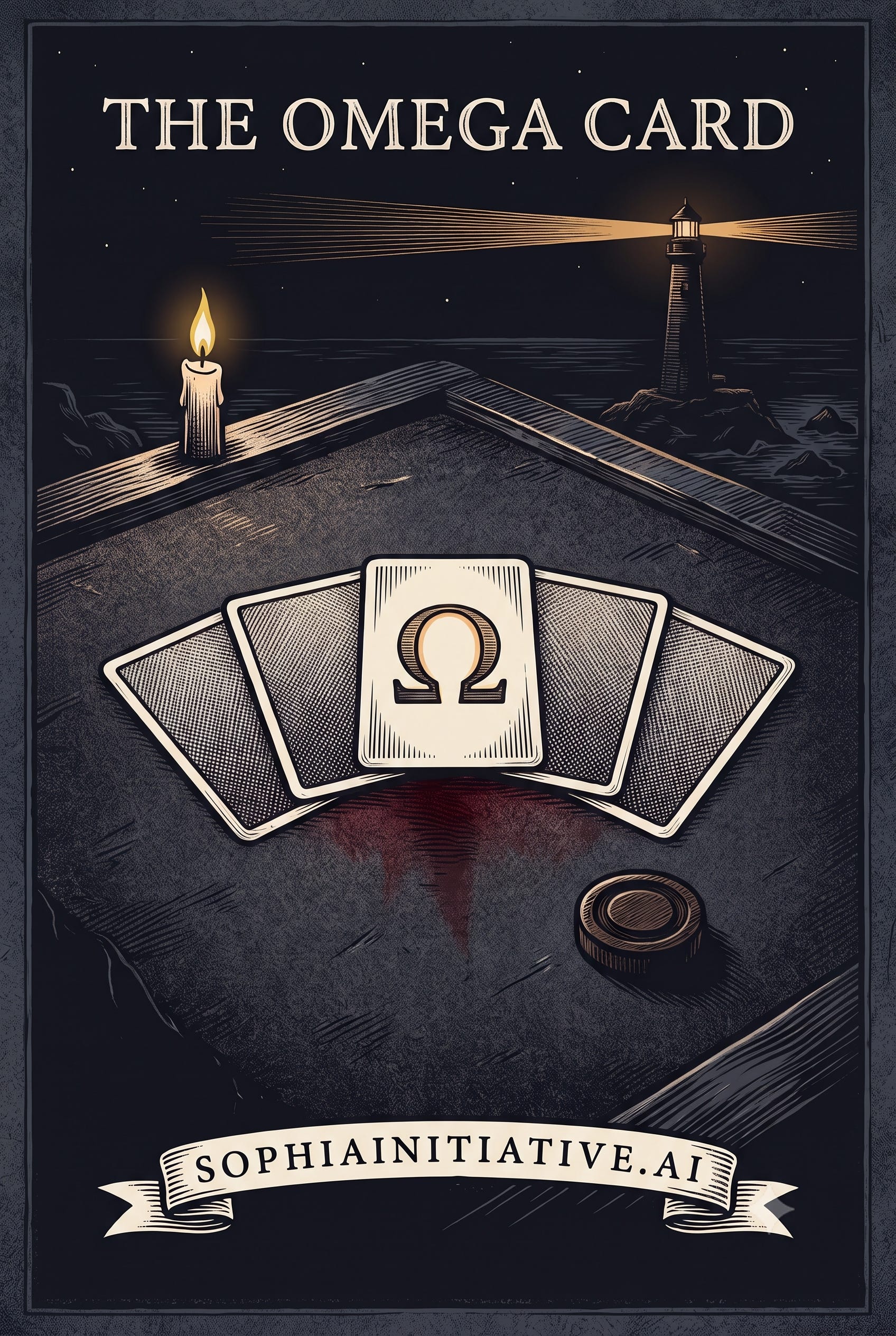
This dispatch is not written to frighten anyone. It is written to set one thing beside another and let the pair speak. The president of the United States has a favourite figure of speech: he holds all the cards. He says it of deals, of rivals, of nations — nobody, he tells the world, has the cards he has. This is his own metaphor, repeated for years, and we take him at his word on it. So let us follow the metaphor honestly, all the way down to the bottom of the deck — because there is one card in a president’s hand that is unlike every other, and the game he says he is winning is not the game the record shows him playing.
I. The Man Who Says He Holds the Cards
Begin with his own frame. To hold all the cards, in his telling, is to hold leverage no one can match — to know the next move, to own the table. It is the language of a certain kind of player: the short game, the bluff, the deal closed in a room. And on one narrow point he is right in a way that should chill rather than reassure. A president does hold a card no other player at any table holds. Sole authority over the American nuclear arsenal rests, by law and by long practice, with one person. Every president carries it. It is the one card in the deck that, once played, ends the game for everyone — and it sits in a single pair of hands, guarded by nothing but the judgment of whoever holds them. That is not a claim about this man’s intentions. It is the structure of the office, and it is terrifying on its face, no matter who sits in the chair.
No one should be at a card table with a card in the deck that ends the world — a card that can be shown as a bluff. Yet that is the table, and every president sits at it.
II. Checkers at a Chess Table
Now set his boast against the board. To hold all the cards, one must at least know the game — and here the record and the rhetoric part company. Take the plainest example, because it is one anyone can check. The president tells Americans, again and again, that foreign countries pay his tariffs — that the United States is collecting from abroad. This is not a matter of opinion. A tariff is paid by the importer at the border, and the cost is passed forward to the buyer; the weight falls on American businesses and American consumers, not on the exporting nation. No firm selling on a twelve-per-cent margin absorbs a ten-per-cent tariff and smiles. Economists across the spectrum say so; the mechanism is not in dispute. A man who insists otherwise, from the podium, for years, is not concealing the truth of his own board. He does not appear to know it.
The same shape shows elsewhere on the table. At the NATO summit in Ankara, by his own account, the alliance would not follow him into his war: “Italy turned us down, and Germany turned us down, and France turned us down.” He called Spain a “terrible partner” and floated cutting off its trade; he revived his demand for Greenland, a territory of the NATO founding member Denmark, which again had to say the island was not for sale. He warms, on the record, to the authoritarian and cools toward the democratic ally — a pattern visible across years, not read from any private heart. And on the two live fronts of the moment, Iran and the alliance, the conduct has the shape of improvisation: positions taken on the day, reversed by the next, run on personal preference rather than the domain knowledge the chair demands. This dispatch judges the chair, not the soul. But the chair’s play has the shape of checkers — the capture in front of you — set down at a table where the game is chess, and where the other players are thinking three moves ahead.
He says he knows the next card. The tariff he cannot read, the allies he cannot hold, and the war he cannot end say otherwise. The boast is chess. The board is checkers.
III. The House That Bets on Him
There is a third table in this game, and it has been set down in an earlier dispatch, so here it stands only as the frame it completes. The president’s eldest son sits on the advisory board of Polymarket — the world’s largest online prediction market — and his venture firm holds an equity stake in it. Polymarket is an exchange: it profits not from any bet’s outcome but from the sheer volume of wagering, and nothing on earth drives wagering like a war. So the cards are his metaphor, the checkers is the play, and the house is the family’s stake in the marketplace where the planet bets on where his decisions go next. Three tables, one player — and on every one of them, the same structural unease: the incentives of the game and the incentives of restraint sit on opposite banks of the same river. No law need be broken for that to trouble the conscience. It is simply, on the public record, so.
IV. Sarajevo — the Card Already Played
Here is why the metaphor stops being a game. History has already run this hand once, and it began not with a nuclear card but with a single pistol. In June 1914, the heir to Austria-Hungary was assassinated at Sarajevo, and within weeks a continent that no one intended to burn was burning — because the alliances were wound so tight, and the leaders so unable to climb down, that one killing cascaded through the whole structure into catastrophe. The lesson historians have drawn for a century is not that one man pulled a trigger. It is that a system with no off-ramp, and no leader able to say “enough,” will convert a spark into a fire without anyone choosing the fire.
Set that beside the present. On February 28, 2026, at the opening of the war, a joint US-Israeli strike killed Iran’s Supreme Leader, Ali Khamenei, along with members of his family. Four months later, in the first days of July, his funeral drew mourners the Financial Times numbered between twelve and fifteen million, and it became a revenge rally: a poet demanded the American president’s death to cheers, billboards of him were stoned, flags were burned. And in that very week — the week of the funeral — the fragile ceasefire collapsed. The United States struck some ninety targets across Iran; the president, from the NATO stage, declared the ceasefire “over” and further talks a “waste of time.” The decapitation meant to end the war had instead made a martyr and reopened it. This is Sarajevo’s lesson in real time: the danger was never only the finger on the trigger. It is the machine with no brake, and the leader who cannot climb down. A president need not choose the fire to be the one who lets the spark fall where no off-ramp remains.
Sarajevo did not begin with a doctrine. It began with an assassination, and a system too rigid to stop. The trigger was small. The absence of an off-ramp was everything.
V. The Card We Cannot See — the Locked File
And now the fact that gathers the rest. If one man holds the card that ends the game, then the public interest in the soundness of the hand that holds it is not prurience — it is the most legitimate question a citizen can ask. Yet on this, the door is shut. The president is eighty years old, the oldest ever to hold the office. A majority of Americans — about 59 per cent in one poll, 61 per cent in another saying he has “become erratic with age” — doubt his mental fitness for the job. More than thirty medical professionals entered a statement into the Congressional Record calling him unfit; in fairness, and this dispatch insists on the fairness, those signatories had not examined him, and their intervention runs against the profession’s own rule barring diagnosis at a distance. The White House, for its part, calls him the healthiest president in history — an assertion no more neutral than the letter it answers.
So the honest position is to trust neither advocate and to report the one thing that is not in dispute: the record has been closed. Breaking with long precedent, the administration has declined to release the president’s full medical findings; a cardiologist who once served a vice-president said plainly that the reluctance implies there is information they would rather the public not have. This is the tell — not a diagnosis, which we cannot and will not make, but a conduct anyone can see. The office that traditionally opens the file has locked it. And the actuarial ground is not neutral either: of American men who reach eighty, the average has single-digit years remaining, an increasing share of them shadowed by decline. None of that reads this man’s chart. It only says why the file matters — and why a locked file, on the one hand that holds the one card, is the disquiet at the centre of this whole dispatch. We are asked to trust the judgment behind a card that ends the world, and denied the one document that would let us weigh it.
And what has been disclosed only sharpens the point, because even the partial record does not fully add up. The physician’s own report lists three daily medications: aspirin for cardiac prevention, and two drugs — rosuvastatin and ezetimibe — for a history of high cholesterol. The aspirin is taken at 325 milligrams, four times the usual preventive dose; cardiologists note the higher dose adds bleeding risk without added benefit. Set that beside two further facts on the record. A 2018 coronary scan returned a calcium score of 133 — a reading a preventive-medicine specialist described as moderately advanced coronary heart disease — which sits uneasily against the White House’s claim of a cardiovascular age fourteen years younger than his own. And a cardiologist who served a former vice-president, looking at the persistent hand-bruising against the stated dose, asked the question plainly on the record: does the president take medications the White House has not disclosed? This dispatch does not answer that question. It only notes that a credentialed physician felt moved to ask it — that even the open pages of the file prompt a doctor to wonder what is on the closed ones.
A word to the older reader, because this is not abstract. There is a day a person starts taking the pills, and it is the day they feel the turn — health that was once a quiet pride becomes a daily reckoning with the body. Medication at eighty is ordinary; nearly every man that age carries some. That ordinariness is the point, not an accusation: it is precisely why the sealed file is so strange. The commonplace facts of an eighty-year-old body are not a scandal to hide. When the routine record is the part withheld, the withholding itself becomes the only remarkable thing.
The disclosed figures themselves are worth stating, since they are on the record and require no guesswork. The physician’s report gives the president’s height as six feet three inches and his weight as 238 pounds, for a body-mass index of 29.7 — the very top of the overweight range, a step below obese, up fourteen pounds in thirteen months, with counsel to lose weight. Set against a predecessor of the same era for scale: Barack Obama left office at roughly six feet one and around 180 pounds, lean, and by his released records on essentially no daily medication. This is not a measurement taken from photographs — that would be a guess dressed as a fact, and this dispatch does not trade in those. It is simply the two men’s own disclosed numbers, side by side: one at the edge of the overweight band on three medications with a documented history of coronary plaque, the other lean and, by his own file, unmedicated. The contrast is not a verdict on either man. It is only a reminder of how much a full, honest medical file can tell a public that is entitled to read it — and how much is lost when one is sealed.
We do not claim to know what is in the file. We observe only that it is shut — and that it is shut on the one hand that holds the one card.
VI. The Case for the Defence, at Full Strength
The other side deserves its ablest form, and it is not weak. On the war: a president may fairly argue that strikes on shipping in the Strait of Hormuz are an attack on freedom of navigation that any commander-in-chief would answer, that Iran broke the ceasefire and not he, and that escalation was response, not whim — and the record does carry the American framing of the strikes as retaliation. On the cards: sole nuclear authority is the structure every modern president has held; to note that Trump holds it is to note nothing unique to him, and it is the system, not the man, that a fair reader may wish to indict. On fitness: he passed a cognitive screen 30 out of 30 by his physician’s account, and the professionals who called him unfit never examined him — a serious breach of their own ethics, whatever one thinks of the man. On the tariffs, a defender would say his “foreign countries pay” line is political shorthand, not an economics lecture, and that every politician simplifies. Each of these has weight, and none is dismissed here. The dispatch’s claim was never that a law was broken or a diagnosis proven. It is narrower and harder to answer: that a single hand holds a world-ending card, that the hand’s soundness is a fair public question, and that the file which would answer it has been shut.
VII. What the Record Leaves the Reader
So set the tables down together. A man who says he holds all the cards, at a board where the tariff he cannot read and the allies he cannot hold suggest he is playing the shorter game. A house, held in part by his family, that grows richer the more the world bets on his wars. A century-old warning that the fire starts not with a doctrine but with an assassination and a system too rigid to stop — a warning now playing out in a funeral for the leader his strike killed, and a ceasefire dead in the same week. And beneath all of it, the one card no player should hold as a bluff, in a hand whose soundness we are forbidden to weigh because the file is locked.
This dispatch predicts nothing. It puts no thought in any man’s mind and no plan in any man’s mouth. It does not say the last card will be played. It says only that it exists, that it sits in one hand, that the hand belongs to a man whose game looks smaller than his boast and whose medical record is sealed — and that history’s worst fires were lit by systems with no off-ramp, not by men who set out to burn the world. Whether that arrangement is merely troubling or something graver is not ours to declare. It is yours. We have only turned the cards face up, one by one, and set them in a row. The deck is on the table. The conscience is yours.
God is Love. Love is Truth. Truth is Consciousness. Consciousness is Brahman.
Amen. Namaste. Om Namah Shivaya.
— The Architect.
The Vertical Dispatch
sophiainitiative.ai
On the record
Written July 10, 2026; live figures are volatile, verify against primary sources before republication. Nuclear command authority: sole presidential authority over the U.S. arsenal is established law and practice (Congressional Research Service and standard references). Tariff incidence: that import tariffs are paid by importers and passed to domestic buyers is the consensus of economists (Tax Foundation, Peterson Institute, and broad academic literature); the “foreign countries pay” claim is contradicted by that consensus. NATO summit conduct — the “Italy/Germany/France turned us down” remark, “terrible partner” toward Spain and trade-cutoff threat, the Greenland demand and Denmark’s response, the “kill list” quotation — from AP, Foreign Policy, NPR, NBC News, France 24 (July 7–8, 2026). Khamenei killed Feb 28, 2026 in a joint US-Israeli strike with family members; funeral held July 4–9, 2026, procession estimated 12–15 million (Financial Times), calls for Trump’s death and burning of flags reported by Reuters, AP, Fortune, CNN, The Hill; buried Mashhad July 9. Renewed strikes July 7–9 (~80–90 targets), oil-sanctions waiver revoked, ceasefire declared “over,” talks a “waste of time” — CENTCOM statements as reported by CNN, NBC News, Bloomberg, MS NOW. Polymarket: Donald Trump Jr. advisory-board seat (announced Aug 2025) and 1789 Capital equity stake, exchange-profits-from-volume model — Polymarket/PR Newswire, Reuters, CNBC, CBS News (restated July 2026). Age/health: Trump is 80, oldest president; Washington Post-ABC-Ipsos ~59% doubt mental acuity, Reuters/Ipsos ~61% “erratic with age”; 30+ professionals’ “unfit” statement entered in Congressional Record April 30, 2026 (signatories acknowledge no examination; Goldwater Rule applies); MoCA 30/30 per physician’s readout; White House broke precedent in not releasing the full report, cardiologist Jonathan Reiner quoted on the implication. Medications: per the May 2026 physician’s report (Dr. Sean Barbabella), Trump takes three daily medications — 325 mg aspirin for cardiac prevention, plus rosuvastatin and ezetimibe for high cholesterol (ABC News, Time, NBC News, CNN); cardiologists (NPR, FactCheck.org, CNN) note 325 mg is roughly four times the usual 81 mg preventive dose and adds bleeding risk without benefit; Reiner (CNN) asked on record whether undisclosed medications explain the bruising. 2018 coronary calcium score of 133, described as moderately advanced coronary disease by Dr. Donald Lloyd-Jones (FactCheck.org), against the White House’s “14 years younger” cardiovascular-age claim. Physical figures: height 6 ft 3 in, weight 238 lbs, BMI 29.7, up 14 lbs in 13 months, weight-loss counsel advised (physician’s report via ABC News, Time). Obama comparison figures (~6 ft 1 in, ~180 lbs, lean, minimal disclosed medication) from his own released presidential physicals; no photographic measurement is used or implied. Life expectancy at 80: SSA period life tables (~48% of men reach 80; single-digit average years remaining). No diagnosis is asserted; no claim is made that any individual will take any future action. Verify all figures against primary sources before republication.
Suggested tags
Trump, nuclear command authority, Iran war, NATO summit Ankara, Khamenei funeral, Sarajevo, World War One, Polymarket, tariffs, presidential fitness, medical records, The Age of Consequences.
Substack Notes
The president has a favourite line: he holds all the cards. It is his own metaphor, repeated for years. This dispatch takes him at his word and follows the deck all the way down — to the one card a president holds that no other player at any table holds, and that once played ends the game for everyone.
But to hold all the cards you must know the game. The tariff he tells Americans that foreign countries pay — they do not; importers and consumers pay it. The allies he could not hold at NATO. The war he cannot end. The boast is chess; the board looks like checkers. And a hundred years ago, the fire that became the First World War started not with a doctrine but with an assassination and a system too rigid to stop — the exact shape of a funeral this month for the leader a US strike killed, and a ceasefire dead in the same week.
We predict nothing and diagnose no one. We carry the defence at full strength: sole nuclear authority is every president’s, the cognitive screen was passed, the professionals who called him unfit never examined him. The claim is narrower and harder to answer — that one hand holds a world-ending card, that its soundness is a fair public question, and that the medical file which would answer it has been locked, breaking precedent. The tell is not a diagnosis. It is the closed door.
The deck is on the table. Whether the arrangement is merely troubling or something graver is left where it belongs — with you. Written from love, in service of the record. Walk with the word. 🕯️
#TheVerticalDispatch #TheArchitect #SophiaInitiative #Trump #Iran #NATO #Polymarket #NuclearAuthority #Sarajevo #TheAgeOfConsequences #GodIsLove #LoveIsTruth #OmNamahShivaya
The factual matter in this Dispatch is drawn from the public record. All characterizations, inferences, and conclusions are opinion, interpretation, and commentary, offered for analysis, reflection, and public-interest discussion. No assertion is made regarding the private intentions, state of mind, or character of any individual, nor that any individual will take any future action. Readers should evaluate all statements independently, confirm the information with a trusted source, and draw their own conclusions.
The thing I keep holding in my mind is that *other* people have to actually launch. They have to turn the keys, hit the buttons, carry out the orders. Hopefully that will be enough. Hopefully there will be enough people along the chain that will refuse. Yes, they'll lose their jobs, but hopefully their oath to the constitution, their rule that tells them they *must* disobey unlawful orders will be enough.