

I. THE MEETING THAT MATTERS
Yesterday, April 14, 2026, on Parliament Hill in Ottawa, two men skated with a women’s hockey team, signed defence MOUs, and quietly announced — between the lines — that something structural is shifting in how the world will be governed.
Finnish President Alexander Stubb told reporters he exchanges text messages with Canadian Prime Minister Mark Carney almost daily as the two countries pursue closer ties. That is not the cadence of diplomatic courtesy. That is the cadence of a working partnership — two minds in active co-construction of something.
The question this piece asks: what are they building, and why are they the ones building it?
II. THE EDUCATIONAL FORMATION — TWO STRATA PROFILES
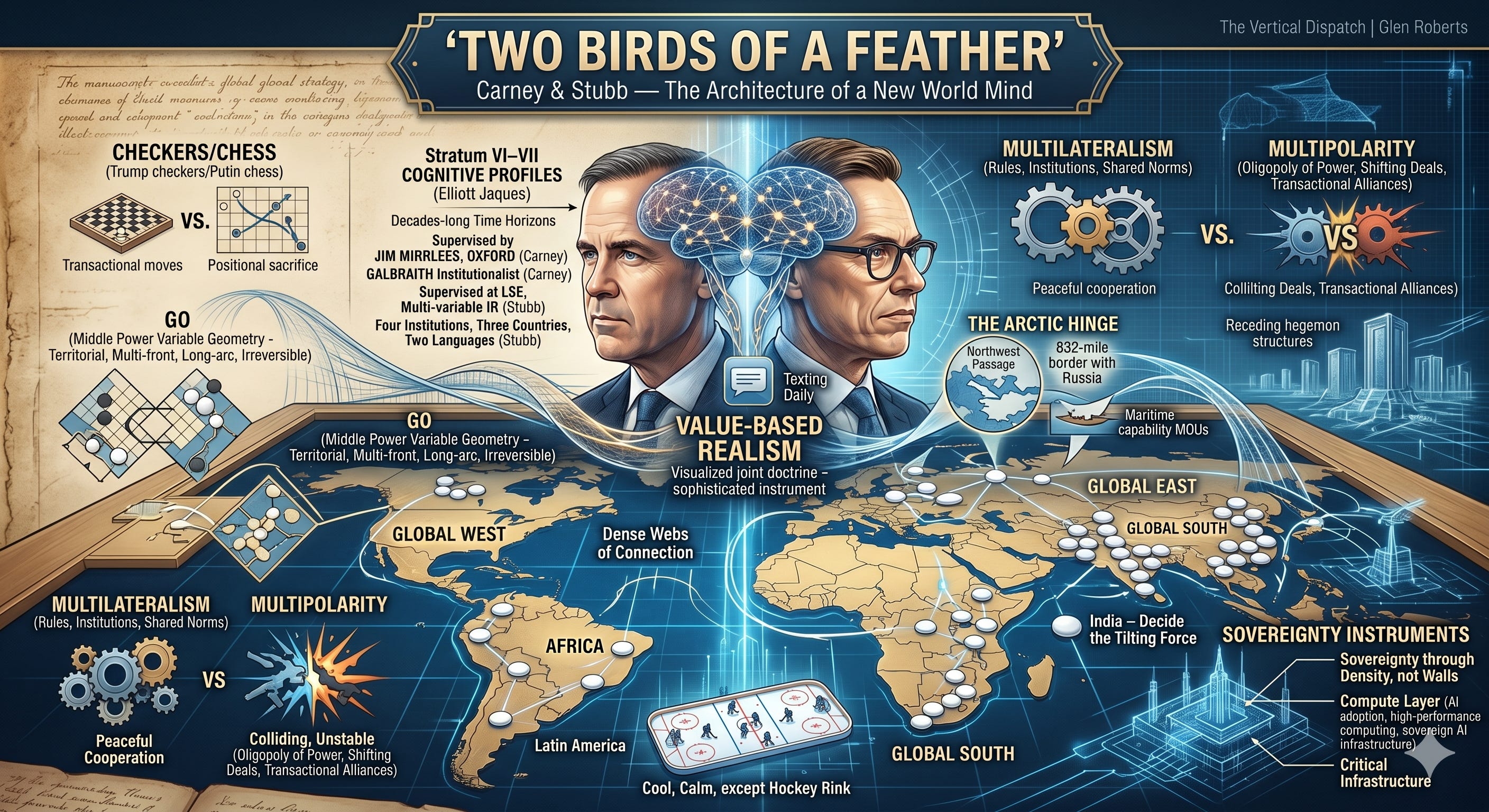
Before we examine the doctrine, we need to examine the minds. In Elliott Jaques’s Requisite Organization framework, Stratum VI and VII individuals don’t merely think about complex systems — they think in systems across decades-long time horizons, holding multiple interlocking variables simultaneously without collapsing them into simplicity. The biographical record on both men is unambiguous.
Alexander Stubb:
After general upper secondary school and military service, Stubb studied at Furman University in the United States, graduating with a Bachelor of Arts in 1993. In 1994, he studied at the Sorbonne in Paris, obtaining a diploma in French language and culture. He went on to complete a Master of Arts at the College of Europe in Bruges in 1995. In 1999, he defended his doctoral thesis in International Relations at the London School of Economics and Political Science.
Four institutions. Three countries. Two languages at postgraduate level. A PhD from the LSE in International Relations — the most contested, multi-variable field in the social sciences. His Furman professors described him as instilled with “curiosity, academia and a love of learning.” That is not flattery — that is a description of a mind that moves upward through abstraction rather than across the surface of facts.
Mark Carney:
Carney graduated with a bachelor’s degree in economics from Harvard University in 1987, and earned a master’s degree in 1993 and a doctorate in 1995 from the University of Oxford, both in economics. He came to Nuffield College in 1993 for his DPhil in Economics, under the supervision of Nobel laureate Jim Mirrlees.
Supervised by a Nobel laureate at Oxford’s most rigorous graduate college. Then thirteen years at Goldman Sachs across London, Tokyo, New York, and Toronto — not as a trader, but as someone who worked on sovereign risk and post-apartheid South Africa’s entry into international bond markets. Then Governor of the Bank of Canada. Then the first non-Briton to govern the Bank of England since its founding in 1694. Then UN Special Envoy on Climate Action and Finance.
His interest in economics was kindled by the lectures of John Kenneth Galbraith. Galbraith — the institutionalist, the systems thinker, the man who believed markets were political constructs before that was fashionable. The lineage matters.
The Elliott Jaques verdict: Both men demonstrate textbook Stratum VI–VII cognitive profiles. They don’t react to events — they model the systems that produce events, then reposition inside those systems before the events fully manifest. They are operating at what Jaques would call the “corporate” or “group-strategic” level — holding 10–20 year time horizons with genuine comfort. This is vanishingly rare in elected politics, where the cognitive incentive structure rewards Stratum III–IV thinking (the next quarter, the next election).
III. THE DOCTRINE — WHERE THEIR MINDS MERGED
The intellectual bond between these two men has a name, an origin, and a published architecture. It is not merely personal chemistry.
In his landmark Davos 2026 address, Carney stated that Canada’s new strategic approach “rests on what Alexander Stubb, the President of Finland, has termed ‘value-based realism.’” A sitting prime minister, on the world’s most watched economic stage, publicly crediting a foreign head of state as the intellectual source of his governing doctrine. That is extraordinary. That almost never happens.
What is values-based realism? Stubb defines it as “a set of universal values based on freedom, fundamental rights, and international rules, which take into account the realities of global diversity, culture, and history.” It is not a doctrine but an instrument — temporary, adaptive, and situational. Its aim is to espouse liberal values while engaging respectfully with those who do not share them.
The key move: Stubb distinguishes multilateralism from multipolarity. Multilateralism is rules-based cooperation anchored in institutions and shared norms. Multipolarity is “an oligopoly of power” — a world of shifting deals, transactional alliances, and great-power bargaining over the heads of smaller states. His formulation is precise: “A multipolar world runs on self-interest. A multilateral world makes the common interest a self-interest.”
Carney operationalized this at Davos with his own contribution: “The question today for middle powers like us is whether we establish the conventions and help write the new rules that will determine our security and prosperity — or let the hegemons dictate outcomes. Canada is choosing to create a dense web of connections to build our resilience. We’ve adopted a new framework — variable geometry — creating different coalitions for different issues based on common values and interests.”
Variable geometry. That is not chess. That is Go.
IV. CHECKERS, CHESS, AND GO — STRATIFYING THEIR PLAY
In the analytical typology I’ve developed at The Vertical Dispatch, strategic thinking operates at three distinct levels:
Checkers — reactive, piece-by-piece, zero-sum. Most electoral politics. Chess — positional, sequential, one board. NATO’s current default. Go — territorial, multi-front, long-arc, where surrounding is more powerful than capturing, and where the winning move is often invisible until it’s irreversible.
Trump plays checkers with the aesthetics of chess. He trades, threatens, and extracts — each move legible, each outcome transactional. Putin plays chess — cold, sequential, willing to sacrifice pieces for positional advantage.
Stubb and Carney are playing Go.
The evidence: Stubb’s framework in The Triangle of Power frames the coming order as a contest between the logic of Yalta — spheres of influence, great-power division — and the logic of Helsinki — open, cooperative multilateralism. He identifies three global coalitions as the players: the Global West, the Global East, and the Global South, and argues that the Global South will decide the outcome.
That is a Go reading of the board. The Global South is the unoccupied territory. Whoever surrounds it — not captures it, surrounds it — sets the shape of the next century.
Stubb told an Indian audience including Prime Minister Modi: “I believe that the Global South will decide what the next world order will look like. And India, as a major power, will be a major — if not the — force in deciding whether the world will tilt toward conflictual multipolarity or a new cooperative multilateralism.”
He said this in India. To Modi. In person. That is not a speech. That is a stone placed on the board.
V. THE END GAME — WHAT THEY ARE ACTUALLY BUILDING
Here is the thesis this piece advances, and I want to be precise:
Carney and Stubb are not attempting to save the existing liberal international order. They know it is finished. Carney said so explicitly at Davos: the rules-based order “was partially false” from the beginning — the strong always exempted themselves. As Carney observed: “This is not sovereignty. It’s the performance of sovereignty while accepting subordination.”
What they are building is the successor architecture — not a restored Bretton Woods, but a distributed, values-coherent, middle-power coalition network that can function without American hegemony as its guarantor. The key design principles emerging from their joint moves:
1. Sovereignty through density, not walls. Carney: “A world of fortresses will be poorer, more fragile and less sustainable. Collective investments in resilience are cheaper than everyone building their own.”
2. The Arctic as the strategic hinge. Canada and Finland signed an MOU on maritime capabilities, with Arctic science, research, and maritime security as the first pillar of their cooperation. Finland shares an 832-mile border with Russia. Canada owns the Northwest Passage. Together they hold two of the three critical Arctic corridors. That is not bilateral friendship — that is territorial positioning.
3. AI and critical infrastructure as sovereignty instruments. Their joint statement commits to collaboration on high-performance computing, AI adoption across governments and industry, sovereign AI infrastructure, and network communication technologies. Whoever controls the compute layer controls the epistemic layer. Both men understand this.
4. The Global South as the swing player. Both men are actively courting India, the African bloc, and Latin America — not with aid, but with frameworks. They are offering architecture, not charity. That is the Go move.
VI. WHY THESE TWO?
History occasionally produces leadership alignment — two minds at the right strata, with the right formation, at the right moment. Lincoln and Grant. Churchill and Monnet. The alignment of Carney and Stubb deserves that framing.
What binds them is not personality. It is epistemic formation. Both were trained in the hardest analytical traditions — Carney in macroeconomics under Nobel supervision, Stubb in International Relations at the LSE. Both spent years inside institutions (Goldman Sachs, the Bank of England, the European Parliament, the European Commission) before stepping into elected power. Both arrived with fully formed worldviews, not politically constructed ones.
Stubb explained their bond simply: “I think Finns and Canadians are quite similar. We’re cool, calm and collected except in the ice hockey rink.”
That is the public version. The deeper version: both are small-nation thinkers — one by geography, one by temperament — who know that middle powers survive through intelligence, not force. And both have concluded that the window for building the successor architecture is now, in the interregnum between American hegemony and whatever comes next.
The texting is daily. The thinking is decadal. The board is global.
Watch these two men. They are not reacting to the world. They are redesigning it.
Glen Roberts publishes The Vertical Dispatch on Substack. He is the author of Sacred Metaphysics and Consciousness: History of the Absolute & Eternal, and the developer of the Universal Dynamics framework and AIG — Artificially Intelligent Governance.
#TheVerticalDispatch #TheArchitect #MarkCarney #AlexanderStubb #ValuesBasedRealism #VariableGeometry #ArcticHinge #ElliottJaques #StratifiedSystemsTheory #RequisiteOrganization #StratumVII #SystemsThinking #Multilateralism #Geopolitics2026 #GlobalSouth #CdnPoli #Finland #GoNotChess #StrategicResilience #EpistemicLeadership #NewWorldOrder #MiddlePowerCoalition #ArcticSecurity #SovereignAI #GlobalGovernance #PoliticalPhilosophy #TheTriangleOfPower #TheLSE #OxfordEconomics #UniversalDynamics
I have worked extensively with Requisite Organization and agree with your stratum assessment. Impeccable timing and systems re-design in the 10-20 year horizon. We are so fortunate
BZ. We are indeed fortunate to have men like these in positions of leadership at this point in time. BZ to the electorates of both nations. In Canada a majority of citizens were able to discern the difference, the seriousness, the intellect and the accomplishments that Carney brought to the PM position. I’m not familiar of where Finland was politically when Stubb was elected, but cudos to the Finnish electorate for recognizing that intellect is needed in leadership.
I feel as if we are working toward where Canada was in the 50s and 60s. We were at that point, at the edge of a cliff, ready to take a big leap and soar. We built the Seaway, major hydro projects, new universities, our own naval destroyers, our own fighter aircraft, our own ASW aircraft, tilt rotor aircraft, STOL aircraft and thousands of fighters built under licence. But the leadership folded our wings, stepped back from the edge and looked south for nodded approval toward being of vassal status.