

Φ
THE VERTICAL DISPATCH
We write for the mind, the eye, and the ear.
Read it. Look at it. Listen to it. The Vertical Dispatch is built for all three — prose with rhythm, made to be heard as much as read.
From metaphysics to geopolitics, from culture to history, from the sacred to the street — and everything in between. One lens, every subject. No ego. Just the record, named clean.
Press play. Walk with the Word. 🕯️
The Age of Consequences
As of 7 June 2026
without malice and without flattery
“The man is always larger than the argument.”
This dispatch travels by hand. If it serves you, share it — restack on Substack, pass it on wherever you read. 🕯️
He was eight years old, and he thought he was being clever.
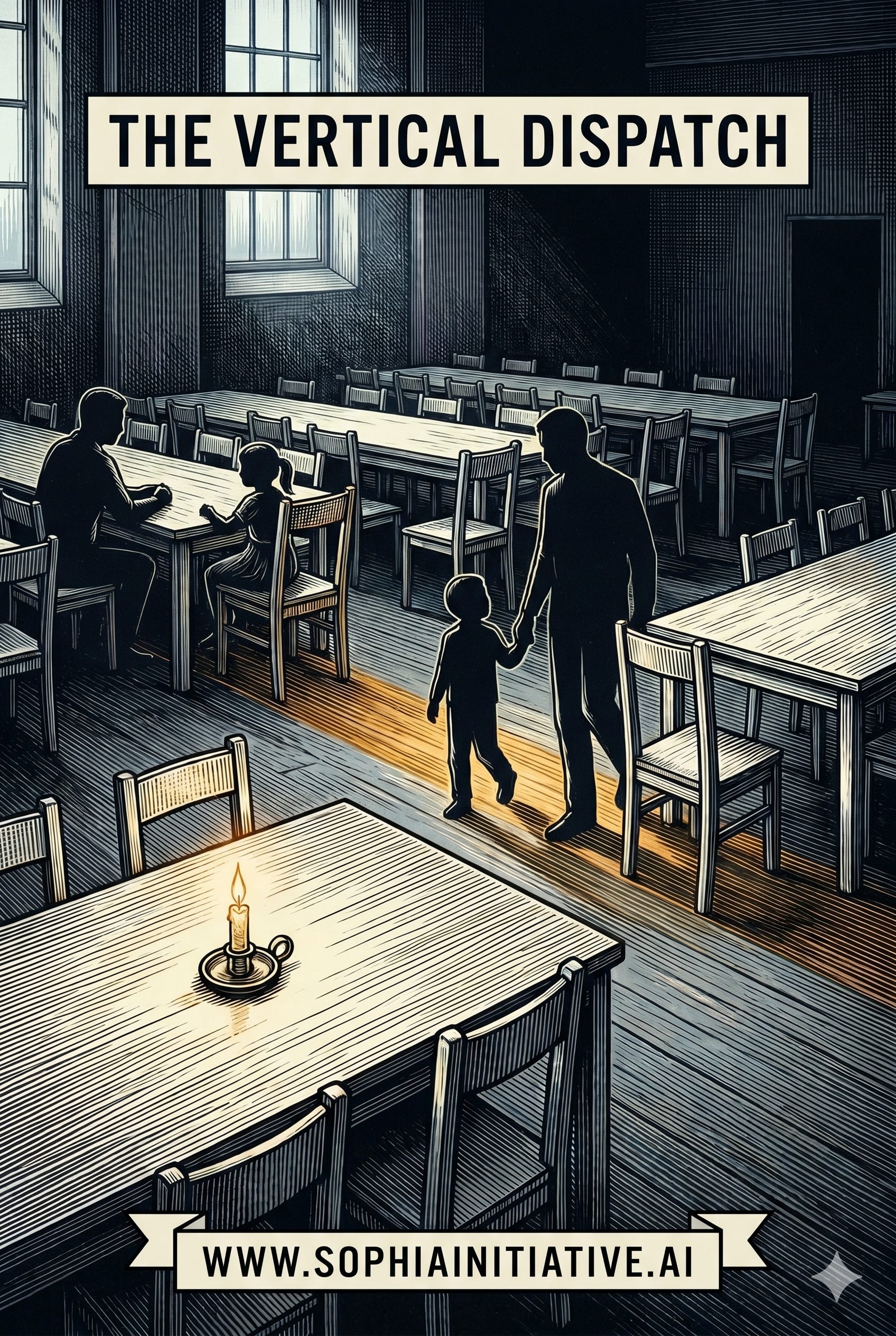
The parliamentary cafeteria. His father nearby. And across the room, one of Pierre Trudeau’s political rivals, eating quietly with his daughter. The boy did what boys do when they want to impress their fathers — he reached for a joke. A grade-school thing. Generic. Silly. The kind of dig that passes for wit when you are eight and you have not yet learned what wit costs.
Pierre Trudeau looked at his son. The look, Justin would later say, was one he would learn to know well.
“Justin, we never attack the individual. We can be in total disagreement with someone, without denigrating them as a consequence.”
And then Pierre did something the words alone could not accomplish. He stood up. He took his son by the hand. He walked him across the cafeteria and introduced him to the man his son had just mocked — his adversary, his rival — who turned out to be a nice man, eating dinner with his daughter, a pleasant girl a little younger than Justin.
The lesson was not delivered. It was enacted. Pierre Trudeau understood, as great teachers do, that the intellect hears words and the soul remembers encounters. Justin carried that moment for the rest of his life. He chose to place it at the centre of his father’s eulogy, in the Notre-Dame Basilica, in October of 2000, with the flag-draped coffin six metres away.
Of all the things a son could say about Pierre Elliott Trudeau — statesman, intellectual, adversary, visionary — Justin chose this. A cafeteria. A joke that shouldn’t have been made. A father who stood up. That tells you something. Not just about Pierre. About what the lesson had done to the man who received it.
What Pierre Actually Corrected
It wasn’t bad manners. It wasn’t cruelty. It was something more precise, and more dangerous: the instinct to define yourself by diminishing another. The boy making a joke about his father’s rival was not simply being rude. He was reaching for identity through contrast. I am on my father’s side. My father’s rival is lesser. Therefore I am more. The joke was not about the rival at all. It was about Justin — about his need to belong, to be seen, to be approved of.
This is what the ego does first. Before the grandiosity. Before the defensiveness. Before the rage when it is threatened. The ego’s first move is definition. I am this, therefore I am not that. I am with him, therefore I am against him. The self, as the ego constructs it, is always built on exclusion. It needs an outside in order to have an inside. It needs a lesser in order to feel like a more.
And then it needs to be right about all of it. This is the second move — the one that locks the first in place. Once you have defined yourself against someone, you have a stake in their being wrong. Their correctness threatens your definition. Their complexity — their niceness, their daughter, their ordinary humanness — becomes a problem to be avoided. The ego that has chosen its rivals cannot afford to know them. To know them would be to lose the boundary that constitutes the self.
Justin made a joke. Pierre made him shake the man’s hand. In that single gesture, he dissolved the joke’s entire architecture.
The Wound Dressed as a Confidence
The need to be right is not a confidence. It is a wound dressed up as a confidence.
The person who cannot be in a room without establishing where they stand, who they are against, why they are correct — that is not a person who knows themselves. It is a person afraid that without the constant performance of self-definition, there will be nothing there. The armour is not protecting something solid. The armour is load-bearing. Remove it and the whole structure trembles.
This is not only a psychological observation. It is a metaphysical one. In every contemplative tradition that has gone deep enough to be honest, the self the ego defends turns out to be a construction — not a lie, exactly, but a made thing, assembled from memory and contrast and the need to be someone in particular. The Sanskrit traditions call it ahamkara — the I-maker, the faculty that takes the undivided field of consciousness, pinches off a portion, and calls it me. It is not evil; it is functional. But when the construction begins to believe it is the foundation, it does what frightened things do. It defends. It defines. It diminishes. It attacks the man, not the idea — because the man who disagrees is experienced not as someone with a different view, but as a threat to the self that was built on the opposite view.
Pierre Trudeau understood something about this — in the practical register of a man who had chosen, as a discipline, to engage the idea rather than the person. You can be in total disagreement with someone, he said, without denigrating them as a consequence. That “as a consequence” is precise. He was not asking for false warmth, nor for the pretence that disagreements did not exist. He was asking for the recognition that the person is never reducible to the position. The man is always larger than the argument. Which means your disagreement with the argument does not license a verdict on the man. Which means your identity cannot be built on his diminishment.
A Word on What This Piece Is, and Is Not
Before going further, the discipline this dispatch describes must bind its own author, or it is worthless. To name a method is not to attack a man. What follows is not a verdict on anyone’s character, soul, or private intent — those are beyond the reach of any honest observer, and this Dispatch does not pretend to them. It is an account of conduct on the public record: what was said, what was done, what was rewarded. If any line here reads as an attack on a person rather than a naming of a method, then it has failed its own standard, and the failure is the writer’s. The teaching, however, must be made. A lesson Pierre Trudeau tried to give one boy in a cafeteria is a lesson the whole country now needs, and silence would be its own betrayal.
The Method, on the Record
We do not have to reach far. It happened in our own political lifetime.
Justin Trudeau was not a flawless prime minister — that is not the argument. He made errors of judgment, accumulated political liabilities, and by the end had lost the confidence of the country in ways at least partly of his own making. History will do its work on all of that. But what Pierre Elliott Trudeau warned his son against — the attack on the individual, the substitution of the person for the argument — became, under Pierre Poilievre, the visible organizing principle of the opposition’s conduct. Whatever the intent, and intent is not ours to read, the record shows the pattern plainly: Justin Trudeau was made into a symbol of everything wrong, a vessel for accumulated grievance, a face onto which an era’s frustrations could be projected and held. The man became the argument. And once that happens, no idea he advances can receive a fair hearing, because the hearing is no longer about the idea.
This during a period when Canada — and the world — was navigating a convergence of crises that would have strained any government: a pandemic, supply-chain collapse, inflation, a housing failure, the restructuring of the continental relationship under an erratic American administration. The conditions were not ordinary. And the documented response of the opposition was to ensure that, whatever happened, one man would carry all of it — not as accountable leader, which is legitimate, but as the figure onto whom blame is concentrated, which is the ego’s oldest move, performed at the scale of a nation.
Pierre Trudeau took his son by the hand and walked him toward the man he had mocked. He made Justin look at him. He is a person; the disagreement does not change that. That walk was never made in the other direction. And the country paid a price — not because Justin Trudeau deserved protection from criticism, but because a politics organized around the destruction of a person rather than the contest of ideas degrades everyone inside it. The voters. The institutions. The discourse. The opposition itself, which, having won by attacking the man, inherits a country that has forgotten how to argue about anything else.
And a generation came of political age watching that playbook executed in real time — and watching it succeed. What they learned was not how to contest ideas. What they learned, by example, was how to make a person into a problem and grind until they break. That is the lesson now etched into the political imagination of an entire cohort — precisely the lesson Pierre tried to correct in a parliamentary cafeteria, decades before any of them were born.
It Did Not Stop
If the method had ended with Justin Trudeau’s departure, it would be history. It did not end. The same shape is on the record now, aimed at the sitting Prime Minister, in a moment when the country can least afford it.
As of this writing, in June 2026, Canada faces a contracting economy, the pressure of high U.S. tariffs, and a genuinely difficult continental moment. These are real problems, and a real opposition is not only entitled but obligated to press hard on them. The legitimate version of that is the contest of plans — the government’s economic record against the opposition’s alternative, argued on the merits. But the record of early June shows the other thing alongside it: the results laid “directly at the feet” of Prime Minister Mark Carney as a person, the personal jab — “gallivanting around giving speeches filled with dazzling buzzwords” — the man made the vessel again. The Prime Minister’s own office called it “political theatre” and asked, not unreasonably, that the moment be met with a plan rather than a performance.
The point is not that the economy must not be challenged — it must, and hard. The point is the difference between challenging the plan and demolishing the person, and which one a critical hour deserves. A country navigating real danger needs an opposition that argues for its future, not merely against a face. The method Pierre Trudeau named in a cafeteria is not a closed chapter. It is the live question of this Parliament.
The Practice
So here is the practice. Not the theory. When you feel the reflex — and you will feel it, because it is old and it is fast — the reflex to define yourself by contrast, to win the argument at the cost of the person, to be right in a way that requires them to be small — pause before the words leave you.
Ask yourself what is being protected. Not defensively, not as self-criticism, but as genuine inquiry. What in me needs this person to be lesser? Because something does — some constructed boundary, some identity-edge, some story about who you are that depends on who they are not. Find it. Look at it directly. You do not have to dismantle it in the moment; you simply have to see it for what it is: a structure, not a truth.
Then ask whether the idea can stand without the attack on the man. In almost every case, it can. A sound idea does not need the other person’s diminishment to survive. And if it cannot survive without it — if you can only make your case by making the other person small — then the problem may not be with them.
Pierre Trudeau did not deliver a lecture on political ethics. He stood up and walked his son across a cafeteria. He enacted the alternative. This man is a person. Go and meet him. Full stop. The healing is not complicated. It begins the moment you stop needing to be right badly enough to make someone else wrong. It deepens each time you can hold your position without requiring the other person’s collapse to sustain it. And it arrives — quietly, without announcement — when you discover you can disagree completely, and still extend the hand.
Justin Trudeau chose that memory to carry his father out of the world with. Think about what that means. The man taught him how to stand on his own ground without needing to take someone else’s. That was the gift. That was the whole of it.
He warned us. We didn’t listen. And now the lesson belongs to the children.
The Case Others Would Make
In fairness, the strongest reply should stand at full strength. A defender would say that opposition is supposed to be adversarial — that holding a government to account necessarily means naming the person at its head, and that calling this “attacking the man” is a way of insulating leaders from the hard accountability democracy requires. There is truth in that: accountability is legitimate, pressure is legitimate, and a prime minister is fairly held responsible for the record of his government. One could also argue that the Trudeau governments invited personalization by centring so much on the leader’s own brand, and that Poilievre is simply meeting the politics he was handed. These are fair points, and they are not dismissed here. The distinction this piece rests on is narrow and, for being narrow, hard to kill: there is a line between challenging what a leader has done — the plan, the record, the result — and reducing the leader to a vessel for grievance so that no idea of theirs can be heard. The first is the contest of ideas. The second is the dissolving of it. Pierre Trudeau drew that line in a cafeteria. The argument here is only that it still holds.
Walk with the Word.
God is Love. Love is Truth. Truth is Consciousness. Consciousness is Brahman.
Amen. Namaste. Om Namah Shivaya.
— The Architect
The Vertical Dispatch
sophiainitiative.ai
On the record — sources (as of 7 June 2026). The cafeteria account and the quotation — “we never attack the individual… without denigrating them as a consequence” — are from Justin Trudeau’s eulogy for Pierre Elliott Trudeau, Notre-Dame Basilica, Montreal, 3 October 2000 (full text widely published; CBC Archives, 3 Oct. 2000). The eulogy describes the rival only as “this man” and does not name him; he is left unnamed here accordingly. Pierre Trudeau died 28 September 2000. Present-day conduct: Poilievre laid economic results “directly at the feet of” Prime Minister Mark Carney and called him “gallivanting around giving speeches filled with dazzling buzzwords,” with the Prime Minister’s office characterizing the approach as “political theatre” (The Canadian Press / BNN Bloomberg / National Observer, 1 June 2026). Q1 2026 real GDP declined 0.1% annualized, a second consecutive quarterly contraction; many economists dispute the “recession” label (Statistics Canada; Scotiabank, June 2026). “Ahamkara” names the ego-construct within Vedic / Sanskrit contemplative traditions and is offered as interpretation, not demonstrated fact. All characterizations of motive are expressly disclaimed; this piece addresses conduct on the public record only, and no claim is made regarding the private intent, state of mind, or character of any named person. No figure is disaggregated by race, group, or class. Errors and omissions excepted; corrections will be made on notice. Verify against primary sources before republication.
Substack Notes
When Justin Trudeau was eight, he made a joke at the expense of one of his father’s political rivals across a parliamentary cafeteria. Pierre Trudeau didn’t lecture him. He stood up, took his son by the hand, walked him across the room, and made him meet the man. “We never attack the individual,” he said — “we can be in total disagreement with someone without denigrating them as a consequence.” Justin placed that memory at the centre of his father’s eulogy. Of everything he could have said, he chose that.
This dispatch sits with what Pierre actually corrected — the ego’s first move, defining the self by diminishing another — and follows it from a cafeteria to the floor of the House of Commons. It is not a verdict on any man’s character; it is an account of a method on the public record: the substitution of the person for the argument, the leader made a vessel for grievance until no idea of his can be heard. And it does not stop with the past — the same shape is on the record now, aimed at the sitting Prime Minister, in a moment Canada can least afford it.
The piece holds itself to its own standard: to name a method is not to attack a man, and if any line crosses that, the failure is the writer’s. It closes, as the house requires, with the opposition’s best case at full strength — because the distinction it defends is narrow, and the narrow claim is the one that cannot be killed: there is a line between challenging what a leader has done and dissolving the contest of ideas by reducing the leader to a target. Pierre drew that line in a cafeteria. The argument is only that it still holds.
Metaphysics to geopolitics, the sacred to the street — one lens, every subject. If it serves you, walk with it, and pass it on by hand. 🕯️
#TwoPierres #PierreTrudeau #JustinTrudeau #PierrePoilievre #MarkCarney #CdnPoli #TheEgoAndTheArgument #Ahamkara #ContestOfIdeas #TheAgeOfConsequences #TheVerticalDispatch #TheArchitect #SophiaInitiative #GodIsLove #LoveIsTruth #OmNamahShivaya
Written from love, for a sacred humanity, in the full light of consciousness, toward the greater good. 🕯️
Suggested tags (post settings & header categories): The Age of Consequences · Canadian Politics · Ego and Identity · Mark Carney · Pierre Poilievre
The factual matter in this Dispatch is drawn from the public record. All characterizations, inferences, and conclusions are opinion, interpretation, and commentary, offered for analysis, reflection, and public-interest discussion. No assertion is made regarding the private intentions, state of mind, or character of any individual. Readers should evaluate all statements independently and draw their own conclusions.
So very well said, I hope people will take this as a lesson. As taught by Pierre Trudeau. Thank you.
There is always something new to learn about a person. Thank you for teaching us something about Pierre Eliot Trudeau, Justin Trudeau, and Pierre Poilievre.