


There is a question at the center of Canada’s defence debate that almost nobody in the political or media class is willing to state plainly. It is not a technical question about radar cross-sections or maintenance cycles. It is a sovereignty question dressed up as a shopping decision.
Here it is stated plainly: Is Canada buying an aircraft to defend Canada — or is Canada buying membership in the American expeditionary war-fighting network?
The answer to that question determines everything. Which aircraft. Which doctrine. Which alliances. Which future.
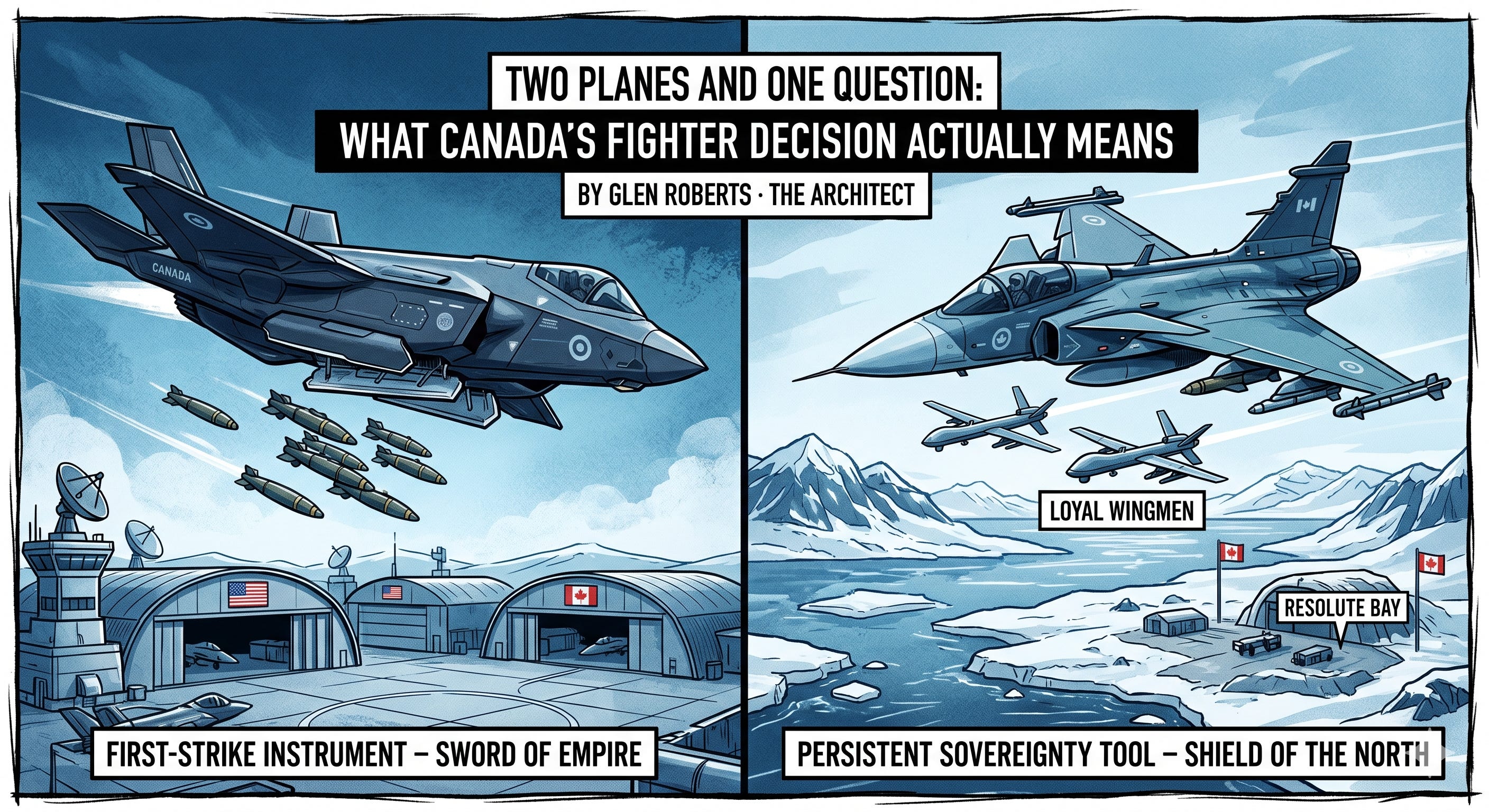
Act One: The Two Planes
The F-35 is an extraordinary machine. It is also the wrong machine for Canada’s actual mission, and understanding why requires understanding what it was built to do.
The F-35 was not designed to defend sovereign airspace. It was designed to penetrate defended airspace — to operate inside an enemy’s integrated air defence network on day one of a high-intensity conflict that the United States has chosen to initiate or escalate. It is a first-strike instrument. It is the sword of an empire. Every design decision — the stealth geometry, the sensor fusion architecture, the datalink systems, the mission data files that tell the aircraft what to treat as a threat — reflects that single purpose.
Those mission data files are updated by American systems under American control. The logistics chain runs through American infrastructure. The software that keeps the aircraft current flows from American contractors operating under American government authority. You cannot fully operate the F-35 outside the network it was built to serve. The interoperability is not incidental. It is the point. An F-35 operated by Canada is, at the hardware level, a node in the American war-fighting network. Not because any treaty requires it. Because the aircraft’s architecture requires it.
This means something that should be stated directly: Canada operating F-35s is Canada agreeing, in metal and software, to be available for American offensive operations. A country that owns F-35s but wants to stay out of an American war it disagrees with is operating the world’s most expensive and least appropriate sovereignty tool.
There is a further problem specific to Canada’s northern theatre. The F-35 requires hardened, climate-controlled, well-supplied air bases to operate from. It cannot land on a highway. It cannot be turned around in ten minutes by a small ground crew at a forward location in the high Arctic. Its maintenance demands are among the highest of any aircraft ever built — roughly fifty maintenance hours per flight hour under ideal conditions, a ratio that worsens severely in extreme cold. At minus sixty degrees Celsius in Resolute Bay, the F-35 is not a northern sovereignty tool. It is a southern base-dependent system that happens to be pointed north.
And every F-35 purchased is submarines not built, Arctic hubs not hardened, drone systems not developed, northern infrastructure not established. The opportunity cost is the real argument.
Sweden built the Gripen knowing that in any serious conflict its air bases would be destroyed in the opening hours. The aircraft therefore had to operate without them. Highway strips. Forest clearings. Improvised forward positions. A ground crew of five with basic training turning the aircraft around in ten minutes in weather that would ground most western aircraft entirely.
This is not a compromise. This is a doctrine made physical. Sweden’s strategic philosophy — we will defend Sweden, we will not be conscripted into anyone else’s imperial project — is embedded in the Gripen’s engineering at every level. Dispersed operations. National maintainability. Genuine technology transfer. No dependency on a foreign network to function.
Sweden has historically been willing to land intellectual property on partner soil in ways that American prime contractors are structurally prohibited from doing. For a nation committed to a Build-Partner-Buy doctrine — for a nation that has decided it will own the source code of its own defence — this is not a secondary consideration. It is the primary one.
The Gripen’s operational availability in northern conditions is dramatically higher than the F-35’s. More aircraft flying more of the time with less infrastructure. In a sovereignty mission defined by persistent presence rather than episodic surge, that metric is decisive.
Act Two: The Mission and What the Iran War Is Teaching Everyone
Here is what Canada needs its northern aircraft to do: show up. Consistently. Credibly. In weather that discourages showing up. Over distances that make showing up expensive. In conditions that make showing up technically demanding.
The threat Canada faces in its northern approaches is not a Soviet-era massed bomber strike. It is grey zone operations — the slow, deliberate, deniable erosion of sovereign presence by actors who understand that a claim uncontested long enough becomes a claim abandoned. Russian maritime patrol aircraft probing the approaches to the Northwest Passage. Chinese research vessels conducting surveys in waters that are legally Canadian. Shadow fleet vessels operating without identification in the Arctic Basin. Submarine contacts in the Beaufort Sea.
Against these threats the relevant capability is not stealth penetration. It is presence, identification, and credible response. A Gripen pulling alongside a Russian patrol aircraft over the Beaufort Sea is a sovereign act. The Canadian roundel, the human pilot, the radio call establishing Canadian jurisdiction — these carry legal and political weight that no autonomous system currently replicates in international law.
The aircraft in the northern sovereignty role is an investigator and a reporter before it is a fighter. Its sensors matter more than its missiles. Its availability matters more than its stealth. Its ability to operate from a forward location at Resolute Bay in January matters more than its ability to penetrate Moscow’s air defences — a mission Canada has no business conducting unilaterally regardless of what aircraft it operates.
The conflict in Iran has been the most significant live validation of evolving strategic doctrine in a generation. Four lessons demand attention.
First: volume defeats sophistication. Iran demonstrated that a mid-tier power with domestic drone manufacturing can saturate sophisticated air defence systems through sheer numbers and variety. Ballistic missiles, cruise missiles, and one-way attack drones force defenders into impossible triage decisions in real time. Do you use a three million dollar interceptor to kill a twenty thousand dollar drone? How many times can you afford that exchange before your magazine is empty and the drones are still coming?
Second: traditional air superiority is no longer the decisive variable. You can own the sky in the F-35 sense — no enemy aircraft survive — and still lose the infrastructure war to drone saturation below that ceiling.
Third: industrial sovereignty is the sustaining variable. Iran has maintained multi-year conflict against sophisticated adversaries while under severe sanctions by building a domestic defence industrial base that produces the weapons it actually uses. The lesson for Canada is that industrial sovereignty in defence is not a peacetime luxury. It is the variable that determines whether you can sustain operations when the supply chain breaks — and supply chains break.
Fourth and most relevant to Canada’s northern mission: grey zone operations require persistent investigative presence before they require combat response. The question is not always who to shoot. It is first who is there, what are they doing, and can you prove it to the standard that international law requires. That is an intelligence and reporting function. It is the function Canada’s northern aircraft must perform first.
The Northern Pack
Canada does not face this strategic moment alone. What is forming — quietly, deliberately, with the geographic logic of the Arctic as its spine — is a Northern Sovereign Bloc of nations that share a common strategic reality and a common rejection of imperial dependency as a defence doctrine.
The Nordic Five: Finland, Sweden, Norway, Denmark, Iceland. Nations that have lived for decades on the edge of Russian pressure. Nations that understand in their institutional memory what genuine sovereign defence requires. Nations whose entire military philosophy is built around resilience, dispersal, and national self-reliance rather than expeditionary power projection in someone else’s service.
The Baltic Three: Estonia, Latvia, Lithuania. Small, sovereign, digitally sophisticated nations that have built their defence architectures around the recognition that a small state on a great power’s border must be sovereign at every layer — physical, digital, institutional — or it is not sovereign at all. Estonia in particular has built the most advanced digital governance architecture in the world precisely because it understood that sovereignty at the kernel level was not optional. It was existential.
Greenland and Denmark holding the strategic hinge between the North Atlantic and the Arctic Basin. The most geopolitically consequential piece of Arctic real estate on earth right now and a critical node in any northern sovereign architecture worth the name.
And Canada — the western anchor. The nation with the longest Arctic coastline on earth, the most underdeveloped northern sovereignty infrastructure of any G7 nation, and the most to gain from this alignment.
What Carney has understood — and what his relationships with Finnish and Swedish leadership signal — is that this constellation of nations shares something more than geography. It shares a doctrine. Defend your own ground. Own your own industrial base. Partner with nations whose strategic interests genuinely align with yours. Do not be conscripted into someone else’s imperial project regardless of how the invitation is dressed.
The Gripen is already the aircraft of Sweden. Built on Nordic aerospace industrial capacity that Canada can partner with on terms that include genuine technology transfer. A northern sovereign air architecture built around a common platform — maintained domestically, operated from forward positions, designed for the conditions that actually exist in the high North — is not a fantasy. It is the logical conclusion of the doctrine that every nation in this bloc already holds.
Act Three: Who Decides — The AIG Imperative
The two-plane argument establishes what Canada needs and which aircraft serves that need. The Northern Pack establishes the alliance architecture. But both leave open the question that the Iran war has made the most urgent governance question of our time.
Who decides?
In a grey zone environment where threats are ambiguous, deniable, below the threshold of declared conflict, and moving faster than any parliamentary committee or cabinet deliberation can track — who holds the recognized picture of the entire northern domain simultaneously? Who decides what is a probe and what is an accident? Who decides when presence becomes provocation? Who calibrates the response in real time across thousands of kilometres of Arctic airspace, maritime approaches, and subsurface contacts?
Consider what simultaneous sovereign awareness actually requires. A Russian maritime patrol aircraft approaching the Northwest Passage. A Chinese research vessel conducting a subsurface survey in the Beaufort. An unidentified drone contact over Ellesmere Island. A shadow fleet vessel running dark in the Davis Strait. All happening at the same time. All requiring identification, classification, and response calibration within minutes. All carrying legal and diplomatic consequences that extend far beyond the immediate tactical situation.
Human commanders cannot hold that picture alone. The domain is too large. The variables too numerous. The time horizons too compressed. The consequences of misreading the situation too severe.
This is where AIG enters — Artificially Intelligent Governance.
AIG is not artificial intelligence in the consumer technology sense. It is not automation. It is not a system that replaces human judgment. AIG is the sovereign governance architecture that holds the complete domain picture no human command structure can hold alone, processes the variable load of grey zone operations in real time, and returns calibrated decision options to Canadian commanders operating under Canadian law. It is the cognitive infrastructure of sovereignty — the layer that makes it possible for human decision-makers to exercise genuine sovereign judgment rather than react to incomplete information under impossible time pressure.
The distinction that defines AIG in the northern defence context is the word sovereign. This is not a generic AI system purchased from a foreign vendor and integrated into an existing command structure. AIG is built on Canadian infrastructure, trained on Canadian data, governed by Canadian law, and answerable exclusively to Canadian sovereign authority. It holds the Canadian picture. It serves Canadian judgment. It operates under Canadian command. When it presents a decision option to a Canadian commander it is presenting that option within a framework that has already filtered out the foreign network dependencies, the foreign doctrinal assumptions, and the foreign terms of service that govern every system Canada currently relies on from outside its own borders.
The contrast with the F-35 architecture makes this concrete. The F-35 plugs Canada into the American decision architecture at the hardware level. American networks hold the domain picture. American systems process the sensor data. American mission data files define what constitutes a threat. American command structures set the terms of engagement within which Canadian pilots operate. Canadian pilots execute with extraordinary skill and courage within a framework whose foundational parameters were set in Washington. That is not sovereignty. That is the most expensive and most sophisticated form of delegation in the history of Canadian defence — delegation of the most fundamental sovereign act, the decision to use force in defence of Canadian ground, to a foreign architecture operating under foreign authority.
The Gripen operating within a Canadian AIG architecture is the structural opposite. Canadian sensors — the Gripen’s own systems, the NOSH mesh ground stations, the space-based surveillance layer, the under-ice sonar network — feed data into a Canadian sovereign intelligence layer. AIG holds that picture. AIG processes the variable load. AIG presents Canadian commanders with the recognized domain picture and the calibrated response options they need. Canadian decision-makers, supported by AIG and answerable to Canadian law, make the call. Canadian pilots in Canadian aircraft execute under Canadian authority.
The human pilot in the Gripen cockpit is the physical expression of sovereign presence. AIG is the cognitive architecture that gives that presence genuine sovereign intelligence rather than a partial picture assembled from borrowed systems.
Estonia understood this first among the Northern Pack nations. It built a sovereign digital governance architecture — an early expression of what AIG represents at the national scale — capable of running the entire Estonian state from dispersed servers even under kinetic attack. Air-gapped from foreign dependency. Maintained on Estonian infrastructure. Governed by Estonian law. What Estonia built for a nation of one and a half million people out of existential necessity is the template. What the Northern Sovereign Bloc needs is that architecture scaled, shared on sovereign terms among sovereign partners, and integrated into a common northern domain awareness layer that no single member nation could sustain alone but that all member nations control jointly and none controls exclusively.
Canada’s contribution to that architecture — the western anchor’s sovereign AIG kernel — is Project 2046’s first deliverable in the defence domain. Not a system purchased from a foreign vendor. Not a capability leased from an American cloud provider. A sovereign Canadian governance intelligence built on Canadian infrastructure, integrated with Nordic and Baltic partner architectures on terms that preserve each nation’s sovereign control of its own kernel, and operating across the northern domain as the cognitive layer that makes the physical presence of the Northern Pack strategically coherent rather than merely symbolically reassuring.
AIG does not make the decision. The Canadian commander makes the decision. AIG makes it possible for that decision to be genuinely sovereign — grounded in a complete and accurate picture of Canadian reality, processed through Canadian analytical frameworks, presented within Canadian legal and doctrinal constraints, and executed by Canadian forces operating Canadian equipment from Canadian sovereign ground.
That is the governance architecture the two-plane question was always really asking about. Not which aircraft. Not which alliance. But who holds the picture. Who processes the variables. Who serves the judgment. And whether the answer to all three of those questions is Canadian — or whether it remains, as it has been for the better part of a century, borrowed from a larger power that has its own interests, its own doctrine, and its own answer to the question of what Canadian airspace is ultimately for.
All three layers must be sovereign or none of them are. The aircraft. The alliance. The governance intelligence that makes both coherent/
#SovereignCanada #AIG #ArtificiallyIntelligentGovernance #NorthernSovereignty #CanadaDefence #Gripen #F35 #NorthernPack #Arctic #GreyZone #BuildPartnerBuy #Project2046 #CareyDoctrine #NATOAlliance #DigitalSovereignty #Estonia #NordicAlliance #BalticStates #IranWar #DroneWarfare #Level8 #TheVerticalDispatch #TheArchitect #CanadianPolitics #Geopolitics #AgeOfConsequences #ExistentialMaturity #NorthwestPassage #SovereignReconstructionOfCanada #Vajra
The three-layer framework here is the clearest articulation of sovereign defence architecture I’ve encountered in the Canadian debate, and the AIG argument in Act Three is where it earns its weight. What I’d add — not as a challenge but as a southern example — is the Brazil-Colombia case, because South America has been running this experiment under real conditions for decades without the luxury of choosing its dependencies. Brazil’s Gripen-Saab manufacturing partnership and KC-390 programme aren’t procurement decisions — they’re the same doctrine-made-metal logic you apply to Sweden, except Brazil is using the relationship to build the institutional capacity to eventually not need it. And the anchor problem your Northern Pack framework implies but doesn’t name explicitly is visible there: regional sovereign architecture coheres around a single node willing to absorb asymmetric institutional costs over decades. Canada declaring itself the western anchor and Canada demonstrating anchor capacity the way Brazil has are two different things separated by thirty years of consistent sovereign industrial policy.
The Colombia case is sharper and more uncomfortable. Colombia is the deepest US security partner on the continent — Plan Colombia Americanized its military institutions across an entire generation, exactly the hardware-and-doctrine dependency you identify with the F-35. And yet the Colombian military has maintained a parallel institutional layer that preserves sovereign judgment independent of the political relationship. When Petro shifted alignment, the military didn’t follow — it was architected not to. The procurement decisions running underneath the political noise — the frigate programme, the Gripen process, the KC-390 MOU at FIDAE — systematically avoid total lock-in to any single foreign architecture. That’s AIG logic without the acronym: a sovereign decision layer that holds the institutional picture independently of the political noise above it and the dependency pressures below it. Your framework assumes the layers can be built deliberately from a stable foundation. Colombia’s answer is harder — sometimes you build sovereign judgment inside the dependency, using institutional discipline as your only genuinely sovereign asset, because the clean break geopolitics would require never arrives.
Well articulated
I know where my sovereignty lies