

Φ
THE VERTICAL DISPATCH
We write for the mind, the eye, and the ear.
Read it. Look at it. Listen to it. The Vertical Dispatch is built for all three — prose with rhythm, made to be heard as much as read.
From metaphysics to geopolitics, from culture to history, from the sacred to the street — and everything in between. One lens, every subject. No ego. Just the record, named clean.
Press play. Walk with the word. 🕯️
This dispatch travels by hand. If it serves you, share it — restack on Substack, and pass it on wherever you read. 🕯️
The Age of Consequences · Building Canada Strong
A Canadian Geopolitical Analysis · without malice and without flattery
As of July 7, 2026
“For over a century, Canada has been a net exporter of security to Europe.”
— Prime Minister Mark Carney, closing remarks, The Hague, June 25, 2025
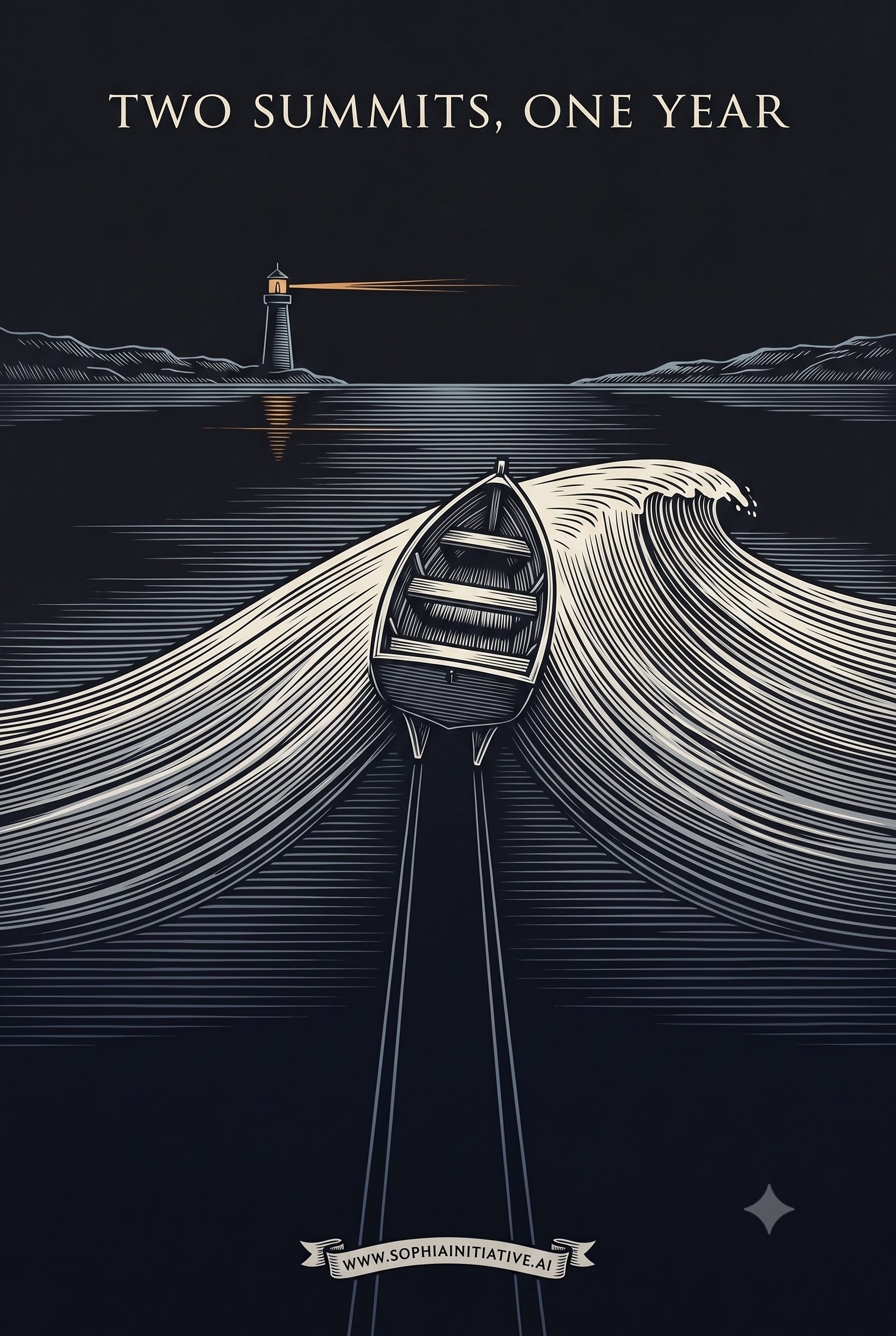
Twelve months separate two rooms. In June of 2025, in The Hague, a new Canadian prime minister stood among the thirty-two and signed his name to a number: five percent of national output on defence by 2035. In July of 2026, in Ankara, the same prime minister stood in a room the alliance had deliberately shrunk to keep the peace, and did something the number alone does not capture. He did not simply spend more. He changed the direction of the spending. This is a dispatch about that turn — what Canada did at NATO under Mark Carney, and what the doing reveals about where the country is pointing its boat.
There are three things to see here, and they are not rivals. There is the shape of the turn — two summits, one year, and the pivot that runs between them. There is the substance of the turn — the submarines, the bank, the radar planes, the fighter review, the ledger of what a middle power actually bought and built. And there is the meaning of the turn — what, exactly, this hedging is a hedge against. Structure, evidence, meaning. We take them in that order, because the honest way to read a conclusion is to watch it assemble itself from the record.
I. The Shape — Two Rooms, One Year
Read the two summits side by side and the story is in the contrast. At The Hague, the alliance agreed to the five-percent target — 3.5 percent for core military spending, 1.5 percent for defence-related infrastructure, over ten years, with a review in 2029. It was, in the plainest terms, a victory handed to the United States. NATO Secretary General Mark Rutte opened the shortened summit by praising the American president by name — thanking him for a change the alliance credited to his pressure. Canada arrived as a nation reaching the two-percent floor for the first time that year, and Carney’s own words framed the alliance as the instrument of Canadian safety: collective security, he said, remained the strongest and most effective way of protecting Canadian sovereignty. The posture was that of a member re-committing to a house it had underfunded.
Ankara, one year on, is a different posture in the same body. The setting itself tells part of it: the summit was streamlined — leaders and analysts agree, to avoid a diplomatic blow-up — and the American president arrived not as the alliance’s benefactor but as its chief uncertainty, threatening to pull troops from Europe, floating control of Greenland as a condition, and announcing a phased withdrawal of American warplanes, destroyers and submarines from NATO countries. Into that room Canada did not bring a re-commitment. It brought an architecture — a set of purchases and institutions whose common thread is a tilt away from the single American hub and toward Europe, toward partners, toward building at home. Same prime minister. Same five-percent number. A different direction of travel.
At The Hague, Canada re-joined the house. At Ankara, it began building a second keel.
II. The Substance — What Was Bought, Financed, and Built
The turn is not rhetoric; it is a ledger. And the ledger has a clean shape: one thing Canada bought from Europe, one thing Canada is financing and housing itself, one thing Canada is building on its own soil. Buy, finance, build.
The submarines — bought from Europe. On his way into the summit, Carney stopped in Halifax to name a German-Norwegian consortium, TKMS, as the preferred bidder to build up to twelve submarines for the Royal Canadian Navy — the most lucrative procurement in Canadian history. The tell is in the choice itself. Canada passed over South Korea’s Hanwha (held in reserve) for a European partner whose fleet will be interoperable with allied navies; the Norwegian prime minister called it a “huge” decision and spoke of three nations fielding twenty-six submarines that can operate as one. Defence Minister David McGuinty framed it as Arctic interoperability — shared crews with Germany and Norway. Carney said the decision was taken within a year rather than by the end of the decade because of “the urgency of the situation” and “the threats that we face.”
The defence bank — financed and housed by Canada. Carney has spent the year campaigning for a Defence, Security and Resilience Bank — a multilateral institution to mobilise private capital for the defence sector, explicitly framed by his negotiators as part of a call for an alliance of middle powers to answer what he sees as the fracturing of the traditional, American-led world order. The bank is to be headquartered in Canada. This is the item that most fully expresses the pivot — and it is also the item the page must not flatter. At Ankara, eight countries committed to it: Albania, Belgium, Greece, Latvia, Luxembourg, Romania, Turkey and Ukraine. Canada had aimed for around ten founding nations. No other G7 ally, and no major European heavyweight, has yet signed on; Germany is an observer “reviewing the outcome,” the Netherlands opted out. The ambition is real. So is the gap between the ambition and the roster.
The radar planes — built in Canada. The quietest item is arguably the strongest card. Rutte announced the alliance is looking to jointly procure up to ten Saab GlobalEye airborne early-warning radar jets — aircraft largely manufactured in Canada. Where the submarines are Canada spending capital outward to Europe, the GlobalEye is the alliance spending into Canada’s industrial base. Canada had already, in late May, confirmed negotiations with Saab for five to six of the aircraft for its own use — filling a long-standing sovereign gap, and projected to create over three thousand domestic jobs. Buy, finance, build: the third leg lands the weight at home.
Behind these three sit the year’s quieter record, the scaffolding Carney arrived with: the launch of a Defence Investment Agency and a Canadian Defence Industrial Strategy calling for nearly half a trillion dollars in defence-related investment over the decade; Canada becoming the first non-European nation to join the European Union’s SAFE initiative; the two-percent target met for the first time; and, through Operation REASSURANCE, Canada’s largest sustained military presence in Europe in more than thirty years, with the Latvia deployment extended by three years. McGuinty has named the next waypoint — 3.5 percent by 2029 — and says the numbers will land in the fall budget.
III. The Fighter Review — the Pivot Caught in the Act
If you want to watch the turn happening in real time, rather than after the fact, look at the fighter jets — because there the decision is not yet made, and the tension is fully visible. In early 2025 Carney ordered a review of Canada’s 2023 contract for eighty-eight Lockheed Martin F-35s, citing over-reliance on the American defence industry amid the trade war. The review has stretched well past its original timeline and remains unresolved. Ottawa has legally committed to the first sixteen jets and quietly begun payments on long-lead components for fourteen more — preserving its place in the production queue — while openly weighing a mixed fleet: roughly thirty F-35s retained for the deepest NORAD integration, and some sixty Swedish Saab Gripens, assembled in Canada, for everything else.
The honest reading holds both hands of this. On one side, the pull toward the American jet is structural, not sentimental: NORAD runs on interoperability — shared sensors, shared data links — and Air Force leadership and internal evaluations have favoured the F-35 on capability. Backing out has a real cost. On the other side, the Gripen offer carries lower operating costs, Arctic-friendly maintenance, thousands of domestic jobs, and — the word that matters most in this whole dispatch — data sovereignty: a fighter Canada could build and control on its own ground rather than depend upon at another power’s discretion. The pressure is not subtle. In January, the U.S. Ambassador to Canada, Pete Hoekstra, told the CBC that if Canada did not proceed with the full order, NORAD “would have to be altered,” and the United States might fly its own jets into Canadian airspace to fill the gap. That is the vice the review sits inside: the alliance’s integration on one jaw, the country’s autonomy on the other.
The submarines show the turn completed. The fighters show the turn in mid-air — the boat between two angles, not yet settled on either.
IV. The Meaning — a Hedge, and What It Hedges Against
Set the ledger down and ask the only question that matters: why this direction, and why now? The tempting answer — the one a hostile reader reaches for first — is that a middle power is spending lavishly to flatter an angry patron, buying European toys to look independent while its budget bleeds. That reading is available, and fairness requires carrying it at full strength. But it does not survive the pattern. You do not house a rival financing institution on your own soil, pass over the American fighter for a jet you can build yourself, and pick a European submarine consortium, if your aim is to please Washington. The through-line is not appeasement. It is insurance.
The meaning, stated plainly and without reading anyone’s mind: Canada is building a second keel because it can no longer assume the first one will hold. For seventy-five years the American security guarantee was the load-bearing wall of the Western order. This year the wall’s own architect is asking aloud what happens if it comes out — pulling ships from Europe, conditioning presence on Greenland, calling the alliance a one-way street through his Secretary of State. You do not need to predict whether the wall falls to notice that a prudent tenant, hearing that talk, starts framing a second support. Carney’s conduct — not his stated motives, which we do not claim to know — has the shape of exactly that framing. The subs, the bank, the radar planes, the fighter hedge: each is a beam set against the possibility that the American guarantee becomes conditional. That is what the turn between the two summits is for.
And the honest close is the open question, at full strength, because a dispatch that binds claims to their referents must not let its own claim outrun the record. It is not yet known whether the second keel will bear weight. The bank has eight small and mid-sized partners and no heavyweight; a middle-power architecture without a heavyweight anchor is an aspiration, not yet a structure. The fighter decision is unmade. The five-percent commitment, as Carney himself conceded at The Hague, means real domestic trade-offs — what less the federal government can do — that Canadians have not yet been asked to weigh at the ballot box. The turn is real and it is documented. Whether it is wise, and whether it will hold, belongs to the reader and to the years ahead. What can be said now is only the structure: two summits, one year, and a country that walked into the second room building the thing it walked into the first room still trusting it would not need.
God is Love. Love is Truth. Truth is Consciousness. Consciousness is Brahman.
Amen. Namaste. Om Namah Shivaya.
— The Architect.
The Vertical Dispatch
sophiainitiative.ai
On the record
The Hague summit (June 22–25, 2025), the 5% pledge (3.5% core / 1.5% infrastructure, 10-year horizon, 2029 review), and Carney’s closing remarks are from the Prime Minister of Canada’s office and CBC News (June 25, 2025). Rutte’s praise of the U.S. president at The Hague is from Yahoo/CBC coverage of that summit. The 2026 Ankara summit (July 7–8, 36th NATO summit, hosted at the Beştepe Presidential Complex) and Rutte’s three priorities are from NATO.int and Congressional Research Service report R49018 (July 2026). The TKMS submarine selection, the eight defence-bank founding nations, the removed financing-panel slot, and PM Carney’s Ankara bilaterals are from The Canadian Press (via BNN Bloomberg, National Observer, Lethbridge Herald, Global News), July 7, 2026. The DSRB founding-member target (~10) and capital structure are from Reuters (July 2, 2026). The Saab GlobalEye procurement (up to 10 alliance jets largely built in Canada; Canada’s own 5–6 aircraft, ~3,000 jobs) is from Rutte’s Ankara remarks and Army Recognition (June 3, 2026). The F-35 review, the 16+14 long-lead payments, the mixed-fleet scenario, and Ambassador Hoekstra’s January 26, 2026 NORAD remarks to CBC are from CBC News, Aerotime, and 19FortyFive (Jan–May 2026). Trump’s Greenland/troop-withdrawal remarks and Rubio’s “one-way street” framing are from CBC and CBS News (April–July 2026). Defence Investment Agency, Defence Industrial Strategy (~C$500B/decade), SAFE membership, and Operation REASSURANCE figures are from the PMO release (June 30, 2026). No figure herein is disaggregated by race or group. Characterizations of Canada’s strategic direction are interpretation, not attributions of any individual’s private intent. Errors and omissions excepted; corrections will be made on notice. Verify against primary sources before republication.
Suggested tags
NATO, Ankara Summit, The Hague Summit, Mark Carney, Canada defence policy, TKMS submarines, Saab GlobalEye, F-35 review, Gripen, Defence Security and Resilience Bank, middle powers, Canada–US relations, defence procurement, Canadian sovereignty.
Substack Notes
Twelve months, two NATO summits, and a country that changed the direction of its boat between them. In The Hague in 2025, Canada signed onto the alliance’s five-percent defence pledge — a victory the alliance handed to Washington. In Ankara in 2026, the same prime minister brought something different: not a re-commitment, but an architecture tilted away from the single American hub and toward Europe, toward partners, toward building at home.
This dispatch reads what Canada actually did at NATO under Mark Carney — the submarines bought from a German-Norwegian consortium, the defence bank Canada is financing and housing itself, the radar jets built on Canadian soil, and the fighter-jet review still caught in mid-air between the American F-35 and a Swedish jet Canada could build and control. Buy, finance, build — and one decision still unmade.
We carry the honest grain at full strength: the bank landed with eight small and mid-sized partners and no heavyweight anchor; the financing panel Carney was to speak on was quietly dropped from his Ankara schedule; and the five-percent commitment means domestic trade-offs Canadians have not yet weighed. The turn is real and documented. Whether it holds is the open question — and we leave it open, deliberately, because that is the honest thing to do.
Structure, evidence, meaning: two summits, a ledger, and a hedge. Read it for the shape of a middle power learning to build a second keel — not because the great ship is certainly sinking, but because it can no longer be sure the ship will be there when the water turns. Written from love, in service of the record. Walk with the word. 🕯️
#TheVerticalDispatch #TheArchitect #SophiaInitiative #NATO #AnkaraSummit #MarkCarney #CanadaDefence #TKMS #GlobalEye #F35Review #MiddlePowers #BuildingCanadaStrong #TheAgeOfConsequences #GodIsLove #LoveIsTruth #OmNamahShivaya
The factual matter in this Dispatch is drawn from the public record. All characterizations, inferences, and conclusions are opinion, interpretation, and commentary, offered for analysis, reflection, and public-interest discussion. No assertion is made regarding the private intentions, state of mind, or character of any individual. Readers should evaluate all statements independently and draw their own conclusions.
I grew up in the time of long hair; make love not war. Our world made secure by our parent’s sacrifice. This is the boomer background to the long drift away from defence spending. Yet it was defence spending that brought USA out of a decade long depression. It seems defense spending will also be what reactivates Canada.
You name the competing forces accurately.
We don’t have just one big wave, as you lived in the Gaspe, but multiple. Like the rapids I grew up with in Ontario rivers. Two keels, or a light agile craft able to pivot and portage?