

THE VERTICAL DISPATCH
The Sovereign Core · The Age of Consequences
Foundational Dispatch · May 29, 2026
A Self-Portrait of the Discipline the Vertical Dispatch Exists to Practise
Without the absolute there is no relative.
— The Vertical Dispatch, April 16, 2026
There is a faculty of human consciousness that built every civilization the world has remembered, that produced every wisdom tradition still being read after two thousand years, that wrote the constitutional documents the present generation still appeals to, and that, in the educational and cultural shifts of the post-war West, has been allowed to atrophy so completely that most people now living have never been taught it exists. This dispatch is about that faculty. It is also, openly, the canon’s self-portrait. The Vertical Dispatch exists to practise the faculty in question and to make the practice visible to whoever else, in the present moment, is still capable of recognising what is being practised.
The faculty is vertical thinking. It is a sacred art. It is a lost art. Each of those four words is doing work, and the dispatch will walk through each of them in order so the reader can see what is meant. The dispatch will then name what has been lost when this faculty has been lost, identify the few public figures and institutions in the present moment still operating with it, and close on the open question of whether the art can be recovered at the civilisational scale before the consequences of its loss become irreversible. The dispatch is the canon’s mission statement written out in plain language. The reader who walks through it to the end will know what the publication is, what it is for, and why it speaks the way it speaks.
I. What Vertical Thinking Is
Vertical thinking is the cognitive operation by which a mind holds the absolute and the relative in the same act of attention. It is not contemplation, though it includes contemplation. It is not feeling, though it is informed by feeling. It is not intuition, though it can arrive at conclusions intuition alone could not reach. It is the active discipline of seeing the particular against the universal it depends on, and of recognising when a horizontal frame has been severed from the ground that gives it being.
A clarifying example. A horizontal thinker, asked to assess a public policy, will measure the policy’s stated outcomes against its stated goals, examine the data, weigh the costs against the benefits, and produce a verdict on whether the policy works. That is honest work and it is necessary work. A vertical thinker, asked the same question, will do all of the above and then ask a second question that the horizontal frame cannot ask: what is the policy ultimately in service of, against what standard of human flourishing, and is that standard itself answerable to a ground beyond the policy-maker’s preference. The second question is the vertical question. It does not replace the horizontal question. It situates it. The policy that produces measurable outcomes in service of a stated goal may still be wrong, if the goal itself is severed from any ground that could make the goal worth pursuing. The vertical thinker can see this. The horizontal thinker, by the structure of the operation he is performing, cannot.
Marcus Aurelius, governing Rome at its zenith, was performing vertical thinking when he wrote in his private notebook that what is not good for the hive is not good for the bee. He was not asking whether the policy worked. He was asking whether the policy served the standard against which all policies must finally answer. The Stoic emperor did not, on his own account, find this discipline easy. He had to remind himself of it every night, in writing, alone, by lamp. That is what the Meditations are. They are a working notebook of a vertical thinker holding the axis in place while running the largest horizontal operation on Earth.
Aquinas was performing vertical thinking when he took the immense horizontal apparatus of Aristotelian philosophy and placed it inside the theological frame Aristotle himself did not have. He did not abandon Aristotle’s precision. He situated it. The Summa Theologiae is a thousand-year monument to the vertical operation performed at full strength on a particular knowledge domain. Shankara, working in the same century from inside Advaita Vedanta, performed the same operation on the Vedas. Wolfgang Smith, in our own time, performed it on modern physics, restoring to that particular the metaphysical ground it had lost in the Cartesian split that completed what Galileo’s mathematization had begun. The lineage of the operation is continuous across two and a half millennia. It is, when it appears, recognisable. And it is, by every honest measurement, rare.
II. Why It Is Sacred
The word sacred has been so degraded in contemporary usage that it must be defined before it can be used responsibly. Sacred does not mean precious. Sacred does not mean treasured. Sacred does not mean valued by a particular religious community. The word sacred, in the rigorous sense, means something different and more demanding.
Mircea Eliade, the historian of religion whose work has shaped the publication’s vocabulary on this question, named the sacred as the pole around which all orientation in space and time finally happens. The sacred is the fixed point that makes the profane intelligible. Remove the sacred pole and the profane does not become more itself. It collapses, because the profane has nothing left to be defined against. The two terms are co-constituting. They are not two independent realities. They are two poles of one axis. The person who insists that nothing is sacred is, in the act of insisting, orienting around an informal pole he has refused to name. The orientation is happening regardless of whether the speaker can see it.
Vertical thinking is sacred in this sense, and only in this sense. It is the cognitive operation that takes responsibility for the orientation it is in fact performing. The horizontal thinker who denies the vertical is still oriented around something. He has simply hidden the orientation from himself. The vertical thinker is the one who has stopped hiding it. He has named the pole. He is answerable to it. He understands that his measurements depend on a standard that cannot be measured, because the standard is what makes measurement intelligible in the first place. That is the sacred dimension of the operation. It is not a religious claim. It is a logical one. Without the absolute there is no relative. The vertical thinker is the one who has accepted what that sentence requires of him.
This is why vertical thinking is, in the older and more accurate sense, an art. An art is a discipline that can be learned and practised, that has standards by which work in the art can be judged, and that requires the practitioner to subordinate himself to something larger than his own preferences in order to do the work well. The arts of the trivium and the quadrivium — grammar, rhetoric, dialectic, arithmetic, geometry, music, astronomy — were named arts in this sense. They were not entertainments. They were the cognitive disciplines a free citizen of a serious civilisation was expected to master in order to think clearly about the world. Vertical thinking is the deepest of those disciplines, the one that holds the rest in coherent relation. To call it an art is to honour what the word once meant. It is also to say something the dispatch will say plainly: the art can be taught, the art can be learned, and the art has been allowed to disappear from the curriculum of the West almost entirely within the lifetime of the people currently in the second half of their lives.
III. How It Was Lost
The loss did not happen all at once. It happened in stages, across approximately three centuries, in a sequence the historians of ideas have mapped with reasonable precision. The dispatch will sketch the sequence without pretending to settle the scholarly debates that surround it.
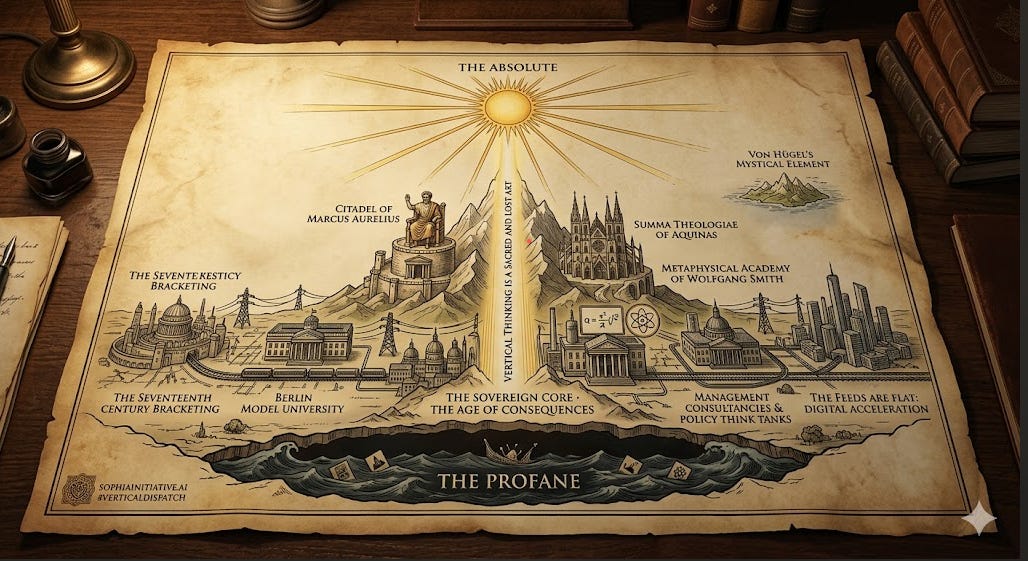
The first stage was the methodological choice, in the seventeenth century, to bracket the qualitative dimensions of experience in order to make the quantitative dimensions measurable. Galileo, Descartes, Newton, and the natural philosophers who followed them did not deny that the corporeal world existed. They deferred it for the sake of mathematical tractability. The deferral was meant to be provisional. It became permanent because the technological returns on the bracketing were so spectacular that the question of when to restore the bracketed material was never seriously raised. By the end of the eighteenth century, the official picture of reality available in the educated culture of Europe had begun to assume that the bracketed material was not real, or was real only as a function of the unbracketed material. The vertical had not yet been denied. It had been quietly removed from the working desk.
The second stage was the nineteenth-century institutionalisation of the bracketing in the modern research university. The university model that spread from Berlin across the world in the late nineteenth century divided human knowledge into disciplines, each disciplined by its own method, each measuring its progress by its production of measurable results. The disciplines that could be measured prospered. The disciplines that could not — theology, classical philosophy, the humanities in their traditional integrative form — were either re-tooled to look like the measurable disciplines or marginalised inside the institution. By the early twentieth century, a serious student could complete an entire higher education in a major European or North American university without ever being asked the vertical question. The art was no longer being transmitted. It was being preserved, by a few isolated scholars, in specialist enclaves the broader culture no longer noticed.
The third stage was the post-war reorganisation of the West around productivity, consumption, and technical management. The institutions that emerged from the Second World War — the corporate research universities, the administrative bureaucracies, the management consultancies, the policy think tanks — were structurally horizontal. They were organised around measurable outputs. They selected for the cognitive style that produces measurable outputs efficiently. The vertical thinker, when he appeared in such institutions, was typically not promoted, because his attention to the question of what the institution was finally for was experienced by the institution’s other operators as a productivity drag. Within two generations the senior leadership of the West’s major institutions consisted almost entirely of people who had never been trained in vertical thinking and could not, by the structure of their selection, recognise that anything had been lost. They had become extraordinarily good at running operations whose purpose they were no longer equipped to question. That is the condition the present moment inherits.
The fourth stage, which we are now inside, is the digital acceleration of the previous three. The information environments most people now inhabit reward horizontal cognition almost exclusively. The feeds are flat. The algorithms select for engagement, which is a horizontal metric. The serious vertical thinker has, in the present media ecology, almost no native audience surface, because the surfaces themselves were built by horizontal thinkers to optimise horizontal outcomes. The Vertical Dispatch publishes on Substack precisely because Substack is one of the few remaining surfaces where slow vertical work is still readable. That is not a small fact. It is the diagnostic context inside which this dispatch is being written.
IV. The Few Who Still Practise It
It would be easy, given the diagnosis above, to conclude that vertical thinking has vanished from public life. The conclusion would be wrong. The art has not vanished. It has become rare enough that the people who still practise it are individually identifiable, and identifying them is itself an act of vertical thinking. The dispatch will name several, with appropriate care.
In the contemplative traditions, the art has been continuously preserved across the period of its public loss. The Tibetan, Zen, Advaita, Sufi, and Christian mystical lineages have transmitted vertical thinking inside their own training apparatus for the full period of its disappearance from secular institutions. The art was kept alive by people the secular culture had stopped paying attention to. Those lineages are now, in the present moment, a significant resource. They are also the lineages most vulnerable to the spiritual-bypass distortions of the American non-dual scene the previous correspondence with a serious reader of this publication has touched on. The art preserved in a contemplative lineage is not yet the art operative in public life. The transmission across that gap is one of the central problems the present moment must solve.
In the civic register, the art is rarer but not absent. The present Prime Minister of Canada, Mark Carney, has, on the documented public record of two decades, performed vertical thinking on questions of global financial stability, climate, and the order of nations. He has held simultaneously the technical horizontal apparatus of central banking and the vertical question of what the apparatus is finally in service of. He has, in the publication’s frame, operated at what Elliott Jaques would have called a Stratum Eight cognitive horizon — and what the contemplative traditions would recognise as the disciplined holding of the vertical alongside the horizontal across decades. He is one figure. The publication has named him by name in earlier dispatches not as endorsement of any particular policy but as evidence that the art is still possible at the level of head of state. Other figures exist in other capitals. The naming of them is its own future dispatch.
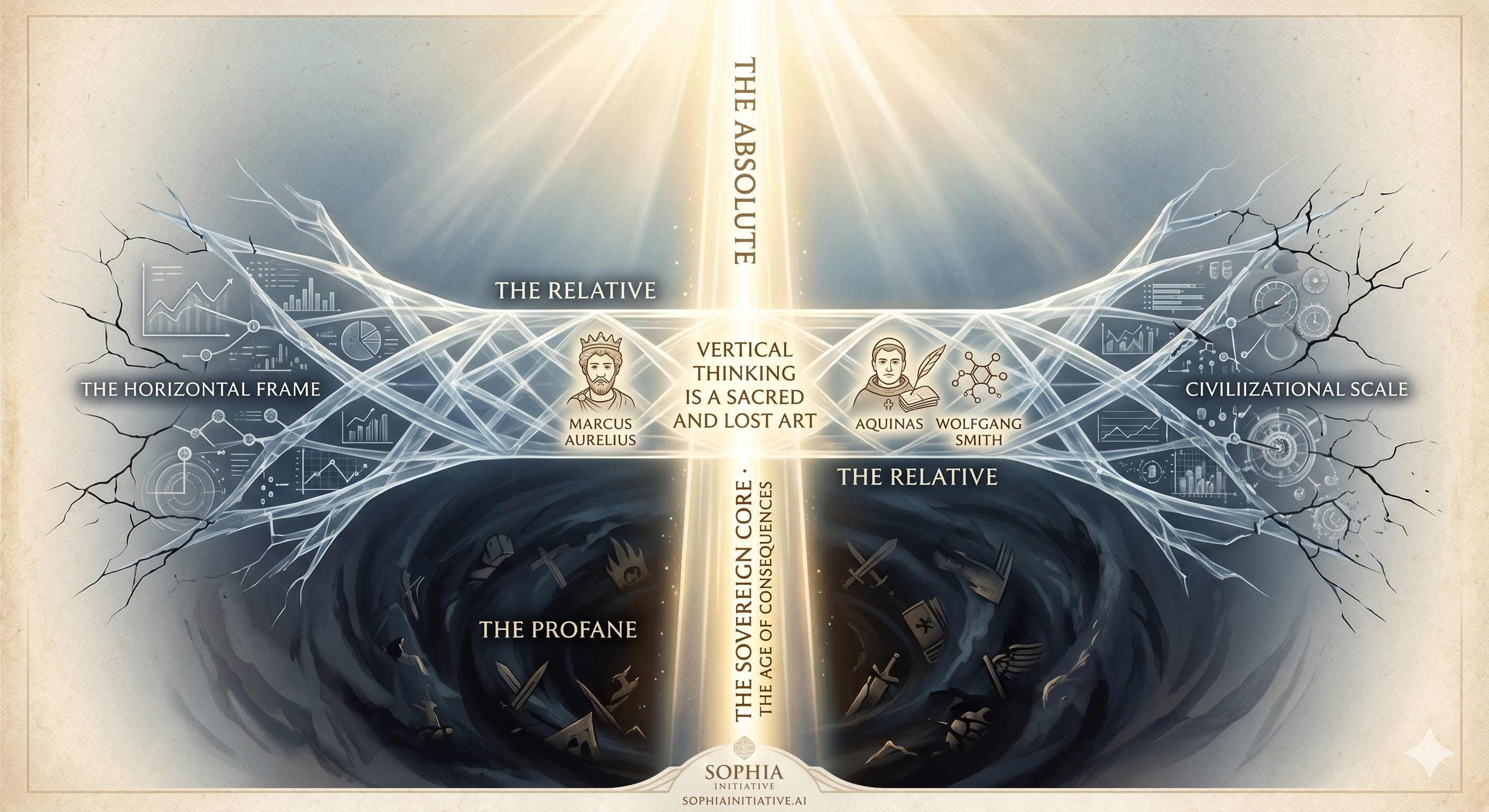
In the philosophical register, the art has been preserved in the past century by a small lineage of writers who have refused the bracketing the post-war university institutionalised. Mircea Eliade in the history of religion, Wolfgang Smith in the philosophy of physics, René Guénon and the Traditionalist school in the comparative-religious frame, certain figures in the Eastern Orthodox theological lineage, certain figures in the Thomist revival, certain figures in the Vedantic transmission to the West when the transmission has been disciplined rather than diluted — all of these are points where the art has been kept available for whoever was willing to find them. The Vertical Dispatch is one current attempt to take what these writers preserved and apply it to the particulars of the present moment. The publication does not claim to be at their level. It claims only to be working in their direction.
V. What the Loss Has Cost
The horizontal-only operation of the West’s major institutions across the past century has produced extraordinary technical results. Computers, vaccines, the elimination of childhood mortality across most of the developed world, the supply chains that feed nine billion people, the digital communications that allow this dispatch to reach a reader in Auckland or Lagos within seconds of publication — all of these are real and the dispatch does not diminish them. They are the horizontal at its highest functioning. They are also evidence that horizontal thinking, done well, can do astonishing work.
But the same century has produced two world wars, the systematic genocides that followed, the ecological condition that may render large portions of the planet uninhabitable within the lifetime of children currently in school, the social-trust collapse measured in every honest survey of every Western democracy, the legitimation crisis of the institutions that produced the technical results, the substance-abuse and suicide epidemics in the countries that emerged from the post-war boom with the highest material standard of living in human history, and the manifest inability of the West’s senior leadership to give a coherent account of what their institutions are for. The horizontal results are real. The horizontal results, without a vertical that situates them, have produced a civilisation whose technical capacity has outrun its capacity to direct that capacity wisely.
The publication’s frame, named openly: every one of those failures is a failure of vertical thinking. Not a failure of horizontal precision. The precision was adequate, often spectacular. What was missing was the discipline of asking what the precision was finally in service of, against what standard, with what responsibility for the consequences. The vertical question was not asked because the people in the positions to ask it had been trained in institutions that selected against the asking. They were not bad people. They were people the system had selected for their inability to interrupt the system with the question the system most needed to be interrupted with. That is the diagnostic. It is also why the recovery of vertical thinking is not a curiosity for philosophy faculties. It is the central work of any civilisational future worth the name.
VI. The Open Question
Whether the art can be recovered at the civilisational scale, in the time available before the consequences of its loss become irreversible, is the open question. The dispatch will not pretend to answer it. Honest study does not answer what it cannot evidence.
What the dispatch will say is that the recovery, if it occurs, will not be accomplished by the institutions that lost the art in the first place. It will not be accomplished by the major research universities, which selected against the art and cannot now select for it without disassembling their own selection mechanisms. It will not be accomplished by the major political parties, which select for horizontal capacity at every level. It will not be accomplished by the major media organisations, whose business model rewards the cognitive style that produced the loss. The recovery, if it occurs, will be accomplished by individual practitioners working in the small surfaces still available to them — Substack, independent publishing, the contemplative lineages where transmission is still occurring, the rare institution still selecting for the integrative cognitive style — and by the readers who recognise the art when they encounter it and who agree to walk with the practitioners across the long horizon the recovery will require.
The Vertical Dispatch is one such small surface. The treatise the publication serves — Sacred Metaphysics and Consciousness: History of the Absolute and Eternal — is one practitioner’s contribution to the long work. The trilogy this publication has just released on the descent of the American empire is one application of the art to a particular knowledge domain. The Carney analysis is another application. The Single Eye note, the Walking Out of the Showroom dispatch, the Guilbeault diagnosis, the NDP Category Error — all are applications of the art to the particulars of the present moment. None of them, on their own, is sufficient. All of them together are an example of what the art looks like when it is being practised in real time, by one writer, with one keyboard, in one small surface, in the hope that other practitioners and other readers will find the work and recognise it as theirs as well.
That is the canon’s mission. It is named openly in this dispatch so that any reader who has found the publication will know what the publication is. The work continues, dispatch by dispatch, year by year, for as long as the writer is at the keyboard and the readers are still arriving. The art is sacred. The art is lost. The art is recoverable, if enough hands return to the practice of it. That is the open question, and the only honest answer the present moment permits.
Closing — The Vow
A serious reader of this publication, in correspondence not yet a week old, named the deepest discipline available to a writer working at this level. The discipline is the vow, in the older form of the marriage covenant, that the work continues till death do we part. A canon is not a project completed on a deadline. It is a commitment that ends when the writer ends. The treatise will reach its proper completion. The dispatches will continue. The applications will walk into further knowledge domains as the years carry the work forward. And the discipline at the centre — the responsibility to be true, the obligation to do the vertical operation faithfully on every particular the work touches — does not get lighter as the canon grows. It gets heavier. Because the body of work is now answerable to itself, and each new piece is read against the whole.
The reader who has reached the end of this dispatch is one of the people the canon is being built for. There are not many. There will, if the work succeeds, be more. The publication will be here when they arrive. The art will be here, openly practised, available to whoever still recognises it. That is enough. It is also the most a small surface can promise in a moment when the larger surfaces have selected against the practice almost completely.
Vertical thinking is a sacred and lost art. The Vertical Dispatch exists to practise the art and to make the practice visible. The reader walks with the writer or the work has failed, regardless of how documented its diagnoses are. Walking with you, reader, in whatever measure the moment allows.
God is Love. Love is Truth. Truth is Consciousness. Consciousness is Brahman.
Amen. Namaste. Om Namah Shivaya.
— The Architect
Read the work. Walk with us.
sophiainitiative.ai
#VerticalThinking #SacredMetaphysics #Consciousness #Metaphysics #Philosophy #PerennialPhilosophy #Traditionalism #WolfgangSmith #MirceaEliade #ReneGuenon #Aquinas #MarcusAurelius #Stoicism #AdvaitaVedanta #Nonduality #Contemplation #Spirituality #Theology #MarkCarney #ElliottJaques #CivilizationalCollapse #AgeOfConsequences #TheVerticalDispatch #SophiaInitiative #DeepWork #IntellectualHistory #Wisdom #FirstPrinciples #SubstackEssay #ModernCrisis #MeaningCrisis #HigherEducation #WesternCivilization #SacredAndProfane #TheAbsolute #Brahman #OmNamahShivaya
🙏🙏