


The Sovereign Core · The Age of Consequences
Field Dispatch · May 29, 2026
Canada has what the world wants. — Mark Carney, New York, May 28, 2026
Thirty-four days from today, on July 1, 2026, the Canada-United-States-Mexico Agreement comes up for its first mandatory joint review since the agreement entered into force in 2020. The review is structural; the agreement runs to 2036 regardless of what happens at the July date; and each of the three parties is required, at the review, to confirm in writing whether it wishes to extend the agreement for an additional sixteen years to 2042. That is the mechanism.
The condition on the ground, as of this morning, is the following. Mexico and the United States are in formal negotiations and have two further rounds scheduled in the coming weeks. Canada and the United States have not yet begun formal negotiations. The United States Trade Representative, Jamieson Greer, conceded publicly on April 7 that the parties are ‘probably’ not going to resolve all issues by July 1. The American side has indicated it wants concessions from Canada — described in multiple Canadian press accounts as an ‘entry fee’ — before it will begin substantive negotiations at all. The concessions named in those accounts include the ending of provincial boycotts of American alcohol sales and the scrapping of the federal Online Streaming Act. Canada is, in plain English, being asked to pay to enter the room in which the negotiation is to take place.
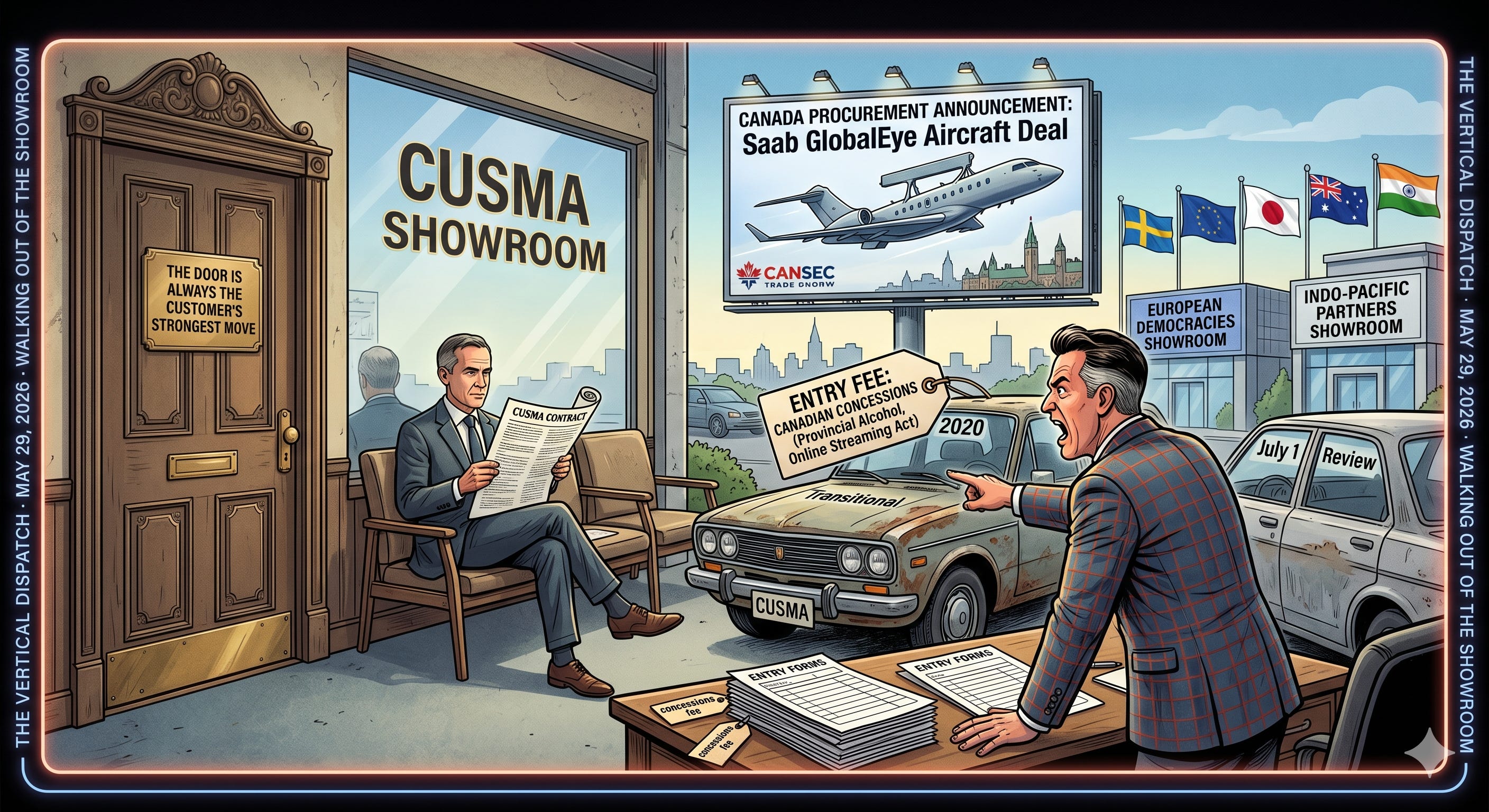
The Vertical Dispatch will name the situation for what it is, with no disrespect to the honourable profession of used car sales, because the analogy is exact and Canadians need to see it clearly. Canada is in negotiation with a used car salesman. The model the customer drove off the lot in 2020 has just been described by the salesman, in the customer’s own showroom, as ‘transitional’ and as having ‘served its purpose.’ The salesman is now asking the customer to pay a fee before being allowed to look at the new models. The salesman is closing with the other customer in the room first — Mexico — and has said he will get to Canada after. And the salesman is letting the customer know, indirectly, that whatever model the customer eventually chooses will carry surcharges the customer will be expected to absorb because the salesman has now made tariffs a fact of the relationship rather than an exception in it.
The Customer Is Not Buying What Is Being Sold
Mark Carney is not a man who walked into this showroom by accident. The Prime Minister of Canada is a former Governor of the Bank of Canada and former Governor of the Bank of England, a man who has spent a career across the central banks, the boardrooms of global finance, and the policy desks of the G7 evaluating exactly the kind of deals the salesman in question now wishes to write. The customer in this showroom can read a contract. The customer can read a balance sheet. The customer can read the salesman.
What the customer has said, on the public record, in the past sixty days, is the following. On April 27, in an interview with CBC News, Carney said the ongoing tariff dispute could be resolved within ‘days’ if the United States side had ‘the bandwidth and the inclination to go through with it.’ Translation: the customer is ready to write the cheque when the salesman is ready to sit down. The salesman is not yet ready to sit down. That is the salesman’s problem, not the customer’s. The customer continues to read the paper in the lounge.
On the same day, Carney said openly that Canada would not ‘chase a small deal’ to get short-term tariff relief. The Vertical Dispatch will name the structural significance of that phrase, because it is the most important phrase a customer in a showroom can use. A customer who refuses to chase a small deal is a customer the salesman cannot rush. A customer the salesman cannot rush is a customer whose walkaway power is intact. A customer whose walkaway power is intact is a customer who governs the negotiation, regardless of what the salesman is shouting from the other side of the lot.
And on the standing question of whether Canada already has, in CUSMA, the best deal it is likely to be offered, Carney’s standing line — repeated at press conferences across the spring — is exact: ‘Let’s be clear, Canada currently has the best trade deal with the United States.’ Eighty-five percent of bilateral trade is already tariff-free under CUSMA. The agreement does not expire until 2036. Withdrawal by any party requires six months’ written notice. The structural position of the customer, sitting in the lounge while the salesman pretends to be busy with Mexico, is the position of someone who already owns the car the salesman is trying to sell him again.
The Door Is Always the Customer’s Strongest Move
Every serious negotiator across every profession has known the same thing for as long as there have been negotiations. The strongest move in the room is the door. The customer who can walk away is the customer who sets the terms. The customer who must close today is the customer who pays whatever is asked. In commercial trade, in diplomacy, in the marketplace and at the chancellery, this is the oldest fact of human exchange.
Canada’s door, twenty-four hours before this Dispatch publishes, became visibly wider. Yesterday, May 27, 2026, at the CANSEC defence trade show in Ottawa, Prime Minister Carney announced that Canada has entered formal negotiations with Saab of Sweden to procure six GlobalEye airborne early-warning and control aircraft — an estimated five-billion-dollar Canadian commitment — choosing the Swedish-Canadian platform over two American manufacturers, Boeing and L3Harris. The GlobalEye is built on the Canadian-made Bombardier Global 6500 airframe. At least forty aircraft, including allied orders, will be manufactured in Canada over the next fifteen years. Three thousand Canadian aerospace jobs are part of the deal. The defence procurement expert Philippe Lagassé of Carleton University, quoted by The Canadian Press, named the announcement as the Carney government’s ‘first step in demonstrating what diversification beyond the American defence industry looks like.’
That is the door, made visible. That is the customer signalling to the salesman, without saying a word about the negotiation in the lounge, that the customer has other showrooms to walk into. The Saab deal is bundled with a still-pending Gripen-E fighter pitch that would, if accepted, further reduce Canada’s ordered F-35 commitment. The European democracies are watching. The Pacific democracies are watching. The customer’s trillion-dollar domestic investment plan, announced this winter and now being executed through procurement decisions like the GlobalEye contract, is a customer’s signal that the customer’s wealth no longer depends on the salesman’s goodwill.
The customer is not threatening to walk. The customer is, deliberately and on the public record, demonstrating that walking is a real option. There is a structural difference between the two postures, and the Carney government has chosen the second with discipline.
To the American Side, with Respect
To all of the boasting from the salesman’s side that America does not need Canada — that the customer should consider himself fortunate to be in the room at all, that the customer’s economy is small, that the customer’s leverage is limited, that the customer’s options are few — the Vertical Dispatch will state plainly what the documented record shows.
Canada is the largest single foreign supplier of crude oil to the United States and has been for a decade. Canada supplies more electricity, more uranium, more potash, more nickel, more lumber, and more refined natural gas to the United States than any other country. The integrated automotive supply chain across the Detroit-Windsor and southern-Ontario corridors is so deeply braided into American manufacturing that the disruption of a single week’s worth of CUSMA-compliant parts flow would shut down assembly lines from Michigan to Mississippi. Canada is the second-largest export market for American goods on Earth, larger than China, larger than Japan, larger than Germany. Two billion dollars in cross-border commerce moves every single day. The salesman who tells the customer that the customer needs the salesman more than the salesman needs the customer is a salesman who has not read the inventory of his own dealership.
And to the broader question — the question of what Canada has that the world wants, which is the line Mark Carney took to the Economic Club of New York yesterday afternoon — the answer is on the documented record as well. Critical minerals essential to the energy transition. The largest fresh water reserves on Earth. Agricultural surpluses in a century of food insecurity. An educated workforce with one of the highest per-capita post-secondary credentials of any economy. Aerospace manufacturing capacity that allies are now signing onto. Energy in every form the future will require. Demographic stability and immigration management. A democratic constitutional order with a functioning judiciary, a free press, and an electoral system that has changed governments without violence for one hundred and fifty-eight years. The customer in the showroom holds, in plain language, what the world is in the process of recognizing it cannot do without.
The Things the Salesman Cannot Make Himself
There is a structural fact about the American economy that the salesman in the showroom would prefer the customer not to study carefully, and which the customer, being a former central banker, has of course studied carefully. The fact is that the United States cannot, by any reasonable timeline, replace what it currently sources from Canada in three of the foundational materials its industrial base depends on: aluminum, steel, and softwood lumber. This is not a Canadian negotiating talking point. It is the assessment of American think tanks, American industry leaders, and the published projections of the United States Trade Representative’s own office.
On aluminum, the numbers are decisive. The United States consumes approximately five million metric tons of aluminum every year. American domestic primary aluminum production in 2024 was six hundred and seventy-eight thousand metric tons. That is to say, the American smelter base produces roughly fourteen percent of what the American economy uses. The remaining four million tons or more come from imports, and Canada has been the largest single supplier for decades. The C.D. Howe Institute, citing publicly available statements by the president of Alcoa — itself an American aluminum producer — has reported that a new smelter currently under development in Oklahoma, projected to add six hundred thousand tons of capacity, is the second new American aluminum smelter to be built in forty-five years. It is expected to be operational only in 2030. The contract to supply its electricity has not yet been signed.
And here is the deeper problem the salesman cannot solve at any timeline, because it is a problem the American industrial base is currently losing to its own digital sector. An aluminum smelter requires approximately fourteen to fifteen megawatt-hours of electricity to produce a single metric ton of aluminum. It is one of the most electricity-intensive industrial operations on the planet. To be economically viable, a smelter requires predictable long-term electrical power at sub-forty-dollar-per-megawatt-hour prices. American electrical grid capacity, in 2026, is being aggressively bid for by the American data centre industry — by Amazon, Microsoft, Google, Meta, and the artificial intelligence training facilities driving unprecedented load growth across the United States. The data centres are offering eighty to two hundred dollars per megawatt-hour on long-term contracts to lock down grid capacity for the next twenty years. The smelter cannot bid against the data centre for the same kilowatt. The data centre wins every auction. That is the structural reality, and it is American, and it has nothing to do with Canada.
The C.D. Howe Institute’s bottom line, in its September 2025 published report on the tariff situation: “Canadian aluminum cannot be replaced rapidly. US importers will have to continue to source aluminum from Canada or reduce their own output.” That is American analysis of an American problem, citing the American producer’s own admission, in an American policy publication. The salesman in the showroom cannot bluff this away.
On steel, the same structural reality applies. In 2025, the United States imported approximately four million metric tons of steel from Canada — eighteen percent of total American steel imports, and the largest single supplier. Steel imports from Canada have held between four and six million metric tons every year for over a decade. To replace this volume, the American steel industry would need to build new integrated mill capacity, train the specialized workforce, secure the iron ore and coking coal contracts, and route the electrical and natural gas supplies — a process that, on documented industry timelines, runs to seven to ten years per major facility and requires environmental review, permitting, capital formation, and labour pipeline development at scales the American policy system has not lately demonstrated the capacity to execute on schedule.
On softwood lumber, the structural constraint is forest. Canadian softwood, drawn from boreal and mountain forests across British Columbia, Alberta, Saskatchewan, Manitoba, Ontario, and Quebec, has supplied the American homebuilding sector for a century. American domestic forestry capacity cannot match Canadian volumes within the relevant policy horizon, because forest grows on a forty-to-eighty-year cycle and is constrained by federal lands policy in the United States in ways Canadian commercial forests are not. The American homebuilding industry, the National Association of Home Builders, and the American Lumber Coalition have repeatedly testified to the United States Trade Representative’s office that softwood lumber tariffs against Canada raise the cost of a single American home by between eight and twelve thousand dollars. That cost is paid by American buyers. The salesman’s tariff falls, in the end, on the salesman’s customer.
And one final item, offered with a wink, but on the documented record like the rest. The temperate rainforests and boreal woodlands of British Columbia, Alberta, and the territories grow, each season, three wild mushrooms — the chanterelle, the morel, and the pine mushroom, known in Japan as matsutake — for which the global market is approximately two billion dollars annually and in which Canadian harvest commands a premium that competing producers cannot match. The pine mushroom alone netted Japanese buyers approximately twenty million dollars per year during the early 2000s and is among the most sought-after culinary delicacies on Earth. The Japanese-Canadian families interned in the Slocan Valley during the Second World War are credited with first identifying the patches; their descendants have returned to them every autumn for eighty years. The Architect will leave aside the further fact that British Columbia’s forests also produce, in commercial quantities, varieties of mushroom the legalization of which is the subject of active debate in several jurisdictions worldwide — a domain in which Canada, with the country’s characteristic understated discipline, is among the more thoughtful regulators on the planet. The point, in either register, is the same. The forest gives what only the forest can give. The salesman cannot make it in a smelter, cannot grow it on a hydroponic shelf, and cannot acquire it without going through the customer. That is the customer’s position, complete.
What this means, for the negotiation in the showroom, is the following. The salesman can shout about the customer’s dependency on the salesman’s market. The customer can answer, calmly and with documentation, that the salesman’s own foundry, sawmill, and smelter capacity cannot meet the salesman’s own domestic demand for at least the next decade — and that the structural reasons for this, including the loss of American grid capacity to the American digital sector, are not Canadian problems, are not solvable by Canadian concessions at the negotiating table, and will not be wished into a different shape by tariff theatrics. The customer holds the inventory. The salesman needs the inventory. The salesman’s bluff cannot survive a quiet reading of the Federal Reserve’s industrial production statistics.
And here, brother and sister, is where the customer’s posture becomes unassailable. The Carney government has not, on the documented public record, used any of this material to threaten the salesman. The customer has not held a press conference to wave smelter statistics at the cameras. The customer has, instead, gone to Stockholm and Brussels and London and made the diversification announcement at home, in Ottawa, the day before flying to New York to tell the world that Canada has what it wants. The customer is letting the structural facts do their structural work, in silence, while the customer’s hands continue to sign agreements that demonstrate the door is real. That is how negotiators behave when they know they hold the position.
What Canadians Should Watch For, and What They Should Not
The Vertical Dispatch offers Canadians the following diagnostic, with no claim to inside information and no political affiliation. What Canadians should watch for, in the next thirty-four days, is not whether a deal is reached by July 1. The deadline is now publicly conceded by the American Trade Representative himself to be unlikely. What Canadians should watch for is whether the deal that is eventually reached — at any date, in any form — preserves the structural position the customer currently holds: a CUSMA-compliant trade relationship with the largest single market on Earth, on terms the customer has spent six years operationalizing, against a backdrop in which the customer has visibly diversified into European and Indo-Pacific alternatives.
If the deal preserves that position, with adjustments to specific sectoral tariffs the customer can absorb without surrendering the structural standing, the customer has done the work of the customer well. If the deal does not preserve that position — if the salesman extracts an ‘entry fee’ that compromises Canadian sovereignty over its own policy on broadcasting, on procurement, on culture, on the digital tax, or on the dispute-resolution mechanisms the previous agreement was built on — the customer is to walk.
And here is the discipline of this moment, named plainly. A customer who walks out of a showroom does not collapse. A customer who walks out of a showroom goes to other showrooms. The customer who has spent the spring of 2026 visibly building other showrooms — Saab, Bombardier, the European democracies, the Indo-Pacific partners, the rebuilt domestic defence industrial base, the trillion-dollar investment plan — is a customer who can afford the door. The salesman’s posture only works on a customer who cannot afford it.
The Closing of This Dispatch
There is a kind of negotiation a country enters when the negotiation matters and the country knows it matters. There is another kind a country enters when one party has decided to treat the negotiation as a transaction in inventory and the other party has decided to treat it as a question of the long arc of the country’s history. Canada’s negotiation with the United States, in the spring and summer of 2026, is the second kind for the customer and the first kind for the salesman. That mismatch is the actual story.
The Vertical Dispatch holds that the customer is conducting himself with the discipline the moment requires. The customer reads the contract. The customer reads the balance sheet. The customer reads the salesman. The customer has the door at his back, and the door has, in the past twenty-four hours, been opened wider by a five-billion-dollar Saab procurement and a New York speech naming, on the documented record, the customer’s actual standing in the world economy.
Canada has what the world wants. The world is in the process of figuring out how much, and on what terms. The customer in the showroom is the only one in the room who already knows the answer.
God is Love. Love is Truth. Truth is Consciousness. Consciousness is Brahman.
Amen. Namaste. Om Namah Shivaya.
— The Architect
Read the work. Walk with us.
#WalkingOutOfTheShowroom #Carney #MarkCarney #Canada #CdnPoli #CanadianPolitics #CanadaPolitics #USPolitics #Trump #TrumpTariffs #CUSMA #USMCA #TradeWar #TradeDeal #Tariffs #CanadaUS #CanadaUSrelations #Aluminum #Steel #SoftwoodLumber #CriticalMinerals #DataCenters #EnergyTransition #Saab #GlobalEye #CANSEC #FourthPole #Diversification #DemocraticAlliance #MiddlePowers #StrategicAutonomy #AfterAmerica #Sovereignty #ValuesBasedGeopolitics #BankOfCanada #ElbowsUp #TheVertical #TheVerticalDispatch #TheArchitect #SophiaInitiative #Project2046 #GlennfordEllisonRoberts
Thank you for the analysis. Our dear PM has been working hard for Canada and we are so very fortunate he threw his hat in the ring. Watching PM Mark Carney is so inspiring. I live jn Alberta so you can imagine, we have el destructo here harming Albertan’s daily and a Master Class in Ottawa under PM Mark Carney.
A great synopsis of the current situation.
Thanks for posting