

Φ
THE VERTICAL DISPATCH
We write for the mind, the eye, and the ear.
Read it. Look at it. Listen to it. The Vertical Dispatch is built for all three — prose with rhythm, made to be heard as much as read.
From metaphysics to geopolitics, from culture to history, from the sacred to the street — and everything in between. One lens, every subject. No ego. Just the record, named clean.
Press play. Walk with the word. 🕯️
This dispatch travels by hand. If it serves you, share it — restack on Substack, and pass it on wherever you read. 🕯️
Sovereign Analysis · The Age of Consequences
Volatile political facts date-stamped as of June 23, 2026
“War is peace. Freedom is slavery. Ignorance is strength.”
— the slogans of the Party, in George Orwell’s Nineteen Eighty-Four (1949)
Everyone knows the phrase. It is the most famous of Orwell’s three slogans, carved on the white pyramid of the Ministry of Truth, and it has become shorthand for any official contradiction we are asked to swallow. But the phrase is doing two completely different jobs in the world, and almost everyone collapses them into one. Pulling them apart is the whole of this dispatch, because the difference between them is the difference between a tragic truth a serious person must live with, and a comfortable lie a cynic uses to dismiss the serious person entirely.
In Orwell’s book, “war is peace” is doublethink — the deliberate holding of two contradictory beliefs at once, accepted because the Party commands it. It is a manufactured lie, language engineered to break the mind’s capacity to tell truth from falsehood, so that a permanent war the regime does not even intend to win can be sold to the population as the guarantor of their security. That is one thing the phrase can mean: the conscious weaponizing of contradiction to control people. Orwell’s warning was about that, and it remains one of the indispensable warnings of the modern age.
But there is a second thing the phrase can mean, and it is not a lie at all. It is a tragic paradox — a genuine, agonizing bind in which two true things pull against each other and refuse to resolve. To keep the peace, you may have to prepare for war. To deter the catastrophe, you may have to build the very thing that could cause it. This is not doublethink. No one is lying. The contradiction is real, and it is faced honestly by serious people who would give a great deal to escape it and cannot. The whole danger of our moment lies in telling these two meanings apart — because the tragic paradox, mishandled, curdles into the manufactured lie, and the cynic who cannot tell them apart dismisses the honest steward as a liar while the real liar walks free.
The difference is between a tragic truth a serious person must live with, and a comfortable lie a cynic uses to dismiss the serious person entirely.
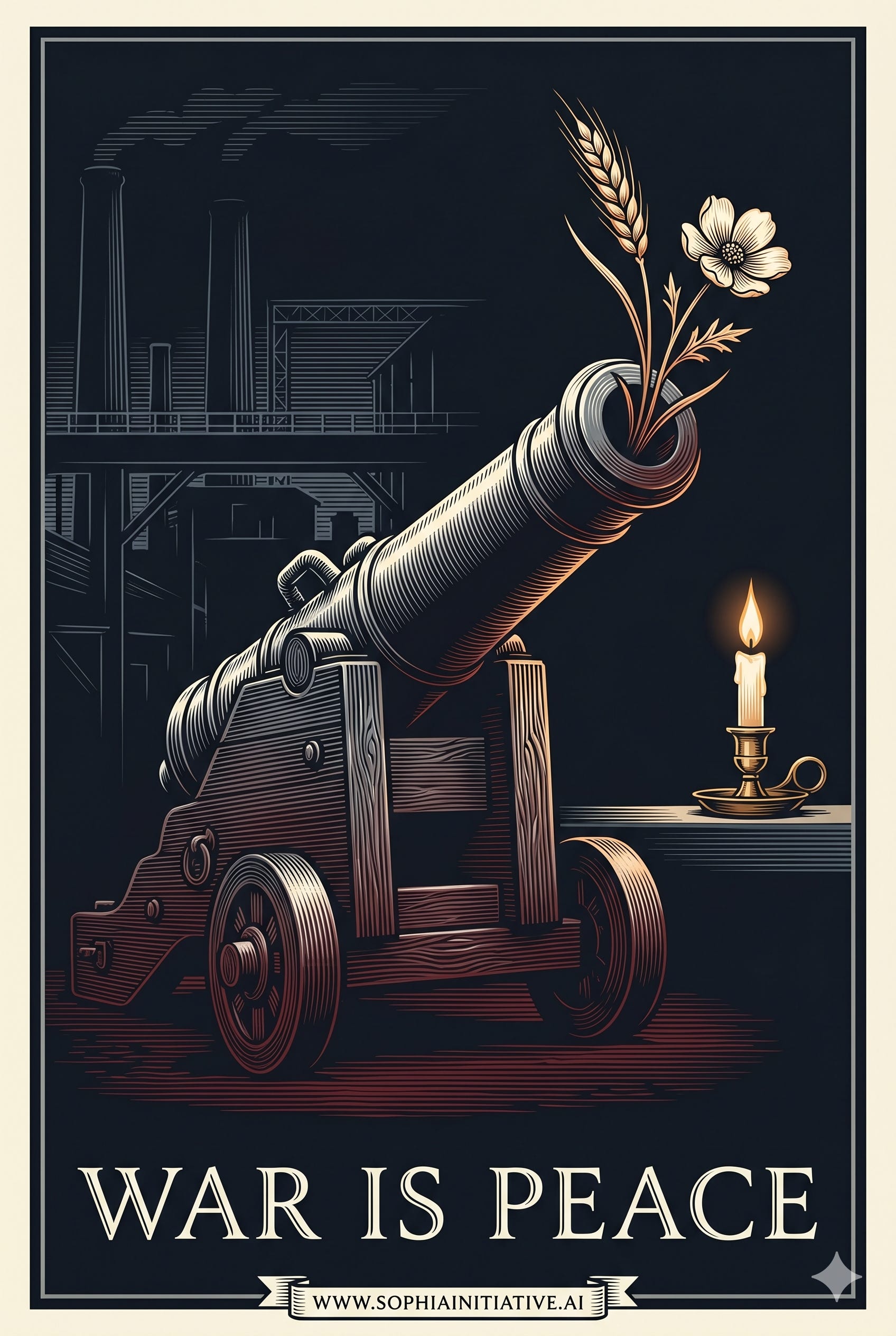
The Machine That Runs Without a War
Begin with the strange fact that gives this dispatch its subtitle: the war economy now runs at full tilt without a war. Across the democracies of the Western alliance, defence budgets are climbing toward two, three, even five per cent of national output — vast sums, reorganising economies, in a time when these nations are not, formally, at war with anyone. The factories run. The procurement contracts are signed. The radars and the rockets and the tactical radios are built and shipped. An entire industrial order is being stood up, justified entirely by a war that has not happened and that everyone hopes never will.
This is the peacetime form of “war is peace,” and on its face it is not sinister. It is deterrence — the oldest argument in strategy, that the surest way to avoid being attacked is to be too costly to attack. The spending buys not war but its absence. The tank that is never fired, on this logic, is the most successful tank ever built, because its whole purpose was to make sure it would never need to be. By that reasoning the war economy in peacetime is not a contradiction at all but a kind of insurance: you pay the premium precisely so the catastrophe never arrives. That is the honest case, and it is a strong one, and most of the people making it believe it sincerely and may well be right.
But notice what the same machine does to the society that builds it, because this is where the paradox bites. A permanent defence economy creates permanent interests — firms, jobs, regions, careers — that depend on the spending continuing, and therefore, quietly, on the threat continuing. It builds a constituency for fear. It draws the best engineers and the largest capital toward the instruments of destruction and away from the instruments of life — the hospital not built, the school not funded, the human scale this publication has written of, weighed once again against the abstraction. None of this requires a single lie to be told. It is simply what the machine does as it runs. The peace it buys is real. The cost it extracts is also real. Both are true, and a society that pretends only one of them is true has already taken the first step from the tragic paradox toward the comfortable one.
The Coercion and the Sovereignty
Now the harder layer, the one that turns this from a meditation into a matter of the present hour. For the middle powers — Canada, and the nations of Europe — the pressure to build the war machine in peacetime arrives from two directions at once, and the two look identical and are morally opposite. Telling them apart is the whole task.
The first pressure is a real and tragic threat. The world is genuinely more dangerous than it was — a revanchist Russia at war on European soil, a rising and assertive China, an Arctic newly contested. The middle powers would need to arm against this even if every ally behaved with perfect honour, because the threat is independent of anyone’s manipulation. That spending is the tragic-necessity kind: the premium paid against a catastrophe that is real.
The second pressure is coercion, and it wears the costume of the first. The senior partner of the alliance — the United States, under its current administration — has, on the record, recast the old guarantee of mutual defence as a transaction: pay more, defer more, or forfeit the protection you have relied upon since 1945. The demand is made in the language of the real threat — “spend two per cent, spend five” — but its substance is leverage. And here is the structural diagnosis, which this publication owes to the late Jane Jacobs by way of a reader’s gift: an alliance is a Guardian institution. It runs on loyalty, honour, the pledge that an attack on one is an attack on all. To run it instead on the logic of the marketplace — payment, leverage, what-have-you-done-for-me — is to create what Jacobs called a monstrous hybrid: the corruption that results when the trader’s morality is forced onto the guardian’s work. The protection racket is exactly this hybrid. The mafia, too, offers “protection,” for a fee, against a threat it is itself partly the source of.
The demand is made in the language of the real threat. Its substance is leverage. The protection racket, too, offers “protection” — for a fee.
And this is where the middle powers have made their move, and where the paradox turns, at last, toward something other than submission. They are spending — but read what they are building. When the Prime Minister of Canada went to France and Ireland and the G7 this month and signed defence and critical-mineral pacts with France, Germany, Italy, and Korea, and secured Canada’s first procurement under the European Union’s own defence initiative, he was not paying the senior partner’s toll. He was building the architecture by which the middle powers need the senior partner less. The spending is real; the direction is the tell. It points not toward Washington but laterally, toward one another — toward a defensive bloc that can stand whether the old patron remains the anchor or walks away. This is not arming in obedience. It is arming so as not to be leverageable — by the adversary, or by the ally. The credible force that cannot be coerced is the only force that is truly sovereign. That is the honourable face of “war is peace”: not the premium paid to a protector, but the strength built so that no protector can hold your safety hostage.
Where the Paradox Curdles Into the Lie
So the keel of the whole matter is a single vigilance: knowing the moment the tragic paradox stops being tragic and starts being the Party’s slogan. They are not the same, but the first decays into the second whenever we stop watching, and the decay is always justified by the realness of the threat. Here is how to tell.
It is still the tragic paradox so long as the spending is debated openly, costed honestly, directed at a genuine threat, and subject to removal by the citizens who pay for it — so long as “we must arm to stay safe” remains a claim that can be questioned, measured, and voted down. It has curdled into doublethink the moment “security” becomes a word that forecloses argument rather than inviting it — the moment to question the spending is to be called naive or disloyal, the moment the threat is kept deliberately vivid to keep the contracts flowing, the moment “war is peace” stops meaning “we arm, with heavy hearts, to deter a real danger” and starts meaning “obey, and do not ask.” The phrase is the same. The thing underneath it has inverted. Orwell’s warning was never that preparing for defence is a lie. It was that the language of security is the easiest language in the world to weaponize — and that the weaponizing always presents itself as mere realism about a dangerous world.
The danger, then, is not the spending. The danger is the day we can no longer tell the steward who arms with a heavy heart from the demagogue who keeps the fear at a boil because the fear is useful to him. Both say “war is peace.” One means it as a tragedy. The other means it as a leash.
The Question, Handed Over
This dispatch will not resolve the paradox for you, because it does not resolve. The threat is real and the spending may be wisdom; the spending reshapes the society and may become its own disease; the coercion hides inside the necessity and must be cut out of it without abandoning the necessity itself. These are not contradictions to be solved but tensions to be held, daily, by citizens awake enough to hold them — which is the one thing the Party in Orwell’s book existed to prevent.
So the questions are yours. Is the spending you are being asked to fund the premium against a real catastrophe, or the toll paid to a protector who has become a landlord? Is the threat you are shown the true measure of the danger, or has it been kept vivid because vivid threats are profitable? And when a leader tells you that safety requires you to spend, to defer, to stop asking — can you still tell the steward from the demagogue, the tragic truth from the comfortable lie? The moment you cannot is the moment “war is peace” has finished its journey from a hard truth into Orwell’s slogan. Keeping the two apart is not a task you complete. It is the daily labour of remaining free. Walk with the word. 🕯️
God is Love. Love is Truth. Truth is Consciousness. Consciousness is Brahman.
Amen. Namaste. Om Namah Shivaya.
— The Architect
For the citizens awake enough to hold the tension the Party existed to dissolve.
The Vertical Dispatch
sophiainitiative.ai
On the record
Orwell. “War is peace. Freedom is slavery. Ignorance is strength.” are the Party slogans in George Orwell’s Nineteen Eighty-Four (1949); “doublethink” is Orwell’s coined term for holding two contradictory beliefs simultaneously and accepting both. Quoted briefly for commentary and criticism. The dispatch distinguishes Orwell’s manufactured-lie sense from the separate, non-Orwellian sense of a genuine tragic paradox; this distinction is the author’s argument, not Orwell’s.
Defence spending. NATO members’ rising defence-spending targets (toward 2%, 3%, and higher of GDP) and the current U.S. administration’s public conditioning of alliance protection on increased allied spending and deference are matters of public record as of June 2026; specific national figures and targets shift and should be verified against NATO and national budget sources before republication. The characterization of the alliance dynamic as “coercion” / “monstrous hybrid” is interpretation and commentary.
Carney’s tour. PM Carney’s June 2026 France–Ireland–G7 (Évian) visits and resulting critical-minerals and defence partnerships (France, Germany, Italy, Korea) and EU SAFE procurement are per PMO releases, June 2026, date-stamped and PMO-confirmed.
Jacobs. The “Guardian” vs “Commercial” moral syndromes and the “monstrous hybrid” that results from mixing them are from Jane Jacobs, Systems of Survival (1992). Applied here as interpretive framework.
Standing note. All characterizations are the author’s interpretation and commentary, clearly distinguished from the record. The honest case for deterrence and for allied defence spending is stated at full strength. The reading judges structures, language, and on-record conduct — never the private mind, motive, or character of any individual or government. No leader is accused of doublethink; the dispatch warns of a danger and hands the judgment to the reader. Volatile facts date-stamped June 23, 2026. Verify against primary sources before republication.
Suggested tags
Orwell, 1984, doublethink, war and peace, defence spending, deterrence, NATO, the middle powers, coercion, Jane Jacobs, Sovereign Analysis
Substack Notes
“War is peace.” Everyone knows Orwell’s slogan. Almost everyone collapses two completely different things into it. In 1984 it’s doublethink — a manufactured lie, language engineered to make a population accept a permanent war as the price of safety. But the phrase can also mean something that is not a lie at all: a tragic paradox, where to keep the peace you really may have to prepare for war. The whole danger of our moment is telling those two apart.
Look at the strange fact: the war economy now runs at full tilt without a war. Defence budgets climbing toward 2, 3, 5 per cent of output, in nations not formally at war with anyone. On its face that’s deterrence — the tank never fired is the most successful tank ever built. But the same machine builds permanent interests that depend on the threat continuing. It builds a constituency for fear. The peace it buys is real. The cost it extracts is real. A society that pretends only one is true has taken the first step from the tragic paradox toward the comfortable lie.
For the middle powers — Canada, Europe — the pressure comes from two directions that look identical and are morally opposite: a real threat (Russia, China, the Arctic) that would demand arming even if every ally behaved with honour; and coercion, the senior partner recasting mutual defence as a transaction — pay more, defer more, or lose your protection. Jane Jacobs named this: an alliance is a Guardian institution; run it on the trader’s logic of leverage and you get a monstrous hybrid. A protection racket. But watch what the middle powers are actually building — lateral pacts, a bloc that needs the old patron less. That’s not arming in obedience. It’s arming so as not to be leverageable — by the adversary or the ally. The force that cannot be coerced is the only force that is sovereign.
The keel is a single vigilance: knowing the moment the tragic paradox curdles into the Party’s slogan. It’s still tragic while the spending is debated, costed, aimed at a real threat, and can be voted down. It’s doublethink the moment “security” forecloses argument instead of inviting it — the moment to question is to be called disloyal. Both the steward and the demagogue say “war is peace.” One means it as a tragedy. The other means it as a leash. Telling them apart is the daily labour of remaining free. Walk with the word. 🕯️
And because this is a Canadian dispatch, here is the plainest gloss I have on Orwell’s doublethink, ordered at the Tim’s drive-thru: “war is peace” is a double-double. Same cup, two creams and two sugars — one symbol, two opposite fillings — and the whole art is knowing what you’ve actually been handed before you drink it. The steward pours it as a tragedy. The demagogue pours it as a leash. Taste before you swallow.
Written from love, in service of the record. Walk with the word. 🕯️
#WarIsPeace #Orwell #1984 #Doublethink #DefenceSpending #Deterrence #NATO #TheMiddlePowers #Coercion #JaneJacobs #TheVerticalDispatch #SovereignAnalysis #TheArchitect #SophiaInitiative #GodIsLove #LoveIsTruth #OmNamahShivaya
The factual matter in this Dispatch is drawn from the public record. All characterizations, inferences, and conclusions are opinion, interpretation, and commentary, offered for analysis, reflection, and public-interest discussion. No assertion is made regarding the private intentions, state of mind, or character of any individual. Readers should evaluate all statements independently and draw their own conclusions.
This essay is really important to keep in mind as Canada moves to increase its military capabilities. We the people need to monitor the line between protecting (funding) our sovereignty versus becoming a military machine like the US has become.