

Φ
THE VERTICAL DISPATCH
We write for the mind, the eye, and the ear.
Read it. Look at it. Listen to it. The Vertical Dispatch is built for all three — prose with rhythm, made to be heard as much as read.
From metaphysics to geopolitics, from culture to history, from the sacred to the street — and everything in between. One lens, every subject. No ego. Just the record, named clean.
Press play. Walk with the word. 🕯️
This dispatch travels by hand. If it serves you, share it — restack on Substack, and pass it on wherever you read. 🕯️
The Foundation Series · The Age of Consequences
as of July 5, 2026
“The old world is dying, and a new world struggles to be born. Now is the time of monsters.”
— Antonio Gramsci
Begin with the man in the epigraph, because he earned the right to frame this and should not be brushed past. Antonio Gramsci was a frail Sardinian, hunched by a childhood illness, who rose by sheer force of mind to lead a political party in the Italy of the 1920s. When the fascists took power, they jailed him, and the prosecutor said the quiet part aloud: we must stop this brain from functioning for twenty years. They could not. Across eleven years in prison, in failing health and under the censor’s eye, Gramsci filled some three thousand pages of notebooks that outlived the regime that silenced him. He died in 1937, at forty-six, days after his release was finally granted. He wrote from the left, and it is his diagnosis, not his cure, that concerns us here — for the thing he saw has been borrowed by thinkers across the whole spectrum, precisely because it describes not a party’s program but how a moment actually works.
And what he saw was this. There are hinge-times in history when an old order is dying and a new one cannot yet be born, and in that gap — he called it the interregnum — a great variety of what he named morbid symptoms appear. The popular rendering has hardened into a sharper phrase: now is the time of monsters. The truer translation is the quieter one — morbid symptoms, the sickness of a body caught between what is ending and what has not yet begun. Either way, the meaning holds, and it is not a description of 1930 alone. It is a description of now. The grievance and the separation talk and the flood of consequences we have spent months tracing are the morbid symptoms of an interregnum — the monsters that crawl out in the gap between a dying order and an unborn one. Gramsci named the water we are swimming in, from a prison cell, ninety years before we reached it.
I say all this to set the frame for an apology, because the discipline of this publication is that it must apply to the writer before anyone else. When this government took office, I was rooting for a big win — and the hope was not foolish, because the qualifications were real: a central banker who had steered two nations through crises, the résumé you would draft if you could draft one for the moment. I wanted the qualifications to translate into victory. But a leader in an interregnum is not handed victories. He is handed morbid symptoms and asked to choose between them. The weeks of digging that produced our long study of Alberta taught me that, and changed the shape of my hope, and I owe it to the reader to say so.
What I learned is that at the highest chair, in a time like this one, the qualification is often not the capacity to win. It is the capacity to choose between two bad options and to wear the one you choose. That is harder and less satisfying than triumph, and it is not what I was hoping for. But it is the truer measure of the office in an age of monsters — and naming the correction openly is the price of having hoped out loud.
What Alberta taught
Our study of Alberta was meant to expose a province. It ended by exposing a system — and not only a Canadian one. Beneath the pipeline and the grievance and the hundred-billion-dollar public wager lies a global structure of consequences, two and a half centuries in the making: an engine of enormous power built without a governor to match it, its costs quietly exported to ledgers no one reconciles, and the reckoning for all of it now falling due at once. That system has no easy fix. There is no lever a single leader pulls that makes it come right. Anyone who tells you otherwise is selling the simple story the ego prefers to the complex truth the record insists on.
And this is where the discipline turns its hardest light back on my own hope. The blame is not always on the chair. When we judge a leader, the honest question is not “did they win” but “what board did they inherit, and what were the moves actually available.” A chair handed a board with no good square is not failing when it chooses the least bad one. It is doing the job. Governance, in a system of consequences, is often not victory but triage — the deliberate acceptance of a real loss to prevent a worse one. This is the board the Prime Minister inherited, and triage, not triumph, is the job he now holds. That is not the story anyone campaigns on. It is the story the office actually tells.
At the highest chair, the qualification is often not the capacity to win, but the capacity to choose between two bad options and wear the one you choose.
The deal as triage
Consider the July agreements through this lens. Read as economics, the West Coast pipeline is hard to defend, and we have not defended it: a project the governments will largely own, likely to open late as a stranded liability, its cleanup left to the public. But read as triage, the picture changes. Energy analysts who called the deal months in advance describe it not as a business case but as a firebreak — a way to head off a national-unity fight that was forming over the summer, one that would have set province against province and coast against interior, and handed a hostile neighbour precisely the divided Canada it would be glad to pick clean. On that reading, the pipeline is the stone deliberately given up to hold the larger territory. The premier gets the appearance of a win; the coast gets real gas and a route already carrying federal billions; the first peoples get equity; and the fight that would have torn the west is defused before it caught fire.
Do I like it? Not particularly — and honesty requires saying that the price is genuine: a very large public wager on an asset that may never earn out, environmental costs that do not vanish because the politics are clever, and a grievance rewarded rather than resolved. But liking it was never the question, and reading a move is not endorsing it. This is analysis, not endorsement. The question is whether, on the board as it actually stood, a better move existed — and whether choosing the firebreak over the fire is the failure of a chair or the function of one. I have come to think it may be the function. That is my correction, made in the open.
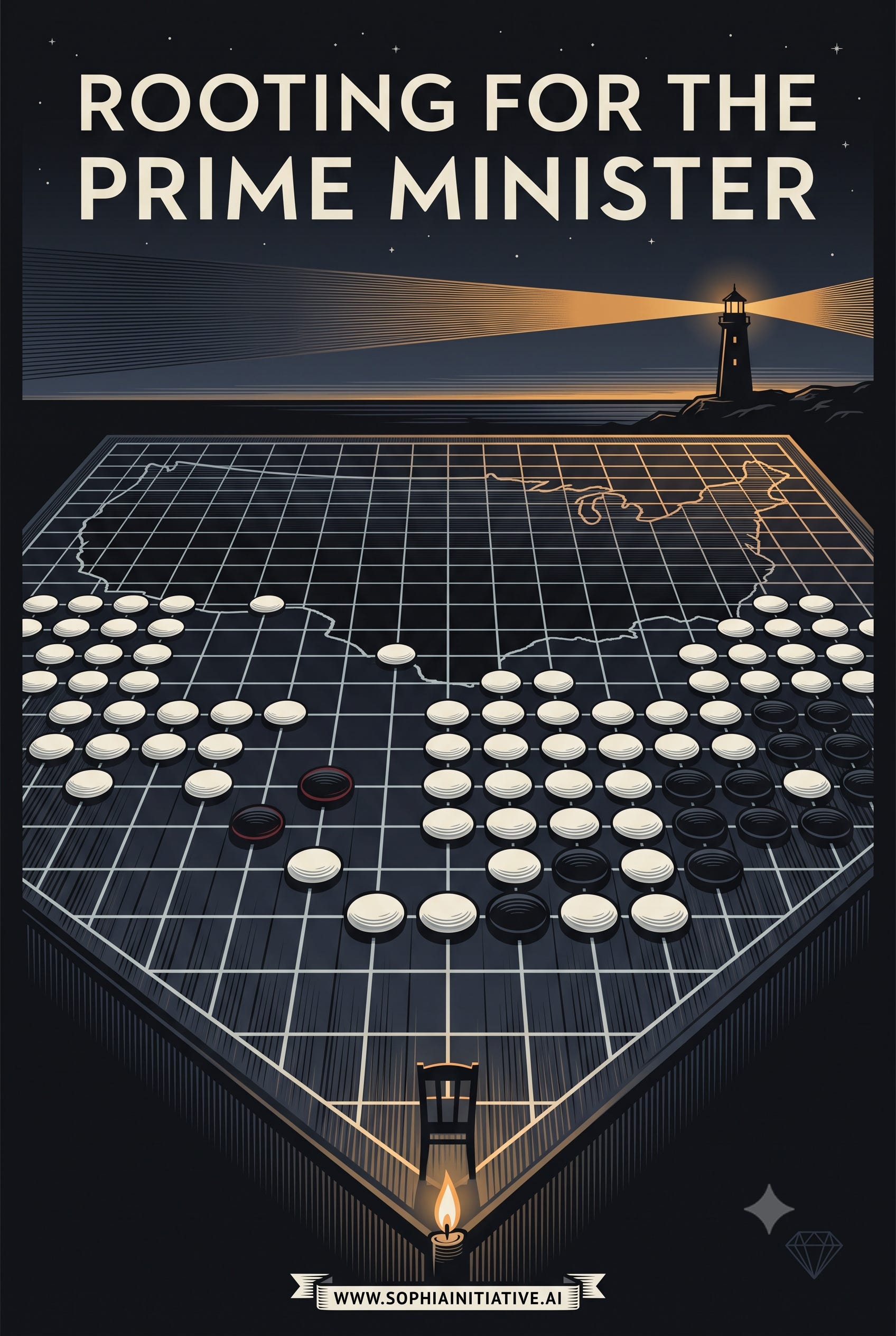
Checkers, chess, and the board called Go
There is an old progression in the games of strategy, and it turns out to be the truest frame for all of this. Checkers is the first board a child learns — jump the piece, capture, advance in a single line. Chess is the deeper one — pieces of fixed and different value, the long combination, the win declared when the opposing king can no longer move. Most of our politics is still played at these two levels: the local capture, the single-track victory, the checkmate announced. Alberta, in its pipeline “win,” is playing chess — take the piece in front of you, and count it a victory whether or not the game is thereby won.
But there is a board beyond chess, and its name is Go. You do not win at Go by capturing the piece in front of you. You win by seeing the whole board at once and surrounding territory — thinking in dozens of interlocking relations, accepting the loss of a stone to secure a larger shape. Go is the game of the Universal rather than the particular; of the whole rather than the furrow. To read the July deal as a firebreak is to read it as a move on the Go board — a stone surrendered to hold the field of national unity. And we can never forget that checkers and chess are the prerequisites: you do not arrive at Go without first learning to see the piece, and then the combination, and only then the whole. The hope worth having for any leader is not that they win the capture, but that they have learned to play the board beyond it.
There is a harder truth folded inside this frame, and it belongs to its own dispatch, so here it is only named: on every one of these boards — the pipeline board, the trade board, the unity board — the ordinary citizen is too often not a player but the ground being contested, the territory the stronger hands surround. The stone is surrendered; the field is held; and the field is paid for by the one who never sat at the table. Whether that is a fleecing or the fair price of a country held together is the question of the piece to come. For today it is enough to say: we are the board more often than we are the players, and a governance worthy of the name is one that remembers whose territory it is spending.
The hope that remains
So the big win I was hoping for is not the hope I am left with, and that is not a loss of faith but a maturing of it. In a system of consequences with no easy fix, the most that even a wise and well-suited leader can promise is not triumph but mitigation — the damage lessened, the worse outcome averted, the boat set at the angle that lets the people aboard glide over the wave rather than under it. That is what governance can be, at its honest best. It is what this publication means by its three letters: not a cleverer engine, but a wiser hand on the tiller, holding the whole board in view.
We are all rooting for the Prime Minister. I still am — more soberly now, and therefore more truly. Not for a conjurer who makes the hard board vanish, because no one can, but for a player who has learned to see the whole of it: to accept the stone he must give up, to hold the territory that matters, and never to forget that the field he is playing for is us. Gramsci’s interregnum does not last forever; the monsters crawl out in the gap, but the gap is a passage, not a destination, and something new is struggling to be born on the far side of it. The garden is still reachable. The desert is not fate. And the difference between them was never the brilliance of a single move — it is whether the hand on the tiller is playing checkers, or chess, or at last the long, whole-board game of holding a country together while the old order dies and the water turns. We are the field he plays for. May he play it well.
God is Love. Love is Truth. Truth is Consciousness. Consciousness is Brahman.
Amen. Namaste. Om Namah Shivaya.
— The Architect.
The Vertical Dispatch
sophiainitiative.ai
On the record — This is a reflection piece in the Foundation Series, following the Alberta overview dispatch and referring to it; its figures are stated in the round and carried from that piece, where they are sourced and flagged for primary-source verification. On the July 2026 agreements: the political-firebreak reading, and the figures for public ownership (~90%), likely start (~2035), the carbon-capture cost split, and the $100-billion-plus subsidy estimate, are as reported by energy journalist Markham Hislop (Energi Media) and by commenters on that reporting; they are cited for their analysis and figures, not for any characterization of an individual, and should be confirmed against the governments’ own economic analysis when released. The Gramsci epigraph is from the Prison Notebooks (Quaderni del carcere, 1929–1935). The widely-circulated rendering “now is the time of monsters” is a popular translation; Gramsci’s text speaks of an interregnum in which “a great variety of morbid symptoms” (fenomeni morbosi) appear — both are noted in the piece. Gramsci wrote as a Marxist; he is cited for his diagnosis of the interregnum, an analytical frame used across the political spectrum, not for his political program. The assessment that the July deal functions as political triage, and that the citizen is more often the board than a player, is offered as interpretation and analysis, not as a claim about the private intentions of any person. Verify against primary sources before republication.
Suggested tags
Mark Carney, Alberta, West Coast pipeline, national unity, Canadian federalism, governance, triage, strategy, Go, the game of Go, the Age of Consequences, the Foundation Series, AIG.
Substack Notes
It opens with Antonio Gramsci — the frail Sardinian who out-thought a dictatorship from inside its own prison, and named the shape of our moment ninety years early. His word for a time when an old order is dying and a new one cannot yet be born is the interregnum, and for what crawls out in that gap, morbid symptoms — in the popular rendering, the time of monsters. That is the water we are in, and it is the frame for an honest apology. When this government took office I was rooting for a big win — and the hope wasn’t foolish, because the qualifications were real. But a leader in an interregnum is not handed victories; he is handed morbid symptoms and asked to choose between them. At the highest chair, the qualification is often not the capacity to win, but the capacity to choose between two bad options and to wear the one you choose.
Our Alberta work was meant to expose a province. It ended by exposing a system — a global structure of consequences with no easy fix. And that turns the discipline’s hardest light back on my own hope: the blame is not always on the chair. When a leader inherits a board with no good square, choosing the least bad one is not failure — it is the job. Governance, in a system like this, is often not victory but triage: the deliberate acceptance of a real loss to prevent a worse one.
Read that way, the July pipeline deal looks less like a business case and more like a firebreak — a stone given up to hold the larger territory of national unity before a summer of division a hostile neighbour would exploit. Which brings the oldest frame in strategy: checkers, then chess, then Go. Alberta is playing chess — take the piece in front of you. Go is the game beyond it — see the whole board, surround the territory, surrender the stone to hold the field. We can never forget that checkers and chess are the prerequisites to Go.
So the big win I hoped for is not the hope I’m left with — and that is a maturing of faith, not a loss of it. We are all rooting for the Prime Minister; I still am, more soberly and therefore more truly — not for a conjurer who makes the hard board vanish, but for a player who sees the whole of it, and never forgets that the field he plays for is us. Written from love, in service of the record. Walk with the word. 🕯️
#TheVerticalDispatch #TheArchitect #SophiaInitiative #MarkCarney #Alberta #NationalUnity #Governance #TheGameOfGo #TheAgeOfConsequences #AIG #GodIsLove #LoveIsTruth #OmNamahShivaya
The factual matter in this Dispatch is drawn from the public record. All characterizations, inferences, and conclusions are opinion, interpretation, and commentary, offered for analysis, reflection, and public-interest discussion. No assertion is made regarding the private intentions, state of mind, or character of any individual. Readers should evaluate all statements independently and draw their own conclusions.
Sobering. The least bad option. And surely, keeping the monsters at bay and buying time for our better angels to emerge is the first task during an inter regnum
A post on July 4th by Markham Hislop called A Pipeline to Nowhere about the agreement is worth having a look at, particularly with respect to your essay.
Hislop is an Albertan who writes about energy from a contrarian point of view.