

Geopolitical Analysis · April 2026 · The Architect
“The supreme art of war is to subdue the enemy without fighting.” — Sun Tzu, The Art of War, c. 500 BCE
“Pride goes before destruction, and a haughty spirit before a fall.” — Proverbs 16:18
“To be free, one needs to be feared.” — Emmanuel Macron, Île Longue Naval Base, March 2, 2026
Analytical Summary
This analysis argues that the Western strategic order established after 1945 is undergoing its most consequential structural transformation since the Marshall Plan — not through military conflict, not through ideological collapse, but through the systematic withdrawal of trust by the allies who built it. The precipitating force is American strategic behaviour under the current administration: transactional, contemptuous of institutional history, and operating at a level of strategic abstraction that cannot perceive the territorial consequences accumulating on the larger board.
The response emerging from Europe and Canada is not reactive. It is architectural. Drawing on four converging developments — Macron’s nuclear forward deterrence framework, Canada’s formal pivot to European defence partnerships, the Arctic resource and security competition, and the collapse of Western public trust in American alliance leadership — this analysis maps a nascent but structurally coherent post-American Western security architecture. Its logic is not chess. It is not even the sophisticated chess that has governed Western strategic thinking for seventy years. It is Go: the ancient Chinese game of territorial enclosure, in which victory is achieved not by capturing pieces but by making entire regions of the board inhospitable to your opponent, one quietly placed stone at a time.
The stones are already being placed.
I. First, Understand the Game
There is a game played on a nineteen-by-nineteen grid with black and white stones. It is called Go — wéiqí in Chinese, baduk in Korean, igo in Japanese. It is approximately four thousand years old, originating in China, and it remains to this day the most strategically complex board game ever devised. So complex that artificial intelligence only surpassed the world’s best human players in 2016 — DeepMind’s AlphaGo defeating champion Lee Sedol four games to one — decades after computers had thoroughly mastered chess. The reason AI found Go so much harder than chess is the beginning of understanding the geopolitical moment we are now living through.
There is a hierarchy of strategic thinking that maps with precision onto the current world order.
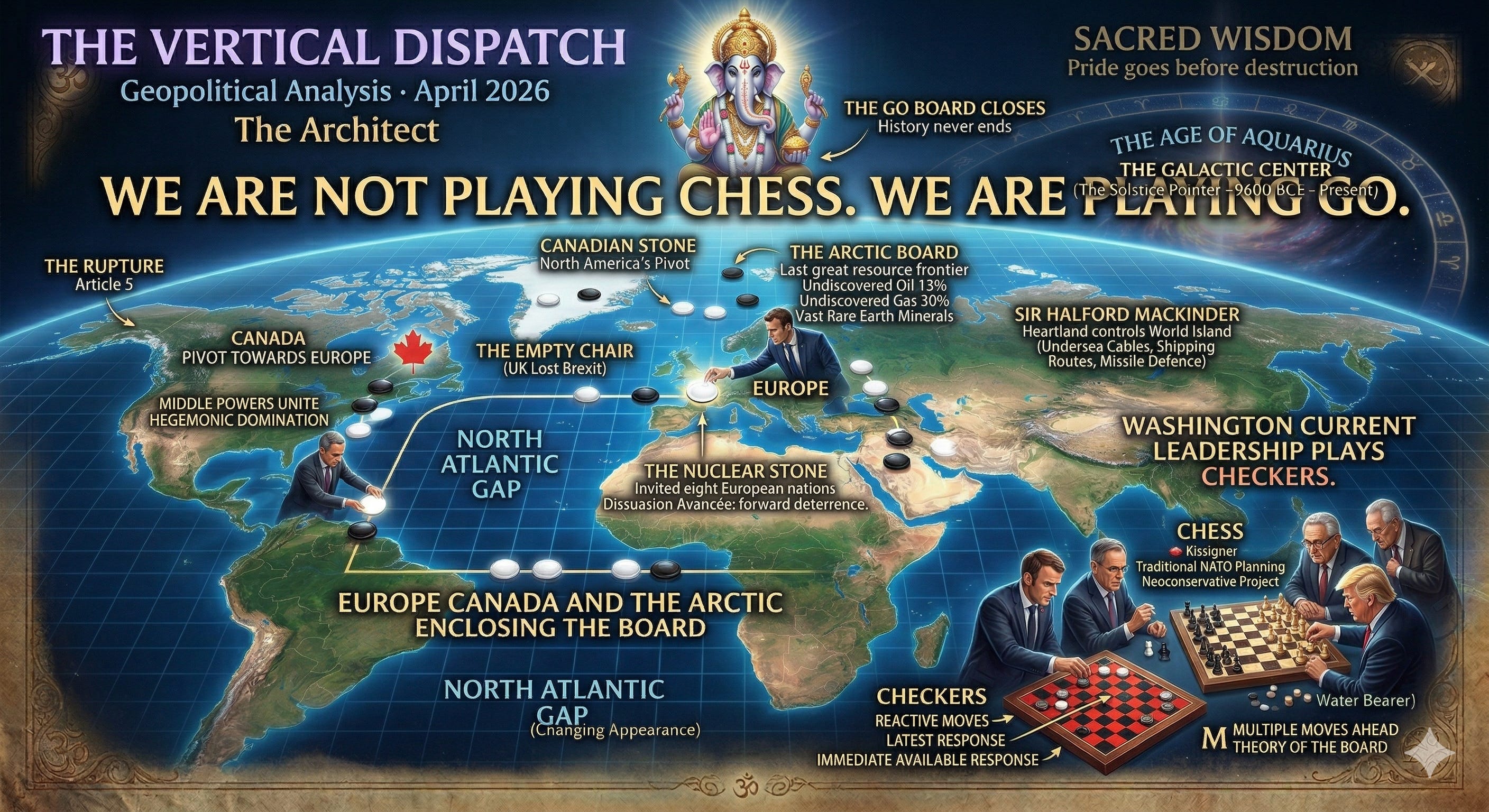
Checkers. You move forward. You take the piece directly in front of you. You react to the last move with the most visible available response. There is no positional theory, no sacrifice for future advantage, no reading of the board as a whole. Aggression and strategy are indistinguishable because the game does not require their separation. Checkers is not stupid — within its own frame it is coherent. But it cannot perceive a game being played at a different level. A checkers player on a Go board will make aggressive, confident moves, take whatever is immediately available, feel the satisfaction of each capture — and remain genuinely unable to see that the territory is enclosing around them until the board has already closed.
Chess is categorically more sophisticated. The chess player thinks multiple moves ahead. They understand that pieces have differential value and that sacrifice can serve strategy. They have a theory of the board, a concept of positional advantage, and the capacity to read threats that have not yet materialised. Most sophisticated Western geopolitical thinking — Kissinger’s realpolitik, traditional NATO strategic planning, the neoconservative project of regime change and democratic expansion — operates at the chess level. It is real strategic thinking. It simply assumes everyone else is playing the same game on the same kind of board.
Go operates on an entirely different logic. You do not win by capturing pieces. You win by encircling territory. This distinction requires precision: in Go, stones can be captured — they are removed from the board when all their adjacent empty points (their “liberties”) are surrounded. But capture is almost never the point. Capture is what the novice fixates on. What the Go master fixates on is shi — a Japanese concept with no satisfying English equivalent, meaning something between “influence,” “potential,” and “the gathering weight of strategic position.” A Go master places stones not to attack but to build shi: a configuration of influence that gradually, invisibly, and irrevocably makes entire regions of the board inhospitable to the opponent.
The opponent who tries to counter each stone individually loses. The opponent who concentrates on one region while neglecting another loses. The only path to survival is to read the full board — the configuration whose meaning will not be visible for fifty moves, when the opponent suddenly realises they have been quietly, completely, and irreversibly surrounded.
This is the terror of Go. Victory does not look like victory until it is total. And by the time it is visible, it cannot be undone.
China has been playing Go for forty years while America played chess and its current leadership plays checkers. The Belt and Road Initiative was not a military strategy. It was a Go move of extraordinary shi — encircling port access, resource networks, and economic dependency across three continents over two decades before the West understood what was being built. By the time the enclosure became legible, it had already substantially closed. Russia plays a brutal hybrid: Go in its near abroad — the patient, decades-long cultivation of ethnic and linguistic influence in Ukraine, the Baltics, and Moldova before the kinetic phase — and chess everywhere else.
What is now emerging in the West — born of necessity, catalysed by American contempt, and architected by a convergence of European and Canadian strategic interest — is the first coherent Western Go play in a generation. In Go, the most important stones are placed quietly, early, with no apparent urgency. Their meaning only becomes visible much later, when the board has closed.
The stones are already being placed. This analysis maps them.
II. The Rupture That Made the Move Possible
On September 12, 2001 — the morning after the worst attack on American soil since Pearl Harbor — NATO Secretary General Lord Robertson announced that the alliance had invoked Article 5 of the Washington Treaty. It was the first and only invocation of collective defence in the alliance’s fifty-two-year history. The clause is precise: an attack against one member shall be considered an attack against all.
Europe went to war for America. Not symbolically. Not administratively. With sons and daughters, in the mountains of Helmand and Kandahar, in ambushes along roads that had no names in Western atlases, in improvised explosive device blasts on routes with optimistic names like Route Cornwall and Route Viking. The scale of this sacrifice is not a matter of interpretation. It is a matter of record, written in names on memorials in London, Ottawa, Paris, Copenhagen, Amsterdam, and Rome.
Canada lost 158 soldiers in Afghanistan — its largest combat deployment since Korea. Denmark suffered casualties at a per-capita rate exceeding any other coalition partner. Ten French soldiers were killed in a single Taliban ambush in the Uzbeen Valley in August 2008 — France’s worst single-day military loss since the Algerian War. British forces bore primary responsibility for Helmand Province for nearly a decade, fighting a counter-insurgency campaign of extraordinary difficulty in terrain specifically designed to exhaust expeditionary forces. Germany, constitutionally constrained and politically cautious, nonetheless deployed the Bundeswehr to a combat environment for the first time since the Second World War, losing fifty-nine soldiers. More than twelve thousand allied troops died or were wounded in America’s post-9/11 wars.
This is the historical record. It is not contested. It is not ambiguous. It is written in names.
In 2026, Donald Trump stood before the world and declared that no NATO ally had ever gone to the front lines with America. He called the alliance a paper tiger. He threatened to withdraw American protection from nations that did not join his administration’s confrontation with Iran — a conflict that European publics overwhelmingly opposed by margins exceeding 70%, and that European leaders were legally and constitutionally constrained from joining without parliamentary authorisation that would not be forthcoming. He characterised seventy years of alliance loyalty, and the blood that expressed it, as worthless.
To understand the strategic consequence of this statement, it is necessary to understand what it is in chess terms. A chess player would immediately perceive that publicly humiliating allies who buried their dead in your wars is a sacrifice that requires a compensating strategic gain of extraordinary magnitude to justify. There is none visible. It is a checkers move: take what is in front of you, dominate the immediate interaction, feel the satisfaction of the aggressive gesture — made without any capacity to read the positional consequences now accumulating on the larger board.
Those consequences are accumulating faster than Washington appears to have noticed.
The polling data is not ambiguous:
● Only 9% of Canadians now consider the United States a trustworthy ally (Angus Reid Institute, March 2026).
● 60% of Europeans trust a common European army over NATO as the guarantor of their security (Eurobarometer Special Survey, Q1 2026).
● 71% of Europeans believe the EU should purchase its weapons from European manufacturers rather than American ones (European Council on Foreign Relations, March 2026).
● 61% of Europeans support the extension of French nuclear deterrence across the European continent (ECFR, March 2026).
● Approval of American leadership among EU member state publics has fallen to its lowest recorded level — below the nadir of the Iraq War period (Pew Research Center, February 2026).
These numbers are not the product of anti-American ideology. They are the rational response of populations watching their governments treated not as allies but as subsidiaries. When a relationship built on mutual sacrifice is reframed as a protection racket, the protected party does not simply accept the reframing. They build alternative arrangements. This is not sentiment. It is structural inevitability.
The rupture is real. What matters now is what is being built in the space it has opened.
III. The Nuclear Stone: Macron’s March 2nd Move
On the morning of March 2nd, 2026, Emmanuel Macron travelled to the Île Longue naval base near Brest on the Atlantic coast of Brittany — the home of France’s submarine-launched ballistic missile fleet, the maritime backbone of the Force de Frappe — and delivered what analysts across the political and strategic spectrum have described as the most consequential speech on nuclear doctrine by any Western leader since the end of the Cold War.
The speech had been in preparation for months. It was not a response to Trump’s Iran ultimatum, though its timing gave it additional resonance. It was the culmination of a strategic argument Macron had been making since his 2019 observation — widely mocked at the time — that NATO was experiencing “brain death,” and his subsequent calls for European “strategic autonomy” that were dismissed as characteristically Gaullist grandiosity. He was, it turns out, reading the board correctly. His critics were not.
Macron announced four concrete and historically unprecedented changes to French nuclear doctrine.
First: France would increase its nuclear warhead stockpile for the first time since 1992, when President Mitterrand announced a unilateral freeze as a post-Cold War gesture. The resumption of stockpile expansion signals a formal reassessment of the threat environment and a determination that French deterrence must be materially adequate to it.
Second: France would cease disclosing the precise size of its stockpile, reintroducing strategic ambiguity as a deliberate deterrent tool. The opponent who does not know how many warheads you possess cannot calculate the acceptable cost of aggression.
Third: France would permit — for the first time in the history of the Fifth Republic — the temporary forward deployment of French nuclear-capable aircraft to allied nations. This changes the geography of deterrence.
Fourth: France would invite eight European nations — Germany, Poland, the Netherlands, Belgium, Greece, Sweden, Denmark, and the United Kingdom — into a structured framework of nuclear deterrence cooperation designated dissuasion avancée (forward deterrence). Sovereign control remains solely with the French President, as constitutional law requires. What Macron is offering is not a finger on the trigger. He is offering the architecture of a deterrence relationship: consultation frameworks, shared threat assessments, forward basing arrangements, and the credibility of French commitment to European security that does not depend on American approval.
The framing was precise and deliberately quotable: “To be free, one needs to be feared.” And: “What I want more than anything is for Europeans to regain control of their own destiny.”
The Go board reading:
Macron has placed a stone of extraordinary shi. It captures nothing immediately. No territory is seized, no adversary defeated, no alliance formally superseded. But its influence extends across the entire European strategic space. It creates a new centre of gravity — French, sovereign, independent of Washington — around which a new security architecture can crystallise. Its meaning will compound for decades.
A critical structural note on the framework:
The reported framework conspicuously includes the United Kingdom — now outside the EU since Brexit — while the apparent absence of Italy and Spain from the initial eight deserves analytical attention. Italy is a G7 power with the fourth-largest economy in the EU and a significant Mediterranean naval presence. Spain is a major EU pillar and a key southern flank NATO member. Their absence from the initial framework either reflects a deliberate sequencing — an initial core that will expand — or a strategic friction point that Macron will need to manage carefully. A European nuclear architecture that excludes the Mediterranean’s two major EU powers risks creating a fault line between northern and southern Europe at precisely the moment when unity is the architecture’s primary asset.
IV. The Empty Chair: What Britain Lost — and Cannot Recover
The Brexit referendum of 2016 was argued on the grounds of sovereignty. Take back control. Independence from Brussels. Freedom from European governance. It was, in the language of checkers, a straightforward and satisfying move: Britain removes its piece from the European board and keeps it for itself. The piece is captured. The move feels like a win.
What the Brexit architects could not read — because they were playing checkers on a Go board — was the territorial consequence that would compound over the following decade.
Had Britain remained in the EU, any architecture of European nuclear deterrence would have required British co-authorship as a structural necessity. London and Paris together — the only two European nuclear powers, the only two European permanent members of the UN Security Council, the two nations with the deepest independent intelligence capabilities on the continent — would have been the twin pillars of any new security order. Instead, Britain in 2026 finds itself invited, as one of eight, into a framework designed by and centred on France. Not a co-architect. A participant.
There is a further structural complication. The British nuclear deterrent — the Trident submarine system — uses American-manufactured Trident II D5 missiles, leased from a shared pool maintained at the US Naval Submarine Base Kings Bay in Georgia. Britain’s “independent” nuclear deterrent is dependent, at the material level, on American goodwill for its operational continuity. France’s Force de Frappe — missiles, warheads, submarines, delivery systems — is entirely domestically produced. When Macron speaks of European nuclear sovereignty, he speaks from a position of genuine self-sufficiency. The structural asterisk on British deterrence is now impossible to ignore.
This is the consequence of a strategic decision — made in 2016, for reasons that seemed compelling at the time — that vacated a position whose value would only become fully apparent a decade later. This is precisely how Go works. The stone placed in 2016 removed Britain from a configuration whose full territorial consequence would only be legible in 2026, when the board had begun to close.
Winston Churchill, who spent his entire political career ensuring that Britain was always at the table where civilisational decisions were made, would recognise this dynamic immediately, and be appalled by it. Charles de Gaulle — who twice vetoed British entry into the European community, who argued that Britain’s Atlantic orientation made it constitutionally unsuitable for European partnership, who was dismissed as vindictive and anti-British for saying so — would be quietly, comprehensively, historically vindicated.
V. The Canadian Stone: The Move That Changes the Geometry
Something of extraordinary strategic significance has happened in Canada — so rapid in its development and so structurally consequential in its implications that Western strategic analysis has barely begun to register its full meaning.
In less than eighteen months, Canada has moved from its position as America’s closest ally, most integrated trading partner, and most culturally proximate neighbour to a nation whose citizens view the United States as a geopolitical risk rather than a geopolitical partner. The speed of this transformation is without precedent in the peacetime history of the bilateral relationship.
The causes are not subtle.
Trump’s repeated public invocations of Canada as a prospective 51st state. Tariff warfare of significant scale applied without the pretence of legitimate trade grievance. The demand that Canada contribute $61 billion to participate in the American Golden Dome missile defence architecture, or face exclusion from a system designed to defend North American airspace that includes Canadian territory. The treatment of a sovereign nation — one that had sent soldiers to die in American wars, one that shares the longest undefended border in the world — as a subordinate territory awaiting eventual formal annexation.
Each of these is a checkers move. Each generates immediate satisfaction for the player making it. Each is catastrophically counterproductive on the larger board, because each one moves a pivotal piece from the American sphere of influence toward the European one.
The structural consequences deserve careful analysis.
Prime Minister Mark Carney — a former Governor of both the Bank of Canada and the Bank of England, a man whose entire career reflects an understanding of systemic risk — has responded not with rhetoric but with architecture. He has explicitly framed Canadian strategic policy as the project of uniting middle powers against hegemonic domination. He has committed Canada to doubling its defence expenditure to the NATO target of 2% of GDP. He has announced a programme of domestic defence industrial development explicitly designed to reduce dependency on American weapons systems.
Most significantly, Canada has formally joined the EU’s Security Action for Europe (SAFE) defence procurement and industrial framework. SAFE is specifically structured as a European defence initiative from which the United States is deliberately excluded. For Canada to join it is not merely a symbolic gesture of displeasure with Washington. It is a formal structural realignment — Canada entering a European defence industrial architecture as a participant, not an observer; as a partner, not a client.
Canada has simultaneously signed a strategic defence roadmap with France. The implications of this agreement, read in conjunction with Macron’s dissuasion avancée framework and Canada’s SAFE membership, are significant: Canada is now formally embedded in a European-led defence architecture that encompasses both Atlantic and Arctic dimensions, that operates independently of American oversight, and that is explicitly positioned as an alternative to American-dominated security frameworks.
The Go board geometry this creates is historically unprecedented.
For the first time in the eighty-year history of the post-war Western alliance, there exists a formal defence partnership between Europe and a North American nation that is not the United States. This partnership is built on the northern border of American territory. It encompasses the Arctic, the North Atlantic, and the most strategically sensitive air and maritime corridors in the Western hemisphere. Canada’s territory — stretching from the 49th parallel to the High Arctic, encompassing the Northwest Passage, sharing maritime boundaries with Greenland and Iceland — sits at the geographic centre of the board that is now being contested.
A checkers player made this move for their opponents. One aggressive, uncomprehending gesture at a time.
VI. The Arctic Board: Where the Game Will Be Won
To understand why the Arctic is the centre of the Go board in the twenty-first century, begin with the resources — because resources are always where the game ultimately resolves.
The Arctic region is estimated to contain 13% of the world’s undiscovered conventional oil reserves and 30% of its undiscovered natural gas, according to United States Geological Survey assessments. These are not marginal deposits. They are reserves whose exploitation, made progressively more accessible by the retreat of sea ice, represent the last major untapped hydrocarbon frontier on earth. The Arctic also holds vast deposits of rare earth elements — the lanthanides and actinides that are the elemental substrate of every lithium-ion battery, every semiconductor, every advanced sensor, every precision guidance system of the modern technological and military era. The nation or alliance that governs Arctic access in the coming decades governs the material foundation of global power.
Then understand the geography, because geography is permanent in a way that politics is not.
The Greenland-Iceland-United Kingdom (GIUK) gap is the most strategically critical naval chokepoint in the North Atlantic. Every Russian submarine transiting from the Kola Peninsula to Atlantic patrol must pass through it. Every surface vessel attempting Arctic navigation approaches it. Control of the GIUK gap — the ability to monitor, constrain, and if necessary deny passage — is the foundational condition of North Atlantic security. During the Cold War, NATO invested enormous resources in SOSUS hydrophone networks, patrol aircraft, and submarine presence specifically to maintain this control. That infrastructure atrophied after 1991. It is now being urgently rebuilt.
Russia has understood this for twenty years. China has understood it for fifteen. Both have invested methodically in Arctic presence: military installations, icebreaker fleets (Russia operates the world’s largest nuclear-powered icebreaker fleet, with over forty vessels; the United States operates two), research stations that function as intelligence platforms, and economic agreements that establish strategic footholds before the legal and governance frameworks for Arctic exploitation have been established.
Trump’s fixation on Greenland — and its unintended consequence.
At the checkers level, the desire for Greenland is explicable. It is a large, strategically positioned island with rare earth deposits and Arctic Ocean access. Take the piece. Win the move. The strategic rationale is real.
What a checkers mind cannot read is the Go consequence of the approach. By threatening to acquire Greenland from Denmark — a NATO ally — through economic coercion and implied military pressure, Trump has accomplished something no Russian or Chinese strategist could have engineered: he has transformed Greenland from a Danish administrative challenge into a symbol of European civilisational sovereignty against imperial overreach. He has made the protection of Greenland’s political future a matter of European alliance solidarity. He has handed every European leader who wants to argue for strategic autonomy the most powerful possible justification.
The strategic architecture forming around Arctic governance:
● European-Canadian Arctic security cooperation, established through Carney’s defence agreements with Macron and Canada’s SAFE membership, creating an institutional framework for joint management of Arctic approaches.
● French nuclear deterrence extension to Arctic-adjacent partners, providing the ultimate deterrent backstop for territorial sovereignty claims.
● Nordic military integration, accelerated by Finland and Sweden’s NATO accession and deepened by bilateral Nordic defence agreements, creating continuous security architecture from the Baltic to the High Arctic.
● European economic engagement with Greenland, positioned as an alternative to either American acquisition or continued Danish administrative dependency.
● Canadian Arctic sovereignty investment, including Carney’s commitment to Arctic military infrastructure and Northwest Passage governance.
The Mackinder insight, updated:
Sir Halford Mackinder wrote in 1904 that whoever controls the Heartland controls the World Island; whoever controls the World Island commands the World. He was thinking of Eurasian land routes. The twenty-first-century update adds rare earth mineral deposits that are the substrate of technological power; undersea cable networks carrying 95% of the world’s internet traffic; missile defence geometry, in which Arctic positioning is mathematically decisive; and Arctic shipping routes that will — as the ice continues its historically unprecedented recession — become the most economical maritime corridors in the northern hemisphere, reducing distances between Europe and Asia by up to 40%.
The stones being placed across the Arctic, the North Atlantic, and the Canadian north are not defensive. They are an enclosure. A Go enclosure. Whose meaning will only be fully legible when the board has closed.
VII. What de Gaulle Always Wanted — and Why He Was Right
Charles de Gaulle was formed by humiliation. Not personal humiliation — though he endured his share, including years of political exile while the Fourth Republic lurched from crisis to crisis. He was formed by the humiliation of France itself.
Napoleon had made France the centre of the world. The Grande Armée, the Continental System, the Napoleonic Code imposed across a continent — France at the apex of European civilisational order. Then came Waterloo in 1815. Then came 1870, when Prussia humiliated France in six weeks and the Second Empire collapsed in the wreckage of Sedan. Then came 1914, when France endured four years of industrial slaughter on its own soil before the combined weight of British and American intervention finally turned the tide. Then came 1940, when the Wehrmacht accomplished in forty-six days what four years of the Great War had not: the complete collapse of French military resistance, the armistice, the occupation, and the shattering of every remaining illusion of Napoleonic grandeur.
De Gaulle watched his nation’s humiliation from a BBC radio studio in London. He understood, with the clarity that comes from witnessing the worst, that France’s survival as a great power depended on a single irreducible principle: never again could France entrust its strategic fate to any external power, however allied, however friendly, however well-intentioned. Not to Britain, which had evacuated at Dunkirk when its own survival required it. Not to America, whose subsequent dominance — benevolent in many respects — nonetheless threatened to replace one form of external dependency with another, more comfortable but equally subordinating one.
The Force de Frappe was built not because France feared the Soviet Union more than its allies did. It was built because France refused to make its ultimate survival dependent on any other nation’s decision. If France’s existence required nuclear deterrence, France would control that deterrence itself, with French weapons, French delivery systems, and French presidential authority.
In 1966, de Gaulle did what no other NATO leader had the clarity or courage to do. He withdrew France from the alliance’s integrated military command and expelled every American base from French soil. Within twelve months, 26 American bases had closed. 100,000 American service personnel had departed. NATO’s headquarters relocated from Paris to Brussels. President Johnson was furious. De Gaulle was called arrogant, ungrateful, destabilising.
He was sixty years ahead of his time.
What de Gaulle wanted — what he spent his entire political life building toward — was a Europe that was genuinely sovereign. Not a Europe that chose American protection because it was comfortable, but a Europe that chose its relationships from a position of self-sufficiency, dignity, and independent power. A Europe that did not need to request Washington’s permission before making a strategic decision. A Europe that, because it was not dependent on American military protection, could speak honestly to America — partner with it where interests aligned, resist it where they diverged, and treat it as an equal rather than a patron.
He did not live to see that Europe. He died in November 1970, and for fifty years his vision was treated as an interesting historical footnote — the Gaullist aberration, the French exception, the impractical ideology of a nation that had never fully reconciled itself to its post-Napoleonic condition.
On March 2nd, 2026, Emmanuel Macron stood on the deck of a nuclear submarine in Brittany and completed what de Gaulle began. Not as nostalgia. Not as romantic nationalism. But because the architecture de Gaulle designed — sovereign deterrence, independent command, European strategic self-sufficiency — had become not merely desirable but structurally necessary.
De Gaulle’s ghost is not haunting the Élysée. It is occupying it.
VIII. Pride Before the Fall
There is a verse in the Book of Proverbs — one of the oldest and most consistently confirmed observations in the history of political analysis — that states with a directness that centuries have not dimmed: “Pride goes before destruction, and a haughty spirit before a fall.”
This is not a religious observation. It is a structural one. It describes what happens to any power that mistakes the peak of its influence for a permanent condition of nature — that confuses dominance with destiny, that reads the height of the mountain as the floor of the world.
The United States at its post-Cold War peak was, by virtually every measurable dimension, the most powerful nation in recorded history. Military reach that could project decisive force to any point on earth. An economy constituting roughly a quarter of global output. Cultural influence of unprecedented breadth. Technological leadership so commanding it defined the terms of modernity. Institutional authority as the architect and primary sustainer of a rules-based international order that, for all its hypocrisies, had produced the longest period of great-power peace in the modern era and the most extraordinary expansion of human prosperity ever recorded.
That peak generated a specific and historically recognisable pathology: the pathology of unipolar certainty. The conviction — never fully articulated in official doctrine but structurally embedded in American strategic culture — that American dominance was not a historical condition produced by specific contingent circumstances, but a natural order reflecting American exceptionalism and America’s manifest role as the world’s indispensable nation.
Hubris of this kind does not generate wisdom. It generates the opposite: a progressive inability to read the world accurately, because the world’s complexity has been replaced, in the mind of the hubristic power, by a simplified map in which it occupies the centre and everything else is peripheral. You stop learning other people’s games because you are certain everyone is playing yours. You stop reading the Go board because you are certain the world is a chessboard. And when the leader is not even a chess player but a checkers player — reactive, transactional, measuring every interaction by its immediate visible result — the blindness compounds into something close to strategic catastrophe.
The cascading failures are not partisan or accidental. The catastrophic miscalculation of Iraq. The 2008 financial crisis, originating in American financial deregulation and spreading through a global system whose architecture America had designed. The twenty-year Afghanistan expenditure — conservatively estimated at $2.3 trillion — that produced, at its conclusion, a Taliban government indistinguishable from the one present at the beginning. The progressive degradation of alliance relationships through decades of treating allied sovereignty as an administrative inconvenience.
And then the current administration — not as an aberration, but as the logical terminus of a trajectory. The explicit transactionalisation of every alliance relationship. The treatment of NATO as a protection racket. The implication that Greenland, Canada, and Panama might be acquired by coercion. The contemptuous dismissal of allies who had buried their dead in American wars — their sacrifice erased by a checkers player who needed a talking point and reached for the nearest available fiction regardless of its relationship to the historical record.
This is not strength. It is the behaviour of a power that has lost the ability to distinguish between dominance and leadership. Dominance is the ability to compel. Leadership is the ability to attract. The United States spent seventy years building the most extraordinary network of voluntary alliances in the history of international relations — not through dominance alone, but through the genuine, if imperfect, provision of security and institutional frameworks that served allied interests alongside American ones. What is now being offered in its place is pure transaction: pay or lose protection. Agree or face tariffs. Support our wars or we will call you worthless to the world.
The allies are drawing the structural conclusion that sovereign states always draw when this calculus is presented to them. Not from anti-Americanism. From the same rational self-interest that has always governed the behaviour of states: when a protector becomes a threat, you build defences. When a leader becomes a bully, you build coalitions. When a partner is playing checkers on your Go board, you stop explaining the rules and start placing your stones.
Pride goes before destruction. The text has been confirmed by every civilisation that ever rose and fell. After three thousand years it remains the most reliable prediction in the history of political analysis. It is not metaphor. It is diagnosis.
IX. The Board Is Being Set
Let us be precise about what is and is not being argued here.
This is not a prediction that America will collapse. The United States remains a nation of extraordinary human capital, institutional resilience, technological dynamism, and democratic tradition. It is not an argument that the transatlantic alliance is finished. It is not a claim that the world will divide cleanly into opposing blocs. History is never that clean.
What is being argued is more specific and, in the medium term, more consequential: for the first time in the eighty-year history of the post-war Western order, the conditions exist for a genuinely post-American European strategic architecture. Not anti-American. Post-American. An architecture that does not require Washington’s approval for its operation, that is not dependent on American military protection for its survival, that governs its own nuclear deterrence, builds its own defence industrial base, manages its own Arctic security interests, and structures its own relationships with Canada, the wider world, and — crucially — with America itself, from a position of strategic self-sufficiency rather than dependency.
The stones already on the board:
● Macron’s dissuasion avancée nuclear forward deterrence framework, with eight participating nations and the first-ever forward deployment of French nuclear assets to allied territory.
● The €1.25 trillion European rearmament programme, the largest European defence investment since the Cold War, structured explicitly to build European rather than American defence industrial capacity.
● Canada’s formal entry into the EU’s SAFE defence initiative — the first non-European partner in the framework’s history.
● The European-Canadian strategic defence roadmap, creating institutional channels for joint planning outside American oversight.
● Nordic military integration, from Finland and Sweden’s NATO accession through bilateral defence agreements, creating continuous Arctic-to-Baltic security architecture.
● The collapse of European and Canadian public trust in American alliance leadership to historically unprecedented lows: 71% of Europeans prefer European-manufactured weapons; 61% support French nuclear deterrence extension; 60% trust a common European army over NATO.
What to watch for — the falsifiability conditions:
The thesis presented here is falsifiable. The enclosure argument strengthens if Germany moves toward constitutional amendment to permit independent nuclear arrangements; if the SAFE framework admits additional non-European partners; if Greenland negotiates a security agreement with the EU that explicitly excludes unilateral American access; if Arctic shipping governance frameworks emerge outside existing American-dominated structures; if a European-Canadian joint Arctic command is established.
The thesis weakens if the current American administration is replaced by one that genuinely rehabilitates alliance relationships; if European political fragmentation prevents unified defence decision-making at the required speed; if nationalist parties successfully argue that the costs of strategic autonomy exceed its benefits; or if economic recession creates fiscal pressure that forces defence budget reductions before the industrial base is established.
History is not a Go board. It is messier, more contingent, and less susceptible to elegant geometric analysis than any metaphor can fully capture. Strategic vision is not prophecy.
But this is the reading of the board as it stands in April 2026, eighty years after the end of the war that built the order now being unmade:
The Arctic is the centre of the board. Greenland, Iceland, and the Canadian north are its most strategically vital positions. France’s nuclear umbrella is its deepest stone of shi. Canada’s pivot is the move that permanently changes the geometric relationship between North America and Europe. The power that believes it is winning because it has made a few aggressive gestures, taken a few pieces, dominated a few immediate interactions — that power does not see that the territory is enclosing around it.
De Gaulle waited sixty years for this moment. He did not build the Force de Frappe as a weapon of war. He built it as a stone of permanent shi — influence that would compound across decades until the day when Europe was ready to become what he always believed it could become: a sovereign civilisational actor, answerable to no external power, strong enough to choose its relationships freely, wise enough to choose them well.
That day has not fully arrived. The architecture is incomplete. The political will is real but contested. The obstacles are significant and the contingencies are real. But the Go master is not looking at today’s board position.
The Go master is reading the configuration fifty moves ahead.
Fifty moves ahead, the board closes. And the world that emerges from that closure will look nothing like the one imagined by those who declared, in 1991, that history had ended and they had won.
History never ends.
It only changes games.
We are no longer playing chess.
We are playing Go.
A Note on Sources and Methodology
The polling figures cited in this analysis represent the most recently available data at time of publication. The 9% Canadian trust figure is drawn from the Angus Reid Institute (March 2026). European security preference data is sourced from the Eurobarometer Special Survey (Q1 2026) and the European Council on Foreign Relations (March 2026). American leadership approval data is from the Pew Research Center (February 2026). Readers are encouraged to verify current figures against primary sources, as the pace of change in Western public opinion on these questions has been unusually rapid and continues to evolve.
The historical military casualty figures for the Afghanistan campaign are drawn from official government records and represent minimum confirmed figures. Total wounded and the full demographic of psychological casualties significantly exceed these counts.
The strategic framework deployed in this analysis — Universal Dynamics — approaches geopolitical events as expressions of structural forces operating across multiple levels of abstraction simultaneously. The Go/Chess/Checkers hierarchy is a heuristic, not a mathematical model. Its value is not predictive precision but the capacity to make visible dynamics that purely transactional or event-driven analysis tends to obscure.
The Vertical Dispatch
Published by Glen Roberts, writing as The Architect
The framework of Universal Dynamics underlies the structural reading of geopolitical force in this and all Dispatch analyses.
© 2026 The Vertical Dispatch. All rights reserved.
#TheVerticalDispatch #WeArePlayingGo #GeopoliticsNow #StrategicAutonomy #MacronDoctrine #DissuasionAvancee #ForceDeFrappe #EuropeanDefence #NuclearDeterrence #PostAmericanWorld #ArcticSovereignty #GIUKGap #MarkCarney #CanadaPivot #SAFEInitiative #NATOCrisis #Article5 #EuropeanRearmament #NordicSecurity #GreenlandSovereignty #DeGaulle #StrategicEnclosure #GoVsChess #ShiInfluence #BeltAndRoad #AllianceRupture #TrustDeficit #HegemonyDecline #MiddlePowers #UniversalDynamics #TheArchitect #GlenRoberts #Geopolitics2026 #GlobalPowerShift #WorldOrder #TransatlanticAlliance #EuropeanUnion #NATOAlliance #ArcticStrategy #NorthAtlantic #ColdWarLegacy #SovereignEurope #StrategicThinking #PrideBefore TheFall #HistoryNeverEnds