

Φ
THE VERTICAL DISPATCH
We write for the mind, the eye, and the ear.
Read it. Look at it. Listen to it. The Vertical Dispatch is built for all three — prose with rhythm, made to be heard as much as read.
From metaphysics to geopolitics, from culture to history, from the sacred to the street — and everything in between. One lens, every subject. No ego. Just the record, named clean.
Press play. Walk with the words. 🕯️
Sacred Metaphysics · The Announcement
As of July 2026
This dispatch travels by hand. If it serves you, share it — restack on Substack, pass it on wherever you read. 🕯️
Something is missing, and we all know it.
We live in the most materially abundant age in the history of the world, and in the midst of that abundance a hunger walks with us that no abundance feeds. We have gained the whole world of things and lost something we cannot name — and the not being able to name it is part of the loss.
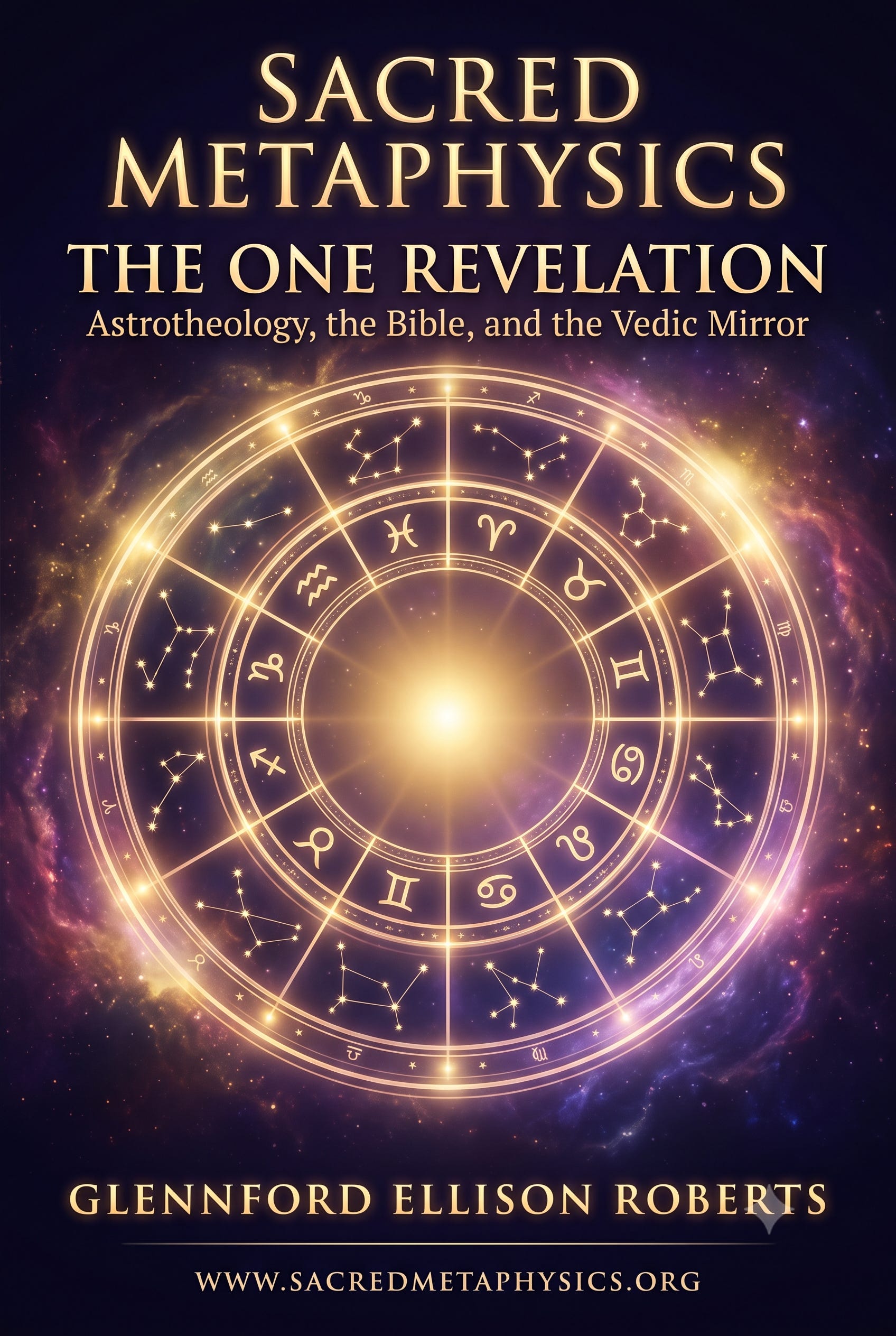
For the better part of two years I have been building a book about what we lost, and how to find it again. It is called The One Revelation, and it will be available on the 9th of November, 2026 — in hardcover, in digital, and online. That date is my birthday, which feels right, because this book is the thing I was most made to give.
Let me tell you what it is.
It Is a Reading, Not a Museum
There is a great tradition of books that gather the sacred symbols of the world and lay them side by side — the recurring gods, the dying-and-rising saviours, the flood remembered on every continent, the wheel of the heavens carved in a hundred hands. Those books show us that the symbols recur. They are magnificent, and I owe them everything.
But this book does something different. It does not merely gather the symbols. It reads them — reads them through to the one thing they were all pointing at.
Because a symbol is not the thing it shows you. A symbol is a finger, and a finger is for pointing, and the whole life of a sign is in the direction it points, not in the shape of the finger. For fourteen hundred years no one could read the hieroglyphs of Egypt, because they insisted on reading the pictures — the bird as a bird, the eye as an eye — when the signs were pointing past themselves to something else entirely. The moment we learned to read through the picture, the words of the gods began to speak again.
The sacred record of humankind is exactly such a script. Every people that ever lived carved the same three things — the order of the stars overhead, the living world around them, and the passage of the soul through death — and each carved them differently, in its own hand, on its own continent, with no contact and no common author. And here is the thing that most books miss: the symbols do not match. They diverge. And that divergence, which looks at first like the ruin of the whole idea, is in truth the proof of it. For if they all matched, we would know one people had copied another. Because they diverge and yet all point the same way — toward a source, toward an order, toward a passage through death and back — we know the thing they point at was really there, before any of them, the same for all of them, belonging to none of them.
A hundred hands that never met, every finger pointing at the same moon.
To read that — to follow the finger all the way up — is a reading, and a reading is a tremendous responsibility. To gather is safe. To read is to stand behind the meaning, and to say what it is.
What It Says: The Two Revelations
The whole book turns on two sentences, its alpha and its omega.
The first: we have been in search of something greater than ourselves. This is the oldest and truest thing that can be said about the human being. From the first night a creature stood upright beneath the stars and felt an order there, we have been reaching — past the small and frightened and separate self, toward something vast enough to be worth the reaching. Every altar, every star mapped, every god carved, every rite of the passage through death, is that one reaching. It is the whole of our history.
And the second, which the whole book climbs toward and which I will only name here: the greatness was always within us. Not the small self we were fleeing — that was a prison and no one was meant to worship it. But beneath it, nearer than the breath, THE SELF we had forgotten we were: THE UNIVERSAL, the source, the ground, the still point from which all things descend and to which all things return. The wave had been searching the whole ocean for water. The sunbeam had been looking everywhere for the sun. The seeker was the sought.
The book is the distance between those two truths — the long road out, and the sudden turning home.
Why Now: The Age We Are Actually In
I did not choose the hour this book arrives in. The stars did.
We read time wrongly. We know only the clock on the wall, the one that counts down and runs out, and we have forgotten the clock in the sky — the great wheel of the ages, turning so slowly that a single tick takes seventy-two years. Every ancient people read that second clock. It tells us not only when but what: that the ages descend from a golden height of clarity down through diminishing ages to a dark age at the bottom, where the veil lies thickest and the symbol hardens into mere surface.
The Greeks read this descent — gold to iron — and read it honestly. But their telling was a ladder that only fell; it went down into the dark and stopped. The East kept the other half: that the descent is not a ladder but a wheel, and the wheel turns, and the dark age is not the end but the turning point. The seers of India and the poet of Greece and the prophet in the court of Babylon all drew the same fourfold fall from gold to iron — three peoples who never met — and only the East remembered that the wheel comes round.
We are at the bottom of that wheel now. The iron age. And ours is the first generation in the whole turning that can break the wheel — that holds, in the nuclear age, the power to end the story before it turns. So the question that every earlier age left to the patient certainty of the wheel is, in our time, left with us.
This is where the book gives hope — but not the cheap kind, and not the dangerous kind. Not the despair that lets the newborn age die of thirst. And not the sickening shortcut of those who look forward to the destruction, who imagine you can bomb your way into paradise, who hold a theology in their back pocket that lets them walk past the man in the ditch because the world is scheduled to burn anyway. You cannot force the golden age by fire. The one who tries to hasten the dawn by destruction does not midwife the new world; he drowns the seedling in the very act of claiming to water it.
The hope is quieter, and truer, and it is the whole point:
We are the upturn.
The wheel does not turn for us while we wait. We are the turning. The descent was us, and the ascent is us, and they were never two — they are two motions of the same SELF, the one that fell and the one that climbs, the search and the homecoming folded into a single circle. And because we are the wheel and not merely subject to it, the fate is ours. Not the stars’. Not handed down from outside. Ours.
There is no fate but what we make — and this is why that is true: because the one who was searching and the greatness that was sought were never separate, and so the choosing was always, entirely, our own.
For the Believer and the Unbeliever Both
A word to the one who threw out the vertical with the superstition it came wrapped in, and will not have the word God laid upon him: you need not call it God. I will not make the source the prize in a tribal contest. But you cannot call it nothing, either — for the whole relative world you stand in requires an absolute to be measured against, the way a wave requires the still water beneath it in order to be a wave at all. Knock down every idol, every crude drawing the frightened centuries made — you should; they were only fingers. But you are standing on the absolute to raise the argument at all.
And a word to the believer who fears the stars are pagan: the wheel you were taught to distrust is named in your own scripture — in the oldest book of the Bible, where God answers Job not with theology but with astronomy, pointing him to the Mazzaroth, the constellations, the great clock that was running before his grief began. The four living creatures around the throne are the four fixed corners of that same wheel. It was never smuggled in. It was built into the walls.
And a word to the seeker who wonders what one book can add to the wisdom of the East: this is the Western telling, but it does not walk alone. All through, the Vedic mirror is held up beside it — the yugas laid against the wheel, the four ages of India matching the four metals of Greece and Babylon, the Kalki who comes at the end of the dark age matching the deliverer the whole West awaited. The East kept the very half the West let fall: that the descent is a wheel and not a ladder, and that the wheel comes round. Where the Western scripture gives the body of this book, the Vedic enters as the witness at the keel of each story, the confirming voice from the far side of the earth that says, in another tongue entirely, the same thing — so that what a Christian or a Greek might have taken for the private symbol of his own people is revealed as the common inheritance of humankind.
This book is written to leave both of them seen, not cornered.
Coming November 9th, 2026
The One Revelation is the flagship of the Sacred Metaphysics series — a history-rich reading of the stars, the ancient civilisations, and the Hebrew scriptures as one continuous language pointing at a single referent. It reaches the same summit the mystics always reached, but by the road of history, walked story by story, age by age, down the descending arc and home.
It runs to more than a hundred thousand words — a full hardcover, the flagship it was always meant to be. It will be available on the 9th of November, 2026 — in hardcover, in digital, and online.
And I will report the road each Sunday morning from here to the ninth of November — where the chapters stand, what climbed and what got torn down, the honest weekly account of a book being built in the open. If that is the kind of thing you want to walk beside, walk beside it. The building is half the revelation.
I destroyed an earlier version of this book. A hundred and thirty thousand words, finished, bound for the publisher. I took it apart because it was not yet true enough — not yet built on the real architecture. I do not regret it. A thing worth building is worth building true, and the only way to know if it stands is to be willing to tear down what doesn’t.
This one stands. And it says the one thing I believe we most need to hear, and have most completely forgotten:
You are what you were always looking for. We are at the bottom of the wheel, and we are the turn. Weeping may endure for the night — but joy comes in the morning; the night is darkest just before the wheel comes round, and we are the ones who turn it toward the dawn.
Surrender the ego, and abide as the SELF.
God is Love. Love is Truth. Truth is Consciousness. Consciousness is Brahman.
Amen. Namaste. Om Namah Shivaya.
— The Architect
sacredmetaphysics.org
sophiainitiative.ai
On the record
The Mazzaroth — the constellations to which God directs Job “out of the whirlwind” — is Job 38:32 (KJV); the word appears once in scripture and is traditionally read as the zodiac or the constellations. “Weeping may endure for a night, but joy cometh in the morning” is Psalm 30:5 (KJV), given here in paraphrase. The four living creatures about the throne are of Ezekiel 1 and Revelation 4, and their reading as the four fixed corners of the celestial wheel is a traditional and interpretive one. The descent of the ages from gold to iron is the myth of the metals in Hesiod’s Works and Days; its counterpart in Daniel 2 (the statue of gold, silver, bronze, and iron) and in the Vedic doctrine of the four yugas (with Kalki as the deliverer at the close of the Kali Yuga) are drawn together here as the Architect’s own comparative reading, offered as interpretation, not as a claim of historical dependence among them. The precession of the equinoxes moves roughly one degree every seventy-two years. “The symbol is not the referent,” the reading of the sacred record as one continuous script, and the framing of the two revelations are the author’s own, from the forthcoming The One Revelation and from Universal Dynamics: I AM Logos. The account of the destroyed earlier manuscript is the author’s own. Date-stamped July 2026. Verify all scriptural and historical references against primary sources before republication.
Suggested tags
The One Revelation, Sacred Metaphysics, Astrotheology, the Bible, the Vedic Mirror, the Yugas, the Wheel of the Ages, Job, Non-Duality, the Self, Book Announcement
Substack Notes
Something is missing, and we all know it. We live in the most materially abundant age in history, and a hunger walks with us that no abundance feeds. For the better part of two years I have been building a book about what we lost and how to find it again. It is called The One Revelation, and it arrives on the 9th of November, 2026 — hardcover, digital, and online. That date is my birthday, which feels right, because this book is the thing I was most made to give.
It does not merely gather the sacred symbols of the world, the way the great books do. It reads them — through to the one thing they were all pointing at. Because a symbol is a finger, and a finger is for pointing. Every people carved the same three things — the stars overhead, the living world, the passage through death — and they diverge, and the divergence is the proof, not the ruin: a hundred hands that never met, every finger pointing at the same moon. If they all matched, one had copied another. Because they differ and still point the same way, the thing they point at was really there.
The whole book turns on two sentences. The first: we have been in search of something greater than ourselves. The second, which it climbs toward: the greatness was always within us. The wave was searching the ocean for water. The seeker was the sought. And the hour is not cheap hope and not the dangerous kind — not the despair that lets the age die of thirst, and not the shortcut of those who imagine you can bomb your way to paradise. We are at the bottom of the wheel, the iron age. And here is the whole of it: the wheel does not turn for us while we wait. We are the turning. We are the upturn.
More than a hundred thousand words, a full hardcover, arriving the 9th of November. And from here to that morning I will report the road each Sunday — where the chapters stand, what climbed and what got torn down, the honest weekly account of a book being built in the open. The building is half the revelation. Walk beside it. 🕯️
Written from love, for a sacred humanity, in the full light of consciousness, toward the greater good. 🕯️
#TheOneRevelation #SacredMetaphysics #Astrotheology #TheVedicMirror #TheYugas #WheelOfTheAges #Job #TheBible #NonDuality #TheSelf #WeAreTheUpturn #TheVerticalDispatch #TheArchitect #SophiaInitiative #GodIsLove #LoveIsTruth #OmNamahShivaya
The factual matter in this Dispatch is drawn from the public and scriptural record. All characterizations, inferences, and conclusions are opinion, interpretation, and commentary, offered for analysis, reflection, and public-interest discussion. Scriptural references are given in paraphrase within fair limits and cited to their source. Readers should evaluate all statements independently and draw their own conclusions.
This certainly has interest for me. Looking forward to reading it.
I look forward to its release