


Φ
THE VERTICAL DISPATCH
We write for the mind, the eye, and the ear.
Read it. Look at it. Listen to it. The Vertical Dispatch is built for all three — prose with rhythm, made to be heard as much as read.
From metaphysics to geopolitics, from culture to history, from the sacred to the street — and everything in between. One lens, every subject. No ego. Just the record, named clean.
Press play. Walk with the word. 🕯️
This dispatch travels by hand. If it serves you, share it — restack on Substack, and pass it on wherever you read. 🕯️
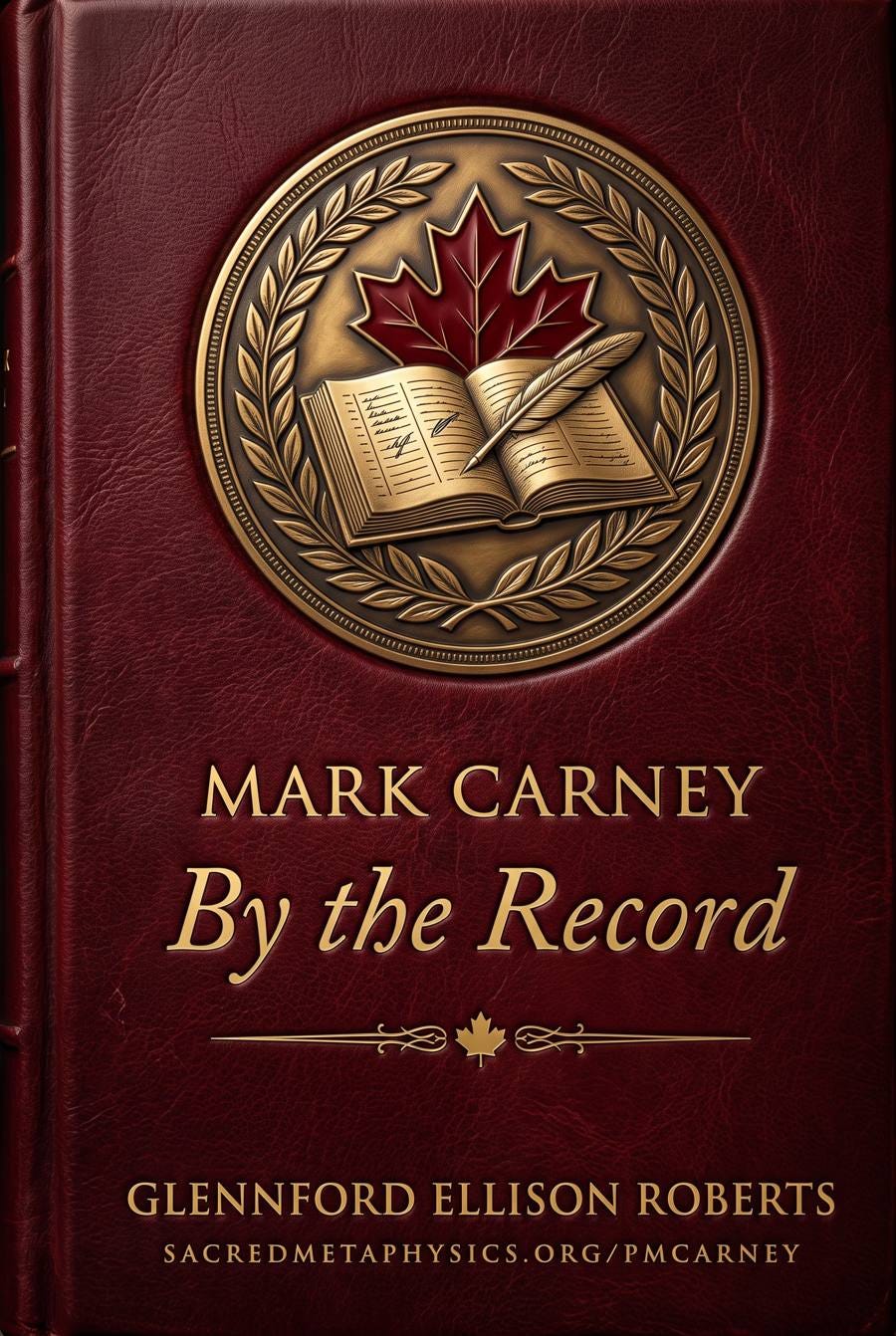
Mark Carney: By the Record is a diary of a life on the record: from his birth in Fort Smith in 1965 to his rebirth as Canada’s 24th Prime Minister, and from then on, the record as it happens, week by week. This free weekly gives you the days. The monthly volumes give you the whole record: the world’s press, What It Means, and The Ladder of promises kept, given up and still open.
Read more at sacredmetaphysics.org/pmcarney
By the Record · The Week on the Record
We don’t judge the act; we record the act. Every day carries its sources, and every day is written 48 hours after it ends. Not first, but right. Each day is marked with its running count: Y for year in office, W for week, D for day.
Y2W80D554 · Friday, September 18 — Ottawa
Back from Europe, he went before his Liberal caucus on the eve of the fall sitting. They gave him a standing ovation, and he joked with them. Three new members, winners of the August by-elections, were welcomed in. He called the week of summits behind him “just the warm-up.”
“This is a crucial session of the House of Commons,” he said. The government would bring in legislation he called the most “consequential” in decades. “As we build Canada strong, we remain laser focused on bringing down costs for Canadians and keeping Canadians safe.” For major projects he repeated his rule, “one project, one review, one year,” and spelled it out: “If we’re going to say no, say no quickly. If we are going to say yes, say yes on time.” On the online harms bill: “The status quo is failing our kids. The tech companies won’t fix it. We will not stand by.” He described “a new, powerful, confident and united Canada.”
Selling the clean-energy project he had announced in August, the largest in North American history, he called it “the functional equivalent of 18 gigawatts and 18 Hoover dams,” and, repeating the number, moved his hands in and out in the manner of the President’s familiar gesture. The room laughed. The moment travelled as far as India’s press.
He spoke plainly about Washington. Formal trade talks had ended August 21. “Last month, we made the right decision to suspend our negotiations with the United States,” he said. Of the red lines, the outlets in the room reported his next words differently, but the sense was the same: the Americans had offered too little and asked too much, and Canada would not give it. He pointed to the $7.5 billion in support for workers and businesses hit by the tariffs, announced in August, and said Canada would return to the table “in good faith” when the United States is ready.
Afterward, Liberal MP Robert Oliphant: “I’ve never experienced anything quite like what I’m experiencing in my riding, in terms of overwhelming support for the prime minister and trust.”
Sources: Canadian Press, via paNOW · CTV News, via AM800 · Global News (Canadian Press) · Toronto Sun, via Yahoo · Finance Canada – $7.5B package, Aug. 25 · Canadian Inquirer – the gesture · WION (India) · PMO – clean energy, Aug. 17
Y2W80D555 · Saturday, September 19 — Ottawa
At 10 a.m. he joined the Liberal National Caucus retreat, which was closed to media. Nothing further is on the record.
Sources: PMO itinerary
Y2W80D556 · Sunday, September 20 — Saint-Pierre-et-Miquelon, then Ottawa
The islands. Saint-Pierre-et-Miquelon lies about 20 kilometres off Newfoundland’s south coast, the last remnant of New France. His office called the day “this first official visit by a Canadian Prime Minister to Saint-Pierre-et-Miquelon.” Macron was the first French president to come since François Hollande in December 2014.
Emmanuel Macron, President of the French Republic since 2017, was waiting for him. Macron was the first head of state Carney met as prime minister, in Paris on Day 4, March 17, 2025. The two held a working lunch and laid a wreath at the memorial to Free France.
That history was the theme of the day. In December 1941, Free French forces peacefully took the islands back from the Vichy regime. Carney told the islanders: “In 1941, as tyranny spread across Europe, the inhabitants of these islands were called upon to choose sides. They refused to be collaborators.” And of the two countries: “At their closest point, just a few kilometres separate Canada and France. Our values are closer still.”
Macron, in French, as reported by AFP: “Nous croyons ensemble que nos pays sont deux grandes nations indépendantes.” Euronews rendered it: “two great independent nations who want to stay that way.” AFP reported that on arrival he answered the President’s claims plainly: “Saint-Pierre-et-Miquelon est français.” Saint-Pierre-et-Miquelon is French.
According to the readout from Carney’s office, the two leaders told their space agencies and defence ministries to develop and share common space infrastructure, “such as launch systems and ground reception and control infrastructure.” They welcomed a new partnership between the Canadian Chamber of Commerce and CCI France, agreed to deepen work on defence, aerospace and wildfire management, and discussed “an alliance for the future between Canada and the European Union.” They tasked their Regional Joint Cooperation Commission with work between the islands and Atlantic Canada on economic integration, energy transition, climate resilience and cross-border security.
For the islands themselves, Macron announced €19 million for port renovation (AFP). Carney closed his remarks: “Long live Saint-Pierre-et-Miquelon! Long live France! Long live Canada!”
Jonas Gahr Støre, Prime Minister of Norway since 2021, and a former foreign minister who led Labour back to power, was in Ottawa by evening. On Parliament Hill the two announced they would advance an enhanced Defence Cooperation Agreement in the new year, building on Canada’s choice of the German-Norwegian Type 212CD submarine. They signed memoranda between their polar institutes, their space agencies and their geological surveys, the last for critical-minerals mapping, and set up a new Arctic Dialogue. Their joint statement put it in one line: “Arctic security is national security for both countries.”
Carney gave the phrase he carries about the North: “The phrase that always sticks with me… is ‘High North, low tension.’” Then he tied the day together: “The time spent whether it’s in the high north in Norway, a meeting with the French president who’s directly implicated in a number of these decisions, our meeting today and beyond, it’s all connected.” Støre warned of Russian “real threats coming from hybrid activity, ranging all the way to potential sabotage.”
Yom Kippur. He issued a statement for the holiest day in Judaism. It noted antisemitic incidents at post-war highs and said: “Jewish Canadians will never stand alone in confronting antisemitism.” It closed G’mar chatima tova.
In the Financial Times. The same day, the Financial Times published an opinion piece by four founding leaders of a new coalition, Partners for Multilateralism: António Costa, President of the European Council; Brazil’s President Luiz Inácio Lula da Silva; Kenya’s President William Ruto; and Carney. Its title: “Multilateralism is not idealism, it’s a necessity.” Its argument, in one line: “No country, however powerful, can manage these challenges alone.”
Sources: PMO – Macron readout · PMO – remarks at Saint-Pierre-et-Miquelon · Canadian Press, via Yahoo · AFP, via La Libre · Euronews – Hollande 2014 · Euronews · PMO – Støre readout · PMO – Canada–Norway joint statement · Canadian Press, via paNOW · PMO – Yom Kippur · Canadian Press, via BNN Bloomberg · EU External Action Service – the op-ed text · The Japan Times
Y2W80D557 · Monday, September 21 — Ottawa, then New York
Parliament returns. The House sat for the first time since June. At 2:15 p.m. he was in his seat in the West Block for Question Period, facing Conservative Leader Pierre Poilievre across the floor. Three new Liberal MPs took their seats from the summer by-elections: Braeden Caley for North Vancouver–Capilano, Tanveer Shahnawaz for Beaches–East York, and Daniel Gobeil for Chicoutimi–Le Fjord. The government brought in Bill C-39, the Building Canada Strong Act, to speed approvals for data centres, ports, airports and energy projects. Union leaders warned it could weaken strike protections under the Canada Labour Code. Labour Minister Patty Hajdu rejected that reading.
The flight that didn’t land. He was to leave for New York at 4:20 p.m. for the launch of Partners for Multilateralism, the coalition Canada founded with Australia, Barbados, Brazil, the European Union, India and Kenya. A key circuit failed at an air traffic control facility in Philadelphia and halted every major airport in the New York area. He missed the launch. David Lametti, Canada’s Ambassador to the United Nations, spoke in his place: coalitions should “build trust and prove what works.” At the table were Australia’s Prime Minister Anthony Albanese, the President of the European Council, António Costa, and Kenya’s President William Ruto. Carney arrived in New York late that night.
The members. Founding members, September 21: Canada, Australia, Barbados, Brazil, the European Union, India and Kenya. Joined since: Albania, Bosnia and Herzegovina, Croatia, Cyprus, Finland, Guatemala, Liechtenstein, Luxembourg, Moldova, Norway, San Marino, Slovakia, Spain, Türkiye and Uruguay. The United States, China and Russia are not members.
A thread in the record. The coalition carries forward a line he drew eight months earlier, at the World Economic Forum in Davos on January 20, 2026 (Y1W45D313): “Middle powers must act together because if you are not at the table, you are on the menu.” And, in the same speech: “This is the task of the middle powers, the countries that have the most to lose from a world of fortresses and the most to gain from a world of genuine cooperation.” The Canadian Press wrote that week: “For nearly a year now, Carney has been travelling the globe calling on middle powers to band together in defence of what he has called ‘shared interests, and occasionally shared values, rather than shared institutions.’”
What the word means. Multilateralism is countries solving shared problems together, through agreed rules and common institutions such as the UN, NATO and the World Trade Organization. The alternatives are acting alone (unilateral) or one deal at a time with a single partner (bilateral). It matters most to middle powers: alone, Canada cannot match the United States or China, but joined with many others it has weight, and rules that protect it. The coalition was formed to defend that system and make it work. Critics call multilateral bodies slow and easily blocked. The next day in New York, Carney said: “…if the multilateral system fails to reflect the realities of the time, it won’t stand the test of that time.” And: “No one country, no matter how powerful, can manage these challenges alone.”
Potash. That day the President posted on Truth Social that the United States was working on a deal to buy potash from Belarus: “The pricing would be for substantially less than we are currently paying to Canada, very good news for our Farmers and Ranchers.” Saskatchewan Premier Scott Moe answered on X: “More than 40 countries - Canada and its allies - have sanctions against Belarus for supporting war criminal Putin’s invasion of Ukraine. Buying blood potash from Belarus is supporting Russian aggression.”
No response from the Prime Minister or his office that day is on the record. It came the next afternoon, in New York.
Sources: PMO itinerary · Canadian Press, via BNN Bloomberg – Parliament returns · Canadian Press, via BNN Bloomberg – the missed launch · PMO – UNGA release · PMO – remarks to media, Sept. 22 · PMO – Davos speech, Jan. 20, 2026 · Canadian Press, via BNN Bloomberg · BNN Bloomberg – potash · Global News – potash reaction
Y2W80D558 · Tuesday, September 22 — New York
José Antonio Kast, President of Chile, met him in New York on the sidelines of the United Nations General Assembly, the annual gathering of world leaders at the UN, now in its 81st session. They discussed defence and aerospace, critical minerals and ocean biodiversity, and the Antarctic, where Carney said Canada wants to join a joint expedition planned for 2027. He thanked Kast for Chile’s help with Canada’s wildfires. Canada is Chile’s largest foreign investor, with nearly $40 billion invested last year.
João Lourenço, President of Angola, who chaired the African Union in 2025, came next. Canadian exports to Angola more than doubled in 2025, to over $200 million. The two agreed to work toward a memorandum on economic cooperation and an investment protection agreement, and Carney invited him to Canada.
King Abdullah II of Jordan, on the throne since 1999, spoke with him about Gaza, the West Bank, settlements and the tension between the U.S. and Iran. They agreed to deepen defence collaboration.
To the press. In the afternoon he spoke to reporters: “The post-war world is ending, but the underlying logic of that world that justified multilateral cooperation is more compelling than ever. … Cooperation is therefore not an act of idealism. It is a practical necessity.” On Gaza: “A long-held international consensus for a two-state solution – a consensus held by every one of my predecessors since the formation of this organisation – will mean nothing if these conditions continue.” He announced $100 million more for Palestinians, $80 million of it humanitarian and $20 million for peace and security, bringing Canada’s support since October 2023 to more than $600 million. And he announced an intention to restrict trade in goods from illegal Israeli settlements, in answer to the E1 plan: “Canada and our partners recognise the direct threat to peace posed by the Israeli government’s endorsement of the E1 settlement scheme, and with reluctance, we have announced our intention to bring forward trade restrictions targeting goods produced in those illegal Israeli settlements.”
E1 is a tract of about 12 square kilometres in the West Bank, between East Jerusalem and the Israeli settlement of Maale Adumim. Israel approved about 3,400 homes there in August 2025, and opened bidding on more than 1,200 of them on August 18, 2026. Canada had joined France, Germany, Italy, the Netherlands, the United Kingdom and Norway in condemning the plan. The UN Secretary-General has called it an “existential threat” to a contiguous Palestinian state. Israel’s foreign minister, Gideon Sa’ar, rejected the criticism.
He was asked about potash: “Canada supplies 40 per cent of the world’s potash. It is an incredible strength of our economy.” Canada, he said, is “a reliable, cost-competitive supplier.” Then he turned the threat into an offer, suggesting Canada and its neighbours cooperate to become fertilizer independent: “It’d be great for American farmers, and it’s an opportunity we’re prepared to explore.”
He was asked about India: “We are making good progress in our trade negotiations with India.” Narendra Modi will visit Canada in mid-December. He called it “an exceptionally important relationship on many, many levels.” Asked whether he would meet the President, he said he preferred to spend the week with leaders he doesn’t normally see.
The President’s afternoon. The President addressed the Assembly that day. Later, with Zelenskyy, he changed course on potash: “Belarus has a lot of potash, and our farmers need good prices, and we want to get a lower price. We’ll continue to go with Canada, but Belarus would like to sell it for a much lower price.”
Two-state meeting. In the evening Carney co-hosted a high-level meeting on the two-state solution and UN Security Council Resolution 2803, with the leaders of the United Kingdom and France.
The world’s press. India’s papers led with Modi’s visit, among them the Deccan Herald: “PM Modi expected to visit Canada around December: Mark Carney.” Malaysia’s Free Malaysia Today carried it too.
Sources: PMO – Kast · PMO – Lourenço · PMO – King Abdullah II · PMO – remarks to media · Euronews – E1 · BNN Bloomberg – live updates · BNN Bloomberg – fertilizer independence · Globe and Mail · Canadian Press, via BNN Bloomberg · Deccan Herald · Free Malaysia Today
Y2W80D559 · Wednesday, September 23 — New York
He co-hosted the OceanEye International Alliance with Ursula von der Leyen, President of the European Commission. The alliance is a network for watching the ocean year-round, including with autonomous underwater gliders. “Canada is an ocean nation. We border three oceans. We have the world’s longest coastline,” he said. “We cannot protect what we cannot see. We cannot manage what we do not understand.” Von der Leyen: “We must listen to the ocean and we must protect it much more.” Thirty countries signed on.
Canada committed $82 million over five years for ocean observation and the Global Ocean Observing System, and ratified the High Seas Treaty, with more than $24 million to put it into effect. The 12th Our Ocean Conference will be held in Halifax on May 10–11, 2027, chaired by Canada’s Ocean Envoy, Diana Fox Carney, his wife. During the week Canada also committed $16 million for biosecurity.
His office closed the Assembly with his words: “At this pivotal moment in history, the world can count on Canada. In the face of upheaval and uncertainty, Canada shows up, builds coalitions, and gets work done.” He did not meet the President during the week.
In The New York Times. The same day, The New York Times published an interview with him. Asked about preparing for the possibility of U.S. military action against Canada, he said: “That’s not a base case, but it would be irresponsible not to.” He called it an “extreme tail risk” and declined to give specifics. The Times’ Canada bureau chief, Matina Stevis-Gridneff, said afterward that he “did not use the word ‘invasion’”; that was the paper’s word. In the same interview, on the F-35 decision: “It is a real decision because of differing capabilities, because of strategic dependencies, and because of the economic return.” Asked about a second term: “It’s too early to start asking.”
Sources: PMO – UNGA release · Canadian Press, via BNN Bloomberg · PMO – ocean remarks · CTV/CP24 – the NYT interview · BNN Bloomberg – the NYT interview
Y2W80D560 · Thursday, September 24 — Ottawa
Home from New York, he received Tô Lâm, General Secretary and President of Vietnam, on Parliament Hill. The two raised relations between their countries to a Strategic Partnership. They signed or renewed four memoranda, on conventional and clean energy, maritime transport, environment and climate change, and food safety, and an expanded Air Transport Agreement opened the way to direct passenger and cargo flights between Canada and Vietnam. Vietnam is Canada’s largest merchandise trading partner in Southeast Asia; trade between them has doubled in five years. Both leaders put a Canada–ASEAN free trade agreement at the top of the list; the readout puts its value at nearly $2 billion to Canada’s economy and some 14,000 jobs. He also met his cabinet.
The interview, the day after. His ministers were asked about his words to The New York Times. Defence Minister David McGuinty: “It is normal. All militaries in the world spend time analyzing risk scenarios.” Evan Solomon, the minister for artificial intelligence, called it prudent to run every scenario. Peter MacKay, the former Conservative defence and foreign minister, said the comments took Canada “from the realm of retaliation to provocation.”
Sources: PMO – Vietnam readout · CTV/CP24 – live updates · BNN Bloomberg
Week 80 in Review
A week of two coasts and one airport that failed. On Sunday he stood with France’s president on the last remnant of New France, at a memorial to islanders who refused to collaborate in 1941. That evening he stood with Norway’s prime minister in Ottawa, adding submarines, space and polar science to Canada’s European ties. On Monday he took his seat as Parliament returned. Then a broken circuit in Philadelphia kept him out of the room for the launch of the coalition he helped found, and an ambassador spoke in his place. He reached New York at night and spent the next two days with Chile, Angola, Jordan, the European Commission, and the British and French leaders. On Thursday, home in Ottawa, he made Vietnam a strategic partner.
In between, the President tried to price Canadian potash against Belarus, and a day later said America would keep buying Canada’s. On the record, the answer from Ottawa was not a counter-threat but a fact: forty percent of the world’s potash comes from Canada. Asked whether he would seek out the most powerful man at the Assembly, he said he would rather spend the week with the leaders he doesn’t normally see. And to an American newspaper he called U.S. military action against Canada an “extreme tail risk,” one it would be “irresponsible not to” prepare for.
By the record, and nothing else. The full monthly volume, with every day in full, the world’s press, What It Means and The Ladder, is for subscribers: sacredmetaphysics.org/pmcarney
God is Love. Love is Truth. Truth is Consciousness. Consciousness is Brahman.
Amen. Namaste. Om Namah Shivaya.
— The Architect.
Written from love, for a sacred humanity, in the full light of consciousness, toward the greater good. 🕯️
The Vertical Dispatch
sophiainitiative.ai
On the Record
How this record is kept: the primary source is the Prime Minister’s own office (pm.gc.ca: releases, readouts, statements, speeches, itineraries), then Parliament and the departments, then wire services and public broadcasters (The Canadian Press, Reuters, AP, CBC/Radio-Canada, AFP), major Canadian papers, and the world’s press. Opinion is never used as fact. Every quote is checked word for word against its original page before publication. Sources for each day are listed under that day.
The day code: Y·W·D counts from Day 1, Friday, March 14, 2025 (Y1W1D1). Weeks run Friday to Thursday. Week 80 runs from Day 554 to Day 560, in Year 2.
The 48-hour rule: a day is written two days after it ends. The week closes Thursday; Thursday settles by Saturday; The Week on the Record is published Sunday at 6 a.m. Eastern. Friday and Saturday open the next week and appear in the next edition.
Still to be read word for word before republication: the caucus “red lines” line, reported three ways (CTV, Global, Toronto Sun), to be settled from the video; the Støre quotes (Canadian Press); Macron’s “Saint-Pierre-et-Miquelon est français” (AFP, from a headline); the day of the $16 million biosecurity commitment; the New York Times interview quotes, taken from Canadian coverage (CTV/CP24, BNN Bloomberg), to be read against the Times itself.
Verify against primary sources before republication. Walk with the word.
Suggested Tags
Mark Carney, By the Record, The Week on the Record, Canada, Saint-Pierre-et-Miquelon, Emmanuel Macron, Jonas Gahr Støre, Norway, United Nations General Assembly, Partners for Multilateralism, Middle Powers, Multilateralism, Potash, India, Ocean, Parliament of Canada.
Substack Notes
The Week on the Record, Week 80. Sunday on the last remnant of New France, where islanders refused to collaborate in 1941. Sunday night with Norway. Monday, Parliament returns, and a broken circuit in Philadelphia keeps the Prime Minister out of the room for the launch of the coalition he helped found. Tuesday and Wednesday at the UN: Chile, Angola, Jordan, the European Commission, the oceans. Thursday, Vietnam in Ottawa, and an interview that asked the hardest question of all.
And in between, a threat to buy Belarusian potash instead of Canada’s, answered not with a counter-threat but with a fact: forty percent of the world’s potash comes from Canada. A day later, Washington said it would keep buying Canadian.
Every day sourced. Nothing judged. Just the record. Walk with the word. 🕯️
#TheVerticalDispatch #ByTheRecord #TheWeekOnTheRecord #MarkCarney #Canada #MiddlePowers #Multilateralism #UNGA #TheArchitect #SophiaInitiative
Factual matter in this Dispatch is drawn from the public record and sourced above, including points still being checked, which are named as such rather than resolved. The Week on the Record describes public acts and public words; it makes no assertion about the private intentions or character of any living person. Readers are encouraged to verify all claims independently.