


Φ
THE VERTICAL DISPATCH
We write for the mind, the eye, and the ear.
Read it. Look at it. Listen to it. The Vertical Dispatch is built for all three — prose with rhythm, made to be heard as much as read.
From metaphysics to geopolitics, from culture to history, from the sacred to the street — and everything in between. One lens, every subject. No ego. Just the record, named clean.
Press play. Walk with the word. 🕯️
This dispatch travels by hand. If it serves you, share it — restack on Substack, and pass it on wherever you read. 🕯️
Sovereign Analysis · The Canadian Shadow Series
As of June 24, 2026 — ahead of Alberta’s October 19 referendum
“A referendum is like a Pandora’s box. It can lead to polarization, much greater division, and a really poisonous kind of political atmosphere.”
— Ian Cooper, Albertan scholar, Dublin City University Brexit Institute, to CBC News, June 2026
Ten years ago this week, on June 23, 2016, the United Kingdom voted to leave the European Union. The margin was narrow nationally — 51.9 per cent to 48.1 — but in the northern English towns that carried it, like Wakefield in Yorkshire, nearly two-thirds chose to leave. They voted, many of them, to take their country back: to control their borders, to cut immigration, to free up money for their health service, to be governed from home rather than from Brussels. A decade later, a CBC reporter walked that same Wakefield market and found something close to a consensus among the people who live there. Neither side is happy. The leavers feel betrayed. The remainers feel vindicated and poorer. And almost everyone is exhausted by ten years of arguing over a single ballot question that settled nothing.
This is a Canadian dispatch, and it runs that story for one reason: Alberta is about to open the same box. On October 19, Albertans will vote on a slate of referendum questions, several of them aimed at the province’s place in Canada, set against a separatist movement that wants a binding vote on independence itself. The argument for it rhymes, almost word for word, with the argument for Brexit: a proud region, rich in resources, tired of being governed by a distant capital that does not understand it, told that a vote to leave is simply leverage — a way to force a better deal, with the costs overstated by the same elites who always say no. Britain heard every one of those arguments ten years ago. Britain now has something Alberta does not yet have: the receipts. This dispatch reads them.
Britain has something Alberta does not yet have: ten years of receipts. This dispatch reads them.
The First Receipt: What the Numbers Actually Say
Begin with the hardest question, the one that cuts past feeling: do the facts, a decade later, show that Brexit was an error of judgment? On the economics, the measured record points one direction, and it has only sharpened with time. Britain’s own independent fiscal watchdog, the Office for Budget Responsibility, holds to its estimate that leaving will cut the United Kingdom’s long-run productivity by four per cent compared with remaining — the full effect building over fifteen years, driven by a roughly fifteen per cent fall in trade with its largest market. And the more recent independent studies have revised the damage not down but up: research drawing on the National Bureau of Economic Research, Goldman Sachs, and Bloomberg Economics now puts the cumulative hit in the range of six to eight per cent of GDP — roughly double the original estimate. In plain money, a four per cent loss on a three-trillion-pound economy is on the order of one hundred and twenty-five billion pounds a year in lost output and nearly fifty billion in lost tax revenue.
This is not a partisan claim. The Governor of the Bank of England himself has said, in public and on the record, that the level of activity and growth in the economy is lower, and named the reason plainly: reduce the size of the markets you trade with, and you reduce your growth. When a country’s central bank governor and its independent budget office and the major outside estimates all converge on the same finding — lower trade, lower productivity, lower growth — that convergence is itself the answer to the question. On the economic measure, the judgment looks, ten years on, like an error. And the public has moved with the evidence: a YouGov poll on the eve of the anniversary found fifty-five per cent of Britons would now vote to rejoin the European Union, against thirty-four per cent opposed.
But here the discipline of this publication requires a careful line, because “error” is not only an economic word. The people of Wakefield did not vote for a percentage of GDP. They voted for sovereignty, for control, for the feeling that their country was theirs and that someone in power had finally heard them. Those are not line items, and the facts that measure money cannot fully measure them. What the record can say is this: the economic cost was real, is real, and has grown. What it cannot say is whether that cost was worth paying for the things the leavers wanted that no economist can price. We distinguish the measured from the read. The measured says: a real and deepening loss. The read — whether it was worth it — belongs to the citizen, not the analyst. We hand it over rather than pretend to settle it.
The measured record says: a real and deepening loss. Whether it was worth it belongs to the citizen, not the analyst.
The Second Receipt: Real Number Against Real Number
Now lay the two ledgers side by side, because the parallel is almost eerily exact. Brexit’s central wound was trade friction with its largest market — the whole model runs on it: less trade, less productivity, less growth. Alberta’s central risk is identical in kind and nearly identical in size. The University of Calgary economist Trevor Tombe has estimated that a five per cent rise in the cost of moving goods into or out of an independent Alberta would shrink the provincial economy by roughly four per cent — about twenty billion dollars in lost activity in a single year. Extended across a decade and adjusted for inflation, that is on the order of one hundred and thirty billion dollars in lost economic activity. Premier Smith’s own early estimate of the price of separation ran to nearly four hundred billion dollars in transitional costs and twenty-five to fifty billion a year after.
And Alberta’s version carries a burden Britain did not: it would be landlocked. An independent Alberta’s access to international markets for its oil, gas, grain, and goods would depend on the goodwill — and the toll — of Canada or the United States, the very leverage it sought to escape. It would forfeit the federal transfers that flow in each year, including a health transfer worth billions and a social transfer worth billions more. It would inherit a share of the national debt estimated in the tens of billions, need a new currency, a new pension plan smaller than the one it left, and a worse credit rating that would raise the cost of every dollar it borrowed. Roughly nine hundred thousand Albertans work in sectors where at least a third of the jobs depend on exports to other provinces or abroad. Two divorces from a trading union; two self-inflicted wounds of roughly four per cent of the economy. The British number and the Alberta number, arrived at by different economists on different continents, rhyme almost to the decimal.
The Third Receipt: The Freedom That Was Never Hidden
There is a cost deeper than any percentage, and it is the one the young understand best because it is the one they carry longest. Under European membership, a young Briton’s working life was not bounded by an island of sixty-seven million people. It opened onto a continent of four hundred and fifty million. Freedom of movement — the right to live and work in any of twenty-seven countries with no visa, no permit, no papers — meant that a graduate, a tradesperson, a nurse, an engineer could chase not merely a job but the real opportunity, in whatever city across Europe actually wanted their particular skill. This was no hidden clause buried in fine print. It was one of the four named freedoms of membership, argued in daylight on every platform, on every leaflet, central to the entire campaign. Everyone knew it was on the ballot. It was traded away with open eyes.
And the loss runs the whole length of the ladder. At one end, the young Briton who once could take casual work anywhere on the continent now needs a permit they often cannot get. At the other end, the doctor or the architect whose qualification was once automatically recognized across the Union must now have it re-recognized country by country, a door that no longer opens on its own. The difference is not between having a job and having none — most will have a job. The difference is between a horizon that spanned a continent and one that stops at the water. Brexit did not take the young their employment. It took their field of the possible, and shrank it. Measured in the only currency that finally counts — the life a person is free to build — that is the heaviest cost of all, and it falls on the generation that voted most heavily to keep the door open and will live longest with it shut. A decision weighted toward those with the fewest years left to feel it closed a door that another generation will spend its whole working life standing outside.
Brexit did not take the young their jobs. It took their field of the possible, and shrank it from a continent to an island.
Hold that against Alberta, because the mirror is exact. A young Albertan today can work anywhere in Canada — Toronto, Vancouver, Halifax — with no permit and no border. That is the same open door, and separation is the same hand closing it. The Brexit generation can tell the Alberta generation precisely what it feels like to wake one morning and find the country you grew up free to roam now asks for your papers at its edge.
The Fourth Receipt: The Promise That Cannot Be Kept
There is one Brexit promise whose failure is worth naming on its own, because Alberta is being made the identical promise by a premier whose own record already contains its contradiction. Wakefield voted Leave, above all, to cut immigration. A decade later, immigration to Britain has not fallen — it has inverted. The European arrivals are gone; non-European arrivals from Asia and Africa have replaced them, and the overall numbers are roughly what they were. The promise of control collided with the economy’s actual hunger for workers, and the economy won. The leaver who voted to lower immigration got a different immigration, not less of it — and feels, justly, that he was sold something that could not be delivered.
Now look at Alberta, and at the premier leading it toward the same vote. Among the questions on the October ballot are several aimed at restricting newcomers, including a reference to an “Alberta-approved immigration status,” and the Premier has lately warned against “throwing the doors wide open to anyone and everyone across the globe.” Yet the public record holds the other half of her own mouth. In March of 2024, in a letter to the Prime Minister that sits on the Government of Alberta’s own website, Danielle Smith requested that Ottawa immediately raise Alberta’s provincial nominee allocation to twenty thousand newcomers a year, to address “critical labour shortages” in construction, technology, health care, and education. She called immigration “critical” to the province’s economy and said the federal limits were undercutting Alberta’s ability to fill jobs and grow. In 2024 she spoke publicly of doubling Alberta’s population to ten million. The premier now campaigning on restriction is the same premier who, in writing, asked for more. We draw no conclusion about her private mind; we set the two documents side by side and let the reader read them. The point is not the contradiction alone. It is that Brexit already proved the immigration promise undeliverable against the economy’s real need — and Alberta is being offered that same promise by someone whose own files already show she knows the province needs the workers.
The Box That Cannot Be Reshut
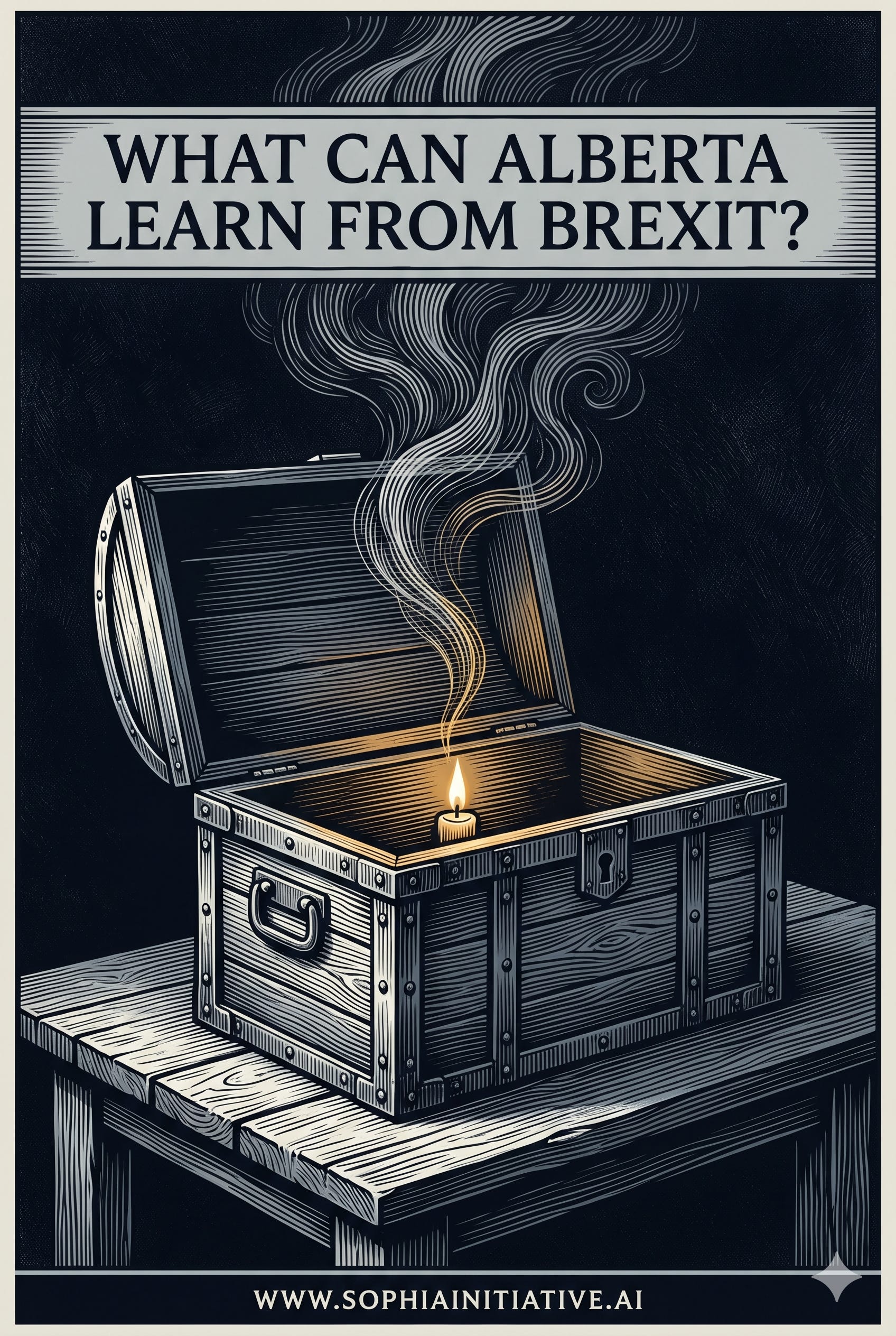
Beneath all four receipts lies the deepest lesson, and it is not about economics at all. It is about the instrument itself. A referendum, the Albertan scholar Ian Cooper told CBC from the Dublin Brexit Institute, is like a Pandora’s box. Voters are told that a Yes is merely a negotiating tactic — a peaceful, civilized way to force a better deal. But the box, once opened, does not close on command. It can draw permanent battle lines through families, towns, and a whole society; it can poison the political air for a decade; it can deliver not the clean exit promised but an endless, exhausting argument that satisfies no one. Britain is the proof. Ten years and six prime ministers later — the country has churned through that black Downing Street door at a rate that would once have seemed impossible — it is no closer to peace on the question than it was the morning after the vote. The referendum did not settle British politics. It detonated the stability of every government that has touched it since.
And here is the cruelest line in the whole ledger, the one a careful Albertan should carry into the booth: rejoining a union is far harder than leaving it. Leaving takes a single afternoon and a ballot. Getting back what was given away — the trade, the freedom of movement, the seat at the table, the trust — can take a generation, if it can be done at all. The vote is quick. The consequence is long. That asymmetry is the whole danger of the box.
The vote is quick. The consequence is long. Rejoining a union is far harder than leaving it.
The Case for the Box, at Full Strength
Now the other side, at full strength, because the keel of this work is to give the strongest version of the opposing case before any verdict — and here it is genuinely strong, and the reader who dismisses it has not understood the thing. A people’s right to govern themselves is not cancelled by a productivity statistic. To tell Albertans that the numbers forbid them from asking the question is to commit the precise sin that drove both Brexit and Alberta separatism in the first place: the distant expert, secure in his own prosperity, lecturing the proud region that its grievance is irrational and its desire for self-rule is a rounding error on a spreadsheet. The leavers of Wakefield were not fools. They were people who had watched their towns hollow out for a generation and were told, every time, that the experts knew best. The vote was, among other things, a refusal of exactly that condescension.
And Alberta’s grievance has a real core that no honest dispatch may wave away. The province does send more to the federation than it receives; its energy industry has been treated, at times, as a national embarrassment rather than a national asset; its concerns have been dismissed from Ottawa with a regularity that would breed resentment anywhere. The argument that a credible threat to leave is the only language a distant capital respects is not absurd — it is a calculation, and reasonable people can make it. The case against the box must concede all of this at full strength, or it is just one more expert telling Alberta to be quiet. The honest position is not that Albertans have no right to ask. It is that they deserve to ask with the receipts in hand — and Britain has spent ten years and a great deal of treasure assembling exactly the receipts that Alberta is being urged to vote without reading.
What There Is to Learn
So, what can Alberta learn from Brexit, ten years later? Not that the grievance is illegitimate — it is real, and the dismissal of it is part of what built the movement. Not that Albertans have no right to their question — they do, as surely as Britons did. What Alberta can learn is narrower and harder and more useful than any slogan on either side. That the costs the experts named turned out to be real, and then turned out to be larger than they first said. That the promise to cut immigration collided with the economy’s need for workers and broke — and that the premier making the promise has already, in writing, asked for the workers. That the freedom to live and work across a whole country, taken for granted until it is gone, is the kind of loss the young feel longest. That the box, once opened, does not close, and that the vote which takes an afternoon can cost a generation. And that rejoining is far harder than leaving.
Britain did not have these receipts in 2016. It bought them, at great price, over ten years, and they are lying open on the table now for anyone who cares to read before they vote. That is the one gift the British experiment offers the Albertan voter: the chance to know, in advance, what was learned too late across the water. The Vertical does not tell you how to vote. It tells you to read the receipts first. The box is on the table. Britain has shown what is inside it. Walk with the word. 🕯️
God is Love. Love is Truth. Truth is Consciousness. Consciousness is Brahman.
Amen. Namaste. Om Namah Shivaya.
— The Architect
For the young of both countries, who inherit the door that others choose to close.
The Vertical Dispatch
sophiainitiative.ai
On the record.
Political and economic facts are as of June 24, 2026, and are volatile; verify current figures before republication. Brexit. The UK voted to leave the EU on June 23, 2016, 51.9% leave to 48.1% remain; Wakefield and many northern English towns voted roughly two-thirds leave (CBC, June 23, 2026). Economic estimates: the UK Office for Budget Responsibility maintains a long-run 4% productivity reduction vs. remaining, driven by an assumed ~15% fall in UK-EU trade, full effect over 15 years (obr.uk). More recent studies estimate a cumulative 6-8% GDP loss (NBER 2025; Goldman Sachs; Bloomberg Economics; per GLA Economics and Brexit FactBase compilations). Bank of England Governor Andrew Bailey publicly stated growth and activity are lower due to reduced trade-market size (June 2026 reporting). YouGov (June 2026) found 55% would vote to rejoin the EU, 34% opposed. Loss of EU freedom of movement and mutual recognition of professional qualifications upon leaving the single market are mechanical consequences of Brexit (Centre for European Reform; OBR). UK immigration inverted from EU- to non-EU-dominant with roughly unchanged overall levels (CBC, June 2026). Alberta. A referendum slate is set for October 19, 2026, including questions on immigration and Alberta’s constitutional place; a separation petition was struck down May 13, 2026 (unconstitutional for failing the duty to consult First Nations) and is under appeal. Trevor Tombe (University of Calgary) estimated a 5% rise in trade costs would shrink Alberta’s economy ~4% (~$20B in one year); Lennie Kaplan extended this to ~$130.2B over 2027-2036 in 2017 dollars (Troy Media, Nov. 2025). Premier Smith’s own early estimate: ~$400B transitional plus $25-50B annually (CBC, June 3, 2026). AFL issue brief (Feb. 2026): landlocked status; loss of federal transfers including ~$6.6B Canada Health Transfer and ~$2.1B Canada Social Transfer (2025-26); a $75-100B debt share; smaller pension; new currency; worse credit rating. ~900,000 Albertans work in sectors where ≥35% of jobs depend on interprovincial/international exports (Tombe, via The Hub). Smith immigration record. In a March 27, 2024 letter to PM Trudeau (published at alberta.ca), Smith requested Alberta’s Provincial Nominee Program allocation be raised to 20,000/year for 2024-2026 to address “critical labour shortages” in construction, technology, health care, and education, calling immigration “critical”; she spoke in 2024 of doubling Alberta’s population to 10 million (Global News). She has since defended Oct. 2026 referendum questions restricting newcomers and warned against “throwing the doors wide open” (Global News, Feb. 2026). Both positions are quoted from the public record; no claim is made as to private intent. The “Pandora’s box” characterization of referendums is Ian Cooper’s (Dublin City University Brexit Institute, to CBC, June 2026). No figure herein is disaggregated by race, group, or class. All characterizations and the central thesis are the author’s interpretation and commentary; the opposing case (the legitimacy of Alberta’s grievance and right to self-determination) is stated at full strength. Verify all load-bearing facts against primary sources before republication.
Suggested tags:
Alberta separation, Brexit, referendum, Danielle Smith, freedom of movement, trade, the Canadian Shadow Series, Sovereign Analysis, Pandora’s box, self-determination.
Substack Notes
Ten years ago this week, Britain voted for Brexit. A decade later, the receipts are in — and Alberta is about to open the very same box. On October 19, Albertans vote on a referendum slate aimed at the province’s place in Canada, and the argument for it rhymes almost word for word with the argument for Brexit: a proud, resource-rich region, tired of a distant capital, told a vote to leave is just leverage. Britain heard every one of those arguments in 2016. Now it has something Alberta doesn’t: ten years of evidence.
This dispatch reads the receipts. The economic verdict has only sharpened with time — the OBR holds to a 4% productivity loss, newer studies say 6-8% of GDP, and the Bank of England’s own governor says growth is lower because you shrank your trading market. The Alberta number, arrived at by a Calgary economist on the other side of the world, rhymes almost to the decimal: roughly 4% of the economy, about $130 billion over a decade — plus the burden Britain didn’t carry, of being landlocked.
But the deepest cost is the one no ballot lists: the freedom to live and work across a whole continent, or a whole country, taken for granted until it’s gone. Brexit didn’t take the young their jobs — it took their horizon, and shrank it from a continent to an island. A young Albertan can work anywhere in Canada today, no permit, no border. Separation is the same door closing. And the immigration promise that drove both? Britain’s didn’t fall, it inverted — and the premier leading Alberta toward the vote is the same one who asked Ottawa, in writing, for more workers.
We end on the other side at full strength — Alberta’s grievance is real, the right to ask the question is real, and the expert who lectures a proud region commits the very condescension that built the movement. But a referendum is a Pandora’s box: the vote takes an afternoon, the consequence takes a generation, and rejoining is far harder than leaving. Britain bought those receipts at great price. They are lying open on the table. Read them before you vote. Written from love, in service of the record. Walk with the word. 🕯️
#TheVerticalDispatch #SovereignAnalysis #AlbertaSeparation #Brexit #Referendum #DanielleSmith #FreedomOfMovement #TheCanadianShadowSeries #TheArchitect #SophiaInitiative #GodIsLove #LoveIsTruth #OmNamahShivaya
The factual matter in this Dispatch is drawn from the public record. All characterizations, inferences, and conclusions are opinion, interpretation, and commentary, offered for analysis, reflection, and public-interest discussion. No assertion is made regarding the private intentions, state of mind, or character of any individual. Readers should evaluate all statements independently and draw their own conclusions.
Thank you for this, Glen, I think it is an excellent summary of reality.
I also think the PM Carney is doing his best to show respect and appreciation to Alberta, but even if he weren’t, the case for staying is much stronger and is apparent to the majority of us Albertans.
However, this is the era of Donald and Danielle in Wonderland so nothing is certain. I’m grateful for cannabis gummy bears.
Unfortunately the Alberta referendum issue appears to be based on emotion, not facts, for a considerable part of Albertans. It is up to the federalist side to make their case for Canada to remain whole in a logical and coherent manner. I hope that they are successful.