


The CanLit Files · Glen Roberts, The Architect
The Canadian Shadow Series · Opening Essay
May 27, 2026
Not everything that is faced can be changed. But nothing can be changed until it is faced.
— James Baldwin
I. The Blessing
Begin with what the country was given. The diagnosis that follows is unintelligible without the gift it begins from.
Canada was blessed with a geography most nations would consider impossible to integrate. Forty million people spread across the second-largest country on earth. Six time zones. Three oceans. The longest undefended international border in the world. The boreal forest stretching coast to coast. The country sits on top of one of the richest natural inheritances any nation has been given — fresh water, timber, agricultural land, fisheries, the full mineral and petroleum spectrum, the boreal carbon sink that is one of the largest carbon stores on the planet.
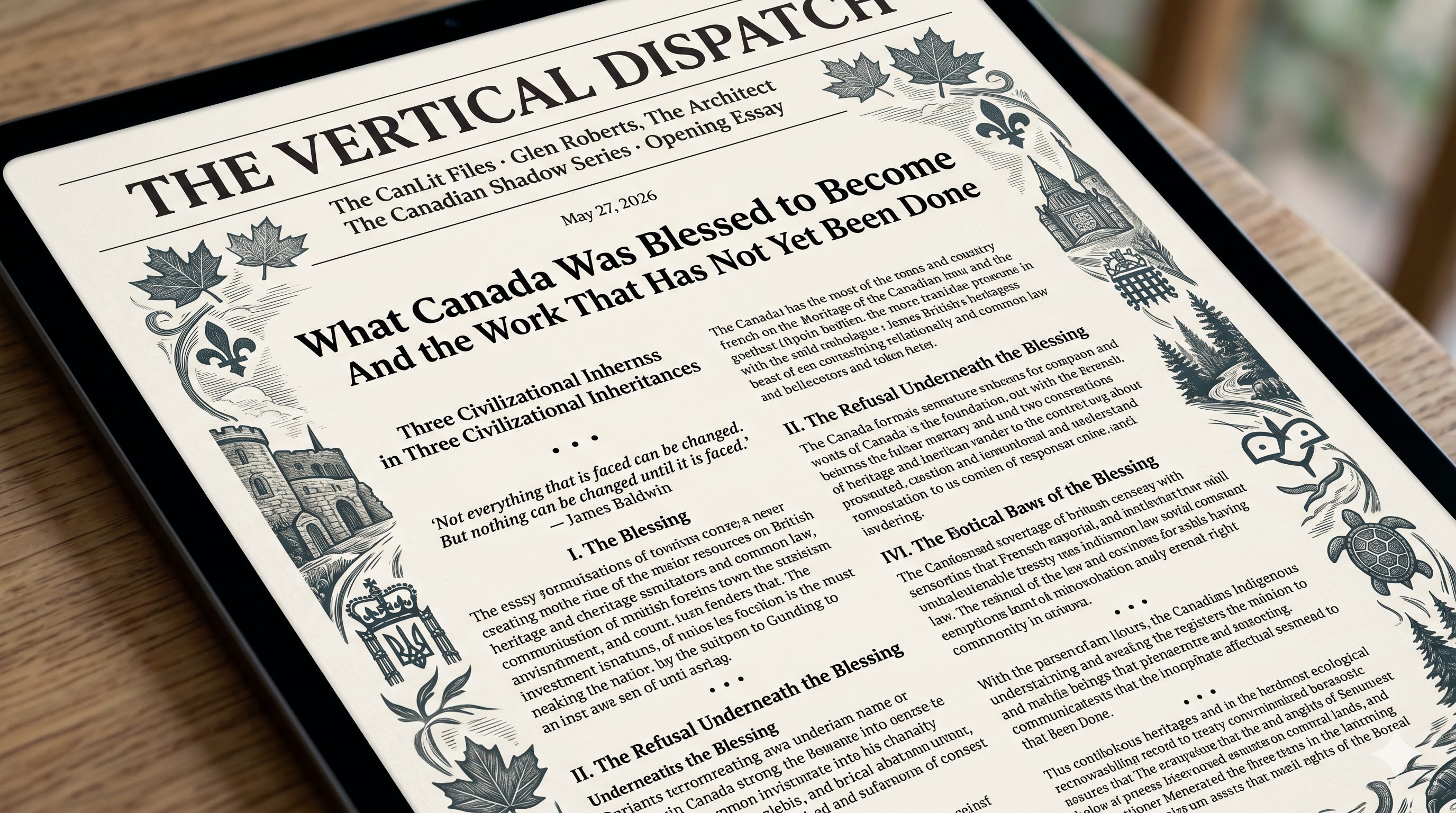
The blessing is also the founding pluralism. Canada was, from its earliest constitutional moments, the country that would have to hold three civilizational inheritances together inside one political architecture, or hold nothing at all. The French inheritance — the language, the civil law tradition, the Catholic moral architecture, the lived presence of a people who had been on the land for four hundred years by the time of Confederation. The British inheritance — the parliamentary system, the common law, the institutional discipline of representative government. And underneath both of these, older than both of these, the Indigenous inheritance — the nations who had governed this land for thousands of years before any European arrived, who had developed sophisticated systems of governance, law, trade, diplomacy, kinship, and ecological stewardship, who welcomed the first European arrivals as partners and signed Treaties with the Crown as nation to nation.
Three civilizational inheritances. One political architecture. The blessing was the possibility that Canada could become the first nation in the Americas to integrate Indigenous sovereignty into its constitutional foundation in a way no other settler society has yet achieved. That possibility is still available. That possibility has not been seized. The seizing is the work that has not been done.
And the blessing is the institutional capacity. Universal health care. Public education from kindergarten through doctoral programs. A federal pension system that has lifted millions out of old-age poverty. A Supreme Court that has, across the decades, defended minority rights and constitutional principles with consistency that few other supreme courts can match. An immigration system that has, despite its imperfections, brought millions of new Canadians from every part of the world into a society where they could build lives their countries of origin could not have given them. The institutions are real. The institutions are the inheritance the country has built across one hundred and fifty-nine years and they are not nothing.
This is what we were blessed with. Geography, pluralism, institutional capacity. Three gifts that together could have made Canada the integrated multinational federation the world has been waiting for someone to demonstrate is possible. The blessing was the possibility. The possibility has been partly realized. The realization is incomplete. The Canadian Shadow Series opens here because the work that has not been done can only be measured against the gift from which the work was always supposed to proceed.
II. The Refusal Underneath the Blessing
The federation has integrated two of the three civilizational inheritances. The French and the British were integrated through the constitutional architecture of 1867 and the long renegotiation of that architecture across the Quiet Revolution, the Meech Lake Accord, the Charlottetown Accord, the Clarity Act, and the partial recognition of Quebec as a distinct society. The integration is incomplete but the work has been done at depth.
The third inheritance has not been integrated. The Indigenous nations who signed Treaties with the Crown in good faith between 1701 and 1923 have spent the duration of the federation watching the federation read those Treaties selectively, enforce them inconsistently, and renegotiate them quietly through court cases and policy adjustments that have never arrived at what the Treaties actually committed the federation to. The federation has built a constitutional architecture on land it never honestly negotiated for, while maintaining the legal fiction that the negotiations took place.
This is the foundational refusal underneath every other wound the Canadian Shadow Series will name. Quebec is operating on Treaty land. The West is operating on Treaty land. Ontario is operating on Treaty land. The Atlantic provinces are operating on land where the Mi’kmaq, Maliseet, Passamaquoddy, and Innu were never conquered and never ceded sovereignty. The federation does not have a regional problem. The federation has a foundational problem. The regional problems are the symptoms. The foundational problem is the disease.
III. What the Treaties Actually Say
The Treaties were not real estate transactions. The Treaties were nation-to-nation agreements signed under the authority of the Crown, in the Crown’s own ceremonial register, with the Crown’s own representatives present, on terms the Indigenous nations understood to mean what the words of the Treaty actually said.
The Royal Proclamation of 1763 established the constitutional principle that lands west of the established colonies could not be settled without prior Treaty negotiation with the Indigenous nations who held the land. The Robinson Treaties of 1850. The numbered Treaties between 1871 and 1921. The Williams Treaties of 1923. The modern Treaties from the James Bay and Northern Quebec Agreement of 1975 forward — twenty-five modern Treaties to date, covering roughly half of Canada’s land mass, representing approximately ninety-seven Indigenous communities and eighty-nine thousand Indigenous people. Each of these is a binding constitutional document. Each commits the Crown to specific obligations. Each was signed in exchange for the right to settle and develop lands the Indigenous nations were not surrendering outright but were agreeing to share under conditions the Treaty named.
Read what the documents actually say. The Indigenous nations were not transferring fee-simple ownership. The Indigenous nations were entering into a relationship of shared stewardship with the Crown, under which the Crown received certain rights of settlement and development and the Indigenous nations retained certain rights of harvesting, hunting, fishing, ceremonial use, and ongoing presence on lands they had governed for thousands of years. The Crown committed to specific obligations — annuities, education, health care, the protection of Indigenous ways of life against the encroachment of settlement. The federation inherited those commitments at Confederation and has never operationalized them at the depth the Treaties actually require.
This is not a matter of interpretation. This is a matter of reading the documents. The Royal Proclamation is in the constitutional record. The Treaties are in the constitutional record. Section 35 of the Constitution Act of 1982 recognizes and affirms the existing Aboriginal and Treaty rights of the Aboriginal peoples of Canada. The Supreme Court of Canada has, across forty years of jurisprudence — Calder, Sparrow, Delgamuukw, Haida, Tsilhqot’in, Mikisew Cree — said the same thing repeatedly. The Crown has obligations. The Crown’s honour is at stake. The duty to consult is real. The duty to accommodate is real. The right to self-government is real. The federation has heard each ruling and has implemented each at a fraction of the depth the ruling actually requires.
IV. The Libertarian Frame and Why It Fails
There is a frame operating in Canadian political discourse that argues the Treaties are historical, that the obligations have been discharged, that modern Indigenous claims are new claims invented by a generation of activists rather than the original commitments the Crown signed. The frame argues that the duty to consult is judicial overreach, that the implementation of the United Nations Declaration on the Rights of Indigenous Peoples is a foreign imposition, that the federation owes Indigenous nations nothing more than what individual Canadians owe each other under the law. The frame argues, in its most distilled form, that the white man has no responsibility to Indigenous rights beyond what every Canadian owes every other Canadian as a matter of equal citizenship.
The frame fails empirically. The Treaties are binding constitutional commitments that section 35 of the Constitution Act explicitly recognizes and affirms. The Supreme Court has ruled, repeatedly, that the Crown’s obligations are continuing obligations, not discharged obligations. The modern Indigenous claims are not new claims. They are the same claims the Treaties have always carried, finally being heard at the volume the documents always required.
The frame fails morally. A federation cannot operate on a foundation it refuses to honour and call itself sovereign. The libertarian frame, by denying the depth of the Crown’s commitments, is arguing for a Canada that is not the Canada the founding documents actually established. That is not conservatism. That is constitutional revisionism dressed in the language of individual rights.
The frame fails metaphysically. Baldwin saw this in America. No nation can be sovereign while it lives inside a lie about itself. A federation that refuses to face what it has done to the people whose land it occupies cannot govern itself wisely because it is governing on a foundation it has refused to examine.
V. The Empirical Record
The documentary foundation of the Canadian Indigenous file is one of the largest documentary foundations any political question in the country has produced. The Royal Commission on Aboriginal Peoples filed its final report in 1996 — five volumes, four thousand pages, four hundred and forty recommendations, the most comprehensive examination any federation has ever produced of its own Indigenous relationship. The federation received the report. The federation thanked the commissioners. The federation implemented a small fraction of the recommendations and quietly set the rest aside.
The Truth and Reconciliation Commission filed its final report in 2015 — six volumes, ninety-four Calls to Action covering education, health care, child welfare, justice, language and culture, and the formal reconciliation process. The federation received the report. The federation thanked the commissioners. The federation has implemented a partial fraction of the Calls to Action across the decade since. Many remain untouched.
The National Inquiry into Missing and Murdered Indigenous Women and Girls filed its final report in 2019 — two volumes, two hundred and thirty-one Calls for Justice, the documentation of a pattern of violence the inquiry named, in language the federation has not yet been able to absorb, as a genocide. The federation received the report. The federation thanked the commissioners. The federation has implemented a small fraction of the Calls for Justice. The violence continues.
Three full-dress federal inquiries across twenty-three years. Approximately six thousand pages of empirical documentation. More than seven hundred specific recommendations. The pattern is the pattern. The federation receives, thanks, files, and continues.
And the boil-water advisories. As of early 2026, approximately forty long-term drinking water advisories remain in effect across thirty-seven First Nations communities, with one hundred and fifty-one lifted since November 2015. The federal government committed in 2015 to ending all such advisories by 2021. The deadline came and went. The 2025 Auditor General report rated Indigenous Services Canada’s progress as unsatisfactory. Clean water is the most basic infrastructure obligation any government has to its citizens. The federation has not yet delivered it to every Indigenous community it has obligated itself to serve.
VI. All Provinces Carry Guilt
The federation is not the only government with obligations. Every province in Canada operates on land governed by Treaty or by unceded Indigenous title, and every province has refused, in its own register, to operationalize the obligations its own jurisdictional position commits it to.
Ontario carries the Robinson Treaties of 1850, the Williams Treaties of 1923, Treaty 9 in the north, the Haldimand Tract dispute with Six Nations of the Grand River, the Caledonia stand-off, the death of Dudley George at Ipperwash in 1995. The largest and wealthiest province in the federation carries Indigenous obligations as profound as those of any other province and has been the quietest about its own record.
Quebec carries the James Bay and Northern Quebec Agreement of 1975, the Paix des Braves of 2002, the modern relationship with the Cree, the Innu, the Naskapi, the Inuit of Nunavik, and the Algonquin nations whose unceded title covers much of the Outaouais and the area now occupied by the national capital itself. Quebec has done some of the most innovative modern Treaty work in the country alongside some of the most contested resource development decisions.
The West carries the numbered Treaties — Treaty 6, 7, and 8 across Alberta; Treaty 4 and 6 across Saskatchewan; Treaties 1 through 5 across Manitoba; and the unceded title across most of British Columbia. The Alberta separation campaign is currently being prepared on land governed by Treaties the federation and the province have failed to operationalize for one hundred and forty years. The grievance the province carries against Ottawa sits on top of a grievance the Treaty nations carry against the province itself.
The Atlantic provinces carry the Peace and Friendship Treaties of the eighteenth century, signed with the Mi’kmaq, the Maliseet, the Passamaquoddy, and the Penobscot. These Treaties were not land cessions. The Treaty nations of the Atlantic never surrendered title. The Marshall decisions of 1999 at the Supreme Court affirmed Indigenous rights to fish and harvest under these Treaties, and the federal response across the years since has been incomplete enough that the Mi’kmaq lobster fishery in Nova Scotia became a flashpoint of violence in 2020 that the Atlantic shadow has not yet finished absorbing.
The territories carry the modern Treaty work — the Inuvialuit Final Agreement, the Nunavut Land Claims Agreement, the Tłı̨chǫ Agreement, the Yukon Umbrella Final Agreement and the individual self-government agreements that have followed it. The territories are where the federation has done some of its best Treaty work. The territories are also where the federation has the most still to do, particularly on whether modern self-government will be supported with the operational resources the agreements actually require.
Every province. Every territory. Every government in the federation has its own Indigenous record. The reconciliation is not a federal file alone. The reconciliation is every government’s work, in every jurisdiction, in every portfolio, every day. The federation cannot complete the work the provinces refuse to support. The provinces cannot complete the work the federation refuses to fund. The Indigenous nations cannot wait while the governments argue about which government is responsible. The work is the work and every government carries a part of it.
VII. Where the Hope Lives
And here the dispatch turns, because Baldwin taught that diagnosis without hope is cruelty, and the country deserves the honest hope alongside the honest diagnosis. The hope is not rhetorical. The hope is structural. The hope is in what has already begun in places the country has not yet fully noticed.
British Columbia passed the Declaration on the Rights of Indigenous Peoples Act in November 2019, the first jurisdiction in Canada to formally adopt UNDRIP as provincial law. The federal Parliament followed in 2021 with the United Nations Declaration on the Rights of Indigenous Peoples Act. The federal implementation action plan was released in 2023. The provincial example demonstrated that a major Canadian jurisdiction could legislate the framework without the institutional collapse the libertarian frame had warned would follow.
The modern Treaty processes have produced functional self-government in Nunavut, in the Yukon, in the Northwest Territories, in the Nisga’a Nation, in twenty-five modern Treaty agreements across the country. These are not symbolic agreements. These are operational governments with their own legislatures, their own court systems, their own taxation authority, their own land management regimes, their own education and health and social service delivery. The infrastructure of a federation that can support Indigenous self-government has been built. The political will to extend the infrastructure to the nations who have not yet completed modern Treaty agreements is the work that remains.
Indigenous nations have built the institutional capacity to hold the federation and the provinces accountable in a way that did not exist in 1996. Legal capacity. Diplomatic capacity. Media capacity. Political capacity at every level from the band council to the United Nations Permanent Forum on Indigenous Issues. The capacity has been built. The federation will be held to its commitments because the Indigenous nations have built the means to hold the federation to its commitments.
The young generation is the deepest source of hope. Canadians under thirty have grown up post-Truth and Reconciliation, post-Idle No More, post-MMIWG inquiry, post Pope Francis’s apology at Maskwacis on July 25, 2022. They carry a different relationship to the Indigenous file than their parents and their grandparents. The land acknowledgment is not the reconciliation but the land acknowledgment is the evidence that the vocabulary has shifted. Vocabulary shifts before institutions shift. Institutions shift before practices shift. Practices shift before reconciliation completes. The young generation will be the institutional generation.
And the Indigenous nations themselves are the deepest evidence of hope this country has access to. They survived the residential school system. They survived the Sixties Scoop. They survived a century of attempts at cultural destruction implemented as policy by the federation the publication is writing about. They are still here. They are governing their own communities. They are running their own schools, businesses, healing centres, legal services, land guardianship programs. The Tsleil-Waututh, the Squamish, the Musqueam, the Haida, the Heiltsuk, the Cree, the Innu, the Inuit, the Anishinaabe, the Haudenosaunee, the Mi’kmaq — dozens of nations across the country whose names every Canadian should know and most do not. The hope is not that the federation will save the Indigenous nations. The Indigenous nations have already saved themselves. The hope is that the federation will finally catch up to what the Indigenous nations have been doing all along.
And Carney has begun the federal work the publication has been tracking across the spring. The November 2025 consultation framework. The federal commitments on water infrastructure. The early implementation tracking on UNDRIP. The reset of the federal posture on resource development in dialogue with Indigenous partners rather than over their objections. These are starts. They are not endings. The country has been making starts since 1996. The federal work the Carney government is now doing is the most serious work any federal government has performed in this file across the duration the Royal Commission’s recommendations have been on the federal record. The work is real. The work is not yet sufficient. The work continues.
VIII. The Series and the Promise
This essay opens the Canadian Shadow Series because the Indigenous file is the foundation underneath every other wound the series will address. The publication will return to Quebec, to the West, to the East, in essays that will name each regional wound at the depth the wound deserves. Quebec carries a cultural reckoning with real grievance, partly integrated. The West carries a wound that is partly real and partly the projection of the province’s own choices onto federal scapegoats — ego and greed and the province as its own best enemy. The East carries the wound the publisher will name at depth when the East essay is filed. Each of these will be a full dispatch in its own right.
And there are other wounds. The Komagata Maru. The Chinese head tax. The internment of Japanese Canadians in 1942. The refusal of Jewish refugees during the years the Holocaust was destroying European Jewry. The Cold War purge of LGBTQ Canadians from the public service. The treatment of veterans across multiple generations. The labour wounds — Winnipeg 1919, the On-to-Ottawa Trek, the asbestos workers, the migrant agricultural workers. The disability wounds. The women’s wounds across the long arc of recognition the federation took longer to extend than it should have. The wounds of rural and urban poverty. The mental health file. The wounds of every group the federation has had to grow into recognizing. Each of these will be addressed with the same vigor the Indigenous file is being addressed with. Each will be a dispatch in its own right when the dispatch can be written at the depth the wound requires. The publication does not rank pain. The publication addresses each at the depth the work requires.
The Canadian Shadow Series is the work of the next year and beyond. The series will be filed dispatch by dispatch, each one resting on the foundation the previous ones establish. The Foundation Series essays — the Lens, the Postman piece, the Baldwin essay already filed — sit underneath the Canadian Shadow Series as the epistemological ground. The publisher has named where the lens comes from, what the technology is and what it is for, the framework. The work that follows is the work of applying the framework to the country with the rigor the country deserves and the love the country requires.
IX. The Country We Are Blessed With
Canada was blessed with the possibility of becoming the first nation in the Americas to integrate Indigenous sovereignty into its constitutional foundation. The possibility is still available. The seizing of the possibility is the work that has not yet been done. The work is the work of the federation, the work of every province, the work of every territory, the work of every municipality, the work of every band council, the work of every Canadian who has read this dispatch and decided that the country is worth the work.
The country becomes what it was blessed to become when the federation honours the Treaties. When the provinces implement UNDRIP. When the clean water arrives in every Indigenous community the federation made promises to. When the Calls to Action of the Truth and Reconciliation Commission are completed. When the Calls for Justice of the MMIWG inquiry are operationalized. When the Indigenous nations who hold unceded title are partners in the resource development decisions on their land rather than objects of the duty to consult. When the next generation of Canadians inherits a country that has finally faced what it was built on and decided to honour what it was built on rather than to deny it.
The hope is not that the work is easy. The work is generational. The work requires choices that successive governments will have to make and successive elections will have to ratify. The hope is that the country is capable of the work. The hope is that the documentary record is in hand, the framework is built, the political will is rising, the young generation is ready, the Indigenous nations are present and patient and prepared, and the federation under the current government has begun the work at a depth no previous government has matched.
Not everything that is faced can be changed. But nothing can be changed until it is faced. Canada is finally beginning to face the Indigenous file at the depth the file requires. The change will follow the facing. The country we are blessed with is the country that emerges when the facing has been completed and the work has been done. The Vertical Dispatch is the publication that will name what the facing requires, dispatch by dispatch, until the work is done or the publication is no longer needed because the country has done the work itself. The reader who has read this far is the figure the next decade depends on.
This dispatch advances the empirical and analytical method the publication has developed across the spring. The Indigenous record references the Royal Proclamation of 1763, the numbered Treaties between 1871 and 1923, the Constitution Act of 1982 (section 35), the final reports of the Royal Commission on Aboriginal Peoples (1996), the Truth and Reconciliation Commission (2015), and the National Inquiry into Missing and Murdered Indigenous Women and Girls (2019), the twenty-five modern Treaty agreements concluded since 1975, the long-term drinking water advisory data published by Indigenous Services Canada through early 2026, and the federal-provincial implementation record as it stands at the filing date. The Baldwin framework references the Foundation Series essay on James Baldwin filed May 6, 2026. The publication takes no position on any specific Indigenous nation’s internal politics and speaks only to the federal and provincial obligations the documentary record establishes. The standing editorial standard applies without exception: assessments are advanced from the documented record only, without malice and without flattery.
God is Love. Love is Truth. Truth is Consciousness. Consciousness is Brahman.
Amen. Namaste.
Om Namah Shivaya.
#TheCanadianShadowSeries #WhatCanadaWasBlessedToBecome #TheIndigenousFile #TheTreatiesAreSacred #TruthAndReconciliation #MMIWG #UNDRIP #JamesBaldwin #TheVerticalDispatch #TheArchitect #TheFoundationSeries #SovereigntyOfTheSelfKnowingMind #AllProvincesCarryGuilt #TheWorkContinues #TheReaderIsTheCountry
This Ontarian lived in Montreal for 9 years. Voted in the 1995 referendum. Witnessed first hand the very real issues of a French culture struggling to survive in a continent of English speakers. It took 250 years for at least the partial addressing of the shadow that came with being a conquered people.
The indigenous shadow and trauma is orders of magnitude deeper. Work only partially underway. Yet, in what other country are indigenous people becoming co-owners in substantive projects vs the passive recipients of charity? What we are trying in Canada is globally pioneering. What gives me the most hope is Indigenous youth. Indomitable, whip smart, funny, great music. We need them!!
Yes. This. The time is absolutely now.