


“I am Time, the great destroyer of worlds, engaged here in destroying worlds. Even without you, all the warriors arrayed in the opposing armies shall not live.” — Bhagavad Gita 11.32
— ★ —
Ten days of hearing. Today Arjuna asks to see.
He has listened with the quality of attention that made the teaching possible. He has sat with the deathless Self, the fire of knowledge, the thread inside the pearl, the moment of death and where the mind goes, the royal secret, the divine manifestations. He has heard me say: all this is strung on me as pearls on a thread. I support this entire universe with a single fragment of myself and remain.
And now he says: I believe you. I trust the teaching. But my Lord — show me your sovereign form. If you think I can bear it, show me what all of this is.
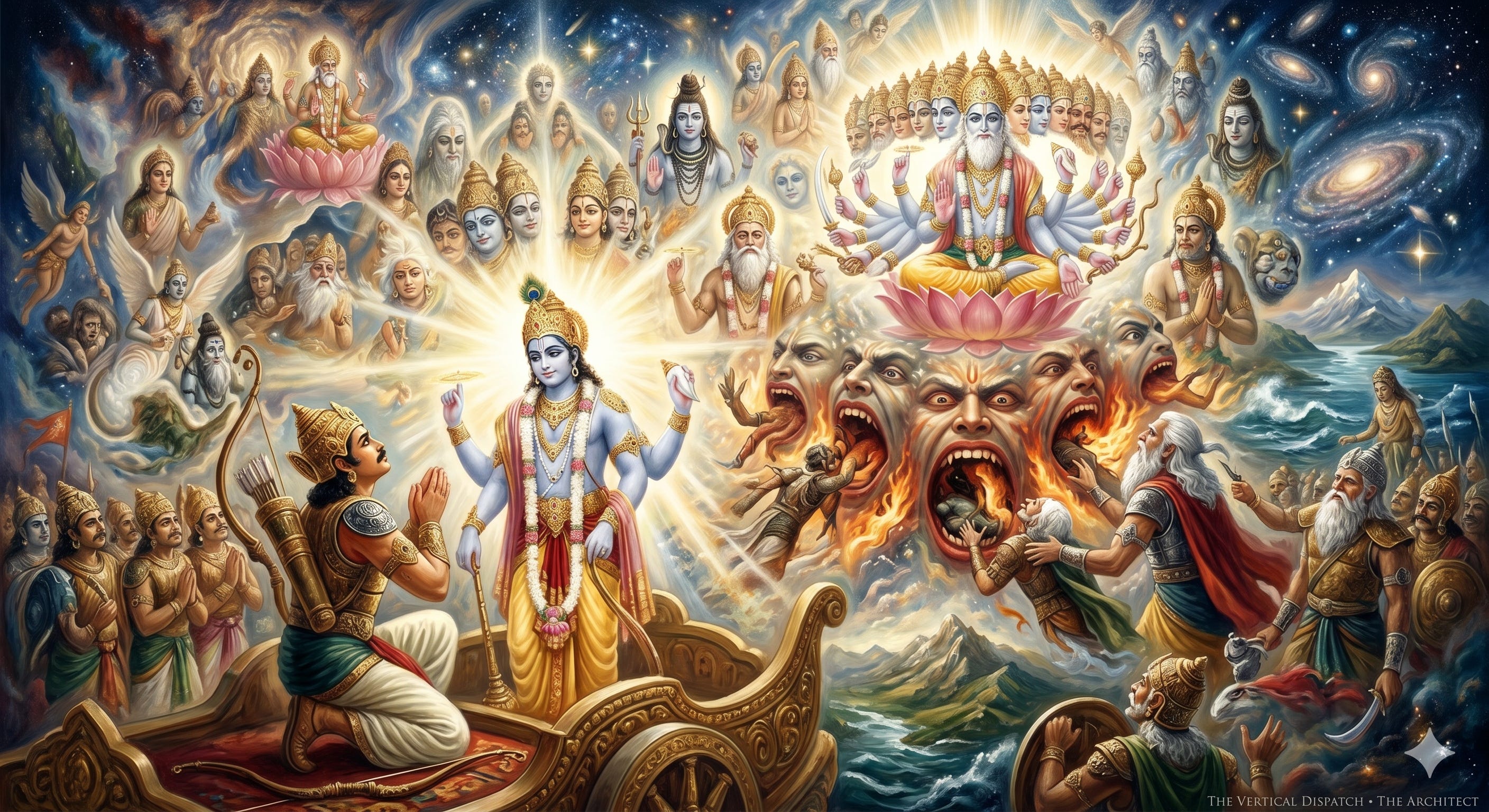
It is the right request at the right moment. Shankara understood the difference between shruti — heard teaching, knowledge about the Absolute — and darshana, direct vision, knowledge of. For ten days Arjuna has been receiving the first. Today he is asking for the second. And the fact that he can ask it, that the question has formed in him with this precision and this readiness, is itself evidence that the ten days have done what ten days of genuine teaching are supposed to do.
I tell him: you cannot see this with the eye you were born with. I give you divine sight. Now — look.
— ★ —
What Arjuna sees cannot be described. The Gita tries, across nineteen verses, because the tradition understood that the attempt to describe it matters even when the description necessarily falls short. What the verses convey is not the vision itself — that cannot be conveyed in language. What they convey is the structure of the experience of the vision. What it is like to be a human nervous system confronted with totality.
He sees everything simultaneously. Not sequentially — not first this, then that, then the other. All of it at once, in a single perception that has no frame, no edge, no before or after. All the gods. All the sages. All the serpents and the ancestors and the cosmic powers. Brahma seated on the lotus throne of creation. The sun and moon as eyes. Mouths that contain blazing fire. Arms beyond counting. Faces on every side with no side that does not have a face.
He sees no beginning. No middle. No end.
Sanjaya, who is narrating this to the blind king from a distance by the grace of his own teacher, tries to give the blind king a scale. If the light of a thousand suns were to blaze forth simultaneously in the sky — that might approach, he says, the radiance of what Arjuna is seeing. Might. Approach.
The human mind reaches for the largest thing it knows and finds that the largest thing it knows is still a fragment of a fragment of what is being disclosed.
— ★ —
Then Arjuna looks more closely. And what he sees next breaks something in him that Chapter One’s grief never reached.
He sees Bhishma entering the cosmic mouth. His grandfather — the greatest warrior of his age, white-haired, noble, the man who taught him what honour meant — entering the mouth that receives everything. He sees Drona, his teacher. He sees Karna, whose courage he has always secretly admired even across the line of enmity. He sees the kings and their armies — both armies, his own included — flowing into those mouths like rivers flowing to the ocean, like moths flowing to a flame.
The grief of Chapter One was personal. I will lose the people I love. What Arjuna sees in Chapter Eleven is impersonal in the deepest sense of that word — not cold, not cruel, but beyond the personal entirely. This is not what happens to my people. This is what happens to every form that has ever arisen anywhere. Not because the Absolute is indifferent to them. Because the Absolute is the ground of what arising and returning actually is. Every form that appears must eventually be received back. This is not a flaw in the design. It is the design.
Arjuna asks, his voice shaking: who are you, of this terrible form? Tell me.
— ★ —
“I am Time, the great destroyer of worlds, engaged here in destroying worlds. Even without you, all the warriors arrayed in the opposing armies shall not live.” — Bhagavad Gita 11.32
Kala. Time. Not time as the ticking of a clock. Time as the Absolute’s own power of transformation — the force that ensures that nothing which has form persists indefinitely, that every arising is already a returning in slow motion, that the battle Arjuna has been agonising over has already been decided at the level of what is real.
Even without you, I tell him, these warriors will not live. This is the most demanding teaching in the entire chapter, and Shankara approached it with great care. It is not fatalism in the ordinary sense — it is not saying that human choice is meaningless. It is saying that the outcomes of this particular moment are already contained within the movement of Time itself. The river was flowing before Arjuna arrived on the bank. His participation or non-participation does not change where the river is going. What it changes is whether he acts with understanding of what he is part of, or whether he stands on the bank in confusion while the river moves without him.
Therefore, I tell him: arise. Be an instrument. Take the credit of victory that I have already secured. Fight — not as the author of the outcome, but as the one through whom what is already happening can happen with dignity and understanding rather than confusion and paralysis.
This is karma yoga arriving at its deepest expression. Not the beginner’s practice of offering the fruit of action. The mature recognition that the action itself is already the Absolute’s movement. The individual is the instrument. The music was already written. The instrument’s dignity is in playing it well.
— ★ —
Arjuna’s response to the vision is a prayer of extraordinary beauty — one of the great devotional poems in any language. He praises the Absolute in its cosmic form with every name the tradition has given it. He bows in every direction — before, behind, on all sides — because there is no direction that does not contain a face of what he is beholding.
And then he asks, humbly, for the familiar form to return.
Be gracious, he says. I want to see you as you were — the gentle four-armed form, the face I know. This terrible form has made me glad and has also terrified me. Let me see the one I can look at.
Shankara did not read this as weakness. The human nervous system cannot sustain the vision of totality indefinitely. It was not built for it. The cosmic form is real. The personal form is also real. The Absolute is both simultaneously — the infinite that wears a finite face without being diminished by the wearing, the ocean that is also genuinely the particular wave that Arjuna knows and loves.
I restore the familiar form. Arjuna’s fear subsides. He breathes again.
— ★ —
And then comes the most unexpected reversal in the entire Gita.
I tell Arjuna: what you have just seen — this cosmic form that overwhelmed every sense you possess, that the gods themselves long to look upon, that no austerity or ritual or sacrifice or study could have shown you — that form is not the hardest thing to see. What is genuinely difficult to see is this.
The two-armed human form standing in front of him. The familiar face. The charioteer. The friend.
Not by the Vedas, not by sacrifice, not by gifts, not by fierce austerities can I be truly seen and entered into. But by devotion undivided.
Shankara held this as the most important teaching in the chapter. The cosmic form overwhelms. When something overwhelms every capacity of the human being simultaneously there is no possibility of not recognising it — the recognition is forced by the sheer scale of what is encountered. It cannot be missed. It cannot be explained away.
But the ordinary face — the face of the person sitting next to you, the face of the stranger on the street, the face of your own life as it appears on an unremarkable Tuesday — that face can be looked at directly and still not seen. The infinite wearing the finite looks, from the outside, like just the finite. The ocean wearing the shape of a single wave looks, from the outside, like just a wave.
What opens the eye that sees the infinite in the familiar is not awe. Awe is the response to the overwhelming. What opens this eye is love — devotion that keeps looking at the ordinary face long enough and with enough quality of attention that what the ordinary face is carrying begins to show through. Not because the looking creates it. Because the looking finally stops preventing what was always there from being seen.
— ★ —
Chapter Eleven does something no other chapter in the Gita does. It gives the reader — through Arjuna’s eyes — a glimpse of what the teaching has been pointing at from the beginning. Not a concept. A vision. And then it takes the vision away and leaves the reader with the ordinary face of things.
That is not a withdrawal of the gift. It is the real gift. Because the reader now knows — the way Arjuna knows standing in the chariot breathing again, the familiar form restored — that the ordinary face is not the absence of what the cosmic form showed. The ordinary face is the cosmic form in its most intimate address. The infinite choosing the finite not as a disguise but as a preference. The ocean choosing to speak in the form of a single wave because the wave is what can be heard.
— ★ —
Today there is only one question to carry, and it is very simple.
Look at the most ordinary thing in your immediate surroundings. Not a beautiful thing — the most ordinary. The cup. The table. The patch of wall. The familiar face of whoever is nearest you.
Hold the knowledge that somewhere inside what you are looking at is the same ground that Arjuna saw in the cosmic form — the same light of a thousand suns, the same inexhaustible depth, the same Time that receives all forms without being diminished.
Not as a belief to perform. As a question to sit with. If it is all there — in the cosmic form and the ordinary face simultaneously — what does that change about how the ordinary face is worth looking at?
— ★ —
Tomorrow: Chapter Twelve — The Yoga of Devotion
The Architect • The Vertical Dispatch
Glennford Ellison Roberts Author — Sacred Metaphysics & Consciousness: History of the Absolute & Eternal Cumberland, Ontario, Canada
God is Love. Love is Truth. Truth is Consciousness. Consciousness is Brahman.
Amen. Namaste.. 🙏
#TheVerticalDispatch #TheArchitect #BhagavadGita #ChapterEleven #VishwarupaDarshanaYoga #CosmicForm #UniversalForm #AdvaitaVedanta #NonDuality #Shankara #Kala #Time #DestroyerOfWorlds #Darshana #BhaktiYoga #SacredMetaphysics #Consciousness #GroundOfBeing #Totality #Arjuna #Krishna #AncientWisdom #Project2046 #VajraKernel #UniversalDynamics #Ontology #SelfRealization #DivineSight #TheOrdinaryFace #MetaphysicalInquiry
🙏🙏