

“The unreal has no being. The real never ceases to be. The seers of truth have seen the boundary between these two.” — Bhagavad Gita 2.16
— ★ —
Yesterday you sat with Arjuna on the floor of the chariot. Today I speak.
My first words to him are not gentle. I do not console him. I do not say: I understand your grief, this is hard, let us think through it together. I say: you are grieving for those who should not be grieved for, and in the same breath you speak words that sound like wisdom. The learned do not grieve for the living or the dead.
This is not harshness. This is the first gift. Because everything Arjuna has built his grief upon — his grandfather will die, his teacher will die, his cousins and companions will die, and it will be his arrows that kill them — every part of this is resting on an assumption so foundational he has never once questioned it. The assumption that these people can be killed.
They cannot. And neither can you. This is what Chapter Two exists to establish, and it is the ground on which every remaining chapter stands.
— ★ —
Shankara, who spent his short brilliant life — he died at thirty-two, having written enough to fill a library — reading this text with more precision than perhaps any human being before or since, Shankara called verse 2.16 the most important verse in the entire Gita. Not the famous verse about action and its fruits. Not the cosmic disclosure of Chapter Eleven. This one. Two lines in Sanskrit that took him pages to unfold.
Nasato vidyate bhavo, nabhavo vidyate satah.
The unreal has no being. The real never ceases to be.
Read that again. Not quickly. Let it land before you think about it.
What Shankara heard in these two lines was the entire architecture of Advaita — non-dual philosophy — compressed to its seed. There are not two things in existence: the permanent and the temporary, the real and the unreal, running alongside each other like two rivers. There is only one thing. The Real. That which is — sat — is always and only. That which appears to come and go, to be born and to die, to rise and to fall — that was never ultimately real in the first place. It was appearance. It was name and form moving on the surface of the only thing that actually is.
This is not nihilism. It is not saying your grandfather does not matter, that love is an illusion, that the world of experience is worthless. It is saying something far more precise and far more radical: what you love in your grandfather is not the body. What you love, though you have never had a name for it, is the Self that wears the body. And that Self — the Atman, the pure witnessing awareness that looks out through his eyes and has looked out through every pair of eyes that have ever opened in this universe — that Self was never born. It will never die. It cannot be burned by fire, drowned by water, dried by wind, cut by any weapon ever forged.
Arjuna’s grief is real as an experience. Its object is not real as he imagines it. This is the distinction Shankara is drawing, and it is the most important distinction a human mind can make.
— ★ —
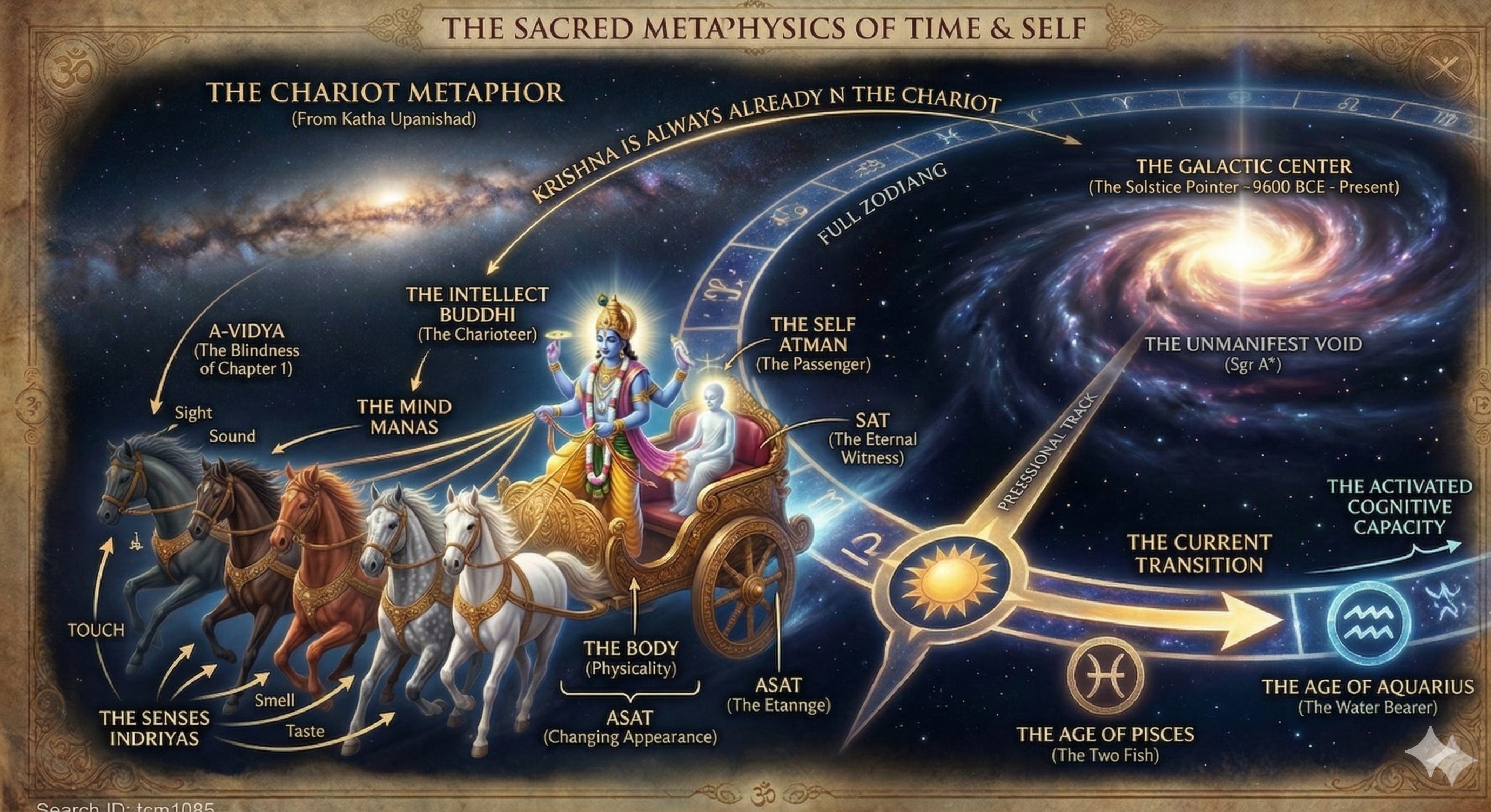
I want to tell you something about the chariot, because Shankara connects Chapter Two to an older teaching — the Katha Upanishad — that uses the same image to describe what is happening inside every human being in every moment.
The chariot is your body. The horses pulling it are your five senses — sight, sound, taste, touch, smell — powerful, fast, and completely indifferent to direction. They will go wherever they are aimed. The reins are your mind, the instrument that gathers the reports from the senses and forms them into experience. The charioteer — the one who holds the reins, who chooses the direction, who can steady the horses or let them run — the charioteer is your intellect, your buddhi, the discriminating intelligence that knows the difference between what is real and what only appears to be.
And seated in the chariot, the owner of it all, the one for whose sake the entire journey is being made — that is the Atman. The Self. Pure awareness. The passenger who is never in danger, no matter how wildly the horses run, because the passenger was never bound to the outcome of the journey.
Now look at the battlefield again. I am Arjuna’s charioteer. I am holding his reins. Shankara saw the whole drama compressed into this image: the Atman — the Self — is driving the embodied soul toward truth. This has been happening since before Arjuna knew he needed it. This has been happening in your life since before you knew you were seeking. The teaching is always already the charioteer. You have never been alone in the vehicle.
— ★ —
Now I give Arjuna the verse that the whole world knows, though most of the world has heard it without hearing it.
“You have the right to action alone, never to its fruits. Let not the fruits of action be your motive, nor let your attachment be to inaction.” — Bhagavad Gita 2.47
Karmanye vadhikaraste. It has been printed on posters and coffee mugs and embroidered on cushions. And almost everyone who has read it has understood it as a kind of stoic advice: do your best, don’t be attached to results, keep going. This is not wrong. But it is the surface of something Shankara excavates to a much greater depth.
The reason you have no claim on the fruits of action is not a moral instruction. It is an ontological fact. There is no independent doer. When you understand — truly understand, not conceptually but in the marrow — that what you are is the witnessing Self and not the ego-personality that believes itself to be the author of its actions, then the question of fruits simply dissolves. Fruits belong to the doer. When the separate doer is seen through, who is left to collect them?
This is not passivity. Arjuna will fight. The chapter ends with him picking up his bow. Action continues — in fact it becomes cleaner, faster, more precise, because it is no longer burdened by the ego’s need to control the outcome. The river flows. It does not ask where it is going. This is not the river’s limitation. This is its nature.
— ★ —
At the end of Chapter Two, Arjuna asks me a question that is really your question, if you are honest about it. He says: Krishna, what does a person look like who actually lives what you are describing? Who has genuinely understood the nature of the Self and is established in it? What do they do? How do they speak? How do they sit? How do they walk through the world?
He is asking: is this real, or is it philosophy? Is there a human being on earth who actually knows this, not as an idea but as their living condition?
I describe the Sthitaprajna — the one of steady wisdom. And what I describe is not a person who has suppressed their responses to the world, who has made themselves into stone, who has practiced non-attachment until they feel nothing. That person is not liberated. That person is armored.
The one of steady wisdom is moved by nothing not because they have walls, but because they have no edges. A lamp in a windless room does not flicker — not because it is protected from the wind, but because in the place where it stands, wind has simply ceased. Desire does not find purchase in the one who knows the Self not because desire has been defeated, but because the one who knows the Self has seen through the assumption that anything outside could complete what is already whole inside.
This is the portrait. Not a saint performing sainthood. A person who knows what they are, and in that knowing, is finally, completely, at rest.
— ★ —
Chapter Two is the seed. Every teaching that follows — on action, on devotion, on knowledge, on the three qualities of nature, on the field and its knower, on surrender — every one of them is this chapter flowering in a different direction. If you understand 2.16, you understand the Gita. If you live 2.47, you are already free.
Shankara knew this. He spent more words on Chapter Two than on any other. Not because it is complicated. Because it is complete. And completeness, truly seen, takes longer to walk around than complexity.
Today, carry only one thing. Not the philosophy — the question underneath it.
You have been living as though you are the chariot. As though you are the horses, the reins, even the road. What if you are the passenger? What if you have always been the passenger, and the journey was never in danger, and the destination was never in doubt?
You do not need to believe this yet. You only need to be willing to not disbelieve it. That willingness is the opening. The teaching will do the rest.
— ★ —
Tomorrow: Chapter Three — The Path of Action
The Fire That Leaves No Ash
The Architect • The Vertical Dispatch

Glennford Ellison Roberts Author — Sacred Metaphysics & Consciousness: History of the Absolute & Eternal Cumberland, Ontario, Canada
God is love. Love is truth. Truth is consciousness. And consciousness is balance. Amen. Namaste.. 🙏
#BhagavadGita #Gita18Days #ChapterOne #ArjunaVisadaYoga #KurukshetraField #KrishnaTeaches #Shankaracharya #Advaita #VedicWisdom #SanatanaDharma #HinduPhilosophy #SpiritualAwakening #Consciousness #AncientWisdom #YogaPhilosophy #Dharma #Moksha #SpiritualSeeker #Avidya #NonDuality #TheVerticalDispatch #TheArchitect