


THE VERTICAL DISPATCH
We write for the mind, the eye, and the ear.
Read it. Look at it. Listen to it. The Vertical Dispatch is built for all three — prose with rhythm, made to be heard as much as read.
From metaphysics to geopolitics, from culture to history, from the sacred to the street — and everything in between. One lens, every subject. No ego. Just the record, named clean.
Press play. Walk with the words. 🕯️
The Age of Consequences · The Canadian Shadow Series
As of June 3, 2026
Building Canada Strong — without malice and without flattery
“Every game has a buy-in. The only question is which table it seats you at.”
This week the Premier of Alberta put a number on the table. Asked what it would cost the province to separate from Canada, Danielle Smith answered with a figure and a list: almost four hundred billion dollars in transitional costs, plus twenty-five to fifty billion a year after that, running indefinitely. Alberta’s share of the national debt, around a hundred and seventy billion. Border control. A central bank. A pension system rebuilt from the Canada Pension Plan. Trade agreements renegotiated from scratch, because — as she put it — you do not get grandfathered in. The press called it a bomb. It is not a bomb. A bomb is a thing you throw at an enemy. This is a buy-in — the price of a seat at a table — and the deepest question this dispatch can ask is not whether the number is right, but which table the buy-in actually seats you at, and which game is being played to get there.
Because there are three games on this board, and they are not the same game played harder. They are different games entirely, with different rules, different time-horizons, and different prizes. There is checkers. There is chess. And there is Go. This publication has come, over a month of reading Alberta closely — its grid, its wells, its windfall, its grievances — to believe that the whole separation drama is best understood as a contest among those three games, and that the Premier herself has, on the record of her own conduct, moved between them. We cannot see into her mind, and we will not pretend to. But we can read the moves. And the moves tell a story.
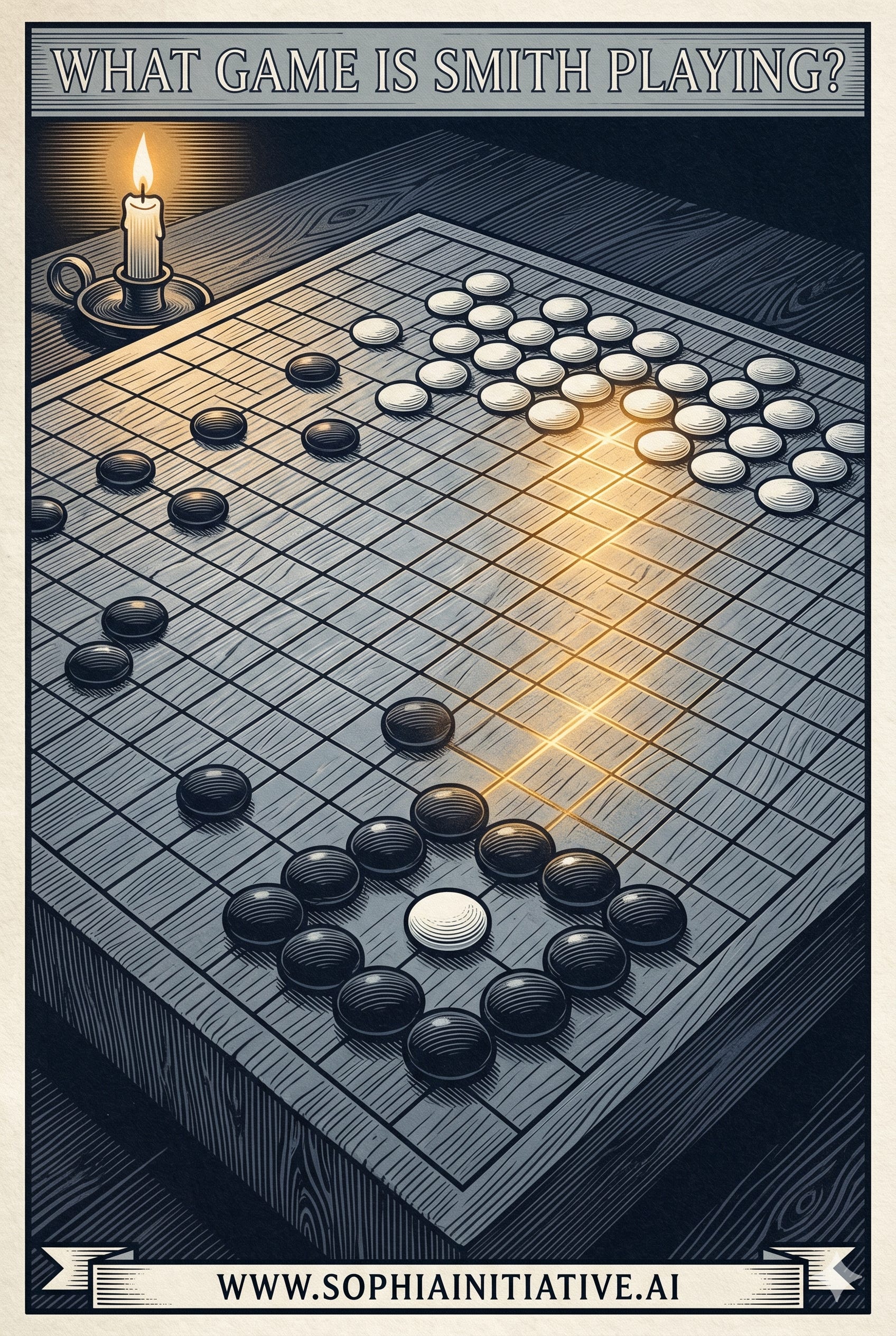
Checkers: The Game for the Base
Checkers is the simplest game. It is played one move deep: you see the piece in front of you, and you jump it. There is no horizon beyond the next capture. The separatist case is checkers in its purest form. Ottawa takes our money; therefore leave; therefore keep the money. The move is the whole of the thought. What checkers cannot see — because it never looks past the jump — is the board that comes after: that Alberta is landlocked, with no tidewater of its own and three small electrical interties to its name; that it would face that four-hundred-billion-dollar buy-in; that every trade agreement Canada has built would have to be renegotiated from the weakest possible position, a brand-new petro-state of under five million people; and that waiting at the edge of that board, openly, is a far larger player. United States officials have met with the Alberta Prosperity Project in Washington at least three times since April 2025; a US Treasury Secretary has endorsed Alberta separatism; serious analysts at the Walrus and at the Center for Strategic and International Studies have written that an independent Alberta would prove unsustainable and that the gravitational pull toward US annexation — as a fifty-first state or a territory — would be considerable. Checkers sees the jump. It does not see that the jump ends with your piece in someone else’s hand.
Here is the reading the record invites, and we offer it as a reading, not a certainty: Danielle Smith is not a checkers player. She is plainly too intelligent for a one-move game, and her own history shows it — she eased the petition rules, she flew the sovereignty banner, she declined to condemn the separatists, but she titled her signature law the Alberta Sovereignty Within a United Canada Act, with the exit door nailed shut inside the name. The checkers, in other words, was played for an audience. It was the move shown to the base — the performance of grievance for the one-move-deep crowd — by a player who was, even then, setting up a different game on a different board. We say this not to praise or condemn her, but because a player who could build what she built next was never really playing checkers at all.
Chess: The Game Against Ottawa
Chess is a deeper game. It looks several moves ahead; it plays for position; it sacrifices a pawn to protect a king. And the chess game Smith has played against Ottawa is, on the record, a genuinely skilled one. The separatist threat was never, on this reading, a move she intended to make — it was a piece she placed on the board to be seen, leverage held in reserve, the credible possibility of departure used to extract concessions from a federal government that could not afford to lose the province. Keep the threat live; never actually move it; bargain from the strength the threat creates. That is not the conduct of a separatist. It is the conduct of a federalist with a very sharp instrument, and for a long time it worked.
But chess has a limit, and it is built into the game itself: chess is adversarial. It is always me-against-you, and the best you can ever win is a better position in a war that never ends. You must keep the threat credible, which means the separatist piece must stay menacing on the board — which means the seam in the country must be kept permanently open, exactly the open seam that a player across the border is built to widen. And then Smith met a grandmaster. Mark Carney is not a provincial chess player; he ran two G7 central banks through two global crises. In November of 2025 he signed a pipeline partnership with Alberta — gave Smith the win, the tidewater route, the spirit of partnership — and in doing so changed the board. A grandmaster does not answer your leverage with counter-leverage; he rearranges the position so that your threatening piece loses its value. Give the province what the threat was meant to extract, in partnership, and the threat has nothing left to threaten. The record suggests Smith has been, in the precise sense of the game, out-positioned — and that the four-hundred-billion-dollar buy-in she laid down this week is partly the move of a chess player who has seen it, and is consolidating on the only ground that remains genuinely hers: Remain.
Go: The Game You Cannot Play Alone
And then there is Go — the oldest and deepest board game on earth, and the one almost no one in this drama is playing. Go is not about capturing your opponent. It is about building territory through connection: placing stones that link to one another, surrounding space, until your position is so well-connected that it is alive and cannot be killed. It is patient. It is positional. It rewards the long horizon over the quick capture, and it is, above all, a game of scale — you cannot build territory without a board large enough to hold it, and stones enough to connect. Norway has played Go with its oil. Beginning in 1990 it deposited all its petroleum revenue into a sovereign fund, withdrawing only the real return, taxing itself heavily to leave the windfall untouched — and forty years later that patient, connected position is worth roughly one and a half trillion dollars, a permanent seat at the world’s table for a country the size of Alberta. That is what winning at Go looks like: territory so compounded it can no longer be killed by a bust.
Here is the fact that should stop every Albertan cold, and it is the province’s own number, not Ottawa’s. Alberta began the same game first. The Heritage Savings Trust Fund was founded in 1976 — fourteen years before Norway’s — with the stated purpose of saving for the future and diversifying the economy. And then Alberta stopped playing Go. Within a decade the regular contributions ended; the windfall was spent on the present, budget by budget, boom by boom. Today that fund holds about thirty-two billion dollars. The University of Calgary economist Trevor Tombe has calculated that had Alberta followed Norway’s discipline, it would hold around five hundred and seventy-five billion. The objection is fair and we record it — critics note that policy is easy in hindsight, that Norway’s fiscal starting point differed, that a vast fund might have triggered federal clawbacks. But the direction is not in dispute. Norway saved a fortune from comparable oil; Alberta, with a fourteen-year head start, saved a fraction — and the difference is the difference between Go and checkers, written in half a trillion dollars.
And it is not only the fund. The pattern repeats on every file the province alone controlled. The orphan wells: a thirty-billion-dollar cleanup liability against two hundred and twenty-seven million in security, on a path that by one estimate would take a hundred and seventy-seven years to clear — the profits taken in the present, the cleanup left to the future, while the state of North Dakota next door solved the identical problem in 2001 with a use-it-or-lose-it rule. The electricity grid: an island system, isolated behind three small interties, among the highest prices in Canada, that sent emergency blackout alerts to Albertans’ phones in the cold snap of January 2024, and that the province will not even run at full capacity to its neighbours. Three files — the windfall, the wells, the grid — and one habit beneath all three: the present devouring the future, the near capture chosen over the long position. Checkers, three times, where Go was the game that counted.
Now hold the hardest truth of all, the one that turns the whole separatist proposition inside out. Go is a game of scale, and a province is not a player at the world’s table — a country is. Here is the part the separatist dream gets exactly backwards: leaving Canada does not promote Alberta to the Go board. It removes it. Inside Canada, Alberta is one of the strongest stones a Go-playing nation possesses — its energy, its diversified economy, its agrifood, its expertise are part of the position of a G7 power that holds a real seat, negotiates the trade treaties with Alberta’s weight behind it, and plays the long game on a board big enough to matter. An independent Alberta does not arrive at that table as a new and respected player. It arrives as a minor stone — landlocked, under five million people, no buy-in earned, no treaty history, courted by the giant next door not as a peer but as a resource to absorb. You do not reach the Go table by flipping the board you are already seated at. And you reach it least of all by paying a four-hundred-billion-dollar buy-in to leave the only table that ever seated you.
The Tell, and the Clock
There is one more thing a Go-literate player would see, and it is a matter of timing so cruel it is almost unkind to name. The entire separatist case rests on oil wealth — the confidence that an independent Alberta, holding its resource, could stand. But the major energy forecasters now increasingly point to a plateau and decline in global oil demand within roughly a decade. The International Energy Agency projects demand cresting around the end of this decade, with combustible-fuel demand possibly peaking as early as 2027; OPEC disputes the timing and sees growth continuing; independent analysts split the difference at 2030 to 2035. The date is genuinely contested and we will not pretend otherwise. But the risk is not: you do not found a petro-nation, at a four-hundred-billion-dollar cost, on an asset whose own industry’s forecasters expect its demand to crest within the lifetime of the founding debt. The checkers move — leave, keep the oil money — would have Alberta pay the largest buy-in in its history to sit down at a small table, holding a hand the world is forecast to stop wanting, just as the bill comes due.
So what game is Smith playing? We cannot see her mind, and we hold to that. But her play has the shape of a particular intelligence — a player who performed checkers for the base because she was never a checkers player; who played skilled, positional chess against Ottawa until a grandmaster changed the board; and who, on the evidence of a four-hundred-billion-dollar case for Remain, appears to have looked up from the chessboard and read the Go board — and understood what it shows. That Alberta, alone, gets no stone on the world’s table. That the seat it already holds, it holds only through Canada. That the long game, the only game that builds a legacy rather than a grievance, can be played from exactly where the province is already sitting — and from nowhere else. Whether she would put it in these words, we cannot say. But the wisest move on the board is the one her conduct now points toward, and it is not the exit. It is the table she is already at.
Final Thoughts: The Board You Are Already At
Let it be said plainly, because this publication does not write to put a province down: Alberta is a strong player. It is among the most diversified economies in the country; it built a tech sector from almost nothing and an agrifood industry that feeds the continent; its people are as capable as any in the federation. The argument of this dispatch is not that Alberta is small or poorly run in its nature. It is the opposite — that Alberta is a Go-sized player that keeps being talked into checkers, a province strong enough for the longest game that is forever being offered the shortest one. The tragedy of the Heritage Fund is not that Alberta could not have built a Norwegian fortune. It is that it started to, fourteen years early, and was persuaded to spend it instead. The tragedy of separatism would be the same mistake made final: trading the seat at the only table that matters for a buy-in to a game that ends in absorption.
The keel of this publication was learned from a man who read the whole water at land’s end — not the wave in front of the boat, which is checkers, nor the contest with the sea, which is chess, but the entire moving body of it, and the right relation of the small craft to all of it. That is Go, and it is the game the moment asks of Alberta and of Canada both: not capture, not leverage, but connection — the patient building of a shared territory strong enough that no storm from the south can cut it off. The buy-in to that game was paid long ago, in Confederation. The seat is still warm. The wisest player at the board is the one who sees that the game worth winning was never somewhere else. It was here, all along. The waters are rough. The keel holds. Walk with the words.
God is Love. Love is Truth. Truth is Consciousness. Consciousness is Brahman.
Amen. Namaste. Om Namah Shivaya.
— The Architect
The Vertical Dispatch
sophiainitiative.ai
On the record — sources (as of June 3, 2026). Separation costing: Premier Danielle Smith, June 2026 (almost $400B transitional plus $25–$50B annual; ~$170B debt share; CPP, border, central bank, trade renegotiation) — CBC, Yahoo/Postmedia (Rick Bell), CP24, Narcity, June 1–3, 2026; the Alberta Prosperity Project rejected the figure. Referendum: Oct. 19, 2026 two-part question (remain, or begin process toward a binding secession vote); Smith campaigning Remain; court ruling against the citizen petition over duty-to-consult (Court of King’s Bench, May 2026). Leadership pressure: Mitch Sylvestre (CEO, Alberta Prosperity Project / Stay Free Alberta) organizing a leadership review or alternate ballot question; Jeffrey Rath and Jason Lavigne cited; UCP president declared the party neutral; Smith’s 2024 leadership-review support was 91.5% (CBC, May 26, 2026). US contacts: FT and CBC reporting on APP–State Department meetings (≥ three since April 2025); Treasury Secretary Bessent endorsement; CSIS and The Walrus analyses of annexation “gravitational pull.” Sovereignty Act: Alberta Sovereignty Within a United Canada Act (2022). Carney–Smith pipeline MOU: November 2025. Heritage Fund: ~$31.9B (Dec. 31, 2025); founded 1976; Norway’s fund ~$1.5T CAD; Tombe counterfactual ~$575B; objections from Andrew Leach and Max Fawcett noted. Orphan wells: AER conventional-well liability ~$30.08B vs ~$227M security; “177 years” estimate (The Narwhal); North Dakota use-it-or-lose-it (2001). Grid: Alberta an “electricity island” with three small interties (Pembina); among highest prices in Canada; Jan. 13, 2024 grid-alert during cold snap; BC–Alberta intertie underused. Diversification: Alberta among Canada’s most diversified economies by employment (Tombe and Mansell); Calgary tech ~$2.1B invested over three years; agri-food exports ~$17.9B (2023). Oil-demand forecasts: IEA Oil 2025 (plateau ~105.5 mb/d by end of decade; combustible-fuel demand possibly peaking ~2027); OPEC projects growth to ~112 mb/d by 2030; independent estimates ~2030–2035 (Enverus). All characterizations of the Premier’s strategy, and the checkers/chess/Go framing, are interpretation and commentary; no claim is made about any individual’s private intentions or state of mind. Errors and omissions excepted; corrections will be made on notice. Verify against primary sources before republication.
#WhatGameIsSmithPlaying #CheckersChessOrGo #Alberta #DanielleSmith #AlbertaSeparation #Referendum #MarkCarney #HeritageFund #Norway #OrphanWells #AlbertaGrid #PeakOil #51stState #CanadaStrong #BuildingCanadaStrong #TheCanadianShadowSeries #TheAgeOfConsequences #ReadingTheRiver #ThreeDoorsDown #TheVerticalDispatch #TheArchitect #SophiaInitiative #GodIsLove #LoveIsTruth #OmNamahShivaya
Substack Notes
This week Danielle Smith put the price of Alberta separation on the table: almost $400 billion to set up, $25–$50 billion a year after. The press called it a bomb. It’s not a bomb — it’s a buy-in, the price of a seat at a table. And the real question is which table it buys, and which game Smith is playing to get there. There are three: checkers, chess, and Go.
Checkers is one move deep — leave, keep the money — and it’s the separatist case, blind to the board that comes after: landlocked, no tidewater, the buy-in, trade renegotiated from weakness, and a giant next door already meeting with Alberta separatists in Washington. But Smith is too smart for checkers; she performed it for the base. Her real game was chess — the separatist threat as leverage against Ottawa — until she met a grandmaster. Carney gave her the pipeline partnership and changed the board, and her threat lost its value.
Then there’s Go: the patient game of building territory through connection — the game Norway played to turn its oil into a $1.5-trillion fund and a permanent seat. Alberta started the same game first, in 1976, and quit; its Heritage Fund sits at $32 billion against a possible $575 billion. The wells, the grid, the fund — three files Alberta alone controlled, one habit: the present devouring the future. And the hardest truth: Go is a game of scale. Leaving Canada doesn’t promote Alberta to the world’s table — it removes it. A province is a strong stone on a G7 nation’s board; an independent petro-state of five million is a minor piece the giant next door means to absorb — just as oil demand is forecast to crest.
So what game is Smith playing? We can’t see her mind and don’t pretend to — but her play has the shape of someone who read the Go board and saw what it shows: Alberta gets no stone on the world’s table without Canada. The seat it already holds, it holds only through the federation. Alberta isn’t too small for the long game — it’s a Go-sized player being talked into checkers. The board worth winning was here all along. Walk with the words. 🕯️
The factual matter in this Dispatch is drawn from the public record. All characterizations, inferences, and conclusions are opinion, interpretation, and commentary, offered for analysis, reflection, and public-interest discussion. No assertion is made regarding the private intentions, state of mind, or character of any individual. Readers should evaluate all statements independently and draw their own conclusions.
As usual, excellent and balanced analysis! Thank you. I would just make one point and that is that while Peter Lougheed had the foresight to initiate the fund, and to support it, every conservative premier since, has squandered that legacy. Underneath that failure is the considerable and continual fiscal mismanagement that has continued to this day. And the only people who have benefitted have been the donors and cronies of the conservatives governments - to the detriment primarily to that part of the population that this same government views as “undeserving,” lazy, non-contributing, a drain.
The comparison between the 3 games, helps me understand what DS thinks she is doing and why she is in the place she is.
Although she is still also playing checkers as the 400 billion number is within the 500 billion amount offered to the separatists from the US. So she is still keeping the separatist dream alive if just barely.