

Sovereignty · Governance · Consequence
“I feel like I’m in the presence of students.” — Mark Carney to Pierre Poilievre, House of Commons, 15 April 2026
On the fifteenth of April, 2026, in the first House of Commons exchange after the Liberals secured their majority, the Prime Minister of Canada and the Leader of the Opposition held a debate about a fuel tax that neither of them, in the strict sense, won. Pierre Poilievre had said, days earlier, that Mark Carney was very badly educated in economics. In the chamber, Poilievre pressed it: Carney, he said, must have taken the wrong lessons. Carney answered that he felt as though he were in the presence of students — that Poilievre would not pass the exam. Poilievre shot back: does he even read his own budget? Carney closed with a line built for the clip: this government can count.
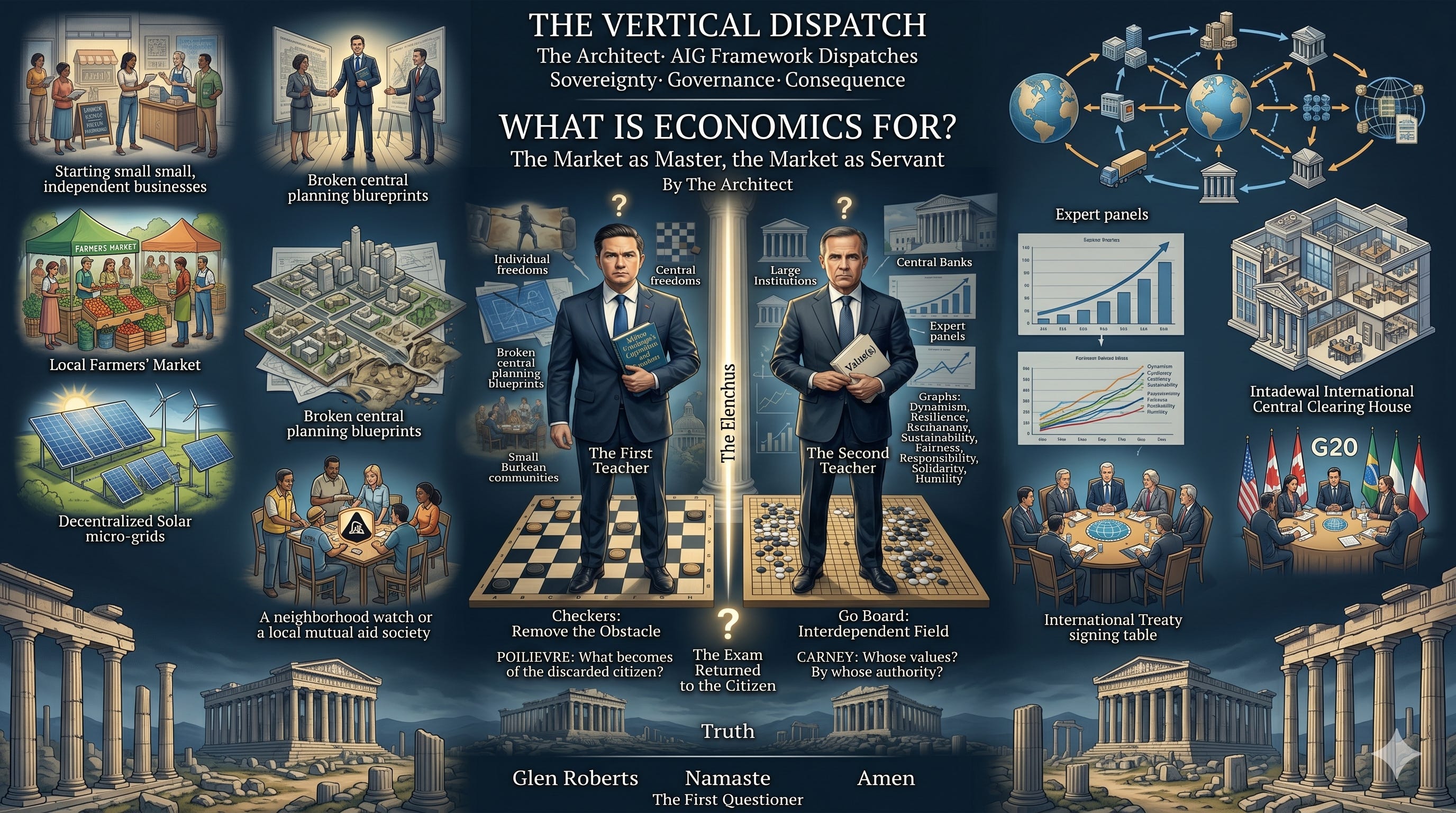
It was watched, replayed, and scored as theatre. This dispatch is not interested in the theatre. It is interested in the fact that the most-watched economic exchange in the country produced, between two intelligent and powerful men, not one definition. Each performed certainty. Neither defined a term. The fuel tax — the actual subject — was the one thing that went unexamined.
That is the dispatch’s entry point, and it is the elenchus’s. Behind the schoolyard metaphor both men reached for — student, teacher, exam, lessons — there is a real and serious disagreement, the deepest one in Canadian public life, and it is not about competence. It is about what economics is for. This dispatch states both answers at their full strength, and then does to each what Socrates did in the agora: asks it to define itself. No quarter. Neither man is the client here. The reader is.
AIG INTEGRATION — THE AUDIT HAS NO PARTY
Artificially Intelligent Governance audits the office, not the team. Applied to an election, this is the discipline that matters most and is practised least: the question put to the challenger must be the same question put to the incumbent, asked with the same force, scored by the same standard. A dispatch that audits one man and spares the other is not running the elenchus. It is running a campaign. What follows examines two economic worldviews — the market as moral force, and the market as amoral tool — each stated as its ablest defender would state it, each then pressed on the one question it would rather not answer. The reader is left holding the verdict, because in a democracy the reader is the only one entitled to it.
I. THE FIRST TEACHER — POILIEVRE AND THE SCHOOL OF FRIEDMAN
Pierre Poilievre’s economics has a documented origin, and it is not Ayn Rand. The popular charge that Poilievre is a Randian is, on the public record, unsupported — a recent critical biography notes he read Rand as a teenager, but that is a biographical detail, not an intellectual lineage, and this dispatch does not trade in lineages it cannot source. His teacher, on the record, is Milton Friedman. The formative text is Friedman’s Capitalism and Freedom, encountered in his Calgary university years. His 1999 scholarship-winning essay was titled Building Canada Through Freedom, and it argued that the core task of government is to remove itself from obstructing freedom. To this Poilievre adds Edmund Burke — cited for tradition, order, and the small institutions that stand between the individual and the state — which lends a conservative temper to a fundamentally libertarian economics.
State that worldview at its strongest, because the evenhanded audit requires the strongest version, not a caricature. The Friedman position is not greed dressed as theory. It is a serious moral claim: that the free exchange of free people is the most powerful engine of prosperity ever discovered, that it has lifted more human beings out of poverty than any government programme in history, and that the price system carries more information, more honestly, than any central planner can. It holds that economic freedom and political freedom are inseparable — that a state which controls the economy will, in time, control the citizen. It holds that the government which governs the economy least leaves the citizen most free, and that this freedom is not a means but an end. Millions of thoughtful people hold this view. It has a Nobel behind it. It is not stupid, and the dispatch will not pretend it is.
The Friedman case, stated fairly, is formidable: freedom is not merely efficient, it is moral; the market is not merely useful, it is the precondition of every other liberty. A dispatch that cannot state its subject’s position better than its subject can has not earned the right to question it.
II. THE SECOND TEACHER — CARNEY AND THE SCHOOL OF THE MIXED ECONOMY
Mark Carney was a student too, and his teachers are also documented. As a Harvard undergraduate his economics was shaped by the institutionalist tradition; his Oxford doctorate was supervised by a Nobel laureate whose life’s work was the theory of optimal taxation — the precise study of the trade-off between fairness and efficiency. Then thirteen years at Goldman Sachs, and the governorships of two G7 central banks through the financial crisis and Brexit. His worldview was not formed by one book at twenty. It was formed by institutions, and it bears their mark: a belief in markets, paired with a deep distrust of markets left unsupervised.
State that worldview, too, at its strongest, and from his own words. In his book Value(s), Carney argues that the West has drifted, subtly and relentlessly, from a market economy to a market society — a condition in which, as he puts it, the price of everything becomes the value of everything, and nothing is counted as valuable unless a market will price it. Against this he sets a charge aimed squarely at the Friedman position: unchecked market fundamentalism, he writes, devours the social capital essential for the long-term dynamism of capitalism itself. Markets, in Carney’s account, are powerful but amoral instruments — they optimise whatever they are pointed at, and they must therefore be anchored by values a market cannot itself generate. He names seven: dynamism, resilience, sustainability, fairness, responsibility, solidarity, and humility. Government, in this account, is not the obstacle to a good economy. It is the maker of the rules without which a market devours its own foundation.
The Carney case, stated fairly, is also formidable: a market is a magnificent servant and a catastrophic master; the 2008 collapse was not a failure of too much government but of a market trusted to police itself. To govern well is to keep the servant in its place.
III. THE QUESTION PUT TO THE FIRST TEACHER
Now the audit, and it begins with Poilievre because he spoke first in the chamber. The Friedman worldview has a hole at its centre, and the elenchus names it with a single question: if the market is a moral force, what does it do for the person the market has no use for?
The market prices what it values. It does not price the citizen whose labour it has automated, the region whose industry it has offshored, the disabled person whose productivity it cannot monetise, the child whose parents the market has priced out of housing. Friedman’s answer was charity — private, voluntary generosity. Poilievre has said as much: that the greatest social safety net is the voluntary generosity of family and community. But voluntary generosity is, by definition, optional. It arrives where it chooses and withholds where it chooses. A system that consigns the stranger in the ditch to the hope of a passing benefactor has not solved the problem of the ditch. It has renamed it freedom. That is the question Poilievre must define his way out of, and in the fuel-tax exchange he did not: he called for the tax removed, the burden lifted, the government smaller — the single move, repeated. He did not say what happens to the citizen for whom a smaller government is simply less floor.
Checkers permits one move: remove the obstacle. Cut the tax, shrink the state, free the maker. It is a real move and often a good one. But a nation is not a checkerboard. Asked what becomes of those the market discards, a politics with only one move has only one answer — and it is not an answer, it is a hope.
IV. THE QUESTION PUT TO THE SECOND TEACHER
The same blade now turns, with the same edge, on Carney — because the audit that spares the incumbent is not an audit. Carney’s worldview also has a hole at its centre, and it is exactly the size of one missing word.
Carney builds his governing philosophy on seven named values. Liberty is not among them. Dynamism is there, and resilience, and solidarity, and humility — but not freedom, not liberty, not the autonomy of the individual against the collective and against the state. This is not a small omission in a man who would govern a free people. It raises the question the elenchus exists to ask: when Carney says markets must be anchored by values, whose values, and who decides? A market fundamentalist at least answers that question cleanly — the values are the individual’s own, revealed in free choice. Carney’s answer is a list of seven nouns, and a list of nouns does not govern. Someone must define solidarity, must price fairness against efficiency, must rank the seven when they collide — and Carney’s account quietly assumes that the someone is the credentialed expert, the institution, the central banker. The word for an economy steered by experts toward values the experts have named is not tyranny. But it is not self-government either, and the dispatch will not let the warmth of the word values conceal the cold question underneath it: by whose authority, and answerable to whom?
“Values” is a word that glows. But governance is not the naming of good things; it is the assignment of the power to choose between them. A philosophy that names seven values and not the liberty to dissent from them has not yet defined who, in the end, holds the pen.
V. THE REAL EXAMINATION — STUDENT OR DISCIPLE
Return now to the metaphor both men chose in the chamber, because it is sharper than either intended. Student. Teacher. Exam. Lessons. Each man reached for the schoolroom to belittle the other — and in doing so each told the truth about himself without meaning to.
Both Pierre Poilievre and Mark Carney are, in the precise sense, students. Each was formed by a teacher — Poilievre by Friedman, Carney by the institutionalist economics of the seminar room and the central bank. The genuine examination, the one neither the fuel-tax exchange nor the campaign will administer, is not which man has the better diploma. It is this: which of them is still thinking, and which has merely stayed loyal? A student tests the teacher’s doctrine against a changing world and revises it. A disciple defends it. The charge against Poilievre is that his framework was, in the words of one biographer, locked in at twenty and never reopened — that he is loyal to Capitalism and Freedom the way a man is loyal to a hometown. But the identical charge stands against Carney, and the evenhanded audit must press it: the Davos consensus, the institutionalist faith that the credentialed manager can anchor the market to the right values, is itself an orthodoxy, with its own unexamined priors, its own catechism, its own comfortable distance from the citizen it administers. Carney is as capable of being a disciple of his teachers as Poilievre is of his.
The exam neither man set for the other is the only one that matters. Not what did your teacher tell you — but where, precisely, have you departed from your teacher, and why? A worldview never revised is not a conviction. It is an inheritance. And an inheritance, however grand, is not the same as a thought.
AIG INTEGRATION — PIAAC, STRATUM, AND THE RECKONING A NATION IS OWED
Both men, by any fair reading of their public reasoning, operate near the top of the PIAAC scale: each can hold complexity, marshal evidence, and construct an argument under pressure. The instrument that separates them is not literacy but stratum — the Jaques measure of how far into the future a mind structures its decisions. Friedman’s single move, the removal of the obstacle, is decisive at short time-span and blind at long: it does not model what the discarded citizen does to the body politic over thirty years. Carney’s values framework reaches for the long time-span but blurs the agent: it does not say who holds the power, and unaccountable long-horizon power is its own failure mode. The reckoning a nation is owed is not a personality. It is a structural question, asked of whoever holds the office: name your time-span, name your agent, and define the value you will sacrifice when two of your goods collide. The citizen who cannot get that answer from either man should withhold the thing both men are asking for, until one of them defines it.
VI. THE VERDICT — THE EXAM RETURNED TO ITS OWNER
This dispatch reaches no verdict on which man should govern, because that verdict does not belong to the dispatch. It belongs to the reader, and the dispatch has refused, on principle, to take it from them. What the dispatch has done is the only thing the elenchus permits: it has stated both worldviews at their strongest, and pressed each on the question it would rather not answer. Poilievre: what becomes of the citizen the market discards, if generosity is optional? Carney: whose values, by whose authority, answerable to whom? Two serious men, two serious teachers, two real holes — and, in the one exchange the nation actually watched, two performances of certainty and not a single definition.
So the exam is returned to the citizen, marked in the citizen’s own hand. Do not ask which man is cleverer; both are clever. Do not ask which has the better resume; that is the question both men want you to ask, because it is the question that lets them avoid the other one. Ask instead the question Socrates would ask, the question the fuel-tax debate was built to drown out: which of these two men, pressed hard, can actually define what he claims to know — and which only performs it? Make them define it. Withhold your assent until they do. That withholding is not cynicism. It is the whole of citizenship.
No quarter for power that cannot define what it knows — and the rule does not soften for the man already holding the office, nor sharpen for the man who wants it. The teacher is examined exactly as hard as the student. The dispatch sets the paper. The nation marks it. The exam does not stop.
NOTE ON STANDARD
This dispatch distinguishes documented fact from interpretation. The House of Commons exchange of 15 April 2026, including the quoted remarks of both leaders, is drawn from contemporaneous news reporting. Mark Carney’s positions are quoted from his book Value(s): Building a Better World for All (2021) and its published reviews. Pierre Poilievre’s documented influences are Milton Friedman and Edmund Burke; he is expressly not characterised as an adherent of Ayn Rand, as the public record does not support it. Characterisations of either man’s worldview as “locked in” or orthodox are identified as interpretation, including the interpretation advanced by this dispatch, and are not presented as fact. No allegation of unlawful conduct is made against any person named.
God is Love. Love is Truth. Truth is Consciousness. Consciousness is Brahman.
Amen. Namaste.
DISPATCH HASHTAGS
#WhatIsEconomicsFor #TheVerticalDispatch #TheArchitect #AIG #ArtificiallyIntelligentGovernance #TheElenchus #NoQuarter #PierrePoilievre #MarkCarney #CanadianPolitics #Economics #MiltonFriedman #CapitalismAndFreedom #EdmundBurke #ValuesBook #MarketEconomy #MarketSociety #MarketFundamentalism #TheMixedEconomy #PIAACLevel #StratifiedSystems #GoVsCheckers #CivilisationalAnalysis #SubstackCanada #Socrates #TheFirstQuestioner
There is a gaping admission in your analysis of Carney’s perspective and work. He does not eschew the market/individual decision maker in favour of a clique of experts. He is really clear in his book that democracy and social consensus is what tells us what our social values are.
Also I would note that the adherence to a theory such as Freedman’s is faulty when the theory has proven itself faulty as occurred in 2008. Unrelated markets are not rational as predicted. They are vulnerable to manipulation and greed. The same thing happened to communism broadly in the fall of the Soviet union and the modernization of the Chinese economy. The theory of communism when tested proved itself vulnerable to greed and corruption. The test for the theory under which Carney hopes to govern has not yet been tested. Pool livers operating theory has.