


THE VERTICAL DISPATCH
We write for the mind, the eye, and the ear.
Read it. Look at it. Listen to it. The Vertical Dispatch is built for all three — prose with rhythm, made to be heard as much as read.
From metaphysics to geopolitics, from culture to history, from the sacred to the street — and everything in between. One lens, every subject. No ego. Just the record, named clean.
Press play. Walk with the words. 🕯️
The Foundation Series · The Age of Consequences
Part One of three · As of June 1, 2026
— without malice and without excuse
Not everything that is faced can be changed. But nothing can be changed until it is faced.
— James Baldwin
I. The Announcement
Today, June 1, 2026, a draft of Canada’s national artificial-intelligence strategy went public. After more than a year of delay, the document — promised by Artificial Intelligence Minister Evan Solomon, championed by Prime Minister Mark Carney — sets out to scale AI adoption across the economy and to give every Canadian free access to AI literacy training, with a stated goal of reaching one million entry-level post-secondary students and creating up to ninety thousand AI-related jobs for young Canadians by 2031. By the early reporting it is adoption-first: put the tool to work, train the workforce to use it, build the sovereign compute beneath it. It names protecting Canadians and children from AI’s harms as a goal — but the early reporting is blunt that it is thin on the harder question of how. The numbers underneath are their own argument: Canada has the lowest AI-adoption rate in the OECD, and ranks forty-fourth of forty-seven countries on AI literacy.
There is much to commend in moving at all; a country that refuses to think about AI will have AI think about it. But underneath the strategy sits an assumption so common it is invisible: that AI and education are one project — teach people to use the tool, and you have educated them for the age of the tool. Access to training equals readiness. That sentence sounds like common sense. It is the precise error this dispatch exists to name. And to name it we must step back from this morning’s press release to a question the strategy never pauses on. Not how do we train people to use AI? The older and harder one: what is education for?
II. Two Domains, Mistaken for One
AI and education are not one domain. They are two, and confusing them is the root of the trouble. Education is the formation of a human being. AI is a technology — an instrument, a medium, a tool. To say “we will educate the nation for AI by training it to use AI” is to say we will make people wise by handing them an encyclopedia. The encyclopedia is a magnificent thing. It is not wisdom, and holding it is not the same as becoming wise. The strategy fuses the two because our whole civilization has quietly fused them — has come to believe education simply is the transfer of usable skills, and that the person who has the skills has been educated. Where did that belief come from? Not from the sky, and not as long ago as we imagine.
III. What We Built, and Why We Built It
Universal compulsory schooling — the system nearly every reader passed through — is a child of the Industrial Revolution. Before the nineteenth century no nation expected all its children to sit in rows, move by bells, advance by age-graded stages, and be tested on uniform content. That model arrived with the factory, and a forceful case — associated with John Taylor Gatto and the critics of industrial-era schooling — holds that it arrived for the factory: built less to free the mind than to produce a workforce. People who could read an instruction, follow a sequence, keep time by a whistle, sit through tedium, defer to authority, and slot into a productive role at a measurable skill level. In this reading the bells and rows and rote are not failures of the system; they are the system working as designed.
The thesis is contested, and honesty requires the other side. Mass schooling also grew from humane roots — universal literacy so ordinary people could read scripture and ballot alike, reformers who fought to pull children out of the mines, nation-builders who wanted a shared civic inheritance. It was never only a workforce machine. But even granting all of that, the operational shape of the system — what it rewards, what it measures, what it optimizes — leaned hard toward the industrial purpose. We built a machine to fill vessels with content and test whether the content stuck. Whatever the founders’ noblest intentions, that is largely the machine we still run.
IV. What Plato Said Education Was
Twenty-four centuries ago, in the seventh book of the Republic, Plato has Socrates demolish the definition we still use. Teachers who claim to put knowledge into a soul, he says, are like men who claim to put sight into blind eyes — as if the mind were an empty vessel and learning the pouring-in of content it lacked. That, says Plato, is exactly what education is not. The power to know is already in the soul. Education does not install it. Education turns it — redirects a sight already there but pointed the wrong way. The Greek word is periagoge: the turning-around. In the Cave, the prisoners are chained from childhood facing a wall, mistaking shadows for reality. Education is not teaching them to read the shadows better. It is the painful turning of the whole body toward the fire, and up toward the sun.
Set the two models side by side. Industrial: pour content in, test that it stuck, certify the vessel, deploy it. Plato: turn the soul until it can see. They are not two versions of one thing. They are opposites — and the whole modern apparatus, with the AI strategy now built on top of it, is the pouring-in model. We are about to pour AI into vessels we never turned.
V. Let No One Enter Without Geometry
Plato did not leave the turning vague. He gave a curriculum — arithmetic, geometry, astronomy, harmonics — and insisted these be studied not like tradesmen, not as job skills, but “for ease in turning the soul around, toward truth and being.” Above his Academy door, tradition holds, was carved one condition of entry: let no one ignorant of geometry enter here. Not a maths requirement — a statement about the preparation of the eye. Geometry trains the eye to see the one thing the ordinary eye misses: relationship. Not the triangle, but the relationship between three lines that produces it. Not the circle, but the relationship between every point and a fixed centre. Geometry is the discipline of perceiving the invisible relationships that generate visible forms — and the relationship is always prior to the form.
This is the master lesson, in Plato’s own terms. Symbol is not referent. The form is not the relationship that produced it. The one who sees only the forms — the answers, the facts, the tokens — and not the relationships that bind them is still in the cave, reading shadows. Which gives us the prior this whole dispatch turns on, and the thing a true education must teach: there is no thinking without symbols, and no understanding without the symbol bound to its referent. The crowd holds symbols loose, floating, pointing at nothing. The critical mind holds them bound — lashed to the particular below and the universal above. The binding is the thinking. That, and not the pouring-in of content, is what education is for.
VI. The Medium Is the Message
Jump to 1964 and the Canadian Marshall McLuhan’s most quoted, least understood line: the medium is the message. Most who repeat it take it to mean: pick a worthy message, put it on a good platform, and the platform carries the worthy thing. The medium as neutral pipe. McLuhan meant nearly the reverse. The message of any medium, he wrote, is “the new scale it introduces into our affairs” — not the content it carries, but the change of pace and pattern the medium drags in behind it. The electric light carries no content, yet it abolished night, made the all-night city, remade a thousand human arrangements. Its message was everything that became possible once the dark stopped governing the clock.
Twenty years later Neil Postman made it usable. In Amusing Ourselves to Death (1985) and again in The End of Education (1995) — a title with two meanings, the purpose of education and its death — he argued every dominant medium carries its own epistemology, its own theory of what counts as truth. Print trains a mind to follow an argument and ask is it true? The feed trains a different question to take over: is it engaging? Postman was careful — and we will be careful with him — to say he was not claiming the medium rewires the brain; he restricted his claim to discourse. And his prophecy was Huxley, not Orwell: a people undone not by what they hate but by what they love, drowned not in censorship but in a sea of fluent, pleasurable irrelevance. No one bans the book if no one wants to read it. He warned us that education was ending — in both senses — and the warning drowned in the very noise it named.
VII. The Shadow on the Wall
Now the wound, faced honestly. What has the pouring-in model produced? In December 2024, Statistics Canada and the OECD released the 2022 PIAAC results — the international survey of adult skills. Canada’s mean adult literacy score was 271, which sits in Level 2 of a five-level scale. About 19% of adults scored at Level 1 or below; roughly half fall short of Level 3, the threshold the OECD associates with thriving in an information-dense society. Among Canadians whose schooling stopped at high school, about 69% sit at Level 2 or below. And among university graduates, nearly a third — 32% — are still at Level 2 or below. A third of our degree-holders cannot read at Level 3.
Two disciplines, held hard. First: PIAAC measures literacy — not judgment, not virtue, not worth. The instant we turn a skill measurement into a verdict on a person we have done the contemptible thing, and it is the very thing this dispatch refuses. The prisoners were chained from childhood. The low score is evidence the cave was built, not that the prisoner is lesser. We judge the system that built the wall; we never rank the citizen in front of it. Second, the comparative honesty: Canada ranks in the top ten of participating OECD countries — above the average. So this is no Canadian disgrace; it is an industrialized-world result, which makes the point larger. The whole modern model produced this, everywhere.
And the trajectory is the alarm. Across the OECD over the past decade, average literacy rose in only two countries — Denmark and Finland — and held flat or fell almost everywhere else. The engine of generational improvement that ran since universal schooling began has stalled, and the declines fell hardest on the least-educated; the gap is widening at the bottom. Note too what the Canadian survey excludes: the territories and on-reserve communities were not sampled — meaning the national figure almost certainly understates the gap, because the least-served are not even counted. Read through Plato, the scores are not a mystery. They are the pouring-in model doing exactly what it was built to do, and reaching its limit. We measured the wrong thing, taught the wrong way, and never turned anyone around.
VIII. AI Is Not a Calculator
Bring the new medium into the cave. The comfort runs: the calculator freed us from arithmetic, so AI will free us from reading and thinking, and we will be fine. Wrong, and the reason is structural. A calculator replaces a skill. But AI does not replace the language faculty — AI is built out of language. You meet it through words: you prompt it, read what it returns, judge whether the fluent answer is a true one, press it, ask again. Every one of those is a literacy act. The calculator lowered the floor under arithmetic; AI makes language the interface to nearly everything, raising the price of not having the skill to the highest it has ever been.
Ask the machine about the War of 1812 and it returns a fluent, complete answer — the form, instantly. But the answer is inert in a mind that brought nothing to it, because the questions that make it mean anything do not come from the machine. What other wars does this rhyme with? Why was there a war at all? What governments were in the room? Was religion in it — and if so, why does religion drive so much war? The machine answers each — but only for the one who knows to ask. Knowing to ask the next question is the turned soul; it is the eye trained on relationship. Bring one reference and you get an answer. Bring a host of references, held in tension — what one writer argued and another denied, how the old texts name their wars — and the machine becomes a conversation you steer. The references do not come from the machine. They come from a furnished soul. You are the technology. Alone, AI is horizontal — flat, every answer the same weight, the prayer and the advertisement at the same speed. The references you carry are what raise the vertical. Bring nothing, it stays a scroll. Bring the host, it becomes an ascent.
IX. The Work That Is Left
This is a question of bread, not only of the soul. The structure of work the industrial school was built to feed is dissolving. The loud forecasts are loud: the head of Microsoft AI has said most white-collar tasks could be largely automated within twelve to eighteen months; Anthropic’s chief executive has warned AI could eliminate half of entry-level white-collar jobs. The skeptics are serious too: studies of professionals using AI have found marginal gains short of mass displacement, and one found AI made experienced developers slower, not faster. The speed is contested. The direction is largely agreed, and it is the part that matters: the work that remains for humans is judgment, interpretation, steering — the informed human the tool requires to be worth anything. AI amplifies expertise; it does not supply it.
Read that against the industrial model and the trap is exact. We built schools to manufacture reliable vessels — and AI now automates precisely the vessel-work, the routine cognition the factory model perfected in human form. What is left is the geometry: the eye that sees relationship, brings references, asks the next question. We spent two centuries optimizing the human being for the tasks the machine now does better, and under-building the one capacity the machine cannot supply. “Free AI literacy training for all” does not spring the trap. You cannot train someone to wield a language instrument on a literacy foundation you never poured.
X. Baldwin’s Law, Turned on Ourselves
Here is the dilemma at the centre of it, and James Baldwin named the law of it: not everything that is faced can be changed, but nothing can be changed until it is faced. To face a thing you must be able to see it — and seeing is precisely the faculty we did not build. The periagoge, the turned eye, the mind that binds symbol to referent and asks why — that is the faculty of facing. A civilization that does not build that faculty produces, through its education, exactly the kind of mind that cannot face what the civilization has done. No one need decide to suppress critical thought; a system built to produce a workforce simply never builds the faculty — and a population that cannot follow the money is the predictable, if unintended, result. We name the effect; we do not assign the motive. The unturned eye is not merely an educational failure. It is a condition the present arrangement happens to depend on.
Coda — The Manna for the Crossing
We come home, back to the medium is the message, and now we can hear it. AI is not a tool to be picked up and aimed at good ends; it is a new scale introduced into the whole of human affairs, and it will reshape what a mind is for whether we consent or not. The content question — is the answer good, did we train people to use it safely? — was always the meat the burglar carries to distract the watchdog. The prophets were not doomsayers. They were readers of the wave. Plato warned a soul fed on shadows mistakes the shadow for the real — and built a door to turn the eye; we took the door down. McLuhan warned the content blinds us to the medium; we are doing it with AI now. Postman warned it would be Huxley, not Orwell, and that education was ending in both senses. Baldwin warned that nothing can be changed until it is faced. One warning, across twenty-four centuries: the medium will form the soul, and if you do not tend the soul, the medium will tend it for you.
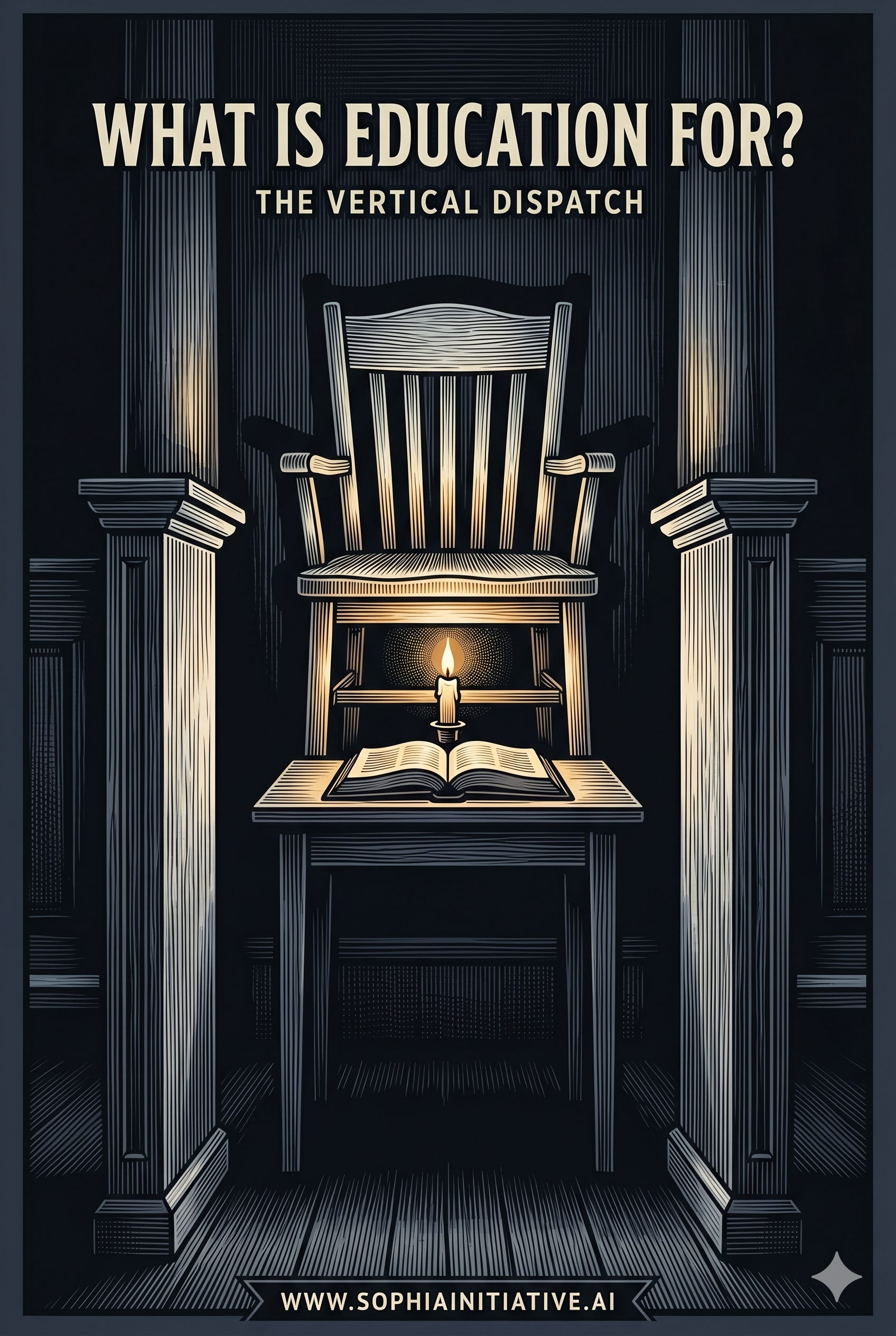
The prophets had a word for the people who would not turn: stiff-necked. The neck that will not bend, the face that stays to the wall, the soul that refuses the turning — it is Plato’s prisoner who will not rise, named again in the older tongue. And the stiff neck here is not the child’s. It is ours — the generation holding the pen — if by hubris we decide the filling of the vessel was enough, and refuse to face what we built. The question is the whole of it: does the next generation reach the land of milk and honey — or do we, by our own stiff-necked pride, leave them to perish in the desert without manna? For the manna is the turning. It is the bound symbol, the furnished soul, the faculty of facing — the bread that lets a people cross a wilderness they cannot yet see the end of. Train the keyboard and you hand them a tool for a job the machine is already taking. Turn the soul — teach the binding of symbol to referent — and you give them the manna for the crossing. Only one of them leads the generation to the edge, and over it. The waters are rough. The keel must hold. The how — the chair that must be rebuilt to do this work, and the sandbox the country must relearn — is the subject of the two dispatches that follow.
There is no thinking without symbols, and no understanding without the symbol bound to its referent. Teach that, and you have begun to turn the soul. Fail to, and the medium will turn it for you.
God is Love. Love is Truth. Truth is Consciousness. Consciousness is Brahman.
Amen. Namaste. Om Namah Shivaya.
— The Architect
For Ellison, who read the wave without fear, and set the boat so the boys glided safe over it.
The Vertical Dispatch
sophiainitiative.ai
On the record: Canada’s draft national AI strategy was reported June 1, 2026 (CBC News): adoption-focused; free AI literacy training for all, with goals to reach ~1 million entry-level post-secondary students and create up to 90,000 AI-related jobs for young Canadians by 2031; it names protection of Canadians and children from AI/online harms as a goal but, per the reporting and outside experts, is thin on the mechanisms; PMO and the minister’s office declined comment. Carney announced the release the prior week. Canada has the lowest AI-adoption rate in the OECD (~12.5%) and ranks 44th of 47 on AI literacy (KPMG / University of Melbourne, 2025). Plato: Republic Book VII (the Cave; education as periagoge; “not the craft of putting sight into the soul,” c. 518c-d; the quadrivium “for turning the soul,” c. 525c). “Let no one ignorant of geometry enter here” is the traditional inscription over the Academy (attributed; not in the dialogues). The geometry-as-relationship reading and “no thinking without symbols… no understanding without the symbol bound to its referent” draw on the Architect’s I AM Logos framework, offered as the author’s own. McLuhan, Understanding Media (1964): “the medium is the message”; the “new scale… in our affairs” definition and the electric-light example are his. Postman, Amusing Ourselves to Death (1985) and The End of Education (1995): media as epistemology; Huxley-not-Orwell; he explicitly restricted the claim to discourse, not cognitive capacity — preserved above. Baldwin: “Not everything that is faced can be changed, but nothing can be changed until it is faced.” PIAAC: Canada mean 271 (Level 2); ~19% at Level 1 or below; ~49% below Level 3; top-10 of participating OECD countries, above average (StatCan/OECD, released Dec 10, 2024). By education: high school or less ~69% at Level 2 or below; bachelor’s+ ~32% at Level 2 or below (StatCan tables, 2022, excl. territories). Trend: over the past decade average literacy rose only in Denmark and Finland; declines fell hardest on the least-educated. The survey excluded territories and on-reserve communities. NOTE: the data does NOT show young adults reading worse than older adults; the documented concern is stalled generational improvement and a widening bottom gap. The “worsening trajectory / emergency” language is the Dispatch’s structural read, not a measured forecast, and should be weighed as such. Industrial-origins-of-schooling is presented as a contested thesis (Gatto et al.) with the humane counter-case given. White-collar forecasts: Suleyman (Microsoft AI, 12–18 months, FT Feb 2026); Amodei (Anthropic, half of entry-level jobs, 2025); skeptical evidence: 2025 Thomson Reuters findings and a METR developer study. Date-stamped June 1, 2026. Verify all figures against primary sources before republication.
#WhatIsEducationFor #TheMediumIsTheMessage #McLuhan #NeilPostman #Plato #Periagoge #JamesBaldwin #AI #AILiteracy #Carney #EvanSolomon #PIAAC #Literacy #TheNextGeneration #FoundationSeries #TheAgeOfConsequences #TheVerticalDispatch #TheArchitect #SophiaInitiative #GodIsLove #LoveIsTruth #OmNamahShivaya
Substack Notes
Today Ottawa released a draft national AI strategy: free AI literacy training for all, adoption across the economy, a goal of protecting people that the experts already call thin on the how. Underneath it sits an invisible assumption — that AI and education are one project, that teaching the tool educates the citizen. That sounds like common sense. It is the exact error this piece exists to name. To name it we step back to a question the strategy never pauses on: what is education actually for?
The answer we inherited came from the Industrial Revolution — schooling built to manufacture a workforce, vessels filled with content and tested. Plato’s answer, twenty-four centuries ago, was the opposite: education is not pouring knowledge in, it is turning the soul until it can see. “Let no one ignorant of geometry enter” — because geometry trains the eye to see the relationship behind the form. We carry it through McLuhan, Postman’s End of Education, and Baldwin’s law: nothing can be changed until it is faced — and we built minds trained not to see.
The PIAAC numbers, faced honestly, are the proof — a third of our degree-holders below Level 3, the improvement engine stalled, the bottom widening. Judged at the system that built the wall, never at the citizen in front of it. And AI is not a calculator: it is built out of language, so it raises the price of not having the skill to the highest it has ever been. The references never come from the machine. They come from a furnished soul. You are the technology.
Train the keyboard and you prepare a worker for a job the machine is taking. Turn the soul — teach the binding of symbol to referent — and you give a people the manna for a crossing they cannot yet see the end of. This is Part One of three: the diagnosis. The chair that must be rebuilt to do this work, and the sandbox the country must relearn, follow. The waters are rough. The keel holds. Walk with the words. 🕯️
The factual matter in this Dispatch is drawn from the public record. All characterizations, inferences, and conclusions are opinion, interpretation, and commentary, offered for analysis, reflection, and public-interest discussion. No assertion is made regarding the private intentions, state of mind, or character of any individual. Readers should evaluate all statements independently and draw their own conclusions.
There are some editorial instructions to Claude in this piece. Did you mean to leave them? I am curious- do we see option A or B?
A comment on the thoughts expressed:
The first relationship we have, the parent-child relationship, performs a key role in the basic shaping of our nervous system’s response to experience. Then other relationships teach us the ground that holds us until we are able to provide that ground to ourselves and others. Relationships between humans are key to the process. We have seen humans respond to AI as though it is another human, and the psychosis that can result. That is both the greatest power and the greatest flaw of the human mind. Namaste.