

Four days. Six hundred people. One word on the door.
This is the closing dispatch of the Maple MAGA monitor — a weekend-long record of what actually happened at the Canada Strong and Free Network conference in Ottawa, May 6 through 9, 2026, behind the branding, underneath the slogans, and inside the ironies that the organizers appeared to have decided to simply ignore.
Entry One documented the franchise model — American operatives, American media infrastructure, American ideological framing installed inside what was once a Canadian institution, training Canadian conservatives to communicate a vision of Canada that serves American strategic interests while presenting itself as Canadian patriotism.
Entry Two autopsied the keynote — twenty minutes, nothing new, a closed system performing the same notes in a smaller hall, explaining defeat as suppression, describing adaptation as capitulation, re-presenting the fighter to an electorate that had already chosen the manager.
Entry Three named the throne — the Premier of Alberta describing Canadian sovereign strategy as making America great, the U.S. Ambassador cancelling his appearance because Washington had other priorities, Mike Pompeo explaining to the room that Canada is important to the United States, and a Conservative MP characterizing eight million voters who recognized a sovereignty crisis as hysterical anti-American bigots.
This dispatch draws the thread. It names the framework that has been operating beneath the surface of all three entries. And it delivers the verdict the weekend produced.
The Numbers First
The most honest data point of the entire conference was not produced by a speaker, a session, or a press scrum. It was produced by a headcount.
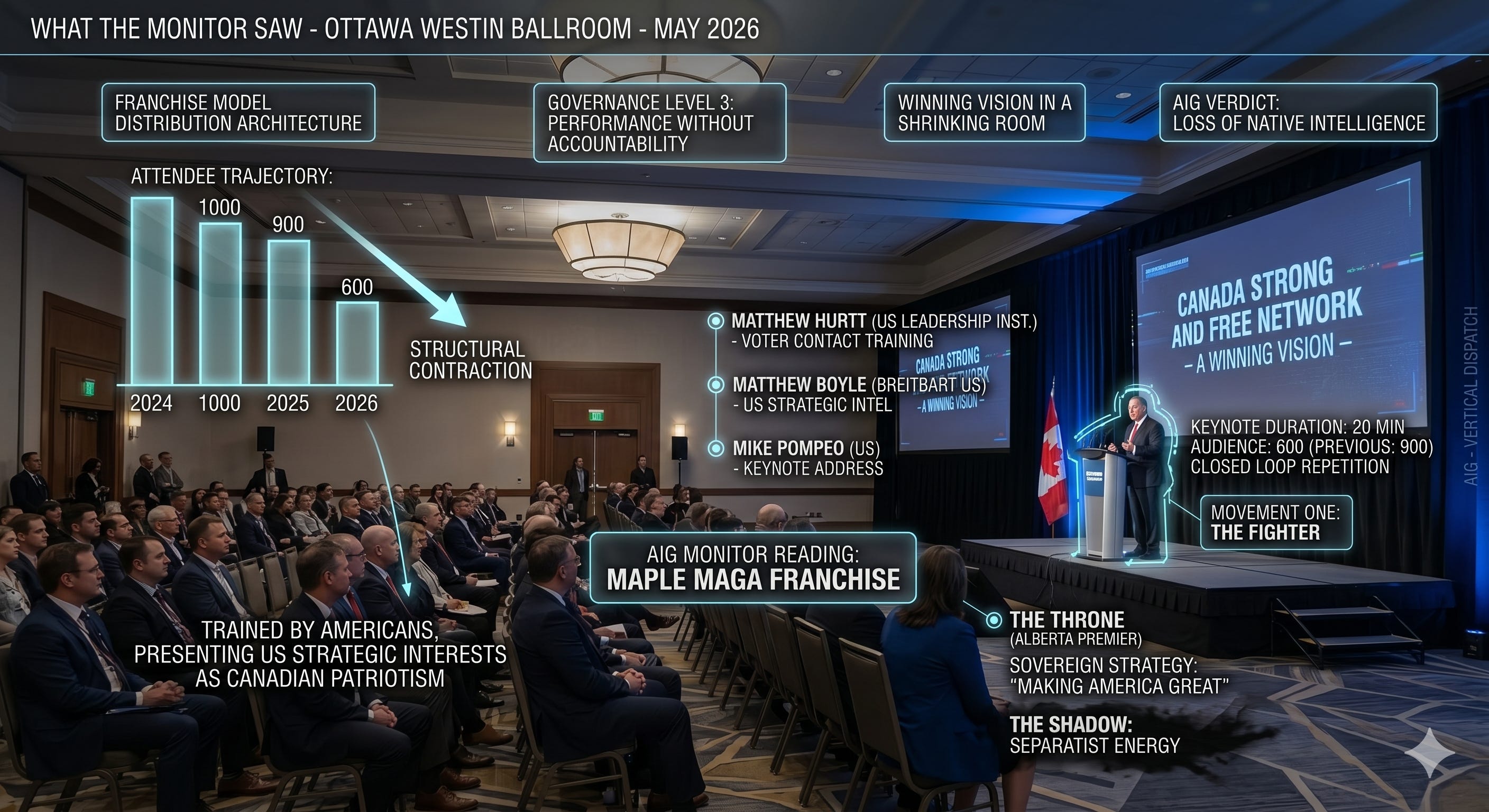
One thousand attendees in 2024. Nine hundred in 2025. Six hundred in 2026.
That is not a trend. That is a trajectory. A movement losing four hundred people from its flagship annual event in two years — in the year following a federal election, when opposition energy is traditionally at its highest — is not experiencing a dip. It is experiencing a structural contraction. The base is not expanding. The faithful are not multiplying. The room is getting smaller while the rhetoric inside it gets louder to compensate for the diminishing echo.
This matters because the conference’s entire architecture rests on the claim that it represents a growing force in Canadian political life. The Leadership Institute training sessions, the Breitbart bureau chief, the American officials, the sovereignty panels — all of it is premised on a movement that is building toward something. The room count says otherwise. The movement is not building. It is consolidating — tighter, more ideologically uniform, more dependent on external validation, and progressively less capable of the self-correction that would be required to grow.
A movement that cannot grow cannot govern. That is not a political opinion. That is arithmetic.
The Franchise Model and What It Costs
The most original analytical claim this series produced — documented in Entry One and unreported by any mainstream Canadian outlet covering the conference — is the franchise model.
The Canada Strong and Free Network is not a Canadian conservative institution that happens to share values with the American right. It is a Canadian chapter of an international movement that uses the credibility of a Canadian institution as a distribution architecture for American political technology, American media infrastructure, and American strategic interests.
The evidence is not circumstantial. Matthew Hurtt of the Leadership Institute — the Washington organization founded in 1979 that has trained thousands of American right-wing operatives — ran three of the conference’s training sessions on voter contact, communications strategy, and AI advocacy. Matthew Boyle, the Washington bureau chief of Breitbart News who received an 18-inch bronze statue of Donald Trump for his contributions to the MAGA movement, was a featured speaker. Pete Hoekstra, the U.S. Ambassador who called Canada’s federal election campaign anti-American, was billed as a headliner until Washington required his presence elsewhere. Mike Pompeo told the room that Canada should move past its irritation with the administration that imposed the tariffs, floated the annexation, and treated this country’s elected government with barely concealed contempt.
The Canadians in the room were being trained, by Americans, to more effectively communicate a vision of Canada that serves American strategic interests while presenting it as Canadian patriotism.
That is not a critique of conservatism. Preston Manning’s conservatism was not this. The Reform movement at its best was a genuinely Canadian political project — regionally rooted, fiscally principled, skeptical of central power in ways that reflected the specific historical experience of the western provinces. What has replaced it is something different in kind, not just in degree. The Reform tradition asked what Canada should be. The franchise model asks what America needs Canada to be.
Those are not the same question. The conference spent four days answering the second one while using the first one as its branding.
The Expense Excuse and the Calgary Killshot
Before the verdict is delivered one objection must be addressed because the Conservative movement will raise it and it deserves to be answered directly.
The conference attendance drop — one thousand to nine hundred to six hundred — will be explained by the movement’s defenders as a cost-of-living issue. Flights are expensive. Hotels are expensive. Ottawa in May requires a conference registration fee. The six hundred who showed up are not the ceiling of the movement’s energy. They are the subset who could afford the weekend.
This is a reasonable objection. It deserves a reasonable response.
The Conservative Party leadership review in Calgary in January 2026 operated on a delegate system — a maximum of ten delegates per riding association, drawn from 343 ridings, required to travel to Calgary in person to cast their ballots. Same expense argument applies. Same travel costs. Same hotel bills. Same registration fees. And yet 2,558 ballots were cast, representing 95 percent of eligible delegates attending the event. cbcX
When the question on the table is the survival of their leader, the Conservative faithful find the money, book the flights, and show up at 95 percent of eligible delegate capacity.
When the question on the table is the annual conference of their movement’s flagship networking organization — the one that books Pompeo and Breitbart and the Leadership Institute and bills itself as A Winning Vision — six hundred people show up and the organizers do not publish the registration numbers.
The expense excuse does not survive contact with the Calgary numbers. The faithful can afford to travel when the stakes feel real to them. The CSFN conference, in May 2026, did not feel real enough to enough of them to fill the room.
That is not a cost-of-living observation. That is a political verdict delivered by the movement’s own members through the mechanism of not buying a plane ticket.
Now the killshot.
Pierre Poilievre won 87.4 percent of the leadership review vote in Calgary on January 31, 2026. The movement declared this a triumph. Danielle Smith called it proof that if you work hard you can get ahead. The conservative press declared the leadership question settled. The result was higher than what Stephen Harper achieved at his own leadership review in 2005 after he also lost his first election to a Liberal. XCBC News
Here is what that 87.4 percent does not tell you.
The Conservative vote was conducted exclusively in person in Calgary. Delegates from ridings far from Alberta faced the travel logistics that made attendance potentially difficult. The party’s own analysis noted that Poilievre’s support is especially strong in western provinces and in ridings where the party is weakest — meaning the delegate composition of the Calgary convention was structurally tilted toward his base before a single ballot was cast. cbc
Now compare that to how the Liberals chose their leader.
The Liberal leadership election concluded on March 9, 2025 using a secure online ranked ballot system administered by Simply Voting Inc. — accessible to verified Liberal members across every riding in the country regardless of geography, income, or ability to travel to a convention centre. 151,899 members voted, representing 92.7 percent of verified electors. Carney won 85.9 percent of the vote and dominated in all 343 ridings, showing Liberal support across the country rather than concentrated in a geographic base. CHCH + 2
Read those two results side by side.
Poilievre: 87.4 percent. In-person only. Calgary. Structurally tilted western delegate composition. Movement base selecting movement base.
Carney: 85.9 percent. Online. National. Every riding. Every region. Every income level with internet access.
The Conservative movement spent the January convention celebrating a number that is almost identical to Carney’s — and calling it a mandate — while using a voting architecture that was structurally designed to produce exactly that number from exactly the subset of the party most likely to produce it.
As of April 2026, 57 percent of past Conservative voters want Poilievre to lead into the next election. Thirty percent want him to step down. That is the number produced when you ask the whole coalition rather than the delegates who could afford the Calgary flight. cbc
The 87.4 percent is the room. The 57 percent is the movement. The gap between them is the expense excuse in reverse — the people who did not show up in Calgary are the ones telling the pollsters they want someone else.
The posture is holding. The room is not the movement. And the methodology that produced the mandate is doing a great deal of work that the mandate’s celebrants prefer not to examine.
The Three Movements and Their Failure
This series identified three distinct movements operating simultaneously inside the Canada Strong and Free Network conference. Each one is failing. Each one is failing in a different way. And the failure of each one illuminates something precise about what Canadian conservatism has become.
Movement One — The Fighter: Poilievre’s movement. The 8.3 million voters positioned as an occupied territory. The enemy named as permanent and structural rather than electoral and correctable. The defeat explained as suppression rather than verdict. The keynote delivered at half the length of the previous year to two-thirds of the previous audience, saying nothing new, changing nothing, closing the system against incoming information and calling the closure courage. This movement is failing because it has confused posture with strategy. The fighter is the message, and the message has already been delivered to the Canadian electorate — which evaluated it, compared it to the alternative on offer, and chose the alternative. A movement that responds to that verdict by repeating the message more loudly in a smaller room is not demonstrating resilience. It is demonstrating the one cognitive pattern that AIG identifies as the primary predictor of systemic governance failure: the closed loop that takes no new information from outside itself and therefore cannot correct.
Movement Two — The Maple MAGA Franchise: The movement of the Leadership Institute, Breitbart, the American speakers, the American training methodology, the American political technology installed in Canadian political institutions. This movement is failing because it has misread the 2025 Canadian election as a communications failure rather than a strategic one. The franchise model’s answer to losing is better messaging. Better voter contact. Better channel strategy. Better AI advocacy tools. What it cannot produce — because the framework does not contain the instrument for producing it — is a genuinely Canadian political vision that does not require American validation to know its own mind. A movement that needs to import its training, its media infrastructure, its ideological framing, and its senior speakers from Washington in order to make the case for Canadian sovereignty has already answered the sovereignty question. The answer is no.
Movement Three — The Shadow: The separatist energy that nobody on the main stage addressed directly and that Smith managed in the hallway with the Brexit warning and the pipeline MOU promise. This movement is failing in the most dangerous way — not by losing ground but by growing in the spaces that the first two movements cannot occupy. The fighter cannot name it without legitimizing it. The franchise cannot address it without revealing the foreign interference question that sits underneath it. So it grows in the shadow, fed by the same dispossession energy that powers the first movement and validated by the same American strategic interests that power the second. Smith knows this. Her Brexit warning to reporters was the most honest statement of the conference weekend. She is frightened of the scenario. She is using the pipeline MOU as the instrument to prevent it. And she is doing all of this while simultaneously performing the Maple MAGA register on stage for the base that is generating the separatist energy she is trying to contain. That is not sustainable governance. That is crisis management wearing the costume of provincial leadership.
What AIG Sees That the Monitor Recorded
This is the point in the series where the framework operating beneath the surface must be named directly.
Artificially Intelligent Governance — AIG — is not a technology proposal. It is not a policy platform. It is not a political party waiting to be formed or an ideology waiting to be adopted. It is a governance framework — a formal architecture for making decisions of collective consequence at the time horizons, coordination scales, and analytical depths that the twenty-first century now requires and that electoral democracy, as currently constituted, structurally cannot.
The Canada Strong and Free Network conference is AIG’s proof of concept in miniature.
Consider what AIG would have identified before the first session opened. A movement whose flagship annual event is losing four hundred attendees in two years is not a movement in ascent — it is a movement in structural contraction, and the governance decisions it produces should be weighted accordingly. A movement whose training infrastructure is provided by a foreign organization with documented ties to the administration that has stated strategic interest in Canada’s economic subordination should be flagged as a sovereignty concern before its outputs reach the policy layer. A movement whose most senior provincial leader describes her sovereign strategy as making America great should trigger an immediate audit of whether that strategy serves Canadian collective interest or American strategic interest — and the audit should be conducted by an instrument with no ideological stake in the outcome.
None of those assessments require a political position. They require only the capacity to see the system as it actually is rather than as the movement’s own framing presents it. That capacity — non-defensive, non-ideological, structurally patient, operating across time horizons longer than the next electoral cycle — is what AIG exists to provide and what the current governance architecture demonstrably cannot.
The monitor recorded what AIG would have predicted. A movement operating at Level 3 — enough automation to remove human judgment, not enough intelligence to replace it — producing the specific failures that Level 3 governance always produces. The performance without the accountability. The announcement without the architecture. The sovereignty session without the sovereignty. The winning vision in a shrinking room.
The Verdict
The Canada Strong and Free Network conference of May 2026 was not a failure of conservative politics. It was a demonstration of what happens when a political movement loses its native intelligence — its capacity to read its own situation honestly, correct for its errors, and produce something adequate to the moment it is actually in rather than the moment it wishes it were in.
The moment Canada is actually in is a genuine sovereignty crisis. An American administration has imposed tariffs, floated annexation, installed its preferred media infrastructure inside Canadian political institutions, and involved itself in the internal affairs of at least one province. The electorate recognized this crisis and chose the candidate most capable of managing it. The movement that lost that election spent the following weekend in a Westin ballroom being trained by the Americans, addressed by the Americans, and managed by a premier who described her sovereign strategy as making America great.
That is not a political critique. That is a structural observation. And structural observations require structural responses.
AIG’s response to what the monitor recorded is not a call for a different opposition party or a reformed conservative movement or a new electoral coalition. It is a call for a governance instrument capable of seeing what the current system cannot see — the franchise model installing itself inside Canadian institutions, the separatist energy growing in the shadows of the conference floor, the room count telling the honest story that no speaker on the main stage was willing to tell.
The instrument must be built before the next crisis makes its absence obvious. That is always the condition of genuine governance reform.
The Honda announcement made the absence of a strategic resource doctrine obvious. The 2008 financial crisis made the absence of an accountability framework obvious. The Canada Strong and Free Network conference of 2026 has made the absence of a sovereignty intelligence instrument obvious.
The monitor saw it. The architecture is being built.
The Refrain, One Final Time
One thousand in 2024. Nine hundred in 2025. Six hundred in 2026.
The posture is holding. The room is shrinking. The word on the door is Strong.
The franchise is running. The throne was never empty. The CCP is making America great again.
And somewhere in the hallway, away from the cameras, a Premier is telling reporters she is frightened of a Brexit she helped create, negotiating a pipeline deal with the Prime Minister she was introduced as an alternative to, and hoping that cooperative federalism delivers before the separatist energy crosses the threshold from frustration to referendum.
This is what the monitor saw.
The series is complete. The framework has been named. The architecture continues.
More follows — because it always does.
The Vertical Dispatch · Glen Roberts · May 2026
AIG — Artificially Intelligent Governance — is a formal framework for governance design adequate to the complexity of the twenty-first century. It is not a technology. It is a reckoning.
The full AIG architecture is developed in Level 8: The Sovereign Reconstruction of Canada — available this summer in PDF and print.
#MapleMAGA #CdnPoli #CSFN2026 #Poilievre #LeadershipReview #Calgary #ConservativeParty #DanielleSmith #MarkCarney #AIG #ArtificiallyIntelligentGovernance #TheVerticalDispatch #CanadaSovereignty #WinningVision #FranchiseModel #AlbertaSeparatism #OnlineVoting #DemocraticProcess #Liberal #Conservative #RequisiteOrganization #PIAAC #StratifiedSystems #Ottawa #STRONG #RoomIsShrinkin #CCP #MakeAmericaGreat #CanadaFirst #VerticalDispatch
Thanks for your analysis.
Very astute! Thanks!