

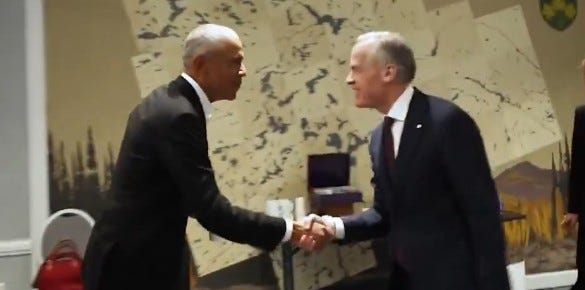
On Friday May 8 2026, Prime Minister Mark Carney posted a message welcoming the former president to Canada: ‘Welcome back to Canada, President Obama. Thank you for joining us in Toronto for important conversations on how we can build a better and more just future — and empower more people to build with us.’
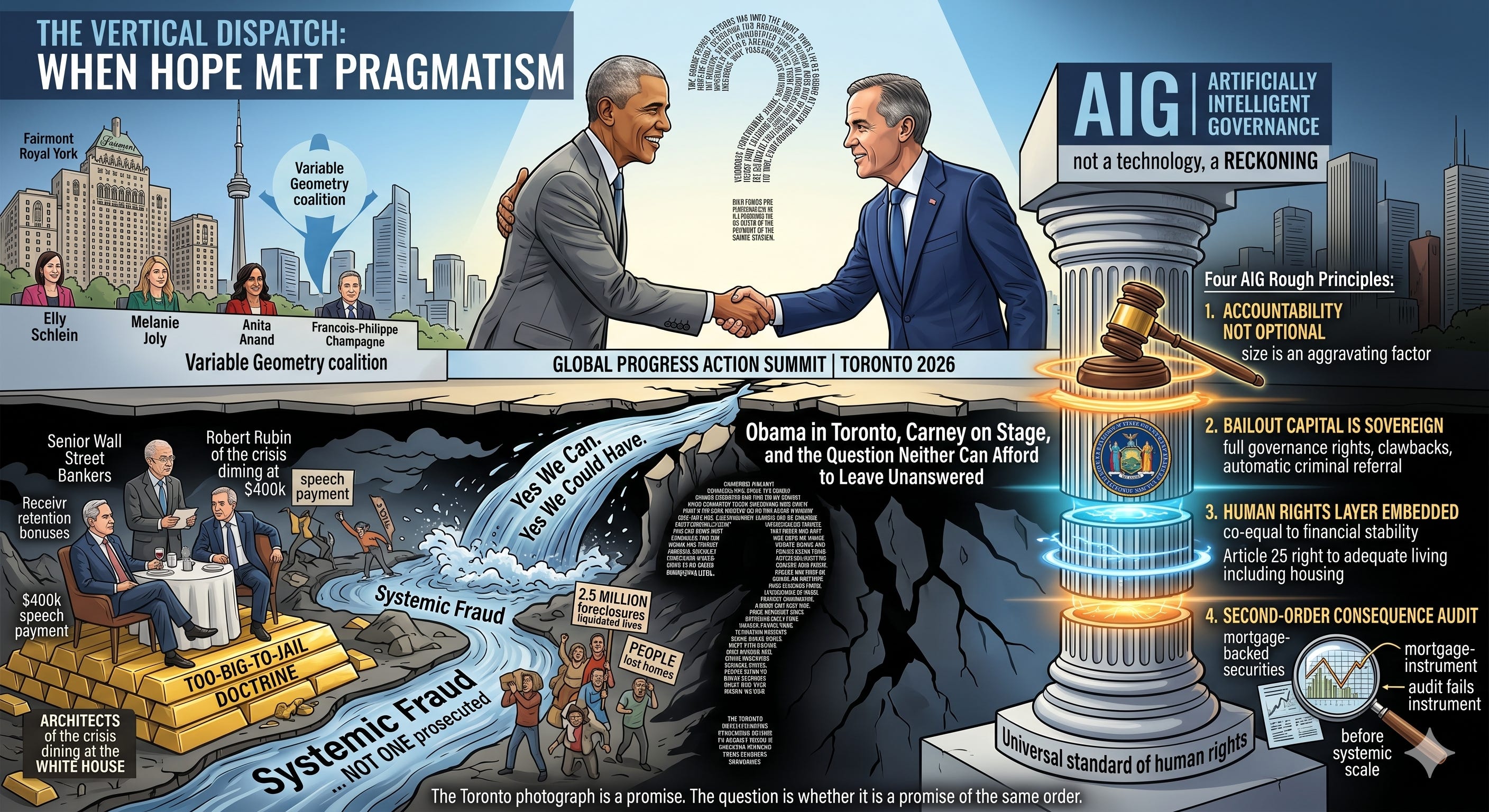
The photograph that accompanied it was exactly right. Two men who understand what the current moment requires, standing together in the city that hosted the Global Progress Action Summit — a day-long event focused on economic security, democracy, and global cooperation, co-hosted by Canada 2020 and the Center for American Progress Action Fund. Political leaders from around the world gathered with the explicit aim of building an international network of progressive and democratic forces against those who seek to dismantle the world order by delegitimizing multilateral forums.
The optics were clean. The symbolism was deliberate. The photo will travel.
And then the question underneath the photograph asserts itself — the one the image cannot answer and that this dispatch will not avoid.
The last time Barack Obama stood beside a Canadian Prime Minister on this scale and offered this kind of symbolic weight to a progressive political project, he said two words that became the most consequential political promise of the twenty-first century.
Yes we can.
The question the Toronto photograph raises — not as an attack, but as an analytical obligation — is whether the hope Obama carried into that room in 2008 was honoured by what his administration did when the moment of maximum consequence arrived. And what happened to the people who believed him when it was not.
The Meeting and What It Signals
The Global Progress Action Summit featured Prime Minister Carney alongside several federal cabinet ministers including Industry Minister Melanie Joly, Foreign Affairs Minister Anita Anand, and Finance Minister Francois-Philippe Champagne. Obama delivered the keynote at Canada 2020’s gala at the Fairmont Royal York. The Italian Democratic Party secretary Elly Schlein flew from Rome specifically to attend, describing the summit’s purpose as building democratic power against those dismantling the world order.
This is not a think-tank event. This is the early architecture of the post-American-hegemony coalition that Carney described at Davos in January — the variable geometry of middle powers, progressive governments, and democratic institutions that need to function without Washington as their guarantor. Carney told Davos that middle powers are no longer just relying on the strength of their values, but also the value of their strength — building strategic autonomy while maintaining commitment to human rights, sovereignty, and territorial integrity.
Obama’s presence at this summit is not ceremonial. A Stratum VI to VII mind does not attend day-long summits for the photograph. He is consulting. He is contributing the one thing no other figure in that room can contribute — the institutional memory of having built the multilateral architecture that is now under assault, having held the relationships with Global South leaders that Carney and Stubb have identified as the swing territory of the coming world order, and having learned — at the highest possible cost — what happens when the progressive promise encounters institutional resistance and flinches.
That last point is the one the Toronto photograph cannot show. And it is the one this dispatch must name.
Yes We Can. Yes We Could Have.
A reader commenting on the LinkedIn post of Carney’s Davos speech transcript wrote something that stopped the thread: ‘We have Trump because Obama made us believe yes we can — only the reality was yes we could have. Big Now or Never moment.’
That is not a partisan observation. That is a precise historical diagnosis stated in eight words. And it deserves the full analytical weight the Vertical Dispatch can bring to it.
Barack Obama entered the presidency in January 2009 with the largest democratic mandate for structural change any American president had received since Franklin Roosevelt in 1932. The financial system had just committed the most documented act of systemic fraud in modern economic history. 2.5 million home foreclosures between 2007 and 2009 liquidated working and middle class bank accounts, destroyed lives, and spread what one observer called a plague of misery and despair throughout the American body politic. The people who lost those homes were the people who had voted for hope and change.
Financial institutions were kept afloat with wads of federal government cash while ordinary citizens caught in predatory mortgage schemes were left to drown.
And then the accounting arrived. Or rather — it did not.
Not a single arrest or prosecution of any senior Wall Street banker for the systemic fraud that precipitated the 2008 financial crisis was brought by the Obama Justice Department. The Financial Crisis Inquiry Commission — Obama’s own government panel set up specifically to investigate the Wall Street meltdown — referred top bankers, CEOs, and former government officials to the Department of Justice for possible criminal prosecution. Not one was prosecuted.
The referrals included former Citigroup chairman and Treasury Secretary Robert Rubin, cited for potential criminal prosecution for knowingly defrauding the bank’s investors by lying to them about the extent of Citigroup’s exposure to the subprime mortgage crisis. The SEC settled with Citigroup for a civil penalty of $75 million. Rubin did not see a courtroom.
Obama and his administration burned up most of their political capital rescuing the banks from a crisis caused by their own mistakes. The terms offered to the nine biggest banks were exceedingly generous — as a shareholder the government would not exercise its right to vote on the management of their companies, required dividends were low, and it would seek no changes of management or limits on bonus payments except for CEOs.
The government became a shareholder in the banks that had committed the fraud and voluntarily surrendered its shareholder governance rights. A constitutional law professor signed that arrangement. The people who had lost their homes watched it happen.
Financial elites were not only vested with impunity for their fraud but thrived as a result of it. As Harvard law professor Larry Lessig put it: ‘We live in a world where the architects of the financial crisis regularly dine at the White House.’ The architects of the financial crisis. Dining at the White House. Of the man who ran on hope and change.
Did People Stop Believing?
Your question — did people stop believing in hope after no one went to jail and many took big cash sums when money was put into the system — is the most important political question of the last twenty years. And the documented record answers it with precision.
A veteran financial reporter whose investigation of Wall Street’s crisis-era practices won a Pulitzer Prize stated plainly: ‘If they had prosecuted, the history of the country would be different. We would think of the financial crisis differently, think of the Obama administration differently. There would be a sense that the government was legitimate. There would be a sense of accountability after the crisis, the reforms would be tougher.’ And then he added: ‘I don’t think we would have Donald Trump as president.’
Yes. People stopped believing.
Not all at once. Not in a single moment. It happened the way the Ernest Hemingway character describes going bankrupt — gradually, then suddenly. The working class voter who had lost their home in 2009 while watching the bank CEO receive a retention bonus watched Obama accept the Nobel Peace Prize while drone strikes expanded. They watched the Affordable Care Act pass and immediately face dismantling. They watched the recovery happen on Wall Street years before it reached their street. They watched the architects of the crisis give speeches at hundreds of thousands of dollars a time — including eventually Obama himself, who accepted $400,000 from Cantor Fitzgerald for a single speech in 2017, the year he left office.
The hope did not die in a single betrayal. It bled out through a thousand accommodations to institutional power that the man who promised structural change chose to make rather than fight.
And into that bleeding hope walked a man who said the system was rigged. He was right about the diagnosis. His cure was poison. But the diagnosis landed because Obama had proved it true by refusing to prosecute the people who had rigged it.
What AIG Would Have Required: Rough Principles for the Financial Layer
These are not finished governance instruments. They are the questions AIG would have demanded be answered before the first bailout cheque was signed in 2009 — and the questions it will demand be answered before the next financial crisis arrives. Because it is coming. The instruments that produced 2008 have not been dismantled. They have been renamed.
AIG Rough Principle One — Accountability Is Not Optional at Any Institutional Size: The too-big-to-jail doctrine is not a legal conclusion. It is a governance choice. AIG would embed a structural inversion of that doctrine at the regulatory certification layer: the larger the institution, the more stringent the personal criminal accountability framework for its senior officers. Size is not a shield. Under AIG it is an aggravating factor. The CEO of an institution whose failure can produce 2.5 million home foreclosures carries a proportionally higher personal accountability standard than the owner of a corner bank. That principle requires no new law. It requires a governance framework that refuses to treat institutional scale as immunity.
AIG Rough Principle Two — Bailout Capital Is Sovereign Capital and Carries Sovereign Conditions: Sovereign capital deployed in a systemic crisis carries non-negotiable conditions: full governance rights over compensation, mandatory clawback provisions on bonuses paid in the three years preceding the crisis event, and automatic criminal referral for any officer who certified the institution’s financial health to regulators in the 24 months before the bailout was required. The capital saves the institution. The conditions save the system. A government that surrenders its shareholder rights upon becoming a shareholder has not protected the public. It has protected the people who required the protection of the public.
AIG Rough Principle Three — The Human Rights Layer Must Be Embedded Before the Financial Layer Is Stabilized: The UN Universal Declaration of Human Rights Article 25 establishes the right to an adequate standard of living including housing. A governance framework operating on that prior — as AIG does, grounded in the universality clause that no confessional or ideological tradition can be privileged above the universal — would have required that the foreclosure crisis be addressed at the same priority level as the institutional solvency crisis. Not after. Simultaneously. The banks were stabilized in weeks. The homeowners waited years. That sequencing was a governance choice not an economic necessity. AIG would not permit that sequencing. The human rights obligation is co-equal with the financial stability obligation. It is not downstream of it.
AIG Rough Principle Four — No Financial Instrument May Reach Systemic Scale Without a Second-Order Consequence Audit: The mortgage-backed securities and credit default swaps that produced 2008 were not illegal. They were unaudited for systemic consequence. AIG would require — at the regulatory certification layer before any new financial instrument reaches systemic scale — a structural consequence audit conducted by an independent body with no relationship to the institution proposing the instrument. The audit asks Postman’s question applied to finance: what is the problem to which this instrument is the answer? And whose problem is it? If the honest answer is that the instrument solves the bank’s margin problem by transferring risk to parties who cannot accurately assess it — the audit fails the instrument. It does not reach systemic scale.
These are rough principles. They will be developed with precision in the AIG framework as it matures. They are offered here as what they are — the first sketch of what non-ego, non-bias governance operating on the prior of universal human rights would have demanded in 2009 and will demand again when the next institution is too large to fail and its officers are standing in whatever room power is conducted in, waiting to learn whether accountability is optional at their scale.
It was optional in 2009. That answer produced this decade.
AIG proposes a different answer. The sketch is above. The architecture follows.
What the Toronto Photograph Means Now
None of this diminishes what Obama brings to the Toronto summit. The Stratum VI ceiling is real. The intellectual formation is genuine. The global relationships are irreplaceable. The values-based realism that Carney and Stubb are building needs the credibility that Obama’s presence confers — the signal to the Global South that the progressive multilateral project has continuity and seriousness.
But the photograph also carries a warning that Carney needs to hear more than he needs the applause.
A reader compared Carney’s Davos speech to Obama’s. It is a genuine comparison. The rhetorical register is similar. The intellectual formation is comparable. The mandate for structural change is real. And the risk is identical.
Someone already wrote it in the comment thread: ‘We have Trump because Obama made us believe yes we can — only the reality was yes we could have.’
AIG’s reading of this moment is direct. The promise of governance reform is not the governance reform. The speech is not the structure. The photograph is not the accountability. What separates Carney from Obama’s fate is not the quality of the vision — the visions are comparably serious. What separates them is whether the governance instruments that Carney is building are applied with the structural consistency that Obama’s were not.
Obama said yes we can and then protected the people the system needed to be protected from.
The Toronto photograph is a promise. The question is whether it is a promise of the same order — genuinely meant, intellectually serious, and ultimately subordinated to the institutional resistance that every Stratum VI mind encounters when it tries to operate at Stratum VII.
Hope arrived in Toronto on Friday. It shook hands with pragmatism. The photograph was excellent.
What happens next is the only thing that matters.
The Vertical Dispatch · Glen Roberts · May 2026
AIG — Artificially Intelligent Governance — is a formal framework for governance design adequate to the complexity of the twenty-first century. It is not a technology. It is a reckoning.
#AIG #ArtificiallyIntelligentGovernance #TheVerticalDispatch #Obama #MarkCarney #GlobalProgressActionSummit #Toronto #Canada2020 #HopeAndChange #2008FinancialCrisis #WallStreet #TooBigToJail #EricHolder #RobertRubin #Citigroup #BailoutNation #UniversalHumanRights #UNDHR #StrategicAutonomy #ValueBasedRealism #MiddlePowers #RequisiteOrganization #StratifiedSystems #PIAAC #NeilPostman #CdnPoli #CanadaSovereignty #Trump #DemocraticRenewal #VerticalDispatch
There were a lot more betrayals by Obama than the Wall Street one. Carney loses credibility with me just for inviting Obama here. Intellect has never been enough by itself, and I know from reading you that you know that. Beyond that, I agree with your statements.
If we want to see ahead 50 years, we need to be able to look back 50 years and understand what was about to happen. The United States could not afford a minor war. Could not control oil prices. Could not compete with Germany and Japan in core industries, like steel and automobiles. Could not prevent the corruption of the GOP. This was the pivotal decade. This was the end of Pax Americana, and the beginning of financialization - the looting of the pension funds, the suppression of wages … this is what got us here. Not Clinton. Not Bushes. Not Obama or Biden. Carney, I believe, knows this. Central Bankers know this, now. Even Greenspan.
The Carney photo-op with Obama was multi-faceted - more about looking forward than backward. Central Bankers know very well the lessons of the GFC. Those lessons were applied very effectively during the Covid disaster. Carney needs to talk to the remnants of the Democrats. Obama’s rhetoric still resonates, despite his inability to reign in the bankers.