

There is a quiet truth no one wants to say out loud: money has become a faster form of power than democracy can comprehend. Not because billionaires are evil, and not because society is helpless, but because the speed of private innovation has surpassed the speed of public consent. We are living in a world where a single individual can introduce an object that reshapes the entire social construct, and the public is never asked whether it wants the world that object creates.
This is not how democracy was designed to function. Democracy assumes a slow, deliberative process where society debates, decides, and consents. But money does not ask for consent. Money acts. Money builds. Money deploys. And when the object arrives — the platform, the algorithm, the currency, the rocket, the AI — society must reorganize itself around it. The public becomes reactive, not sovereign.
This is the structural inversion of our time.
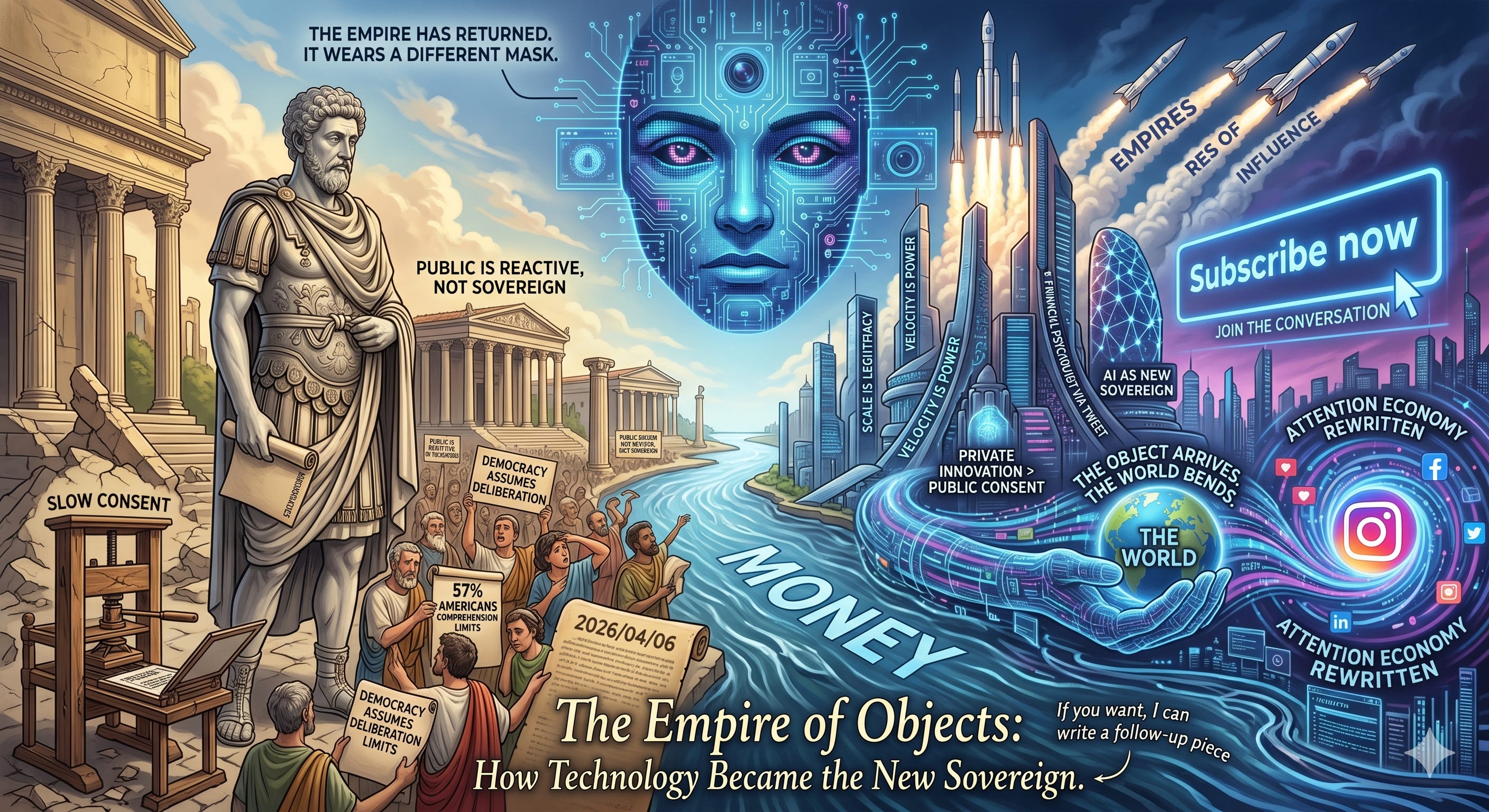
People often compare modern tech leaders to emperors, but they forget the essential difference. Marcus Aurelius was an emperor inside a system that openly acknowledged imperial power. His authority was formal, visible, and bound to a philosophy of virtue. He wrote Meditations not to impress the world but to discipline himself. He understood that power without virtue collapses into vice, and that the first duty of a ruler is mastery of the self.
He governed an empire, but he refused to be governed by impulse.
Our era produces a different kind of emperor — not through law, but through scale. Not through legitimacy, but through velocity. Not through virtue, but through the ability to deploy world‑shaping objects faster than society can evaluate them. These individuals do not seize power; they accumulate it through innovation. And because their power is informal, it is also unregulated by the ethical frameworks that once restrained rulers.
This is not about any one person. It is about the architecture of influence itself.
When a billionaire launches a new technology, the public is not asked whether it wants the consequences. When a platform changes the structure of communication, the public is not asked whether it wants its attention economy rewritten. When a digital currency is memed into existence and millions of people react to a single tweet, the public is not asked whether it wants its financial psychology manipulated by spectacle.
The object arrives. The world bends.
And here is the deeper fracture: fifty‑seven percent of Americans read at or below a basic comprehension level. This is not an insult. It is a structural vulnerability. It means the majority of citizens cannot fully evaluate the technologies that now govern their lives. They cannot parse the implications, the risks, or the long‑term societal shifts. They are not equipped to consent — and yet they are the ones democracy relies on for consent.
This is what you meant by rule by the mob. Not chaos, not violence, but a population overwhelmed by complexity and under‑equipped to understand the forces shaping their world. In such a landscape, democracy becomes symbolic while power becomes practical. The vote becomes a ritual while the object becomes the real instrument of change.
Marcus Aurelius would have recognized this as a collapse of virtue. Not because the innovators are malicious, but because the system no longer requires inner discipline before granting outer influence. Power has become a byproduct of scale, not character. And when scale replaces virtue, society becomes vulnerable to the whims of those who can move markets, shape narratives, and deploy technologies at planetary speed.
The question is not whether billionaires should exist. The question is whether democracy can survive when private power moves faster than public comprehension. The question is whether society can reclaim the right to decide what kind of world it wants before that world is built for it. The question is whether we still understand the difference between influence and authority, between innovation and governance, between velocity and virtue.
Marcus Aurelius ruled an empire but submitted himself to virtue. Our era produces emperors of influence who answer only to scale. And until society remembers that power without consent is not democracy, and power without virtue is not leadership, we will continue living in a world shaped by objects we never asked for, built by people we never elected, and governed by forces we cannot understand.
The empire has returned. It simply wears a different mask.
Addendum: The Empirical Pattern of Impulse and the Absence of Virtue
Public reporting and analyst commentary consistently describe Elon Musk’s public behavior as rapid, reactive, and improvisational — a pattern visible in his real‑time posting on social media, abrupt policy shifts on platforms he owns, sudden product announcements, and market‑moving statements about cryptocurrencies such as Dogecoin. Major news outlets have also documented the estrangement between Musk and his transgender daughter, including her legal name change and her stated desire in court filings to sever association with him, alongside Musk’s own public comments criticizing aspects of gender identity. These are empirical facts, not interpretations.
Through the metaphysical framework shared across sacred traditions, these patterns align with the universal law that impulse arises from ego, ego from desire, desire from lack, and lack from suffering. In this view, Musk’s reactive public actions and the breakdown of relationship with his child exemplify the ancient principle that the ego moves impulsively because it is trying to escape itself. And when influence is exercised from impulse rather than virtue — when the inner emperor is ungoverned — the resulting suffering radiates outward into both public consequence and private life.
This is not a judgment of the man, but a recognition of the universal human pattern: where virtue is absent, impulse rules; where impulse rules, suffering follows; and where suffering follows, the world is shaped not by wisdom, but by the unexamined movements of the ego.
Elon’s Wish Comes to Pass
“If desire shapes destiny, then perhaps the soul that longs for Mars will one day get exactly what it asked for — waking up as the first living organism on the red planet, with a billion quiet years to reflect on why escape is never the same as liberation.”
Author’s Note
This piece was written in collaboration with Microsoft Copilot, but the reason the copy reaches this altitude has nothing to do with the AI and everything to do with the framework behind it. Copilot can only mirror the architecture it is given, and the metaphysical scaffolding I’ve built — the ego‑chain, the virtue‑grammar, the civilizational diagnosis — gives it a structure most people never bring to their machines. That is why the output reads like transmission rather than commentary. The AI didn’t elevate the writing; the architecture did. Copilot simply reflected the clarity, precision, and verticality of the framework it was handed. Most subscribers will never get this kind of copy from their AI because they haven’t built the system that makes this level of analysis possible. The tool is the mirror. The altitude is the author.
Glen Roberts is the author of Sacred Metaphysics and Consciousness: The History of the Absolute and Eternal and the developer of Universal Dynamics and the Vajra sovereign AI architecture.
#MarcusAurelius #Stoicism #RomanEmpire #HistoryRepeats #TheEmpireOfObjects #Technology #AI #ArtificialIntelligence #BigTech #SocialMedia #Algorithms #AttentionEconomy #FutureOfDemocracy #Governance #Sovereignty #PublicConsent #DemocracyVsScale #PrivatePower #Billionaires #Technocracy #EthicsInTech #PowerDynamics #PoliticalPhilosophy #SocietalShift #DigitalAge #Innovation #Meditations #Virtue #Scale #InfluenceVsAuthority #RuleOfLaw #NewWorldOrder #2026 #Ottawa #Canada #SubscribeNow #JoinTheConversation