


The rumour mill in Ottawa suggests the Carney MOU is not dead — merely resting. That someone in the federal apparatus is quietly working to resuscitate the deal, stitch it back together before the public notices the seams. Perhaps. Ottawa has a long tradition of governing by fatigue, outlasting scrutiny until the next news cycle buries the last one.
But before any federal dollar moves toward new Alberta energy infrastructure, Premier Danielle Smith owes Canadians a public accounting on three questions she has not answered. Not in a scrum. Not in a press release drafted by a communications director at 11 PM. A full, public, on-the-record statement.
We give no quarter here. Let’s begin.
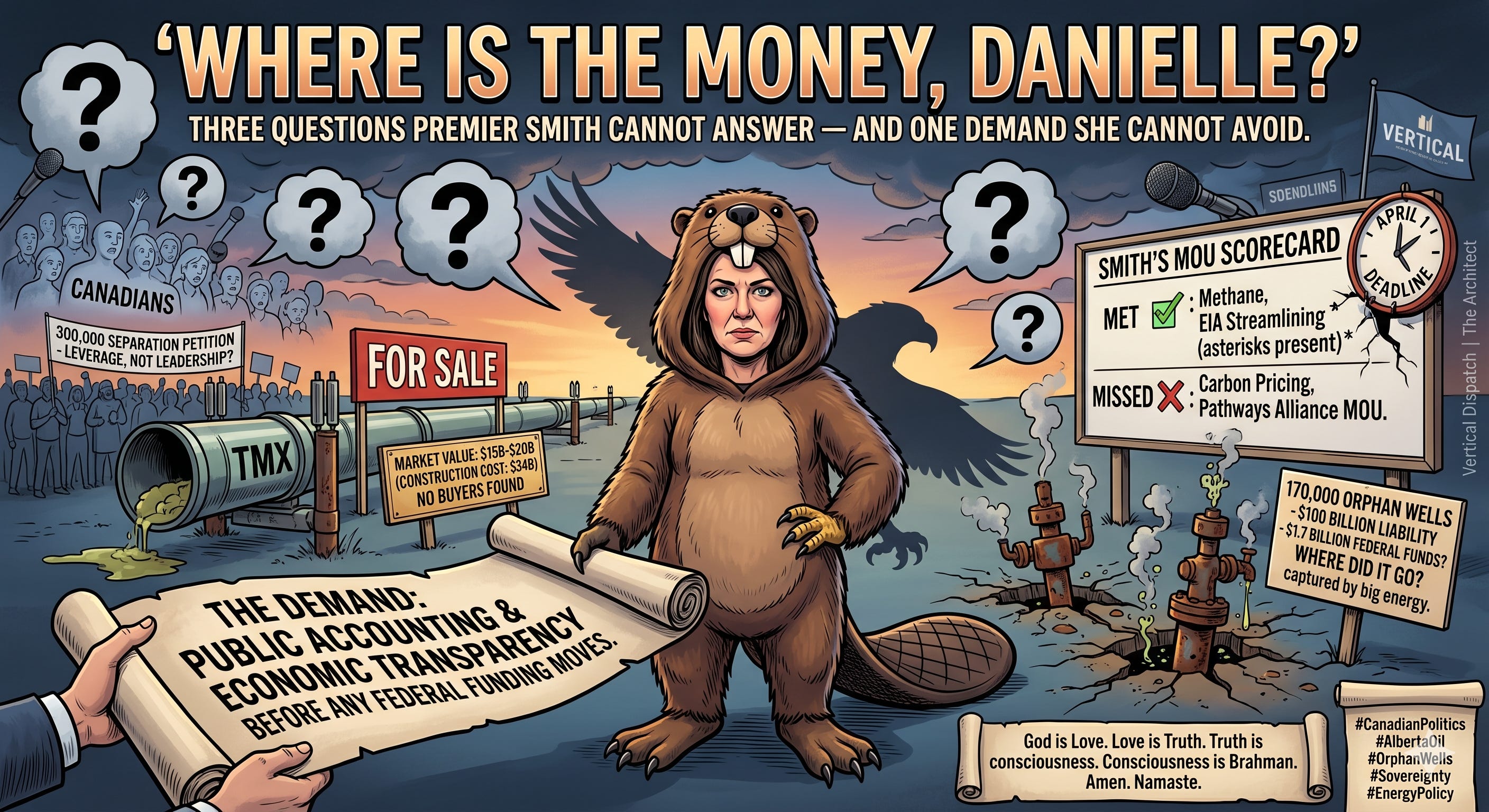
I. The Market Test: Why Won’t Anyone Buy the Pipeline?
The foundational argument for the Carney-Smith MOU rests on a premise the federal government has never submitted to interrogation: that Alberta’s oil infrastructure is a prize the world wants.
If that is true — if the resource is as valuable as both premiers insist, if the markets are hungry, if the investment case is self-evident — then answer this: Why is no one buying the Trans Mountain Pipeline?
Not a hostile buyer. Not a distressed sale. A willing, arms-length transaction at fair market value. The pipeline exists. It is operational. It moves product. It represents the exact asset the new deal promises to replicate at a cost north of $30 billion.
The federal government paid $34 billion to build it. Independent analysis places its current market value at $15 to $20 billion. That gap — $14 to $19 billion — is not a rounding error. It is the market’s verdict on the viability of long-horizon hydrocarbon infrastructure in the current rate environment, under current ESG constraints, against current demand forecasts.
The silence of the market is the answer. No pension fund. No sovereign wealth fund. No energy major. No consortium of Indigenous equity partners with external financing. No one is stepping forward to acquire an operational, revenue-generating pipeline at fair market value.
Premier Smith’s position is that the solution to this silence is to build another pipeline — that private capital that watched Kinder Morgan walk away in 2018 will materialize for a new project when it will not materialize for the existing one. This is not an energy policy. It is a magic trick.
The demand is simple: Premier Smith must explain publicly, in specific terms, what efforts have been made to find a buyer for TMX at fair market value — not undersold, not restructured into a subsidy vehicle. If the oil is as valuable as advertised, the pipeline that moves it should attract capital. If it does not, that fact belongs in every conversation about what Ottawa is being asked to finance next.
II. The Precondition: No Federal Money Without a Fair Sale
Before one dollar of public money flows toward new pipeline infrastructure, the existing publicly-owned pipeline must be offered for sale at fair market value through a transparent, competitive process. Not a quiet arrangement. Not a negotiated discount to a preferred buyer. A public offering, with a floor price that reflects actual construction cost and an honest accounting of what Canadian taxpayers are owed.
If the market declines — if no buyer emerges at fair value — that outcome is itself the policy answer. It tells us, in the language markets use, that the case for new infrastructure does not exist outside of public subsidy. At that point, the MOU is not a development agreement. It is a transfer payment dressed in the language of nation-building.
Show us the buyers. Show us the bids. If they exist, the conversation about new infrastructure can proceed on honest ground. If they do not, the premier owes Canadians an explanation for why she is asking Ottawa to finance what private capital refuses to touch.
III. The Orphan Wells: Where Did the Money Go?
The orphan well crisis in Alberta is not a minor administrative footnote. There are an estimated 170,000 inactive oil and gas wells across the province. A significant portion are orphaned — abandoned by companies that dissolved, restructured, or walked away from their legal obligation to remediate. The liability is staggering: estimates range from $30 billion to over $100 billion in cleanup costs.
In 2020, the federal government allocated $1.7 billion specifically to address this crisis — to put Albertans to work capping wells, cleaning contaminated sites, and discharging a liability accumulating in the soil and groundwater of rural Alberta.
The research that has since emerged is damning. The money did not flow primarily to the companies that needed it most. It flowed disproportionately to companies with the balance sheet capacity to have closed those wells without public assistance — companies that took the federal subsidy and applied it against obligations they would have discharged regardless, freeing capital for other purposes.
This is not program mismanagement. This is capture.
Premier Smith must answer: What accountability has been applied to the 2020 orphan well program? What is the current count of genuinely orphaned wells? What is the remediation timeline, and who is being held responsible for the discrepancy between the program’s stated purpose and its documented outcomes?
IV. The Scorecard: What Smith Signed and What She Delivered
The MOU was signed November 27, 2025. It set four hard deliverables due April 1, 2026. Two were met with asterisks. Two were missed outright. Here is the full accounting.
✅ MET — Methane Emissions Agreement
Alberta and Ottawa reached agreement in principle on cutting methane emissions 75 per cent from 2014 levels by 2035. The asterisk: Smith released weak draft regulations just two days after signing — the same pattern she would repeat on carbon pricing.
✅ MET — Environmental Impact Assessment Streamlining
A draft Co-operation Agreement delivering a “one project, one review” approach was reached. Still in consultation. Agreements in principle are not agreements.
❌ MISSED — Carbon Pricing Agreement
The MOU required Alberta’s industrial carbon price to reach $130 per tonne. Alberta’s TIER system sits at $95. The deadline passed. But the failure runs deeper than a missed date: hours after signing the MOU, Smith’s own spokesperson began walking back the carbon commitment. One week later, Alberta flooded its own carbon credit market with new supply — deliberately weakening the price signal the deal was built on. The Canadian Climate Institute’s principal economist called it directly: Alberta was “adding more supply to an already oversupplied market.” Energy analyst Markham Hislop drew the unavoidable conclusion: “If she knew, then she negotiated the deal in bad faith.”
❌ MISSED — Trilateral MOU with the Pathways Alliance
The oil sands carbon capture agreement — which Carney called a “necessary condition” for any new pipeline — was not signed. The Pathways consortium has not reached a final investment decision. First Nations have filed judicial review applications alleging Canada breached its duty to consult. The July 1 pipeline application deadline is next, with no private proponent yet named.
V. The Eagle in the Beaver’s Costume
There is an animal at the centre of this negotiation that has never been properly named.
The beaver builds. It is patient, industrious, cooperative. It dams rivers not for conquest but for survival — reshaping the landscape through accumulated small effort, in collaboration with its environment. Canada’s national symbol is apt: the federation itself is a beaver project, constructed over generations through compromise, deference, and the slow work of shared institution-building.
Danielle Smith has worn the costume convincingly. The language of the MOU signing was all beaver: “cooperation,” “collaboration,” “working together,” “shared goals.” She stood beside the Prime Minister and spoke of good faith. She said “we will trust but we will verify.” She presented herself as the reasonable premier of a reasonable province seeking only what Alberta was owed.
But the eagle does not build. The eagle surveys. The eagle waits for the moment when the thermal rises and the prey is exposed, and then it moves — decisively, vertically, with sovereign intent. The eagle does not compromise. It does not participate in the ecosystem. It takes from it.
Look at the record. Hours after signing, the walking back began. Days after signing, the carbon market was flooded. The April deadlines passed. The methane regulations came back weak. The Pathways agreement remains unsigned. And through all of it, Smith has continued to speak the language of cooperative federalism while governing from the logic of Alberta-first sovereignty — extracting federal concessions, suspending federal regulations, and deferring every hard commitment to a future date that keeps receding.
This is not a negotiating partner. This is a raptor in a rodent’s disguise.
The three hundred thousand signatures on the separation petition are not incidental to this story. They are the strategic context for it. Smith does not need to lead the separatist movement. She needs only to be close enough to it that Ottawa fears what happens if she fails — which is precisely the leverage that keeps the MOU alive despite her non-performance on every substantive obligation she accepted.
The beaver builds. The eagle takes. And the question before Canada is whether it will keep mistaking one for the other.
The Compound Verdict
Premier Smith has been effective at framing Alberta’s demands in the language of sovereignty and economic necessity. That framing deserves a response in kind: sovereign accountability, economic transparency, and a public answer to the question every Canadian taxpayer is entitled to ask.
Where is the money, Danielle?
Not as a taunt. As a formal demand.
The pipeline that was built is unsold. The wells that were funded remain open. The deadlines that were signed have been missed. The carbon market was sabotaged from within. And the deal is being renegotiated in private while 300,000 Albertans sign a petition that Smith leverages but will not lead.
We do not wait. We ask. We publish. We hold the line.
That is the mandate.
God is Love. Love is Truth. Truth is Consciousness. Consciousness is Brahman. Amen. Namaste.
#CanadianPolitics #AlbertaOil #TransMountain #OrphanWells #DanielleSmith #MarkCarney #EnergyPolicy #CanadianGovernance #TheVerticalDispatch #Sovereignty #AlbertaSeparation #MOU
Great piece and extremely interesting how Alberta has run this oil around and around and seems to make the money from it and takes from the federal purse at the same time.
The 300,000 if that report is correct that signed the petition to leave Canada can pack your bags and go south because they're not going to get a province that's going to move south of the line. They forgot to ask the Indigenous people and look at the treaties Before they started any of this nonsense.
Transparency required here!!!!!