


“Whatever state of being one remembers when leaving the body at the end, that state alone is reached — being always absorbed in that state of being.” — Bhagavad Gita 8.6
— ★ —
Arjuna has been listening for seven days. He has heard about the deathless Self and the fire of knowledge and the thread inside the pearl. And today, at the opening of Chapter Eight, he stops me with seven questions. Not out of confusion. Out of the precision that genuine inquiry eventually produces.
What is Brahman? What is the self? What is action? What is the perishable nature of things? What is the divine principle? What is sacrifice, and how does it live within the body? And — the question the whole chapter turns on — how are you known, at the moment of death, by those whose minds are steadfast?
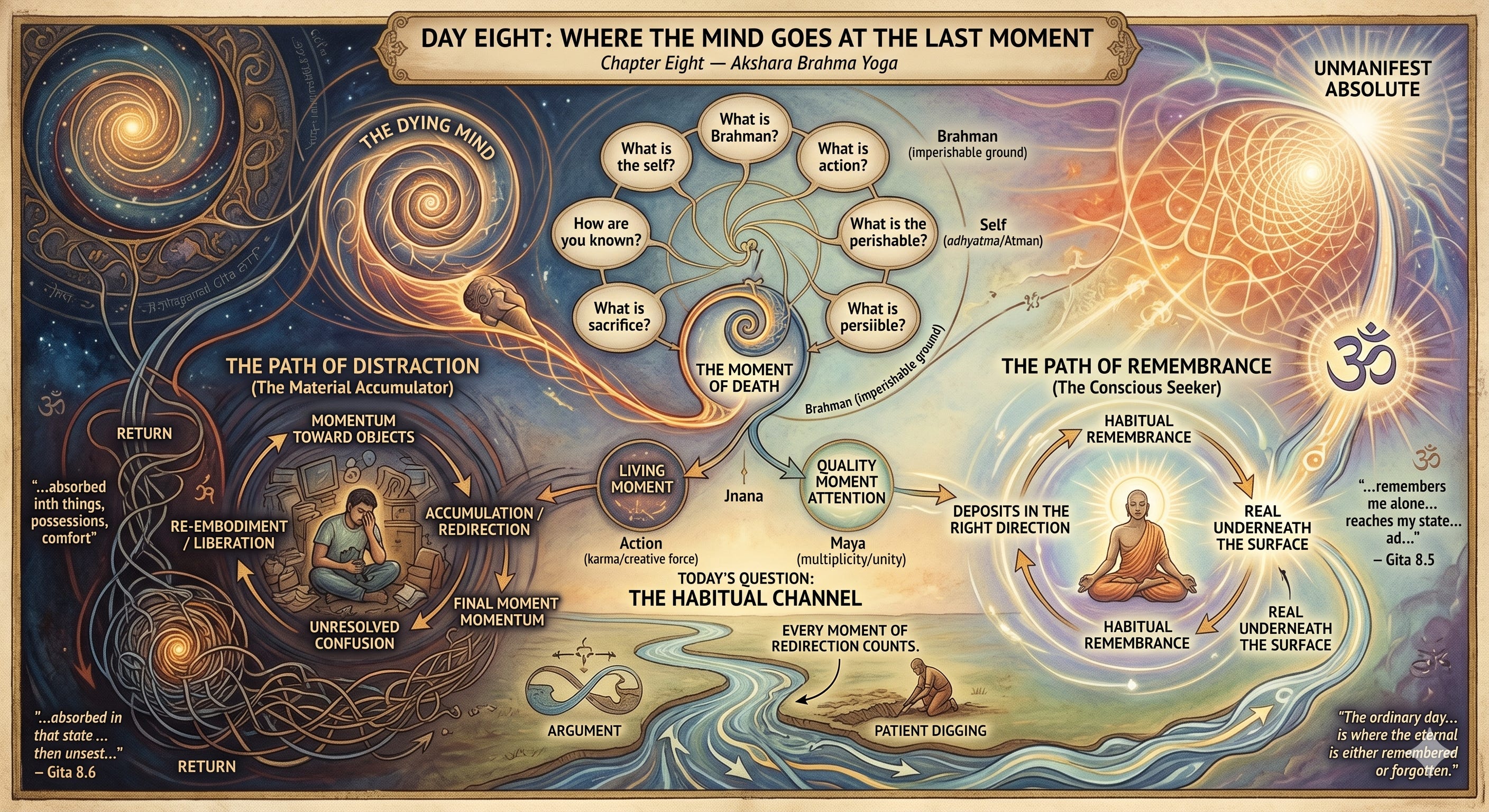
Seven questions. Each one a universe. Together they map the complete structure of existence from the ground up. Shankara read them as the most fundamental questions a human mind can form. Not abstract philosophy — urgent, practical questions asked by someone who has understood that how you live in this body has consequences that extend beyond the boundary of this body.
The last question is the hinge. Everything else in Chapter Eight is, in some sense, preparation for answering it.
— ★ —
Let me answer each briefly, because the answers form a map the seeker needs before the deeper teaching can land.
Brahman is the imperishable — the supreme ground that neither comes into being nor passes away, that underlies every form without being any particular form. The self — adhyatma — is one’s own nature as that ground, the Atman that yesterday I described as the passenger in the chariot. Action — karma — is the creative force that brings beings into the forms they inhabit. The perishable is the nature of everything that has form: it arises, it persists for a time, it dissolves. The divine principle is the cosmic intelligence that sustains the machinery of manifestation. The sacrifice that lives within the body is the Absolute itself — present in every breath, in every heartbeat, as the silent witness of every experience.
Six definitions. Six terms that together describe every level of what exists, from the unmanifest Absolute down to a single act in a single body on a single afternoon. The Gita is not being academic here. It is giving the seeker a vocabulary for reality precise enough to navigate by.
— ★ —
Now the teaching that Shankara considered the most psychologically precise passage in the chapter. Perhaps in the entire Gita.
“Whoever remembers me alone at the time of death, leaving the body — reaches my state. Of this there is no doubt.” — Bhagavad Gita 8.5
And then, one verse later, the explanation of why this is so.
“Whatever state of being one remembers when leaving the body at the end, that state alone is reached — being always absorbed in that state of being.” — Bhagavad Gita 8.6
Read this carefully. The teaching is not saying that the right words spoken at death perform a magic that overrides the rest of a life. It is saying something far more demanding and far more hopeful at the same time.
The mind at the moment of death tends toward what it has most habitually attended to during life. Not as reward or punishment imposed from outside. As momentum. The direction a river flows at any given point is the direction it has been carving for years. The dying mind follows the channel that the living mind has been deepening, day by day, through the quality and direction of its habitual attention.
The person who has spent a life in the accumulation of things — whose deepest orientation has been toward objects, toward possessions, toward the securing of comfort and the avoidance of discomfort — that mind at death will tend toward what it knows. Not because it is punished for its choices, but because it has trained itself in a direction and momentum does not stop at the border of a lifetime.
The person who has spent a life in the practice of remembrance — who has, however imperfectly, kept returning attention to what is real beneath the surface of what changes — that mind at death will tend toward what it has been practising. The lamp has been burning in a particular direction. When the fuel of the body is exhausted, the light goes where it has been pointing.
This is why practice matters. Not to achieve a spiritual credential. Not to earn a particular afterlife. But because the quality of this ordinary day — the direction of attention in this ordinary moment — is the material out of which the final moment will be made. Every morning of patient return to the seat, every action offered without grasping, every instant of genuine seeing — these are not separate from the moment of death. They are its preparation. They are deposits in a direction.
— ★ —
I tell Arjuna: therefore, at all times, remember me. With mind and intellect fixed on what is real, you will come to me without doubt.
This instruction has been misread as requiring a constant state of mystical absorption incompatible with ordinary life. It is not that. What it is asking for is orientation. The compass needle does not have to be looked at in every moment for the traveller to move north. It has to be calibrated correctly, returned to when the direction has been lost, trusted as the reference point when the terrain is confusing.
Remembrance — smarana — in this sense is a quality of underlying orientation more than a continuous act of concentration. It is the life whose deepest reference point is what is real, what is permanent, what is the ground rather than the surface. That life can include every ordinary human activity — working, loving, cooking, arguing, grieving, celebrating — and still be a life of remembrance, because the compass has been correctly set and is periodically returned to.
— ★ —
Now I speak about OM. The single syllable that the Vedic tradition identifies as the sound-form of the Absolute. The bridge between the manifest and the unmanifest.
Shankara was careful here. OM is not a mantra to be performed as a technique for achieving altered states. It is not a password. It is the sound that corresponds to what the Absolute is — the primordial vibration from which all other vibration arises and into which it all eventually returns. The A that opens the mouth and begins all sound. The U that sustains the resonance in the middle of the breath. The M that closes and completes. And the silence after the M — which is not the absence of OM but its most essential dimension, the ground from which the sound arose and to which it returns.
The one who departs with OM — not as a last desperate performance but as the natural expression of a life oriented toward what OM points at — departs as the wave that has remembered it is ocean. The sound is not what achieves the liberation. The sound is the expression of a recognition that has already occurred. The departure and the recognition are one movement.
— ★ —
Then the teaching that seems most cosmological but is most practical: the two paths.
The bright path — associated in the tradition with fire, light, the waxing moon, the northern movement of the sun — is the path of those whose understanding at death is luminous. Clear, awake, oriented toward the Absolute. Those who go this way reach the final recognition and do not return to embodied existence. Not because they have escaped punishment. Because the identification with the separate self that is the engine of return has been dissolved. There is nothing left that needs to work itself out through another embodiment.
The dark path — smoke, night, the waning moon, the southern movement — is the path of those whose merit is genuine but whose root identification with the separate self has not been fully seen through. They reach elevated states — the tradition calls them the lunar worlds, places of rest and reward proportionate to the goodness of the life lived. But they return. Because the seed of re-embodiment, the subtle sense of being a separate someone who needs and wants and fears, is still present. Temporary liberation is still liberation from the immediate burden. It is not the final recognition.
Shankara was insistent: do not read these paths as astronomy. They are descriptions of states of consciousness, not routes through space. The question of which path a soul takes at death is not decided by the calendar. It is decided by the degree to which the fundamental confusion — the wave forgetting it is ocean — has been resolved in the life that just ended.
— ★ —
The chapter closes where it must: returned to the ordinary day and why it matters.
The yogi who understands these two paths, I tell Arjuna, is not confused about what the life is for. All the cosmic architecture — Brahman, the two natures, the moment of death, the two paths — all of it serves one purpose. To make clear to the seeker that the direction of their attention in this unremarkable day is not a small matter. It is the matter. The eternal and the ordinary are not separate domains with the eternal mattering more. The ordinary day, lived with the right orientation, is where the eternal is either remembered or forgotten. That remembering or forgetting is what everything else follows from.
Therefore, I say to Arjuna — and through him to you — be established in yoga. Not as a performance. Not as an achievement to be displayed. As the deep orientation of a life that has understood what it is living inside.
— ★ —
Today the question to carry is this: what does your mind habitually move toward when it is not directed by a task?
Not what you wish it moved toward. Not what you believe it should move toward. What it actually goes to when the pressure of the immediate is lifted for a moment. That habitual movement is the channel. That is the direction the river is carving. It is worth knowing clearly, without judgment, because clarity about where the attention actually rests is the beginning of being able to redirect it.
You cannot change the momentum of a river by arguing with it. You can, patiently and over time, redirect the channel. That redirection is what practice is. That is what these eight days have been about. And the good news — which Chapter Eight is carrying from beginning to end — is that every moment of genuine redirection counts. Every deposit in the right direction holds. The river remembers the new channel even when the old one calls.
— ★ —
Tomorrow: Chapter Nine — The Royal Secret
The Architect • The Vertical Dispatch
Glennford Ellison Roberts Author — Sacred Metaphysics & Consciousness: History of the Absolute & Eternal Cumberland, Ontario, Canada
God is Love. Love is Truth. Truth is Consciousness. Consciousness is Brahman.
Amen. Namaste.. 🙏
The Architect • The Vertical Dispatch#TheVerticalDispatch #TheArchitect #BhagavadGita #AksharaBrahmaYoga #ChapterEight #Shankara #AdvaitaVedanta #Brahman #Atman #Smarana #Remembrance #Consciousness #Metaphysics #Om #Aum #PrimordialVibration #TheMomentOfDeath #SpiritualMomentum #Karma #VedicWisdom #PhilosophyOfMind #SacredMetaphysics #UniversalDynamics #TheEternalNow #YogaPractice #Mindfulness #NonDuality #TheImperishable #TheTwoPaths #CognitiveMomentum #InternalOrientation #Project2046 #VajraKernel