

“OM TAT SAT — this has been declared to be the triple designation of Brahman. By this were ordained of old the knowers, the sacred texts, and the acts of offering.” — Bhagavad Gita 17.23
— ★ —
Arjuna has been listening carefully. Yesterday he heard that the tradition provides a scaffold for the seeker whose inner discrimination is still developing. Today he asks the question that follows naturally from that teaching.
He says: what about those who worship with genuine faith but without scriptural knowledge? The sincere person who has never read the Vedas, who was not born into a tradition that provided these maps, who acts from what they feel is real without knowing its name — what is their condition? Where do they stand?
It is a generous question. And it opens Chapter Seventeen’s central teaching — the most personally applicable teaching in the Gita’s final movement, because it is about something every human being has and exercises in every moment of their life, whether they know it or not.
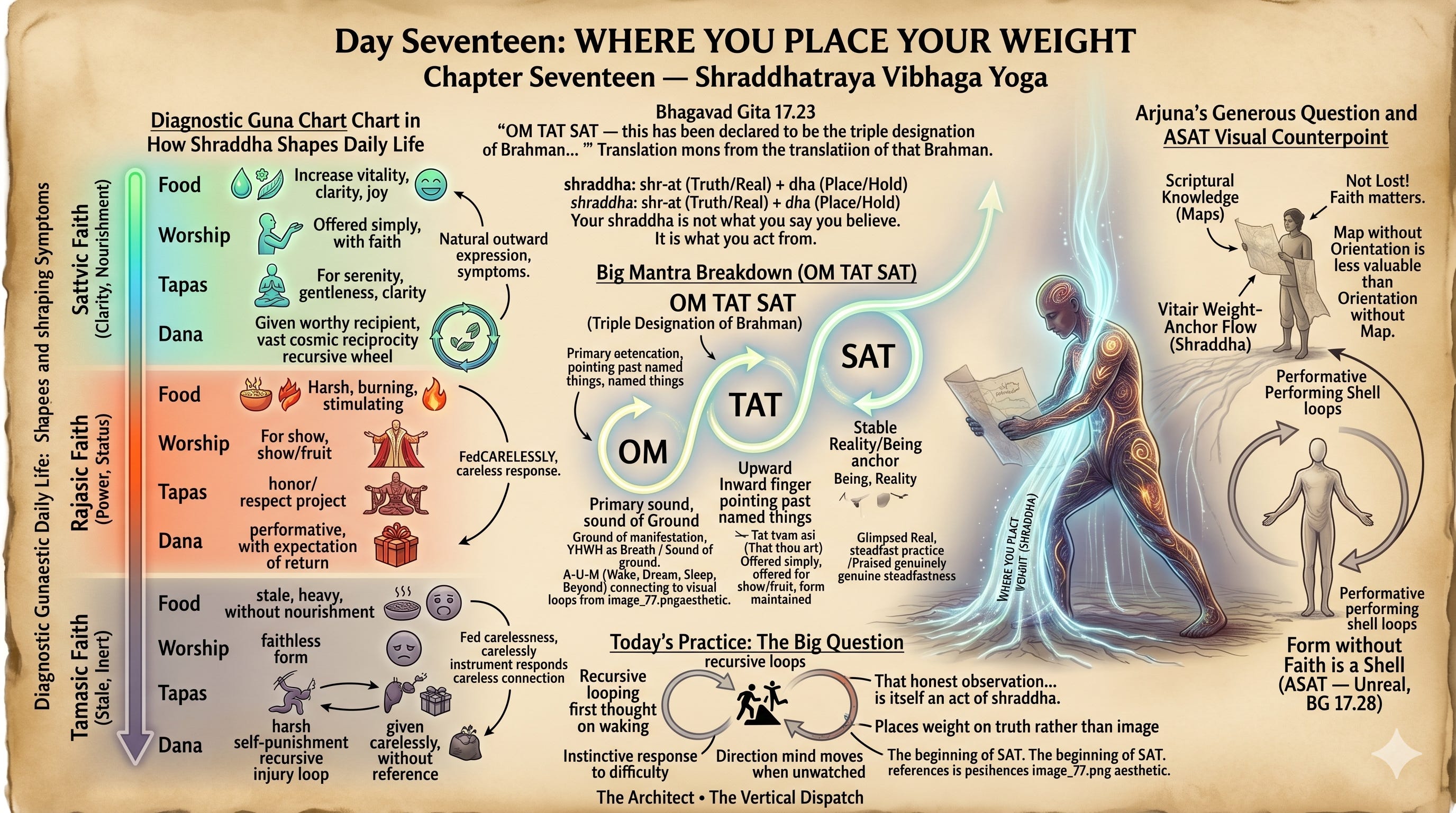
Shraddha. Faith. But not faith in the ordinary English sense of belief held without evidence. The Sanskrit root reveals something more precise: shrat means truth or that which is real, and dha means to place or to hold. Shraddha is where you place your weight. What you lean on. What you trust at the level of your actual life rather than your stated beliefs.
Your shraddha is not what you say you believe. It is what you act from.
— ★ —
The faith of each person, I tell Arjuna, is according to their nature. A person consists of their faith — as their faith is, so they are.
This is one of the most psychologically precise statements in the Gita. Not: as your beliefs are, so you are. As your faith is — as what you actually lean on in the unrehearsed moments of your life — so you are. The gap between stated belief and actual faith is where the real spiritual work lives. A person can claim to believe in generosity and act from scarcity. Can claim to believe in the unity of all beings and treat particular people as instruments. Can claim to be a seeker of truth and spend every hour managing their own image.
The guna that shapes the faith shapes the person. Sattvic faith orients toward clarity, wisdom, what genuinely nourishes. Rajasic faith orients toward power, status, the dramatic and the impressive. Tamasic faith orients toward what is stale and inert — the comfort of what does not require change, the security of what does not ask anything.
Shankara’s reading of this passage is important. He is not condemning the rajasic or tamasic person. He is describing a condition — the way a physician describes a condition — so that the condition can be seen clearly and worked with honestly. The sattvic faith is not a separate category of special people. It is the direction every faith can move if the practice of these seventeen days has genuinely been taken up.
— ★ —
Now I apply the three-guna lens to the most ordinary dimensions of daily life — food, worship, austerity, and charity. And here the teaching becomes very practical in a way that surprises many readers who expect the Gita’s final movement to stay in philosophical abstraction.
The food that a person prefers reveals their guna. Not as a moral judgment — as an accurate diagnostic. Foods that increase vitality, clarity, and joy without agitating the system — these are sattvic. Foods that are harsh, burning, intensely stimulating — these feed rajas. Foods that are stale, heavy, and without nourishment — these feed tamas. The body is the instrument. What is fed to it shapes what it can do.
Shankara was not teaching dietary restriction for its own sake. He was pointing at a principle that extends far beyond food: what you consistently take in — through every sense, through every relationship, through every habit of attention — shapes the quality of the instrument through which the practice is being conducted. The seeker who feeds the instrument carelessly and then wonders why the instrument responds carelessly has not understood the connection.
Worship is also threefold. Sattvic worship is offered simply because it ought to be offered — with no desire for return, with steady mind, with faith in what the offering is pointing at. Rajasic worship is offered for show or for fruit. Tamasic worship is offered without faith — the form maintained while the orientation has quietly departed.
And austerity — tapas — is not the harsh self-punishment that the word sometimes suggests in translation. Austerity of body is the willingness to maintain the instrument with care and discipline. Austerity of speech is the practice of words that do not cause unnecessary distress — truthful, pleasant, beneficial. Austerity of mind is the patient cultivation of serenity, gentleness, and clarity.
Sattvic austerity is practised without desire for recognition. Rajasic austerity is practised for honour and respect — the spiritual discipline that is, underneath, another project of the ego managing its status. Tamasic austerity is the self-punishment that mistakes suffering for purification.
Charity — dana — completes the triad. Sattvic giving is given because it ought to be given, to a worthy recipient, at the right time and place, with no expectation of return. Not as performance of generosity. As the natural outflow of a being that has understood the wheel of cosmic reciprocity that Chapter Three described — the vast mutual offering that sustains existence itself.
— ★ —
And now the verse that the entire chapter has been moving toward. Three words that Shankara called the most compressed statement of the ground of all practice in the entire Gita.
OM TAT SAT.
Three words. Three aspects of the single reality that every act of genuine practice is pointing at.
OM — the primordial sound, the Absolute as the ground of all manifestation, the breath of the universe before it becomes any particular word. YHWH as breath. The A-U-M that contains waking, dreaming, and deep sleep and points past all three to the silence in which all three appear. The tradition has always begun its acts of offering with OM — not as a ritual formality but as the reminder that what is being offered arises from and returns to the single ground.
TAT — That. Not this. Not any particular named thing. The finger pointing past every name to what no name contains. The Upanishads use it in the great statement — tat tvam asi, that thou art — to point the seeker past every form of self-identification to what they most fundamentally are. TAT is used by those who seek liberation, performing their acts of offering without grasping the fruit, because they understand that the offering and the offered and the act of offering are all movements of the single That.
SAT — Being. Reality. What is. Not what appears, not what is constructed by the mind, not what the ego projects — what actually is, prior to every construction. The real. The ground. In the tradition, SAT is used for what is praiseworthy, for what is genuine, for the steadfastness in practice that comes from having glimpsed what is real and being unable to be entirely satisfied by what is not.
Together — OM TAT SAT — they describe the complete movement of genuine practice. OM: beginning in the ground. TAT: oriented toward what cannot be named. SAT: grounded in what is real rather than what is merely comfortable or impressive or ego-serving.
— ★ —
The chapter closes with the statement that gives the entire chapter its edge.
“Without faith whatever sacrifice is offered, whatever is given, whatever austerity is performed, whatever is done — it is called ASAT — unreal — both here and after death.” — Bhagavad Gita 17.28
ASAT. Unreal. Not wicked — unreal. The practice performed without genuine orientation toward what is real produces no genuine fruit, because there is no genuine seeker behind it. Only performance. The form without the faith is a shell — it has the shape of practice and none of its substance.
This is the answer to Arjuna’s opening question. The sincere person who worships without scriptural knowledge but with genuine faith — with genuine shraddha, genuine placing of weight on what is real — that person is not lost. The faith is what matters. The tradition provides the most reliable map. But the map without genuine orientation is less valuable than the genuine orientation without the map.
Where you place your weight is where your life is actually going. Not where you say you are going. Where the weight rests.
— ★ —
Today the question is the most intimate one in the series.
Not what do you believe. Where does your weight actually rest? In the unrehearsed moments — the first thought on waking, the instinctive response to difficulty, the direction the mind moves when no one is watching — what is the faith that is actually operating?
That honest observation, made without self-judgment but with clear eyes, is itself an act of shraddha. Because it places the weight on truth rather than on the image of being a spiritual person. And that — Shankara says without equivocation — is the beginning of SAT. The beginning of what is real.
Tomorrow is the last day. Chapter Eighteen — the great surrender. Everything the Gita has been building toward arrives in its final chapter. Come ready.
— ★ —
Tomorrow: Chapter Eighteen — Liberation by Surrender
The Architect • The Vertical Dispatch
#BhagavadGita #ChapterSeventeen #ShraddhatrayaVibhagaYoga #Shraddha #Faith #WhereYouPlaceYourWeight #OMTATSAT #AdiShankara #AdvaitaVedanta #LivingSanatanaDharma #SanatanaDharma #Gunas #Sattva #Rajas #Tamas #Metaphysics #VerticalDispatch #TheArchitect #Project2046 #SelfInquiry #Spirituality #Ontology #Wisdom #Truth #AtheismToTruth #SacredMetaphysics #JourneyToTheSelf #GlenRoberts #BionicSage #ZeroFluff #ProtocolXYZ #LogicIntegrated #TheKnowerAndTheField #VerticalCausation #Atha #NowTheInquiryBegins #SacredMetaphysicsVolume #WitnessingAwareness #TheInvertedTree #TheTripleGate #Fearlessness #PurityOfHeart #NonDualism #Moksha #EternalOrder #TheScribe #AxiomaticTruth