

Φ
THE VERTICAL DISPATCH
We write for the mind, the eye, and the ear.
Read it. Look at it. Listen to it. The Vertical Dispatch is built for all three — prose with rhythm, made to be heard as much as read.
From metaphysics to geopolitics, from culture to history, from the sacred to the street — and everything in between. One lens, every subject. No ego. Just the record, named clean.
Press play. Walk with the word. 🕯️
This dispatch travels by hand. If it serves you, share it — restack on Substack, and pass it on wherever you read. 🕯️
The Price of Everything · A Vertical Dispatch Feature · Part Six of Seven
June 27, 2026
“The debt is the asset. The asset is the debt. There is no fixed point.”
— a working banker, to the author, off the record
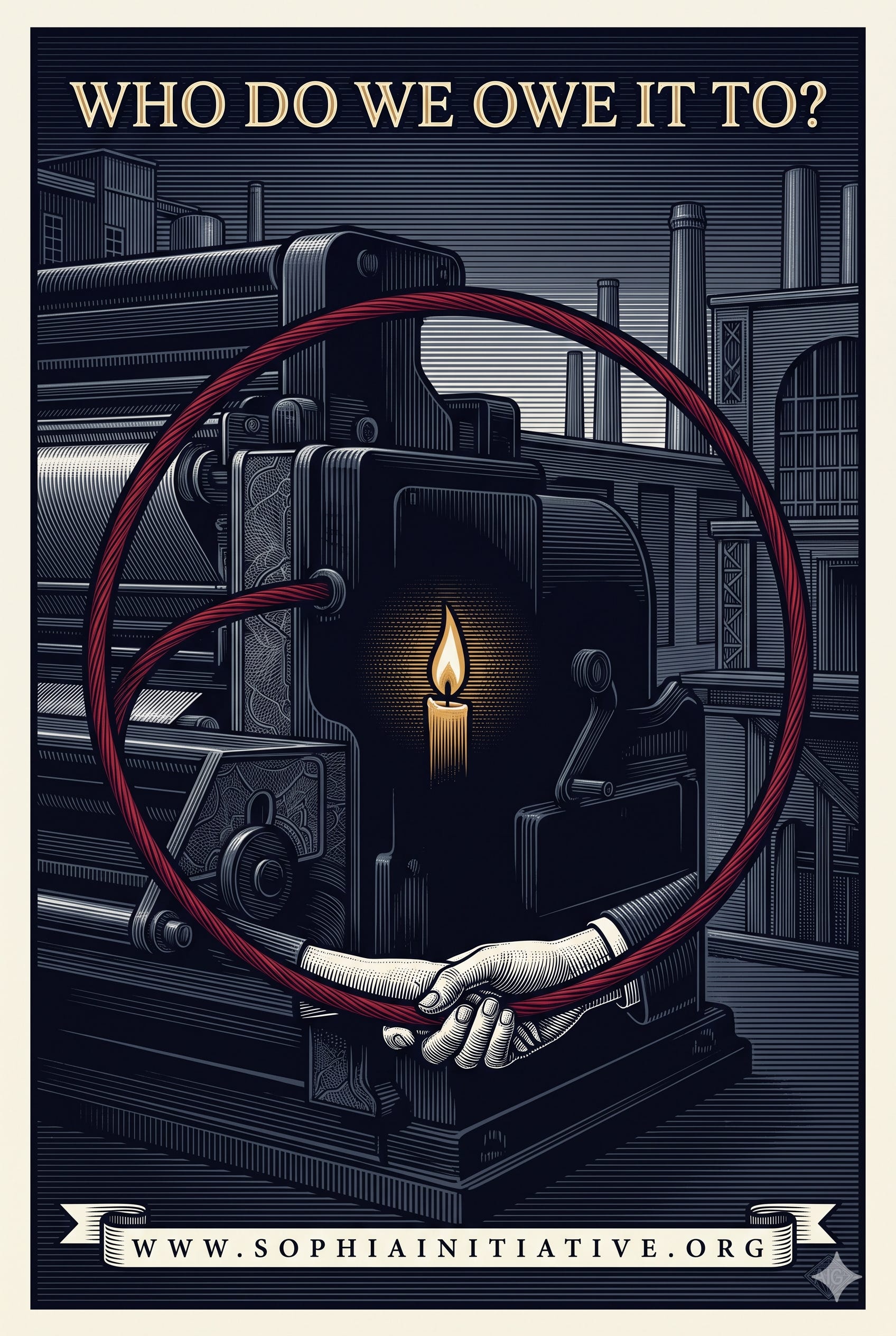
We ended yesterday with a promise. We had named the machine — the throttle that leans on the lending engine, the door that opens in a storm, the three great organs of the global order — and we said that all of it, finally, is built on debt. Someone owes it. And we said that the question which closes in on this whole feature is the one a child would ask and an economist will dodge: who do we owe it all to? We said we would follow the wire out the back of the machine, to whatever hand is holding the other end. Today we follow it. And what we find at the end of the wire is the strangest thing in the whole history of money — strange not because it is hidden, but because it is in plain sight on the public ledgers, and almost no one has stopped to look at what it actually says.
The Wire We Said We Would Follow
Begin with the plainest version, because the plainest version is already astonishing. A government spends more than it takes in. To cover the difference it borrows — it sells a bond, a piece of paper that says: give me your money now, and I will give it back later, with interest. The buyer hands over the money; the government hands over the promise. That promise is the debt. Multiply it across decades and you arrive at the number that crossed a threshold this spring: the gross debt of the United States passed thirty-nine trillion dollars in March of 2026, the first time in history. The annual interest alone on that debt now runs past a trillion dollars a year — more than the entire American defence budget — and here is the first turn of the screw: much of that interest is paid by borrowing more, so that the interest on the debt now generates more debt, a wheel that turns itself.
So far this is only large. The astonishment begins when you ask the child’s question and actually read the answer. That bond — that promise — is somebody’s debt. But a promise is only a debt on one side of the page. On the other side, the very same piece of paper is somebody’s asset. The bond the government owes is the bond someone else owns. The debt and the wealth are not two things. They are one thing, seen from two ends. And so the question who do we owe it to is really the question: who is standing at the other end of all these promises, holding them as their wealth? Follow the wire. See whose hand it is.
The Hand at the Other End
Here is what the public record says, and it is worth setting down slowly, because each answer lands somewhere stranger than the last. Roughly four-fifths of the debt that is held by the public is held not abroad but at home — by American mutual funds, pension funds, banks, insurance companies, and individuals. The foreign portion that fills the nightly news — Japan the largest, then China — is only about a fifth of the publicly held total. So the first answer to who do we owe it to is, overwhelmingly: ourselves. The citizens are the creditor. The same public that is told it groans under the national debt is, in its pensions and its funds and its savings, holding a great share of that debt as its own nest egg. The debtor and the creditor share a face.
Then it gets stranger. A large block of the debt is not held by the public at all. It is intragovernmental — one arm of the government holding the debt of another. The single biggest piece of that is the Social Security trust fund, which by law must take the surplus it collects and lend it to the rest of the government, receiving Treasury paper in return. So the government owes trillions to a fund that is itself part of the government. It is a promise the state has written to itself, filed in its own drawer. On the ledger it is a debt. In the room, it is the left hand owing the right.
And then the strangest answer of all, the one that closes the loop. The single largest holder of the government’s debt is the central bank — the very institution from Part Five, the one that can build money from nothing. In the storms of the last two decades it created money and used it to buy the government’s own bonds, by the trillions. So at the very centre of the web sits this: the government issues a promise to borrow money; the central bank conjures the money from nothing and buys the promise; and the government now owes the debt to an institution that is itself an organ of the state, holding paper it purchased with money that did not exist until it was needed. The debtor printed the money to become its own creditor. Read that twice. It is not a scandal hidden in a vault. It is the published architecture of modern money.
The debtor and the creditor share a face. We owe it, overwhelmingly, to ourselves — to our pensions, to our own trust funds, and to a central bank that printed the money to buy the very promise the government made.
The Vanishing Creditor
Now stand back and look at the whole shape, because the shape is the revelation. We set out to follow the wire to the hand at the other end, expecting to find someone there — a creditor, a lender, a final holder of the world’s debt to whom, in the end, it is all owed. And the wire does not end in a hand. It curves back. It runs from the citizen to the fund the citizen owns; from the government to the trust fund that is part of the government; from the Treasury to the central bank that printed the money to buy the Treasury’s own paper. Every time we reach for the final creditor, the wire loops back to the debtor. There is no fixed point. There is no vault at the bottom of the world where the real money sits and the final lender counts it. There is only the circle of promises, owed by us, to us, through instruments we built to stand between us and the bare fact of it.
This is the mirror, and it is why this part exists. Money, at the scale of nations, is not a substance that some have and others lack and the indebted must someday repay to a creditor who is owed. It is a web of promises, held up by nothing but the agreement to keep believing in it. The debt is owed to no one outside the circle, because there is no outside the circle. We are the debtor and we are the creditor and the paper that passes between our own hands is called, depending on which hand you look at, either our wealth or our debt. The whole towering structure — thirty-nine trillion dollars, the largest number in the human story — rests on a single fact a child could state: it is a promise we made to ourselves, and have all agreed to honour.
What Holds It Up
If it is only a promise, the obvious question is what keeps it from collapsing — and the answer is the most important thing in this whole feature. What holds it up is faith. Not faith in a god, but faith in the promise itself: the shared, daily, unspoken agreement of billions of people to go on treating the paper as real, to accept it for bread and labour and land, to believe that the bond will be honoured and the dollar will still buy tomorrow what it buys today. The money is not backed by gold. It has not been for generations. It is backed by trust — by the confidence that the whole circle of promises will hold because everyone is acting as though it will. The economists have a cold phrase for it: confidence. The older traditions had a warmer one. It is faith. The entire edifice of modern wealth is a cathedral built of belief, and it stands for exactly as long as the believers keep believing.
And this is why the steward of Part Four mattered, and the machine of Part Five, and the whole long walk through the graveyards. Because if the money is a promise held up by faith, then the one unforgivable act — the act that built every graveyard — is the act that breaks the faith. The keeper who debases the promise, who prints until the paper means nothing, who turns the dial for the short game until the believers stop believing: that keeper does not merely make an error of policy. He breaks the one thing holding the cathedral up. The symbol was never the referent. The dollar was never the wealth. The wealth was always the trust, and the trust is the only thing that cannot be printed, conjured, or borrowed back into existence once it is spent.
The money is not backed by gold. It is backed by faith — the daily agreement of billions to go on believing the promise. The wealth was never the paper. It was always the trust. And the trust is the one thing that cannot be printed.
The Case the Other Way
Now the strongest version of the objection, at full strength, because this work sets down the opposing case before any verdict — and here the objection is not just serious, it is held by people who run the actual machine. It runs like this: that to call the national debt a circle of promises owed to no one is a poet’s trick that ignores the brutal reality that the promises are very real to the people on the receiving end. Tell the retiree whose pension depends on those bonds being honoured that the creditor is a fiction. Tell the foreign government holding a trillion dollars of American paper that the debt loops back on itself. The interest is real money paid to real holders. The faith can fail in real time, and when it does — when a currency collapses, when inflation eats a nation’s savings — real people starve. To wave it away as a circle of belief, the objection says, is to play with metaphysics while the house is made of brick and the brick can fall on you.
That objection is right, and this feature will not pretend otherwise — and notice that it does not refute the thesis, it completes it. Yes, the promises are real to those who hold them. Yes, the interest is real money and the pensions are real lives. But that is the whole point: a thing made of nothing but shared belief can be the most powerful and most fragile structure in the world, precisely because so many real lives are staked on it. The fragility is not lessened by the faith; it is created by it. A house of brick can lose some bricks and stand. A house of belief stands perfectly until the day belief withdraws, and then it does not crumble — it vanishes, all at once, the way a currency dies not slowly but in a single season of panic. The mirror does not make the debt less serious. It makes it infinitely more so. The most important number in the world turns out to rest on the least tangible thing in the world. That is not a reason to relax. It is the reason to guard the faith as the sacred and load-bearing thing it actually is.
What Carries Into Part Seven
We have followed the wire and found the mirror. The debt is owed, in the end, to no one outside the circle of us — held up by a faith we rarely name and almost never examine. But we have looked, so far, only at the grandest scale, the national one, the thirty-nine-trillion-dollar promise a country makes to itself. And a fair reader will ask the question that closes this whole feature: if that is what the debt is at the top, at the scale of nations, then what is it at the bottom — in my own wallet, on my own kitchen table, in the card and the mortgage and the loan that feel so personal and so heavy and so much like a debt owed to a very real someone who will very really come for me? That is Part Seven, and it is the last door. We have seen the promise at the scale of a nation. Next we hold it in our own hand — the credit card, the mortgage, the financed machine — and we ask whether the engine that prints the debt of nations is the same engine that printed the couch. We will find that it is. Hold the question where the verdict wants to be. Walk with the word. 🕯️
God is Love. Love is Truth. Truth is Consciousness. Consciousness is Brahman.
Amen. Namaste. Om Namah Shivaya.
— The Architect.
For everyone who was told they owed a debt, and never once asked to whom.
The Vertical Dispatch
sophiainitiative.ai
On the record
This is Part Six of the Feature “The Price of Everything,” and it follows Part Five (“The Machine He Steered,” June 26, 2026). It is a structural and interpretive essay; the load-bearing figures are matters of public fiscal record, sourced to the U.S. Treasury and to non-partisan fiscal authorities, and date-stamped.
The size of the debt. U.S. gross national debt exceeded $39 trillion for the first time on March 17, 2026; as of late June 2026 it stood near $39.3 trillion (U.S. Treasury, “Debt to the Penny,” fiscaldata.treasury.gov; Committee for a Responsible Federal Budget; Peter G. Peterson Foundation). Gross debt is the sum of debt held by the public (~80%, roughly $31 trillion) and intragovernmental holdings (~20%, roughly $7.6 trillion).
Interest exceeding defence. Annual interest on the federal debt has surpassed $1 trillion, exceeding the annual U.S. defence budget; rising debt-service costs are themselves a driver of further borrowing (U.S. Treasury Fiscal Data; Congressional Budget Office; Wikipedia, “National debt of the United States,” summarizing federal data). Figures date-stamped to 2026; verify current totals before republication.
Who holds it. Of publicly held debt, roughly four-fifths is held domestically — by mutual funds, pension funds, banks, insurance companies, the Federal Reserve, and individuals — and roughly one-fifth by foreign holders, led by Japan (~$1.1 trillion) and China (~$760 billion) (Congressional Research Service, “Foreign Holdings of Federal Debt,” March 2026; U.S. Treasury TIC system; Federal Reserve Financial Accounts Z.1, Table L.210). The largest single holder is the Federal Reserve (several trillion dollars in Treasury securities, accumulated chiefly through quantitative easing). The largest intragovernmental holder is the Social Security trust fund (~$2.3 trillion in special-issue Treasury securities), which by law invests its surplus in government securities.
The mirror and the faith. The characterization of the national debt as a “circle of promises,” a debt “owed to no one outside the circle,” and money as backed by “faith” rather than substance, is the author’s interpretation and commentary — consistent with the post-1971 reality that major currencies are fiat (not backed by gold or any commodity) and derive value from confidence and legal tender status. This is interpretive framing, not a contested factual claim; readers should consult primary fiscal and monetary sources and form their own judgment.
The epigraph attributed to “a working banker, off the record” renders a sentiment expressed to the author and is not presented as a verbatim public quotation of any named person. All characterizations herein are opinion, interpretation, and commentary. No assertion is made about the private intentions, state of mind, or character of any individual. No figure herein is disaggregated by race, group, or class. Errors and omissions excepted; corrections will be made on notice. Verify all figures against primary sources before republication.
Suggested tags
national debt, who owns the debt, fiat money, money and faith, the Federal Reserve, Social Security trust fund, government bonds, monetary system, political economy, the price of everything, how money works
Substack Notes
Yesterday we named the machine. Today we follow the wire out the back of it to find who, in the end, we owe it all to. Part Six of The Price of Everything asks the child’s question an economist will dodge — and the answer, hiding in plain sight on the public ledgers, is the strangest thing in the whole history of money.
The U.S. debt passed $39 trillion this spring — the largest number in the human story, with annual interest now larger than the entire defence budget. But ask who holds it, and the wire curves back on itself. Four-fifths of the publicly held debt is owned at home, by the citizens’ own pensions and funds. A huge block is owed by the government to itself, through the Social Security trust fund. And the single largest holder is the central bank — which printed the money from nothing to buy the government’s own bonds. The debtor printed the money to become its own creditor. There is no vault at the bottom of the world. There is no final lender. The wire loops back to the hand that issued it.
This is the mirror. Money, at the scale of nations, is not a substance some have and others owe. It is a web of promises owed by us, to us, held up by nothing but faith — the daily agreement of billions to go on believing the paper is real. The dollar is not backed by gold. It is backed by trust. And the trust is the one thing that cannot be printed, conjured, or borrowed back once it is spent. The wealth was never the paper. It was always the belief.
We end on the opposing case at full strength — that the promises are brutally real to the pensioner and the foreign holder, and that a faith can fail in real time — and then on the last door. If that is the debt at the top, at the scale of nations, what is it at the bottom, in your own wallet? That is Part Seven. Walk with the word. 🕯️
Written from love, in service of the record. Walk with the word. 🕯️
#ThePriceOfEverything #WhoDoWeOweItTo #NationalDebt #FiatMoney #MoneyAndFaith #TheFederalReserve #MonetarySystem #PoliticalEconomy #TheVerticalDispatch #TheArchitect #SophiaInitiative #GodIsLove #LoveIsTruth #OmNamahShivaya
The factual matter in this Dispatch is drawn from the public record. All characterizations, inferences, and conclusions are opinion, interpretation, and commentary, offered for analysis, reflection, and public-interest discussion. No assertion is made regarding the private intentions, state of mind, or character of any individual. Readers should evaluate all statements independently and draw their own conclusions.