


Φ
THE VERTICAL DISPATCH
We write for the mind, the eye, and the ear.
Read it. Look at it. Listen to it. The Vertical Dispatch is built for all three — prose with rhythm, made to be heard as much as read.
From metaphysics to geopolitics, from culture to history, from the sacred to the street — and everything in between. One lens, every subject. No ego. Just the record, named clean.
Press play. Walk with the word. 🕯️
This dispatch travels by hand. If it serves you, share it — restack on Substack, and pass it on wherever you read. 🕯️
Building Canada Strong · The Age of Consequences
June 14, 2026 — three days after the announcement.
Volatile facts date-stamped as of June 11, 2026.
“We are an agricultural superpower.”
— Mark Carney, at the Ontario Food Terminal, June 11, 2026
A note before we begin: this dispatch is a lesson, offered plainly. It will take you about fifteen minutes, and at the end of it you will understand something almost nobody in this country can explain — how food actually moves from a Canadian field to your cart, who owns the road it travels, and why the Prime Minister just committed $3.2 billion to building a kind of building most Canadians have never heard of. There is one big idea here. Once you see it, you will never read a grocery story — or a grocery bill — the same way again.
On the morning of June 11, hours after the strategy was tabled and a day before he boarded his plane for Europe, the Prime Minister of Canada stood in a warehouse in Etobicoke and announced the largest rebuilding of this country’s food system in living memory. The press release called it the National Food Security Strategy. The coverage called it a grocery-affordability plan. Both descriptions are true and both miss the point, because the centre of the plan is a building — the building he was standing in — and to understand why a building is worth a billion dollars of the public’s money, you first have to understand what it is. Almost nobody does. That is not your failure as a reader. It is the whole story.
Start with the question in our title, because it sounds rhetorical and is not. Who feeds Canada? The reflex answer — farmers — is true and incomplete. Canadian farmers, ranchers, and producers ship roughly $100 billion in agri-food abroad every year; we are, in the Prime Minister’s words, an agricultural superpower. And yet this superpower imports nearly 90 per cent of its fresh fruit and more than 70 per cent of its vegetables, pays some of the highest grocery costs in the G7 — up roughly 35 per cent since 2019, about $10,000 a year for an average family — and watches its farmers sell into a system where, across most of the country, there is effectively one buyer. The question is not who grows the food. The question is who owns the road between the field and your kitchen. Answer that, and everything else about Canadian groceries — the prices, the boycotts, the parliamentary hearings, the strange disappearance of the corner fruit market everywhere west of Ontario — snaps into a single picture.
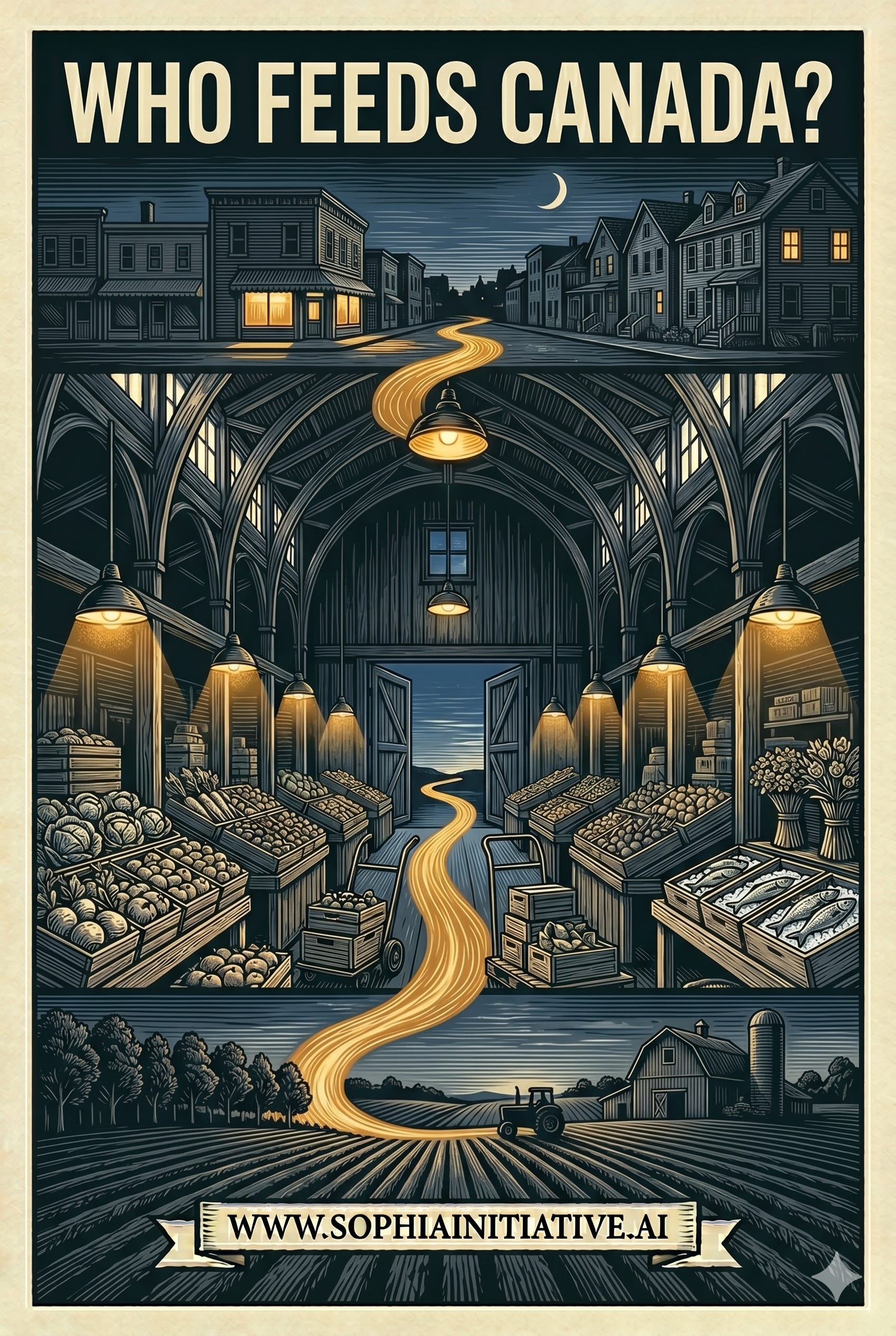
The Building You’ve Never Heard Of
There is a kind of building, ancient and unglamorous, that quietly determines whether a country’s food market is honest. It is called a wholesale food terminal, and the easiest way to understand it is the one you have already seen in the movies: the Dutch flower halls at Aalsmeer, where carts of tulips roll through a building so vast it ranks among the largest on earth and a fifth of the world’s cut flowers find their price by nine in the morning. Or Tokyo’s legendary fish market — Tsukiji in the old films, Toyosu now — where the dawn tuna auctions feed the best-fed city on the planet, and a sushi master with a single counter buys the same quality of fish as a chain with five hundred. Or Rungis, outside Paris: the largest fresh-food market in the world, the belly of France, where every bistro and corner épicerie shops the same halls before sunrise.
Strip away the romance and the machine is simple. A terminal is a stock exchange for food: one neutral hall where many sellers meet many buyers at wholesale scale. Starting around two in the morning, farmers and importers back their trucks up to stalls; the buyers walking the aisles are the independent grocer, the fruit-market owner, the restaurateur, the hospital kitchen — small operators buying by the crate and the pallet, comparing ten sellers’ tomatoes, haggling, loading the van, stocking their shelves by daybreak. Nobody retail-shops there. The hall exists for exactly one purpose, and it is the purpose that makes everything else in this dispatch make sense: the small buyer gets the big buyer’s market. The corner grocer pays what the giant pays. The ten-pallet farmer reaches forty buyers instead of begging one. Prices are discovered in the open, in front of everyone, instead of dictated in a procurement office. It is the medieval market square with a roof on it — the oldest honest-price machine civilization has — and the countries that kept theirs, kept their independent food shops. Walk any street in France or Italy or Japan and the greengrocer, the fishmonger, the butcher are still there. They are not there by charm. They are there because every one of them has somewhere neutral to buy.
The One Hall Canada Built
Canada built exactly one. The Ontario Food Terminal, opened in Etobicoke in 1954, is a genuine giant — one of the largest wholesale produce terminals in North America, moving nearly two billion pounds of fruit and vegetables a year — and it is, for all practical purposes, the only public one in a country of forty million people spanning five and a half time zones. Vancouver has none. Calgary and Edmonton: none. Winnipeg: none. Montreal’s wholesale trade drifted into a privately developed district that is today better known for big-box stores than for produce rows — the city kept its beautiful retail markets, Atwater and Jean-Talon, and let the wholesale floor beneath them dissolve into real estate. Halifax and the Atlantic: nothing at scale. Farmers’ markets exist everywhere, but a Saturday stall selling you six tomatoes is retail; a terminal is a grocer buying six hundred pounds before dawn. Different organ entirely.
And here is the seventy-year natural experiment, written plainly on the map of the country: southern Ontario — terminal country — is where Canada’s independent grocers, fruit markets, and family produce stores survived. The regions that never got a hall defaulted, over two generations, to the chain store and the parking lot. That is not coincidence; that is the experiment already run, with a 1954 baseline and a control group the size of a continent. One building, one region still breathing. The policy announced June 11 begins from exactly this observation. The strategy’s own text commits the new money to expanding the Ontario Food Terminal — this year — and establishing similar terminals, quote, in regions that currently lack this public infrastructure. Which is to say: every region but one.
How Food Actually Moves — Including the Imports
So if most of Canada has no open floor, how does food actually reach the shelf? Through two channels, and the difference between them is the entire grocery file. Channel one is the private pipe: Loblaw, Sobeys, and Metro own their supply chains outright — their own import arms contracting directly with growers in California, Mexico, and Chile, their own distribution warehouses, their own trucking, their own shelves. Field to cart, vertically integrated, top to bottom, theirs. Channel two is the open floor: independent importers, brokers, and farmers selling to whoever walks the aisle — and in Canada, channel two physically exists in one suburb of Toronto. Walk the Etobicoke floor in February and a great share of what is stacked there is imported; the hall is not a local-food boutique, it is the neutral exchange for all produce, foreign and domestic alike. The terminal does not fight imports. It democratizes access to them.
Now follow the corner grocer in Calgary or Moncton through a winter. There is no floor to walk. To stock romaine in February she has essentially one source at scale: the distribution arm of the very chain she competes against. Her supplier is her competitor. The chain sells to her at wholesale — on its terms, at its price, sometimes near what families pay retail — while underpricing her at the Superstore down the road. The honest map carries partial exceptions, and we print them: Western Canada’s co-operative wholesale system supplies its own member stores, and regional produce wholesalers operate in the major cities — which is why the strategy’s careful word is that independents “depend on competitors for supply” often, not always. But mark what the exceptions are: a members-only club and a handful of private middlemen — not an open public floor. Where the chains’ pipe is not the only road, a gated one is. And where neither pipe serves, farmers and stores find each other the last way left: networking — phone calls, handshake deals, a cousin with a truck. It works until the exact moment it matters: a crop fails and the store has no second seller; a crop over-yields and the farmer has no second buyer; a grower retires and an entire local supply line vanishes with his phone number. A terminal institutionalizes the matching that networking improvises — forty fallback buyers and forty fallback sellers under one roof at dawn. Markets that run on who-knows-whom are thin, and thin markets fail precisely when you need them most. The Prime Minister said it himself, standing on the one floor in the country where none of this is true: that is why, at the corner store, “you often are paying a higher price.” And the farmer faces the mirror image: outside terminal country, his buyer of scale is a chain procurement office — one buyer, dictated terms, listing fees and deductions, delisting at will. Economists have a word for a market with one buyer: monopsony. Canadians have a simpler one: take it or leave it. The strategy’s own text states the condition in government prose — independent grocers “depend on competitors for supply” and face restrictions on where they can operate. Read that sentence twice. It is Ottawa describing a tollbooth without using the word.
The Enclosure: How the Road Became Private
Here is where this dispatch parts company with the gentle coverage, because the record permits no gentleness — only precision. No one will find minutes of a meeting where the grocery giants voted to kill Canada’s market halls. They never had to. The halls were never proposed, because the institution was invisible — and into that seventy-year absence, the chains did three things, every one of them documented. First, they bought the road itself: merger by merger — Metro taking A&P, Sobeys taking Safeway, Loblaw taking Shoppers — the wholesale and distribution layer of Canadian food passed into the hands of the retailers, until three companies controlled roughly 60 per cent of the grocery market and five controlled 75, along with, in the strategy’s own words, much of the system for distributing food. Second, they fenced the exits: the giants wrote restrictive covenants into their leases — “property controls” — legal clauses dictating that no competing food seller may open in the plaza, sometimes in the neighbourhood, sometimes for decades, sometimes after the store itself has closed. This is not an allegation; it is a practice so established that the Competition Bureau opened an investigation into the parents of Loblaw and Sobeys over it in 2024, and the new strategy funds the Bureau specifically to fight it. A company that controls where food may legally be sold is not competing in a market. It is governing one.
Third — and this is the entry that ends every benefit-of-the-doubt argument — they colluded, criminally, for fourteen years. The bread price-fixing scheme, in which the country’s largest grocer and its supplier coordinated the price of the most basic food in the cart from roughly 2001 to 2015, is not an interpretation; it is admitted, and the $500-million class settlement was approved by an Ontario court. When the most staple item in the basket was rigged for a decade and a half, the burden of proof in every subsequent grocery argument changes hands permanently. And when Parliament finally moved to write ground rules — the grocery code of conduct, a modest set of standards for how chains treat their suppliers — the resistance arrived in person: in December 2023, Loblaw’s executive chairman told a Commons committee the code would raise food prices, not lower them, with the company claiming a billion-dollar cost spike; Loblaw and Walmart withheld their signatures for years and relented only after the committee formally threatened legislation. Hold the sequence in one hand: fix the price of bread for fourteen years, then warn Parliament that rules of conduct are what will make food expensive. The record does not require us to read a single soul. The conduct, in their own filings, their own leases, and their own testimony, speaks in complete sentences.
Now the evenhanded turn, because this house states the other side’s best case at full strength before answering it. The chains’ defence is real and worth hearing: they broke no merger law — every consolidation was reviewed and approved; their scale genuinely lowers some costs, and their discount banners genuinely serve price-sensitive Canadians; their margins, they note, are thinner than the outrage assumes; and the code of conduct, once revised, they signed. All true. And it is precisely this defence that aims the accountability where this publication always aims it — up, at the referee. Every one of those mergers was approved under a Competition Act that contained, until thirty months ago, the notorious efficiencies defence: a provision nearly unique in the developed world under which an anticompetitive merger could proceed if the companies’ cost savings outweighed the harm to competition. Read that twice, too. Canadian law formally privileged the giants’ efficiency over the public’s competition — by design, through Parliaments of both parties — until it was repealed in December 2023. The chains played the rules ruthlessly. The rules were the scandal. No one had to kill the market hall. It was never built — and the law, until 2023, was written so it never had to be.
What Carney Announced — The Build, With Dates
Against that record, read the strategy for what it structurally is: not a subsidy, not a price decree, but public road-building — the state constructing the neutral layer it allowed to go unbuilt for seventy years. The headline figure is $3.2 billion over ten years, and the centrepiece is the $1-billion Food Link Fund: the Ontario Food Terminal expanded by the end of this year; two new terminals in regions that have none; ten food hubs — the regional, smaller cousins that connect local farmers to nearby buyers — established or expanded by the end of 2028, with the Prime Minister stating an aim of forty across the country. Around the halls, the rest of the build: a $1-billion Agri-Food Project Finance Fund through Farm Credit Canada to expand domestic processing — closing the strange gap by which an agricultural superpower ships its harvest abroad to be processed and buys it back; $750 million for year-round growing through greenhouses, vertical farms, and other enclosed agriculture, with $100 million of it reserved for rural and northern communities; a $150-million Food Security Fund and a $100-million innovation fund for small and mid-sized producers; reform of Nutrition North for the territories; renewed fisheries funds; and a push to drop the interprovincial walls — faster approvals for seeds, feed, and fertilizers, and temporary exemptions so meat from provincial abattoirs can cross provincial borders where slaughter capacity runs short.
And the referee gets armed: nearly $130 million for the Competition Bureau and Competition Tribunal to investigate and combat anti-competitive practices — the property controls by name — alongside a promised crackdown on surveillance pricing, the practice of using your data to decide what price you, personally, should be shown. The stated target for the whole apparatus: lift the share of food Canadians eat that is grown and processed at home from roughly 70 per cent to 80 per cent. And the frame the government itself chose, in the release’s own words: a country’s sovereignty depends on its ability to feed itself, fuel itself, and defend itself. The announcement was staged at the one terminal Canada possesses, days before the Prime Minister departed for a G7 convened at Évian-les-Bains in the shadow of weaponized supply chains. The domestic build and the foreign policy are one argument.
The Five Questions You Are Actually Asking
Will this bring more competition? Structurally, yes — on infrastructure time, not news time. Today, opening an independent grocery west of Ontario means sourcing from your own competitor; that is why almost nobody tries. A terminal removes the supply wall, and the Bureau’s assault on property controls removes the location wall. The seventy-year experiment says the machine works — terminal country is where the independents survived — but halls take years to build and entrants take years to follow. Grade this in 2030, not at Christmas.
Will farmers get a better price? A terminal does not guarantee the farmer a high price; it guarantees an honest one. Today’s farmer outside Ontario faces one buyer of scale — dictated terms, fees, delisting at will. A floor gives him forty buyers at dawn and a price discovered in the open. In a glut, prices still fall; what dies is the dictated discount. And the hall admits the ten-pallet farmer the procurement office won’t return calls to — for keeping family farms alive, that optionality is the ballgame.
What does this mean for the cost of food? Honesty first: do not expect cheaper groceries next year, and distrust anyone who promises them. Expect harder-to-rig groceries permanently. Competition disciplines retail margins slowly; shorter farm-to-shelf chains trim distribution cost; and domestic year-round capacity buys stability — less of a California drought or an American tariff showing up in your romaine. Price level: modest relief, years out. Price honesty and price resilience: that is the genuine product, and it is worth having.
How do imports actually get in? Two channels. The giants’ own import arms contract directly with foreign growers and ship to their own warehouses — field to shelf, privately, theirs. And independent importers — who need an open floor to sell on, which is why, in most of Canada, that channel barely exists. New terminals give the independent importer a western and an eastern floor, which means the corner grocer gets February romaine at the same dawn price as everyone else walking the aisle. Imports don’t end. The chokehold on them does.
Where does this leave the small outlets? Today: buying from their own competitor at prices the Prime Minister himself called out, which is why the corner store costs more and why, outside terminal country, so few corner stores remain. With the build: a neutral source of supply, legal protection from the lease covenants that fenced them out of plazas, and a referee funded to enforce both. The strategy is, at bottom, a bet that if you build the floor, the independents return — because the one place Canada built the floor, they never left.
The Honest Gates
This publication audits every grand plan the same way, including the ones it admires, so here is the cold read. The diagnosis is complete and unflinching — the government’s own documents name the concentration, the dependence, and the tollbooth. The prescription is the right species — infrastructure rather than decree; he did not cap prices, he is building the competition that moves them. The credibility is unusually high because nothing in the plan is speculative: the 1954 terminal proves the hall works, seven years of the Local Food Infrastructure Fund proved the small-scale concept, and the Competition Bureau’s own 2023 study recommended the core of what was just funded. And the milestones are dated — Ontario expanded this year, two terminals and ten hubs by 2028, 80 per cent domestic share — which means the strategy is falsifiable, to its authors’ credit: it cannot hide from its own calendar. Two gates, however, stand open and unnamed. Terminals need land, zoning, and provincial partnership, and Ottawa can fund a hall but cannot site one — the strategy is silent on who signs those deals. And the $750 million of indoor growing runs on electricity that ten gigawatts of data centres are already queueing to buy — nobody has yet said who gets the megawatt when lettuce and compute both want it. Real plan, real money, real dates, two gates to watch. We will grade it at the milestones, not at the podium.
Tabled for the Voyages Ahead
One dispatch, one seeing — that is the rule of this house, and today’s seeing is the hall. But the strategy has opened files this publication will pursue in their own right, and we table them here as standing promises: the full anatomy of Canadian grocery prices — where each dollar at the till actually goes; the farming file — what it now takes to keep a family farm alive in this country, and whether the new floors change the answer; the warehouse harvest — the $750-million bet on growing food under Canadian light, in Canadian winters, with Canadian electrons, and the queue forming for those electrons; and food sovereignty entire, audited by the same four gates we hold to everything. The issue is tabled now, in public, with money and dates attached. So are we.
So — who feeds Canada? The farmers do, as they always have: $100 billion a year of proof. The question was never the field. The question was the road — and for seventy years, across most of this country, the road was private, the toll was quiet, and the law was written to keep it that way. What was announced on June 11, beneath the affordability language, is the public construction of an honest road: the dawn floor where the small buyer gets the big buyer’s market, where the price is discovered instead of dictated, where the farmer meets forty buyers and the corner grocer pays what the giant pays. The oldest honest-price machine civilization owns, the market square with a roof on it — finally being built in the country that forgot to build it. Whether the gates close on schedule is now a matter of public record with dates attached, and we will be standing at each one with the ledger open. Watch the floors go up. Then walk one at two in the morning, when the trucks are backing in and the lamps are lit over the crates — and you will see what your grandparents’ Europe never stopped seeing: what it looks like when nobody owns the road. 🕯️
God is Love. Love is Truth. Truth is Consciousness. Consciousness is Brahman.
Amen. Namaste. Om Namah Shivaya.
— The Architect
The Vertical Dispatch
sophiainitiative.ai
On the record. The National Food Security Strategy and all program figures ($3.2B over ten years; $1B Food Link Fund; Ontario Food Terminal expansion in 2026; two new terminals and ten hubs by end-2028 with a stated aim of forty; $1B Agri-Food Project Finance Fund via Farm Credit Canada; $750M for greenhouses, vertical farms, and enclosed agriculture incl. $100M rural/northern; $150M Food Security Fund; $100M Collaborative Food Innovation Fund; ~$130M for the Competition Bureau and Tribunal; Nutrition North reform; interprovincial meat exemptions; surveillance-pricing crackdown; 70%→80% domestic-consumption target) verified against the Prime Minister’s Office news release of June 11, 2026 and contemporaneous reporting by CBC News, The Canadian Press, Global News, Bloomberg, and Canadian Cattlemen, June 11, 2026. Carney quotations and import-dependence figures (~90% of fresh fruit and nuts, 70%+ of vegetables imported; ~$100B agri-food exports; groceries up ~35% since 2019; ~$10,000 average annual family grocery spend; Big Five at 75% of the market; “you often are paying a higher price”) per the PMO release, CP, and CBC, June 11, 2026. Ontario Food Terminal (opened 1954; ~2 billion pounds annually) per CBC and the Terminal’s public figures. Bread price-fixing (admitted scheme, ~2001–2015; $500M class settlement approved by an Ontario court) per CBC reporting. Grocery code of conduct resistance (Galen Weston’s December 2023 Commons testimony that the code would raise prices; Loblaw’s ~$1B cost claim; signatures withheld until a Commons committee threatened legislation in February 2024; Loblaw signing May 2024; code effective 2025) per CBC, Supermarket News, and Retail Insider. Property controls and the Competition Bureau’s 2024 investigation of the parents of Loblaw and Sobeys per CBC (January 2026) and Global News. Top-three ~60% market share per Retail Council of Canada figures as reported by CBC. The Competition Act’s efficiencies defence and its repeal (Bill C-56, December 2023) per the public legislative record. The Competition Bureau’s 2023 Retail Grocery Market Study recommendations per the Bureau’s published study. The 2019 Food Policy for Canada and Local Food Infrastructure Fund (~$101M, 1,425 projects) per Agriculture and Agri-Food Canada. Historical merger sequence (Metro–A&P 2005; Sobeys–Safeway 2013; Loblaw–Shoppers 2013) per the public record. International terminal descriptions (Aalsmeer, Toyosu, Rungis) are general public knowledge, characterized rather than quantified. The G7 timeline (announcement June 11; Carney’s departure for Europe June 12; the 2026 G7 Leaders’ Summit held at Évian-les-Bains, France, June 15–17) per the PMO and CBC News, June 2026 — corrected from an earlier draft that placed the summit before the announcement. The Alberta data-centre interconnection queue (10+ GW against an interim 1,200 MW cap) per AESO as reported December 2025. Characterizations of the Montreal wholesale district’s evolution are the author’s historical reading and flagged as such; site-specific history should be verified before republication. The note on Western Canada’s co-operative wholesale system and regional produce wholesalers reflects the general public record and is included so the dependence claim is stated as the strategy states it — “often,” not always. Political and program facts are volatile and date-stamped June 11, 2026. Errors and omissions excepted; verify against primary sources before republication.
Suggested tags: Who Feeds Canada, Mark Carney, National Food Security Strategy, food terminal, grocery prices, Loblaw, Competition Bureau, property controls, bread price-fixing, independent grocers, food sovereignty, Building Canada Strong
Substack Notes
Who feeds Canada? Farmers, obviously — $100 billion in exports a year says so. Then why does the agricultural superpower import 90 per cent of its fresh fruit, pay some of the highest grocery bills in the G7, and have almost no corner fruit markets west of Ontario? Because the question was never the field. The question is who owns the road between the field and your cart — and on June 11, days before flying to the G7, Mark Carney committed $3.2 billion to making that road public. At the centre of his plan is a kind of building most Canadians have never heard of, and once you understand it, every grocery story you have ever read reorganizes itself.
It is called a wholesale food terminal — the dawn market hall where the small buyer gets the big buyer’s market. The Dutch price the world’s tulips in one. Tokyo feeds itself from one. Paris eats from the largest one on earth. Canada built exactly one, in 1954, in Etobicoke — and the map tells the rest: terminal country is where the independent grocers survived; everywhere else defaulted to three chains, a duopoly’s warehouse, and a parking lot. This dispatch explains the machine in plain language, and then opens the documented record on how the road went private: the mergers approved under a law that formally privileged efficiency over competition until 2023, the lease covenants that dictate who may sell food near a giant’s store — under active Competition Bureau investigation — the fourteen years of admitted bread price-fixing, and the executive chairman who told Parliament that rules of conduct would make your food more expensive.
Then the build: two new terminals, forty hubs, a referee finally funded, dated milestones that cannot hide from their own calendar — and the honest gates still standing open, because this house audits the plans it admires. Plus straight answers to the five questions you are actually asking: will competition really come, will farmers get a fair price, what happens to your bill, how imports actually enter this country, and what it all means for the corner store.
Fifteen minutes, one seeing, and you will never read a grocery bill the same way. Who feeds Canada? Read it, and answer for yourself. 🕯️
Written from love, in service of the record. Walk with the word. 🕯️
#WhoFeedsCanada #FoodSecurity #MarkCarney #FoodTerminal #GroceryPrices #Loblaw #CompetitionBureau #FoodSovereignty #IndependentGrocers #CanadianFarmers #BuildingCanadaStrong #TheAgeOfConsequences #TheVerticalDispatch #TheArchitect #SophiaInitiative #GodIsLove #LoveIsTruth #OmNamahShivaya
The factual matter in this Dispatch is drawn from the public record. All characterizations, inferences, and conclusions are opinion, interpretation, and commentary, offered for analysis, reflection, and public-interest discussion. No assertion is made regarding the private intentions, state of mind, or character of any individual. Readers should evaluate all statements independently and draw their own conclusions.
Yesterday, I learned about Carney’s role in support of Macron’s EU defence strategy. Today, I learned about Carney’s role in strengthening our food distribution system. The writing is clear and compelling, and presents both sides of each story. This is so rare in our media environment of sensationalist reporting, focused on the latest outrage. This is great reading for anyone wanting more than a superficial snippet of news. Thank you.
This the second of two very well written discussions of the National Food Security Strategy. Leni Spooner's was the other. I suppose that the fruit and vegetables that we import are those that we cannot grow ourselves, at least for vegetables when not in their season.