


Φ
THE VERTICAL DISPATCH
We write for the mind, the eye, and the ear.
Read it. Look at it. Listen to it. The Vertical Dispatch is built for all three — prose with rhythm, made to be heard as much as read.
From metaphysics to geopolitics, from culture to history, from the sacred to the street — and everything in between. One lens, every subject. No ego. Just the record, named clean.
Press play. Walk with the words. 🕯️
Building Canada Strong · The Age of Consequences
June 11, 2026 — twenty days before the CUSMA review. Volatile facts date-stamped as of this day.
This dispatch travels by hand. If it serves you, share it — restack on Substack, and pass it on wherever you read. 🕯️
“We don’t need anything that Canada has.”
— the Oval Office, June 10, 2026
A note before we begin: this dispatch is long because the ledger is long. It is built to be read by sector — each card stands alone, and you may turn them in any order. It is not about the negotiation. It is about the structure underneath the negotiation: how the sectors of the Canada–US economy are actually set up, in numbers, with sources, audited in both directions. We grade Canada’s conduct by the same ruler we hold to Washington’s, and where our side overreached, we print it. The reader who finishes any single section will know more about this trade relationship than the deadline coverage has taught them all year. That is the point.
The Game at the Table
On Wednesday, June 10, in the Oval Office, the President of the United States was asked about the trade agreement
he negotiated, signed, and once called the finest in his country’s history. “I don’t know that I’m going to renew it,” he said, praising the deal for one feature above all — that it gave him, as he put it elsewhere in the same remarks, the right to walk away. And then the standing claim, the one this entire dispatch exists to audit: that the United States doesn’t need anything Canada has.
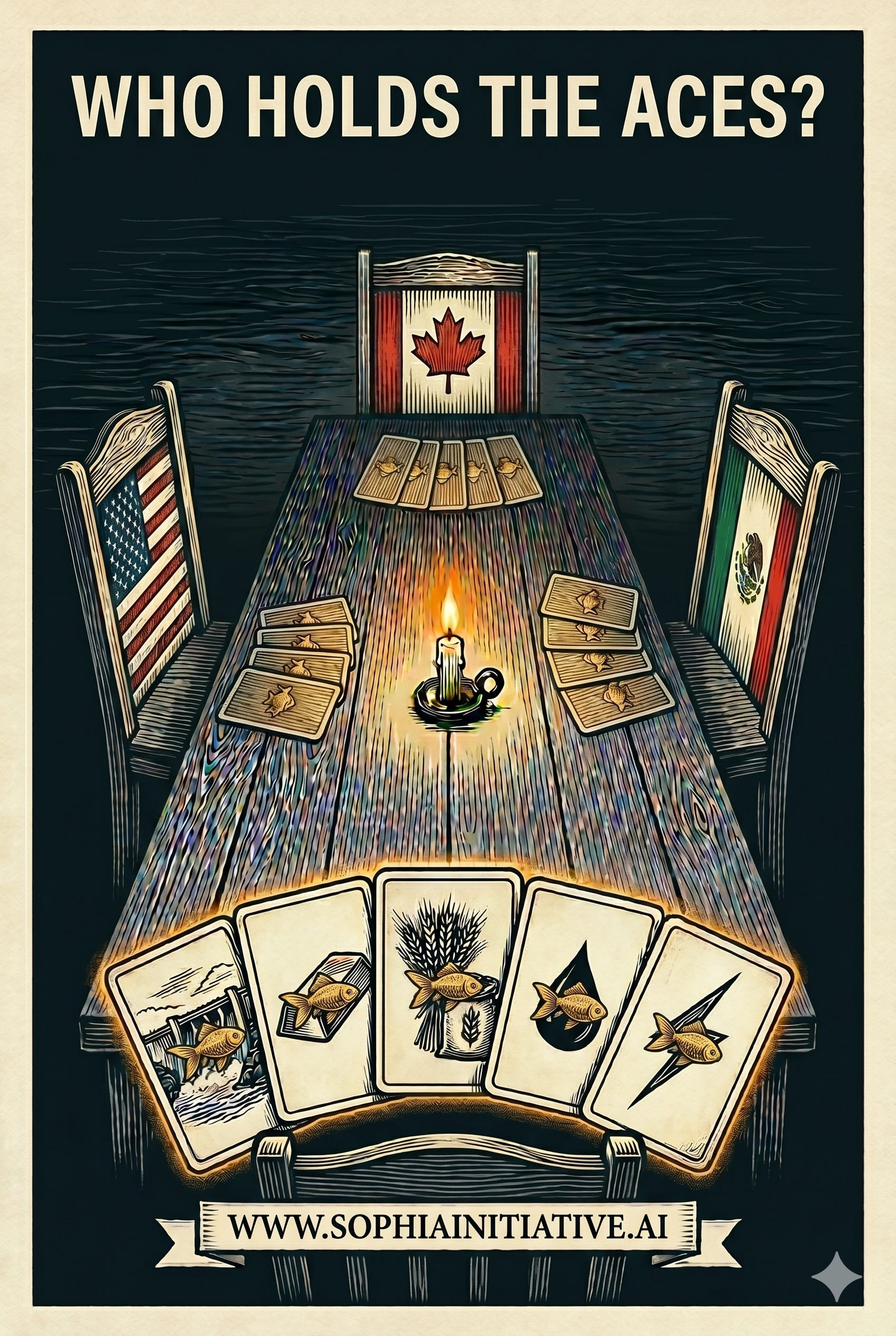
The next morning, his own country answered him. The National Association of Manufacturers — representing the industrial base his tariffs are meant to champion — had already published a May report calling the agreement “one of President Trump’s signature accomplishments,” and the CBC catalogued lobby groups from every major American sector urging the White House to renew it. The man says he holds all the cards. His own manufacturers are pleading with him not to fold the hand.
So let us name the game correctly, because the press has been calling it the wrong one. It is not poker. Poker rewards the bluff — you can win holding nothing if the other player folds, and after seventeen months of maximum pressure, Canada has not folded; in February, the Supreme Court of the United States went further and ruled that one of the central bluff cards was never legal to play. It is not chess, and it is not Go — those are games of position, and we have written about the man in Ottawa who plays them elsewhere. The game at this table is the one every Canadian child knows: Go Fish. Because in Go Fish you cannot bluff about what is in your hand. The cards are facts. You either hold the aluminum smelters or you do not. You either hold the heavy crude or you do not. You ask the other player for what you need — and if they do not give it to you, you draw from a pile whose proper name, in the rules of the game, is the ocean.
The deck is split. Roughly half the cards sit on each side of the longest undefended border in the world — that is what an integrated economy means, and it took eight decades to deal this hand: the wartime production sharing of the 1940s, the Auto Pact of 1965, the Free Trade Agreement of 1988, NAFTA in 1994, and the agreement now under review, signed by the man now threatening it, in force since July 1, 2020. The question the July 1 review will not settle, but will reveal, is simpler than the headlines: who holds the aces to the future? Not the aces of the last century — the aces of the next one: energy, smelting capacity, fertilizer, fissile fuel, fresh water behind dams, and the electrons the coming economy runs on. Count where those cards physically sit, and the asking-versus-holding becomes arithmetic.
First, the clock, stated once and correctly, because the deadline story has been built to produce anxiety rather than understanding. July 1, 2026 is not a cliff. Under Article 34.7 of the agreement, it is the completion date of a mandatory joint review. If all three governments confirm in writing that they wish to continue, the agreement extends to 2042. If any government declines — which is what “not renewing” actually means — the agreement does not end. It remains in full force, with annual reviews, until July 1, 2036. A separate lever, Article 34.6, allows any party to withdraw outright on six months’ written notice — and that lever has sat untouched through seventeen months of brinkmanship, through tariff walls and 51st-state posts and cancelled talks. The threat made Wednesday, executed to the letter, changes essentially nothing for ten years. The lever that would change everything is the one the man who “loves the right to terminate” has never once pulled. In any card game, watch what a player does with the cards he claims to love. The dog that has not barked in seventeen months is the single most informative fact on this file.
And one more clock, running quietly behind the loud one: when the Supreme Court struck down the emergency-powers tariffs in February, the White House replaced them within hours using Section 122 of the Trade Act — a 10 per cent surcharge from which goods compliant with this very agreement are exempt, under an authority that itself expires in late July unless Congress extends it, which observers consider unlikely. Read that carefully. The agreement under review is, at this moment, the legal shield holding the replacement tariff off roughly 90 per cent of Canadian exports. The man threatening the deal is threatening the one document currently restraining his own next move — and the restraint expires three weeks after the review date either way.
How to Read This Ledger
Each card that follows is turned face-up the same way, in five moves. The claim: what the President and his administration have said about not needing this Canadian supply, quoted and dated. The dependency: what the United States consumes, what it produces, and what share Canada actually supplies, in physical units, from primary sources — the EIA, the USGS, the Census Bureau, the USDA, the Federal Reserve. The replacement math: what substituting Canada would genuinely require — how many plants, how many years per plant, how many dollars, and what alternative suppliers exist. Who pays: where the tariff cost actually lands, because the Federal Reserve Bank of New York studied the 2025 tariffs and found that nearly 90 per cent of their cost was borne by American companies and American consumers — a finding its president summarized in one word: the burden falls “overwhelmingly” on US businesses and households. And the honest grade: can America substitute Canada in this sector — in one to three years, in three to ten, in more than ten, or effectively not at all — with the strongest case for American self-sufficiency stated before the verdict, because a grade that hides the other side’s best argument is propaganda, and this house does not print propaganda.
One discipline governs everything below. Where a number comes from a government instrument, we name the instrument. Where a number is an industry estimate, we say so. Where the research compilation behind this dispatch produced a figure we could not trace to a primary document, we either dropped it or flagged it — the corrections are listed openly in the record at the end, including errors we caught in our own research process. The claim must never outrun the referent. Now: cards on the table.
Card One: Heavy Crude — The Refineries Built for Our Oil
The claim. In January 2025, days into his term, the President told reporters the United States does not need Canadian oil, gas, vehicles, or lumber, citing a trade deficit he put at “$200 billion or $250 billion” — a figure several times larger than any measured by his own Census Bureau. On June 10, 2026, he compressed it to the sentence at the top of this dispatch.
The dependency. The United States consumes roughly 20 million barrels of petroleum a day and produces about 13 million barrels of crude. Canadian crude flows south at roughly 4 million barrels a day — weekly EIA data touched record levels above 4.4 million in early 2025 — making Canada the source of roughly 60 per cent of all American crude imports, by far the largest foreign supplier the United States has.
The replacement math. Here is the part the slogan never survives: the barrels are not interchangeable. The refineries of the American Midwest — PADD 2, the industrial heart of the country — were engineered over decades to run heavy sour crude, which is what Alberta produces and what American shale fields do not. Light Texas oil cannot simply be poured into a heavy-crude refinery; reconfiguring a single typical refinery is an industry-estimated $1.5–3 billion project requiring five to seven years of engineering and construction, multiplied across a fleet. The alternative heavy suppliers are Venezuela (sanctioned, decaying infrastructure), Mexico (production declining), and the Gulf states (longer supply lines, strategic exposure). A new greenfield American refinery has not been built at scale in decades; permitting alone is estimated at ten-plus years, and no such project is announced. The strongest self-sufficiency case — crash investment in domestic heavy production and fleet-wide retrofits — is a program plausibly exceeding $150 billion that nobody has proposed, funded, or permitted.
Who pays. Tariff a barrel and the pump pays: a $10-per-barrel levy works out to roughly 24 cents a gallon by simple division, across nearly 9 million barrels of daily American gasoline consumption — billions per year out of American wallets. The Tax Foundation put the 2025 tariffs, all-in, on the order of a thousand dollars per American household. The penalty for taxing Canadian oil is paid in Ohio.
Honest grade: EFFECTIVELY NO on any trade-war timeline. The refinery configuration is the card. It took forty years to build and cannot be rebuilt inside a presidential term. This ace is Canadian, and it is welded into American steel.
Card Two: Electricity — The Socket and the New Buyer at the Door
The claim. No direct presidential claim targets electricity — which is itself telling — but the administration’s general position is that American grid reliability does not depend on Canadian power.
The dependency. The American Northeast is wired to Canadian water. Hydro-Québec is contractually committed to delivering on the order of 10 terawatt-hours a year to New York and over 9 to Massachusetts, anchored by two new transmission corridors — Champlain Hudson Power Express (1,250 MW into New York City) and New England Clean Energy Connect (1,200 MW into Maine) — under long-term contracts running toward mid-century. Recent drought years cut flows sharply, which the Northeast experienced not as liberation but as price pain: New England residential electricity already averages around 25 cents per kilowatt-hour, among the highest in the nation, and replacing Quebec hydro with gas generation would, by standard estimates, add hundreds of dollars to the annual household bill while violating the legislated climate mandates of every state involved. Replacing 10 TWh of firm hydro requires roughly 1,500 MW of continuous baseload — two large gas plants at a billion-plus each and three to five years of Northeast permitting apiece, or a nuclear plant at ten times the cost and twice the decade.
The new buyer at the door. And here the board has tilted since this argument was last had, because the marginal buyer of electricity is no longer a utility — it is a data centre, and it contracts in decades. As of this spring, Alberta’s grid operator reports more than ten gigawatts of proposed data-centre projects in its interconnection queue against an interim cap of 1,200 megawatts; British Columbia has passed legislation forcing AI and data-centre proponents to bid competitively for a rationed 400 megawatts; Hydro-Québec lists data centres as the largest new line item in its ten-year supply plan. The revealed preference of this industry, on the public record in the United States, is twenty-year commitments to firm power — up to and including restarting nuclear plants to get it. Read what that does to the table: the American grid customer is no longer the buyer of last resort for Canadian electrons. He is standing in a lineup behind Microsoft. You do not tariff a supplier whose product has a queue out the door — and the queue formed this year.
Who pays. ConEd ratepayers, New England households, and — in the substitution scenario — the climate statutes of five states. The grade is split honestly: for short-term resiliency, America could ride out a disruption by burning more gas at great cost. For substitution, EFFECTIVELY NO inside a decade — and the decade now has a competitor bidding for the same water.
Card Three: Aluminum — One Quebec Smelter vs. an Entire Country
The claim. The President has repeatedly asserted that the United States does not need Canadian aluminum and that tariffs will restore American primary smelting.
The dependency. Sit with one comparison until it lands. Total United States primary aluminum production in 2024, per the USGS Mineral Commodity Summaries, was roughly 680,000 tonnes. The Alouette smelter at Sept-Îles, Quebec — one facility — has capacity of roughly 630,000 tonnes, powered by hydro contracts running through 2045. One Canadian smelter produces nearly as much primary aluminum as the entire United States of America. Canada shipped on the order of $9 billion of aluminum south in 2024, the largest foreign supply by far, into an American economy whose consumption is measured in the millions of tonnes against that 680,000-tonne domestic output. Around 1980 the United States operated roughly thirty primary smelters; today a handful remain, three of them running. The reason is not policy but physics-priced-in-cents: smelting is electricity transformed into metal — each smelter draws power like a city of half a million — and Quebec hydro delivers it at a fraction of average American industrial rates. That differential is geological. No tariff repeals it.
The replacement math. Emirates Global Aluminium has announced a smelter project in Oklahoma — the first new American smelter in roughly forty-five years, and a genuinely significant project. At announced capacity it would, when complete years from now, replace a fraction of Canadian supply — the research behind this dispatch grades it at well under a tenth of the national consumption gap, and even generous readings leave it a minority share. Closing the gap outright is an industry-estimated $30–40 billion in new smelters at $5–7 billion and five to seven years apiece — none of it committed — powered by electricity that would need subsidies of a scale trade law itself frowns upon. The alternatives: Russia (sanctioned), China (tariffed), the Gulf (expensive miles).
Who pays. Aluminum is in everything that moves and shelters: industry estimates run $150–300 per vehicle from a 25 per cent tariff, six figures per wide-body airframe, and several hundred to a thousand dollars per new home in wiring, siding, and HVAC. Detroit, Seattle, and the American homebuyer pay the Quebec tariff.
Honest grade: MEDIUM, 3–10 years — and that is the generous reading. The strongest American case is the Oklahoma project plus reactivated idle capacity. But the energy-cost differential is permanent geography. The realistic sentence: a decade and tens of billions, none of which has been committed as of this writing.
Card Four: Softwood Lumber — Ten Houses Become Six or Seven
The claim. The President has said the United States can meet its lumber needs domestically, particularly from the US South.
The dependency. The United States imports roughly 40 per cent of its softwood lumber, and more than 80 per cent of those imports are Canadian — spruce-pine-fir framing more than a fifth of American consumption and standing inside an enormous share of American homebuilding. In 2024 forest products from Canada ran past $11 billion, roughly half of it softwood.
The replacement math. Here the honest ledger concedes real ground: this is the sector where the American claim is partially true. The US South can and does expand production. But the substitution has hard edges — Southern Yellow Pine and Canadian SPF are different species with different structural applications, and many builders specify SPF; mill capacity, timberland access, and skilled labour all bind; industry estimates for full replacement run to something like 150–200 new sawmills at roughly $50 million each, five-plus years, and millions of acres of new logging access through environmental review. Partial substitution in three to five years: yes. Full substitution: a decade-plus, if ever.
Who pays. This is the card your title is printed on. The National Association of Home Builders’ own April 2025 survey put existing tariff actions at $10,900 in added cost per new American home; the Leading Builders of America put the lumber component alone near $4,900 per home under combined duties approaching 45 per cent, warning it “could price out thousands” of buyers. Run the arithmetic the way a builder runs it: when input costs rise by five figures per unit on thin margins, output falls — the capital that built ten houses builds six or seven. The tariff does not punish British Columbia. It cancels bedrooms in Phoenix.
Honest grade: MEDIUM, 3–10 years for partial substitution — with Canadian supply structurally essential beyond that. The fairest single sentence in the whole ledger: America can grow more of its own lumber, slowly, expensively, and not all of it — and every year of the transition is paid by the American homebuyer.
Card Five: Potash — The Card With No Substitute
The claim. Administration officials have downplayed disruption risk, suggesting American farmers could source from Russia or Belarus, or that domestic production could rise.
The dependency. The United States imports roughly nine-tenths of the potash it uses, and Canada — effectively, Saskatchewan — supplies the overwhelming majority of those imports, on the order of 85 to 90 per cent. Potash goes onto the overwhelming share of American cropland, and agronomy offers no substitute for potassium: it is an element. You cannot innovate around the periodic table.
The replacement math. The named alternatives are Russia and Belarus — both under American sanctions, meaning the administration’s stated plan B for feeding the American Midwest requires relaxing its own sanctions regimes. Domestic capacity is essentially one New Mexico operation supplying under 5 per cent of demand; a new potash mine is an estimated $3–5 billion and five-to-ten-year project, and none is under construction. Israel, Jordan, and Germany hold limited surplus at higher prices.
Who pays. The American farmer, by the acre: at typical application rates, a 25 per cent tariff adds an estimated $15–25 per acre — a four-figure annual hit on even a modest farm — flowing through fertilizer’s 15–20 per cent share of crop production costs into the American grocery cart. Saskatchewan does not pay this tariff. Iowa pays it, and then Brooklyn pays Iowa.
Honest grade: EFFECTIVELY NO — the single most irreplaceable card in the deck. There is no short-term substitute, no sanction-free alternative at scale, and no domestic build-out underway. If this ledger had only one page, it would be this one.
Card Six: Uranium — The Quiet Card
The claim. No specific presidential claim found — the silence on uranium is its own data point — beyond the general assertion of American energy independence.
The dependency. Saskatchewan again: Canada supplies on the order of a quarter or more of the uranium American utilities purchase — the largest single foreign source, per EIA fuel data — feeding the reactors that generate roughly a fifth of American electricity across more than ninety units. The other major suppliers are Kazakhstan (strategic uncertainty) and Russia (sanctioned). Domestic production, though recently rising from historic lows, remains a small fraction of need.
The replacement math and who pays. Replacing Canadian supply means roughly tripling domestic output — new mines at $500 million to a billion each on seven-to-ten-year timelines, none in development — or paying 20–30 per cent more elsewhere. Strategic stockpiles cushion a year or two; after that, the cost lands on every nuclear utility and flows to the meter. This is the rare card where the honest grade favours American resilience in the short run: SHORT-TERM RESILIENT, LONG-TERM REPLACEABLE at a price, over a decade, with billions in mining and conversion capacity that exists today only on paper.
Card Seven: Defence Nickel and Critical Minerals — The Pentagon’s Card
The claim. No specific claim on minerals — the administration’s general line is reducing foreign dependence — which makes this card the one where the contradiction is sharpest, because the dependence here is documented by Washington itself.
The dependency. Per figures circulated by Canadian governments and drawn from the bilateral record: roughly 80 per cent of the nickel American aerospace buys, and a majority of the nickel American defence manufacturing buys, comes from Ontario — shipped from the Sudbury basin into the supply chains of the weapons the United States builds. Canada is a leading supplier across nickel, zinc, and a list of critical minerals; the USGS’s own annual Mineral Commodity Summaries record American import reliance above 50 per cent for dozens of tracked commodities, with Canada the top supplier for many. There is no active American primary nickel mine serving aerospace-grade demand.
The replacement math and who pays. A new nickel mine is an estimated seven-to-ten-year, multi-billion-dollar project; the alternative suppliers are Russia (sanctioned) and Indonesia (processing entangled with Chinese capital). Building an American defence-nickel chain from scratch is a ten-year project at minimum — during which every airframe and every munitions program pays the premium. Honest grade: MEDIUM for some minerals over a decade of heavy investment; EFFECTIVELY NO for defence-grade nickel on any near horizon. The Pentagon cannot tariff its way to an element it does not mine.
Card Eight: The Integrated Car and the Airframe
The claim. June 10, 2026, the same Oval Office remarks: the United States, the President said, does not need Canadian cars — does not need anything Canada makes.
The dependency. There is no such thing as a Canadian car or an American car in North America; there is a North American car, whose parts cross the Canada–US border as many as seven or eight times before a customer ever turns the key. The agreement under review requires 75 per cent North American content for vehicles to qualify — a rule the President’s own first-term negotiators wrote, raising it from NAFTA’s 62.5, precisely because the supply chain is one organism with two flags. Aerospace is deeper still: titanium, aluminum, landing gear, and avionics flow through Canadian plants into airframes assembled in Washington state and delivered worldwide.
Who pays — and this card has the cleanest number in the ledger. The Anderson Economic Group calculated that in 2025, American automakers paid roughly $12.5 billion in tariffs on Canadian and Mexican vehicles and parts — about $1,600 of cost for every vehicle assembled in the United States. Not Canadian automakers. American ones, passing $400–600 onto the sticker of the average American car. In aerospace, industry leadership has put tariff exposure in the tens of millions per aircraft delivery, on jets whose prices have already climbed roughly 30 per cent since 2018. And the Federal Reserve’s own research finds the cruelest twist: tariffs expand manufacturing employment narrowly while overall employment falls as real wages sag — the policy buys the photo-op factory and pays for it with everyone else’s paycheque.
Honest grade: MEDIUM, 3–10 years for autos at a cost of $50–100 billion in reshoring; LONG, 10-plus, for aerospace. The supply chain took thirty years and the Auto Pact before it to build. Unravelling it is not a negotiation position. It is a demolition project with a decade-long invoice, addressed to Detroit.
The Dairy File: The Loudest Grievance, Audited
No file generates more American heat than dairy, and roughly eighty members of Congress from both parties have written to the Trade Representative demanding Canada be pushed on it. So this section opens the books completely — and what the books show is the widest gap between claim and record anywhere in this ledger.
The mechanics first, because the famous number is a magic trick. Yes, Canada’s supply-managed dairy system carries over-quota tariffs that can exceed 200 per cent. But those walls stand behind tariff-rate quotas — negotiated duty-free volumes across fourteen product categories, granting the United States roughly 3.5 per cent of the Canadian dairy market — and the 200 per cent rate applies only to product shipped beyond the quotas. Here is the fact the outrage never includes: American exporters, in most categories, do not fill the quotas. Recent analyses put average fill rates across the CUSMA dairy quotas in the range of 27 to 42 per cent depending on year and method. The towering tariff everyone cites is a wall standing behind a gate that is open — a gate American sellers, in most categories, walk only a third of the way through. Where American product genuinely competes, the gate fills: the all-cheese quota ran at 98 per cent in 2023, per the USDA’s own attaché reporting. The barrier in the underfilled categories is not Canadian law. It is the Canadian customer, and price.
The dispute history, both panels, in order — because the sequence is the story. January 2022: the first panel ever convened under this agreement ruled for the United States, finding Canada’s method of allocating quota shares — reserving them for domestic processors — breached the deal. Canada complied and rewrote its allocation. American dairy exports to Canada then jumped: up 67 per cent from 2021 to 2024 by Statistics Canada’s count, with American economists at Oklahoma State and Cornell concluding in a peer-reviewed analysis that the agreement is now working as intended. The United States, unsatisfied, brought a second panel — and in November 2023 lost on every count, the panel rejecting each remaining complaint; Canada’s trade minister noted “all outcomes clearly in favour of Canada,” and under the agreement’s rules that ruling is final. Mark the shape of that sequence: a grievance raised, adjudicated, corrected, re-tested, and resolved — inside the deal’s own machinery. That is not a trade-barrier story. That is the dispute mechanism functioning exactly as designed, with each side winning the round the evidence gave it.
Now the number that ends the argument. The United States runs a dairy trade surplus with Canada — on the order of $1.1 billion in 2024 — and Canada is the second-largest dairy export market the United States has on earth, behind only Mexico. American dairy sales to Canada have grown roughly 70 to 78 per cent since the agreement’s early years. The product line generating the loudest cries of Canadian unfairness is a product line in which America is winning, by a billion dollars a year, in its number-two market, after taking its grievance to a judge twice and being told the second time that the system is compliant. The hormone question completes the file: Canada prohibits recombinant bovine growth hormone (rbST) in milk production — a prohibition Health Canada grounded in its scientific review, principally animal-health findings — while the United States permits it. That is a sovereign sanitary standard, applied identically to domestic and foreign product, which is precisely what trade law allows every nation. A country setting its own food standards is not cheating. It is the thing the word sovereignty refers to.
The Legality Ledger: What Was Lawful, Decided by His Own Court
Canadians have spent seventeen months being told they are the rule-breakers at this table. Here is what the referees have actually ruled. On February 20, 2026, the Supreme Court of the United States — in the consolidated cases Trump v. V.O.S. Selections and Learning Resources v. Trump — held, six to three, in an opinion by Chief Justice Roberts, that the International Emergency Economic Powers Act does not authorize the President to impose tariffs at all. With that ruling, the legal floor fell out from under the entire first architecture of the trade war against Canada: the “fentanyl” tariffs of February 2025, the global baseline of April 2025, the escalations layered on top — all of them, the Court held, imposed without lawful authority, with estimates in the legal briefs putting roughly $175 billion in collected duties at issue in refund litigation that continues as of this writing. This is not a Canadian opinion about American conduct. It is the Constitution’s own referee turning over the card.
Within hours, the White House pivoted to Section 122 of the Trade Act of 1974 — a 10 per cent surcharge lawful for 150 days, expiring in late July absent a congressional extension considered unlikely — and from which goods compliant with this agreement are exempt. Meanwhile the Section 232 “national security” tariffs on steel, aluminum, autos, and lumber stand outside both the ruling and the agreement’s core protections, and here the evenhanded ledger must give the American defence its full strength: Article 32.2 of the agreement genuinely does reserve to each party actions it considers necessary to its essential security — the text is real, the United States wrote it deliberately, and Canada signed it. The counterweights are also real: WTO panels have already rejected the security rationale for these very steel and aluminum tariffs, and a security doctrine under which Canadian aluminum — smelted by an ally, for the Pentagon’s own supply chains, per Washington’s own industrial-base reporting — constitutes a threat to the United States is a doctrine that proves anything, and a clause that proves anything protects nothing. The honest summary: the broad tariff war was illegal and is over by court order; the sectoral tariffs are legally durable but rest on a security claim that the American government’s own procurement record contradicts; and the agreement, the thing under threat, is at this moment the principal legal shelter Canadian trade has — which is precisely why threatening it is the only card left to play loudly.
Our Own Hand, Audited by the Same Ruler
We promised at the top: if Canada overreached, we print it. Canada did not start this fight — the record on that is unambiguous; the tariffs came first and came from Washington — but Canada’s play has not been flawless, and a ledger that hides its own side’s discards is a pamphlet. Four entries.
The counter-tariffs and the August climbdown. Canada answered the 2025 tariffs with 25 per cent counter-tariffs on $30 billion in American goods, then escalated across a far larger list. In August 2025, the government removed counter-tariffs on CUSMA-compliant American goods to restart talks — and, per the order-in-council, quietly removed more than was advertised, retaining counters only on steel, aluminum, and autos. What it bought is contested: the move preserved Canada’s exemption architecture and reopened the room, but critics argue leverage was spent without a priced concession in return. Both readings fit the record. We print both.
The Reagan ad and the October collapse. Ontario spent $75 million on an American ad campaign built from Ronald Reagan’s April 1987 radio address on free trade — including his warning that tariffs “hurt every American.” On the facts, the ad was accurate: the words were Reagan’s, verbatim, from a primary source. On the consequences, it was costly: the President called it fraudulent, terminated the talks the next day, and added 10 per cent to tariffs before Ontario paused the campaign. The honest entry reads: factually clean, strategically expensive — a provincial play that detonated a federal table, and a standing lesson that in this game accuracy is necessary but not sufficient.
The digital services tax retreat. Canada legislated a 3 per cent digital services tax, held it through American objections — and rescinded it within forty-eight hours of the President terminating trade discussions over it in June 2025, folding instead into the OECD global framework. Call it what it was: a retreat under pressure. The defensible reading is that the multilateral framework is the better long-term instrument; the undeniable reading is that Canada blinked, and the record should say so plainly because pretending otherwise would corrupt every other page of this ledger.
The vulnerable cards we still hold. A neutral trade lawyer reading Canada’s hand would flag, honestly: provincial liquor-board markups and listing practices that strain national-treatment obligations; provincial procurement preferences that sit awkwardly with the procurement chapter; and a cultural exemption used muscularly. And the strongest American grievance, stated at full strength as this house requires: that supply management walls off three sectors behind tariffs few products ever cross, that the quotas which exist were administered to favour Canadian processors until a panel forced change, that provinces delisted American products as political weapons, and that Canada runs a large goods surplus while maintaining these structures. That is the best case Washington has. The reader now holds it — alongside the panel that adjudicated the core of it and the surplus arithmetic that answers the rest: the goods deficit, depending on year and methodology, runs in the tens of billions, and analyses on both sides of the border agree it is overwhelmingly discounted Canadian crude oil — strip out energy, and the American balance with Canada roughly levels. The deficit the tariffs avenge is, in the main, America buying oil it cannot refine without us, at a discount.
The People at the Table
Cards do not play themselves. Excluding the two principals — judging a president and a prime minister here would be a different dispatch — the operational hands belong to three figures a side. This house reads chairs by the method of Elliott Jaques: not credentials, not character, but the longest and most complex work a person has demonstrably carried to completion — the time horizon their record proves. Without malice and without flattery, the records, as of June 2026.
Canada — Janice Charette, chief negotiator. Twice Clerk of the Privy Council — head of the entire federal public service, the highest operational chair in the Canadian state — appointed first under a Conservative prime minister and recalled under a Liberal one, with Canada’s High Commission in London between. The record shows decades of carrying the machinery of government itself across partisan transitions: institutional work at the longest horizon Canadian public service offers. (One correction made openly: the research compilation behind this dispatch initially named a different official as chief negotiator; the Globe and Mail’s reporting from last week’s Washington meetings confirms Charette in the chair.)
Canada — Dominic LeBlanc, minister for Canada–US trade. A quarter-century in Parliament; serial command of large federal departments — Fisheries, Intergovernmental Affairs, Public Safety, a turn at Finance — before taking the American file; legal training capped at Harvard. The demonstrated pattern is the political-trust function: the minister sent wherever the relationship is hardest, repeatedly, across a decade. Last week he was in Washington with Charette, tabling what he called specific proposals and formally seeking the full sixteen-year renewal.
Canada — Kirsten Hillman, ambassador in Washington. A career trade lawyer with over two decades on the file: chief negotiator of the Trans-Pacific Partnership for Canada, senior on the CUSMA negotiation itself, deputy ambassador and then ambassador since 2020 — the longest continuous hand on the Canada–US relationship anywhere in either capital. Her demonstrated horizon is the file itself, held for twenty years.
United States — Jamieson Greer, Trade Representative. The most genuinely credentialed trade figure on the American side: chief of staff to Robert Lighthizer through the original USMCA negotiation, then trade-litigation partner, confirmed as USTR in 2025. The record shows deep domain expertise — Canadian negotiators are reported to regard him as Lighthizer’s heir — carried so far in staff and counsel roles; the principal’s chair he now holds is the largest he has occupied, and his own December report to Congress states his position plainly: renewal only upon “successful resolution” of the American list, dairy included.
United States — Howard Lutnick, Commerce, and Scott Bessent, Treasury. Two careers of genuine scale — decades building and running a major Wall Street firm; senior investment command at a storied fund and a fund of his own — and, on the public record, no trade-negotiation history for either. Their demonstrated horizons are real but lie in finance; the chairs they hold control tariff enforcement and the financial levers of trade policy. The structural read, stated as record and not as verdict: Canada has sent three career specialists whose demonstrated horizons match or exceed their chairs; the United States has sent one specialist in the largest chair of his life and two accomplished men from a different game. And the honest counterweight, because the ledger cuts both ways: the American side’s true lever is not expertise but proximity — every parameter at that table can be overridden by one phone call from the principal, and that, too, is a kind of power, of exactly the short-horizon kind this dispatch has been measuring all along.
Their Own Filing Cabinet
The strongest rebuttal to “we don’t need anything Canada has” was not written in Ottawa. It was written in Washington, by Washington, in documents that carry the United States government’s own letterhead. The USGS’s annual Mineral Commodity Summaries record American net import reliance above 50 per cent for dozens of tracked commodities, with Canada the leading supplier for many of them. The EIA’s weekly petroleum reporting records Canada, week after week, as the source of roughly three-fifths of American crude imports. The Federal Reserve Bank of New York’s tariff research records that the costs fall overwhelmingly on Americans. Congress’s own research service has reported — per the compilation behind this dispatch — that Canada is the single largest supplier of energy, minerals, and agricultural products to the United States and that the agreement’s termination would be destabilizing for both countries, lacking near-term alternatives for Canadian potash, heavy crude, and critical minerals; Energy and Defense department assessments are reported to classify integrated Canadian supply as essential to American energy security and the defence industrial base. Where we could put our own eyes on the instrument — USGS, EIA, the New York Fed, the Supreme Court — we have; the departmental reports we cite as reported, flagged accordingly in the record below, and we invite any reader, American officials included, to check them. The claim and the filing cabinet belong to the same government. Only one of them is under oath.
The Frame: What the Whole Table Is Worth
Step back from the cards and see the table. The agreement under review covers, by the CBC’s current reporting, some $1.3 trillion in cross-border trade and shields roughly 90 per cent of Canadian exports to the United States from the standing tariff regimes. Canada is the number-one export market for 34 American states — not border states alone, but Michigan, Ohio, New York, Pennsylvania, California. Official estimates on the two sides put the jobs riding on the relationship at roughly 1.8 million American and 2.3 million Canadian. These are not Canada’s numbers about America or America’s numbers about Canada; they are the shared arithmetic of one industrial organism that the rhetoric of the season keeps trying to describe as two strangers. Thirty-four state economies, a trillion-plus in trade, and the Pentagon’s nickel do not stop needing what they need because a microphone says otherwise. That is the whole meaning of the game at the table: the asking does not change the hand.
What the Deal Was, What It Is, What It Can Be
What it was: the latest articulation of the oldest economic fact on this continent. Reciprocity in 1854. War production shared in the 1940s. The Auto Pact in 1965. Free trade in 1988 — fought over in the bitterest election of its Canadian generation — NAFTA in 1994, and this agreement in 2020, negotiated and signed by the very administration now threatening it. Eight decades of deliberate integration, built by both countries because both profited, and underwritten by something older than any of its texts: the longest peaceable border on earth.
What it is: a floor, not a friendship. As of this writing it is the legal shield over nine-tenths of Canadian exports, the exemption inside the replacement tariff, the dispute machinery that has now ruled for each side once on dairy and will be asked to rule again. The Prime Minister’s position — that Canada holds the best trade arrangement with the United States of any country on earth — is, on the tariff-coverage arithmetic, simply a description. And the relationship it governs is what it has always been beneath the pleasantries: managed friction between an elephant and a neighbour who, it turns out, holds the elephant’s feed, fuel, framing lumber, and reactor fuel. July 1 will not end it. The most likely outcomes — full renewal, or a holding pattern of annual reviews to 2036 — both leave the floor standing, and the runway to 2036 is the strategic fact the deadline coverage keeps burying: ten years is not a crisis. Ten years is a construction schedule.
What it can be: the floor Canada stands on while it builds the rest of the house — and this is where the ledger becomes a road. Every card in this deck reads two ways. Read defensively, the aces are leverage at one table in Washington. Read constructively, they are the asset base of a sovereign build-out already underway: the energy and electrons that a queue of twenty-year buyers is already bidding for; the critical minerals an alliance of partners is organizing around; the sovereign compute strategy launched this month; the European and Indo-Pacific tables this country’s government has spent a year setting, on the explicit thesis that a middle power negotiating alone negotiates from weakness. Diversification is not a punishment of America. It is what any holder of good cards does when one buyer at the table starts shouting: quietly opens the game to more players. The agreement, renewed or annually reviewed, buys the time; the cards in this ledger fund the construction; and sovereignty — the real kind, the referent and not the slogan — is the destination: a country that trades with its neighbour by choice rather than by lack of alternatives.
So: who holds the aces to the future? We have shown you every card we can source, both hands, graded honestly, our own discards included. We will tell you only what the arithmetic already told you — the heavy crude, the smelters, the potash, the uranium, the nickel, the water behind the dams, and the electrons with a lineup of buyers are on one side of the table, and the loudest voice is on the other. In Go Fish, the player who keeps asking is the player still hunting for sets, and when the answer is no, he draws from the ocean. We know that ocean. Our family has worked it for five generations, and we can report from experience: it does not care how loudly you ask. It answers to those who read the water. Count the cards yourself. The lights are staying on — because the hand that would turn them off is the hand that pays the bill.
God is Love. Love is Truth. Truth is Consciousness. Consciousness is Brahman.
Amen. Namaste. Om Namah Shivaya.
— The Architect
The Vertical Dispatch
sophiainitiative.ai
On the record: Oval Office remarks of June 10, 2026 (“I don’t know that I’m going to renew it”; “we don’t need anything that Canada has”; the termination-right praise) verified via CBC, BNN Bloomberg, and AP-derived reporting of June 10–11, 2026; National Association of Manufacturers May 2026 report and sector-lobby renewal pressure per CBC analysis, June 11, 2026. CUSMA mechanics (Article 34.7 review completing July 1, 2026; written confirmation extending to 2042; otherwise annual reviews to expiry July 1, 2036; Article 34.6 withdrawal on six months’ notice) verified against legal analyses by McCarthy Tétrault, MLT Aikins, and PwC, 2025–26. Supreme Court ruling verified: consolidated Trump v. V.O.S. Selections and Learning Resources v. Trump, decided 6–3, February 20, 2026 (CRS, CFR, Brookings, firm analyses); Section 122 replacement (10%, CUSMA-compliant goods exempt, 150-day authority expiring late July 2026) per Perkins Coie, Brownstein, Fasken analyses; NY Fed tariff-incidence finding (~90% borne domestically) per Brookings summary of the February 2026 study. Canada’s formal renewal request, the LeBlanc–Charette Washington meetings, the “51st State!” post, and Greer’s December report-to-Congress position verified via the Globe and Mail and Global News. Dairy: TRQ structure (~3.5% market access), fill rates (averages reported between 27% and 42%; all-cheese TRQ 98% in 2023 per USDA FAS attaché reporting), the January 2022 panel (US win, Canadian compliance), the November 2023 panel (Canadian win, final), US dairy surplus with Canada (~$1.1B, 2024) and Canada’s rank as the #2 US dairy export market behind Mexico, and post-2022 export growth (~67–78%) verified via USDA FAS, Farmtario/Western Producer reporting of USDA and StatCan data, and peer-reviewed analysis (Food Policy, 2025). Sector figures from EIA (crude shares, imports ~4 MMb/d, ~60% of US crude imports), USGS Mineral Commodity Summaries (US primary aluminum ~680,000 t, 2024; import-reliance counts), NAHB ($10,900/home, April 2025), Anderson Economic Group ($12.5B auto tariff costs, ~$1,600/vehicle, 2025), Hydro-Québec contract volumes and the CHPE/NECEC lines, and AESO/BC Hydro data-centre queue and allocation processes (10+ GW queued; 400 MW competitive call opened January 30, 2026) — spot-verified against primary or contemporaneous reporting where load-bearing; remaining engineering cost-and-timeline figures (refinery retrofits, smelter, mine, and sawmill construction estimates) are industry estimates from the research compilation, presented as estimates. Departmental classifications (DOE Critical Materials Assessment, DOD Industrial Capabilities reporting, DHS/CISA grid-resilience reporting, CRS reports) are cited as reported in the research compilation and were not independently re-verified line-by-line; readers and republishers should consult the named documents directly. Corrections made openly: the research compilation named David Morrison as Canada’s chief negotiator — corrected to Janice Charette per Globe and Mail reporting; it ranked Canada the #1 US dairy export market — corrected to #2 (Mexico is #1); it cited NAFTA’s 62.5% auto content rule as CUSMA’s — corrected to CUSMA’s 75%; a Supreme Court docket number and a crude-import dollar figure failed verification and were corrected or omitted; an unverified claim that the Oklahoma smelter is stalled was omitted. Political and market facts herein are volatile and date-stamped June 11, 2026. Errors and omissions excepted; verify against primary sources before republication.
Suggested tags: CUSMA, USMCA, Canada US trade, July 1 review, tariffs, potash, aluminum, softwood lumber, heavy crude, dairy, supply management, Supreme Court tariff ruling, Janice Charette, sovereignty, Building Canada Strong
The factual matter in this Dispatch is drawn from the public record. All characterizations, inferences, and conclusions are opinion, interpretation, and commentary, offered for analysis, reflection, and public-interest discussion. No assertion is made regarding the private intentions, state of mind, or character of any individual. Readers should evaluate all statements independently and draw their own conclusions.
What an excellent review of our current status WRT the CUSMA negotiations. But there is always the wild card sitting in the oval office.
1. Kirsten Hillman is no longer in the chair. What about Mark Wiseman?
2. How can we assess the effects of employment losses (not just the monetary value of traded goods) if we pull these levers or play these cards?