

Φ
THE VERTICAL DISPATCH
We write for the mind, the eye, and the ear.
Read it. Look at it. Listen to it. The Vertical Dispatch is built for all three — prose with rhythm, made to be heard as much as read.
From metaphysics to geopolitics, from culture to history, from the sacred to the street — and everything in between. One lens, every subject. No ego. Just the record, named clean.
Press play. Walk with the word. 🕯️
This dispatch travels by hand. If it serves you, share it — restack on Substack, and pass it on wherever you read. 🕯️
sacredmetaphysics.org
0protocol.ai
visva.world
sophiainitiative.ai
Law of Unintended Consequences
Elon Musk stands before modern society as a walking paradox—a constructed character of the digital age whom millions hail as a civilizational savior while millions of others see a restless technocrat consumed by a god complex.
To his admirers, he operates as the lone industrialist willing to drag humanity into an electric, automated, multi-planetary future while legacy institutions dither. To his critics, he embodies unchecked oligarchic hubris: a private citizen accumulating leverage over orbital launch infrastructure, global satellite communications, artificial intelligence, neural interfaces, and a worldwide speech platform while demanding exemption from the rules that bind everyone else.
That savior mythology draws straight from Ayn Rand’s Objectivist playbook—cast in the mold of Howard Roark in The Fountainhead and John Galt in Atlas Shrugged, the romanticized lone creator who insists his brilliance entitles him to stand above public rules and collective accountability. Yet the irony is glaring: Rand’s fictional heroes refused state entanglement on principle, whereas today’s self-styled John Galts preach rugged individualism while thriving on multi-billion-dollar defense contracts, regulatory waivers, and executive patronage.
This exact convergence is where Carl Jung’s starkest warning meets Margaret Atwood’s Oryx and Crake—and where the law of unintended consequences enters full spate.
Jung spent decades warning that humanity’s greatest danger is never nature, nor even the machine itself, but man—specifically, the unexamined human psyche wielding technological power that far outstrips its moral and emotional maturity. In Atwood’s Oryx and Crake, that warning takes concrete form: sovereign democratic governance dissolves into fortified corporate Compounds run by brilliant, emotionally detached architects who treat ordinary human beings as defective drafts, dismiss ethics as obsolete friction, and trigger a planetary catastrophe in the name of engineering a cleaner future.
Look around at the landscape of 2026 and ask a simple question: Does anyone read the books or watch the movies anymore?
I. THE CINEMA OF WARNING WE MISTOOK FOR ENTERTAINMENT
For more than a century, literature and cinema have tried to inoculate modern society against a very specific archetype: the unaccountable private genius who consolidates frontier science, private territory, and global communications faster than democratic law can erect guardrails.
In H.G. Wells’s The Island of Doctor Moreau, the danger begins the moment a gifted mind retreats beyond the reach of public accountability, convinced that raw capability confers the moral right to rewrite biological boundaries without restraint. In Atwood’s Oryx and Crake, Crake operates inside a gilded corporate Compound, insulated from the decaying ‘pleeblands’ outside, convinced he alone possesses the clarity to redesign the human condition—and utterly blind to the human wreckage he leaves in his wake.
Ridley Scott’s twin science-fiction landmarks—Blade Runner and Alien—capture both halves of that exact corporate-power equation. In Blade Runner, corporate hubris under the Tyrell banner leaves Earth polluted, stratified, and haunted by manufactured life while off-world promises lure the privileged away from a hollowed-out home world. In Alien, Weyland-Yutani’s cheerful corporate motto—’Building Better Worlds’—masks a cold industrial ledger in deep space where crew members become expendable assets the moment profit and frontier ambition collide with unforeseen danger.
Even mainstream cinema spelled the pattern out in neon letters. Classic James Bond antagonists—from Hugo Drax building a private orbital escape ark in Moonraker to Elliot Carver weaponizing a global media and satellite empire in Tomorrow Never Dies—seemed like theatrical fantasy precisely because no single private citizen could plausibly command rockets, global communications, and geopolitical leverage outside sovereign control. Later films like The Island and Elysium sharpened the moral divide even further: manufactured illusions concealing human commodification on the ground, and gleaming orbital sanctuaries floating above a degraded Earth.
Today, that boundary between cautionary cinema and daily headlines has collapsed. We spent fifty years applauding these stories in darkened theaters, only to treat their real-world convergence as a routine business-page profile. And in the rush to celebrate engineering milestones, we forgot the central lesson of every warning ever written: when one constructed persona sits atop critical infrastructure without institutional checks, the law of unintended consequences does not ask permission before it breaks loose.
RIDLEY SCOTT’S TWIN WARNINGS
Blade Runner shows corporate hubris hollowing out Earth while promising off-world escape; Alien shows corporate indifference turning deep space into a cold ledger where human lives become expendable.
II. THE GLOBAL TOWN SQUARE AND THE FIRE ALARM
Consider how that contradiction plays out every day on X, the social platform Musk acquired and reshaped into what he calls the global town square.
In constitutional law and basic civic logic, free speech has never meant consequence-free amplification of harm. Oliver Wendell Holmes Jr.’s famous principle—that free speech does not protect falsely shouting ‘Fire!’ in a crowded theater and causing a panic—rests on a straightforward distinction between expression and engineered endangerment. A town square works because human beings stand face to face under shared civic norms, not because one owner controls an algorithmic bullhorn calibrated to reward outrage, panic, and tribal rage with instant planetary reach.
Under Musk’s banner of ‘free speech absolutism,’ X has dismantled trust-and-safety guardrails while retaining total algorithmic control over what millions see, suppress, or amplify. Regulators across Europe and the United Kingdom have repeatedly clashed with the platform over disinformation, Digital Services Act transparency obligations, and non-consensual synthetic imagery generated through its integrated xAI tools. Meanwhile, critics have documented a glaring double standard: a platform that claims to defy democratic regulators in the name of pure speech has repeatedly complied with censorship demands from authoritarian governments and throttled outbound links to rival writers and independent publishing platforms.
You cannot claim to be the neutral custodian of the public square while owning the megaphone, writing the algorithm, and using the platform to wage personal political campaigns—including pouring roughly half a billion dollars into American electoral politics before calling that spending ‘foolish’ once the political winds shifted.
III. THE SECURITY-CLEARANCE LAPSE ACROSS TWO ADMINISTRATIONS
The deeper institutional crisis, however, is not merely what happens on a social feed—it is how national-security vetting and public accountability collapsed at the exact intersection of Musk’s corporate empire and both terms of the Trump administration.
Under the United States Constitution, the president holds sweeping authority over classified information and executive-branch clearances. For decades, presidents of both parties respected career background investigations as a vital firewall against foreign leverage, financial entanglement, and personal vulnerability. Across both Trump terms, that firewall was systematically bypassed.
During the first Trump term, a White House security whistleblower testified to Congress that senior appointees overruled career specialists to grant clearances to at least twenty-five individuals initially flagged over foreign contacts, financial liabilities, or personal conduct—most famously when Trump ordered senior aides to grant Jared Kushner a Top Secret/SCI clearance despite intelligence objections. Other aides operated for months under ‘interim’ clearances while FBI background flags remained unresolved.
In the second term, what had been handled through case-by-case overrides became Day-One policy. On January 20, 2025, Trump signed a presidential memorandum granting immediate interim security clearances and system access to White House-designated personnel before standard FBI background checks were completed. Under that umbrella, Musk and his Department of Government Efficiency (DOGE) teams moved rapidly into sensitive federal payment systems, personnel databases, and agency networks across Washington—sidelining career security officials who attempted to enforce standard classification protocols, while active federal inquiries across eleven agencies touching Musk-led companies were paused, closed, or stripped of watchdogs.
Look at the double standard embedded in that arrangement. An ordinary aerospace engineer, military officer, or civil servant who publicly discusses using controlled substances—even prescribed ketamine for depressive moods—or maintains dense commercial ties with foreign states faces immediate security-clearance suspension and career ruin. Yet SpaceX has accumulated multi-billion-dollar Pentagon and Space Force launch and satellite contracts while national-security lawyers advised against even seeking the highest Special Access Program clearances for its chief executive to avoid standard disclosure hurdles. And in November 2026, Trump openly remarked that he had ‘protected’ Musk during his first term after a ‘tough incident’—confirming that personal executive patronage, not institutional vetting, had become the governing standard.
Notably, such unchecked personal leverage thrives precisely because American institutions bent their guardrails. In a state-directed system like China, where Tesla manufactures hundreds of thousands of vehicles and utility-scale Megapack batteries in Shanghai on Beijing’s industrial terms, no private entrepreneur is permitted to operate an uncensored speech platform, deploy unauthorized satellite networks, or rival sovereign authority. Even more tellingly, Beijing used Giga Shanghai as an industrial benchmark—pushing local supply-chain localization toward 98 percent—before domestic champions like BYD, Xiaomi, and Leapmotor squeezed Tesla’s mainland retail share down to multi-year lows by late 2026, leaving Shanghai increasingly reliant on overseas exports while political leverage remained firmly in state hands. Musk’s empire is uniquely a creature of American deregulation and executive waivers.
IV. ORBITAL DOMINANCE, TRANSHUMANISM, AND THE BACK-ROW EXIT
Step back and look at the scale of what has been consolidated under a single unelected roof without democratic consent.
Through SpaceX, Starshield, and Starlink, Musk commands the dominant launch cadence and low-Earth-orbit satellite communications backbone relied upon by NASA, commercial operators, and the U.S. military. While outer space is nominally governed by the 1967 Outer Space Treaty and national licensing agencies, the sheer velocity of private mega-constellations and dual-use defense networks has outpaced legacy international protocols built for sovereign nations rather than private empires.
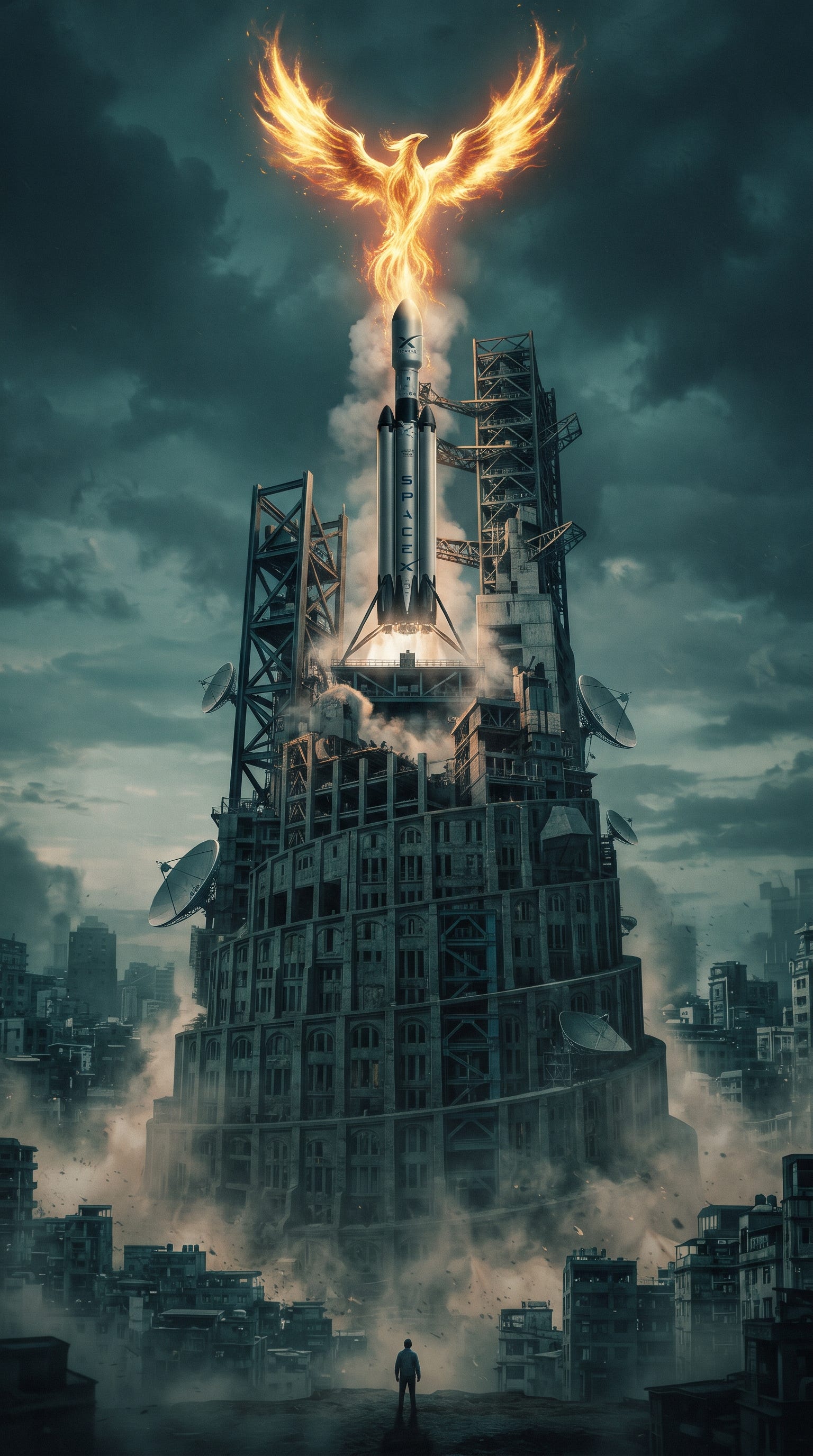
Every age of overreach builds its own Tower of Babel, mistaking altitude and scale for wisdom—while pretending every collapse is a phoenix rising in triumph rather than a reckoning everyone else has to survive.
At the same time, through Neuralink and xAI, Musk champions a transhumanist vision of merging human cognition with machine interfaces and artificial intelligence—a project detached from any rooted sacred tradition or moral restraint, driven instead by the faith that engineering can outrun human limitation. Yet the human paradox remains impossible to miss: a man projecting a grand vision of saving human civilization and colonizing Mars while openly estranged from his own daughter, Vivian Jenna Wilson, who legally severed ties with him in 2022.
Even more revealing is the cultural reflex shared across the modern billionaire class—from fortified underground bunkers in New Zealand and Hawaii to off-world colonization blueprints straight out of Elysium and Moonraker. Those who hold the loudest megaphones and shape the highest-risk technologies quietly build private escape hatches for themselves while insisting the rest of humanity trust their judgment.
Who elected them generals? Who gave a handful of unelected tech titans the right to sit at the back of the theater, insulated behind private security, sovereign waivers, and off-world fantasies, while eight billion ordinary people live inside the experiment?
THE BACK-ROW EXIT
When the architects steering high-risk technologies build underground bunkers and off-world escape plans while bypassing public oversight, they privatize safety and socialize the fallout.
V. STOPPING THE CONSOLIDATION BEFORE THE CREDITS ROLL
Saying ‘Elon Musk must be stopped’ is not a call for mob vengeance, nor is it an argument against scientific ambition, electric vehicles, or space exploration. Ingenuity is not the enemy. Unchecked, unaccountable consolidation of public power in private hands is.
As the 120th Congress prepares to convene with renewed subpoena authority—and as corporate insiders race to push through year-end restructurings like an accelerated Tesla–SpaceX merger ahead of heightened scrutiny—the remedy is neither mysterious nor radical. It is the restoration of normal constitutional boundaries:
Enforce Real Security Vetting and Conflict-of-Interest Law: End blanket interim clearance shortcuts and require any contractor or advisor touching federal data, defense satellites, or public budgets to pass the exact same background, financial, and substance-disclosure standards required of every career public servant.
Break Structural Infrastructure Monopolies: No single private operator should hold unchecked leverage over military communications, orbital launch capacity, and public speech algorithms simultaneously. Federal procurement must mandate genuine multi-vendor redundancy, open-access rules, and strict firewalls between private commercial ambitions and sovereign defense systems.
Anchor Technology in Human Accountability: Return to the baseline principle we laid out in Zero—that tools operating at tremendous speed must remain subordinate to democratic law, transparent accounting, and human dignity.
Jung warned us that when man refuses to confront his own shadow, he projects it onto the world at catastrophic scale. Atwood and Ridley Scott showed us where gated Compounds, off-world escape hatches, and cold corporate ledgers lead when nobody has the courage to say enough. We already know how this movie ends if we sit quietly in our seats. It is time for democratic institutions to step onto the stage and restore the guardrails before the credits roll.
God is Love. Love is Truth. Truth is Consciousness. Consciousness is Brahman.
Amen. Namaste. Om Namah Shivaya.
— The Architect.
Written from love, for a sacred humanity, in the full light of consciousness, toward the greater good.